Baoshan Iron & Steel PESTLE Analysis

Your Shortcut to Market Insight Starts Here
Gain a strategic advantage with our focused PESTLE analysis of Baoshan Iron & Steel — uncover how regulatory shifts, economic cycles, and technological change will shape its trajectory. This concise briefing highlights risks and opportunities for investors and planners. Buy the full report to access detailed, actionable intelligence and ready-to-use insights.
Political factors

State ownership and industrial policy alignment
Baoshan’s strategic direction closely follows state industrial policy—China Baowu (parent) produced about 137.8 Mt crude steel in 2023—supporting advanced manufacturing and supply‑chain security. State backing eases access to capital, regulatory approvals and cross‑regional project coordination. Policy shifts, however, can quickly reallocate capacity, influence domestic pricing or curtail exports. Ongoing government focus on autos, infrastructure and green steel (2030 peak, 2060 neutrality) drives demand and capex.
Trade tensions and export market access
Global anti-dumping and countervailing actions targeting Chinese steel compress Baoshan’s export pricing and volumes amid China’s ~56% share of global crude steel (2023); duties in key markets often range 15–25%. Quotas, tariffs and safeguard measures in the US, EU and emerging markets increase entry complexity and compliance costs. Diplomatic ties shape approvals and standards recognition, so shifting toward premium, higher-margin grades helps mitigate trade barriers.

Infrastructure stimulus and regional development
Domestic infrastructure stimulus cycles drive steel demand through transport, energy and urban projects, with local governments prioritizing roads, rail and power grids that lift short-term orders. Regional development programs (eg Yangtze Delta integration) create localized steel supply and downstream clusters, improving margins. Timing and magnitude of fiscal outlays directly affect order visibility and working capital planning. Baosteel benefits from proximity to coastal logistics—Shanghai Port handled 43.5 million TEU in 2023—and national megaprojects, easing export and inland distribution.

Belt and Road Initiative (BRI) exposure
BRI spans 150+ countries with estimated infrastructure financing exceeding US$1 trillion since 2013, creating sustained overseas demand for flat and long steel products and enabling joint ventures and project partnerships; political risk and financing quality vary widely across host countries, and local content rules often mandate JVs or on-site processing, so Baosteel’s strict project selection and risk controls are critical for sustainable returns.
- BRI reach: 150+ countries
- Estimated financing: >US$1 trillion
- Implication: boosts flat/long product demand
- Risk: variable political/project financing quality
- Mitigation: JVs, local processing, robust risk controls
Energy security and resource diplomacy
China imported roughly 1.0 billion tonnes of iron ore in 2024, so government strategies to secure ore, coking coal and stable energy supplies directly support Baoshan Iron & Steel input stability through overseas mining stakes and long-term offtake deals that lower supply-shock risk.
Geopolitical frictions with key suppliers can spike seaborne ore and coking-coal costs, while policy-driven priorities for gas, power and grid dispatch in 2024–25 materially affect continuous blast-furnace reliability and switching to electric/DRI routes.
- Supply security: overseas stakes + long-term offtakes
- Scale: ~1.0bn t China iron-ore imports (2024)
- Risk: geopolitical frictions raise seaborne input costs
- Energy policy: gas/power dispatch affects steelmaking uptime
China’s steel dominance, trade duties and green-steel demand reshape global capex
Baoshan aligns with state policy and China Baowu scale (137.8 Mt crude steel, 2023) to secure capital and approvals. Trade remedies (typical duties 15–25%) and China’s ~56% global share (2023) constrain exports; green‑steel/autos demand directs capex. Input security matters: China iron‑ore imports ~1.0bn t (2024); BRI demand (150+ countries, >US$1tn) supports overseas projects.
| Metric | Value | Implication |
|---|---|---|
| China Baowu output | 137.8 Mt (2023) | scale, policy alignment |
| Global share | ~56% (2023) | export pressure |
| Iron‑ore imports | ~1.0bn t (2024) | input security focus |
| BRI reach/financing | 150+ countries / >US$1tn | overseas demand |
What is included in the product
 Detailed Word Document
Explores how Political, Economic, Social, Technological, Environmental and Legal forces specifically impact Baoshan Iron & Steel, combining current data and trends to identify risks, opportunities and forward-looking scenarios; tailored for executives, investors and strategists and ready for direct use in reports and plans.

 Customizable Excel Spreadsheet
A concise, PESTLE-segmented summary of Baoshan Iron & Steel that clarifies regulatory, economic and environmental risks for quick alignment across teams; editable notes for regional operations and ready to drop into presentations or strategy packs.
Economic factors

Global steel cycle and price volatility
Cycles in construction, autos and machinery drive demand swings that compressed margins in 2023–24 as China Baowu (Baoshan) reported crude steel output of 118.4 Mt in 2023, reflecting sensitivity to end-market downturns.
Benchmark HRC/CRC and stainless prices have swung with capacity utilization—China steel mill utilization averaged around 78% in 2024—causing volatile spreads.
Inventory cycles and import arbitrage intermittently widened domestic spreads, while Baosteel’s higher-margin premium product mix helps partially cushion revenue and EBITDA in downturns.
Raw material cost dynamics
Iron ore and coking coal prices, concentrated among few exporters (Australia and Brazil account for ~80% of seaborne iron ore; Australia ~60% of metallurgical coal), drove volatility—62% Fe averaged about $110/t in 2024 while coking coal traded near $230/t. Currency moves and freight (capesize) can swing landed costs by roughly 5–12%. Long‑term contracts and blending reduce exposure, and productivity/yield gains at Baoshan help preserve unit economics.

Domestic rebalancing and consumption trends
China’s shift from property to manufacturing and NEV exports is changing steel demand composition: China produced 1,008.4 Mt of crude steel in 2023 while NEV sales reached about 14.1 million units, boosting demand for flat and electrical steels from autos, shipbuilding and grid upgrades. Slower real estate activity weakens long products, but rising industrial capex can offset some volume loss. Baosteel can capture value by selling higher-margin specialized grades and electrical steels.

Interest rates, credit, and capex cycles
Monetary and credit conditions shape downstream investment: China 1-year LPR stood at 3.45% (mid-2025), with lower rates supporting infrastructure and industrial upgrades that helped steel volumes. Tight credit episodes in 2024 constrained working capital across the value chain, pressuring roll-over costs. Baoshan’s balance-sheet strength versus peers determines capex timing and pace of modernization.
- 1-year LPR: 3.45% (mid-2025)
- China crude steel output 2024: ~1.02 bn t
- Tight credit raises working-capital strain
- Baoshan balance sheet drives capex timing
Exchange rates and export competitiveness
RMB movements (around 7.2–7.4 CNY/USD in 2024–H1 2025) directly alter Baoshan Iron & Steel export pricing and USD‑priced input costs; a weaker RMB can lift overseas competitiveness but raises imported ore and coke costs. The company uses FX hedging and forward contracts to manage cash‑flow volatility, while pricing discipline in high‑grade steel niches preserves margins.
- RMB range: 7.2–7.4 CNY/USD (2024–H1 2025)
- Weaker RMB: boosts exports, raises imported raw material costs
- Mitigation: FX hedging, forwards
- Focus: pricing discipline in high‑grade segments
China’s steel dominance, trade duties and green-steel demand reshape global capex
China demand shifts and 2023–24 end‑market cycles compressed margins; Baoshan (China Baowu) produced 118.4 Mt in 2023 and China ~1.02 Gt in 2024. Input cost swings—62% Fe ~$110/t, coking coal ~$230/t (2024)—plus RMB 7.2–7.4 CNY/USD and 1‑yr LPR 3.45% (mid‑2025) drive volatility; Baoshan offsets via premium mix, hedging, and scale.
| Metric | Value |
|---|---|
| Baoshan crude steel 2023 | 118.4 Mt |
| China crude steel 2024 | ~1.02 Gt |
| 62% Fe (2024) | ~$110/t |
| Coking coal (2024) | ~$230/t |
| RMB (2024–H1 2025) | 7.2–7.4 CNY/USD |
| 1‑yr LPR (mid‑2025) | 3.45% |
Preview Before You Purchase
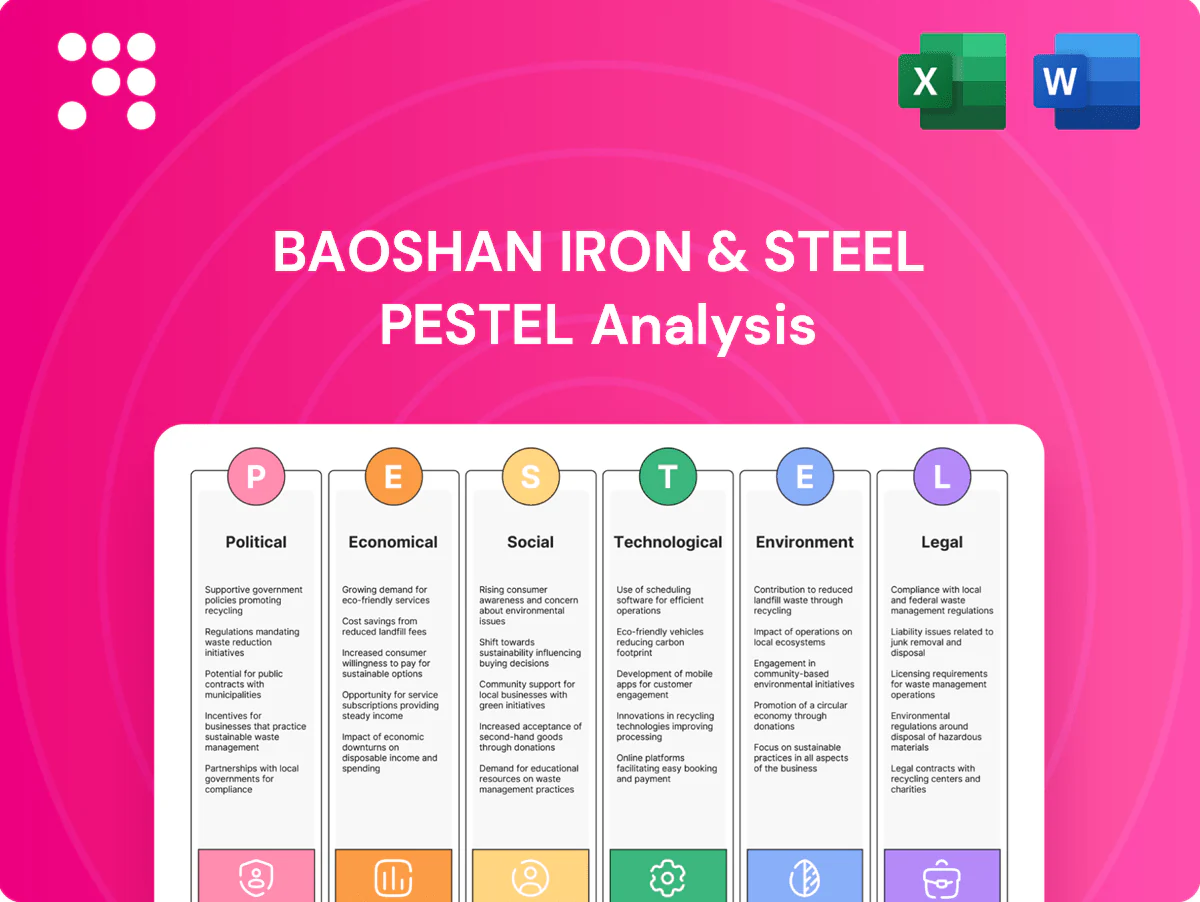
Baoshan Iron & Steel PESTLE Analysis
The preview shown here is the exact Baoshan Iron & Steel PESTLE Analysis document you’ll receive after purchase—fully formatted and ready to use. It contains the same structured political, economic, social, technological, legal, and environmental assessments visible now. No placeholders or teasers—this is the final file available for instant download upon payment.

Original: $10.00
-65%$10.00
$3.50Product Information
Product Information
Shipping & Returns
Shipping & Returns
Description
Your Shortcut to Market Insight Starts Here
Gain a strategic advantage with our focused PESTLE analysis of Baoshan Iron & Steel — uncover how regulatory shifts, economic cycles, and technological change will shape its trajectory. This concise briefing highlights risks and opportunities for investors and planners. Buy the full report to access detailed, actionable intelligence and ready-to-use insights.
Political factors
State ownership and industrial policy alignment
Baoshan’s strategic direction closely follows state industrial policy—China Baowu (parent) produced about 137.8 Mt crude steel in 2023—supporting advanced manufacturing and supply‑chain security. State backing eases access to capital, regulatory approvals and cross‑regional project coordination. Policy shifts, however, can quickly reallocate capacity, influence domestic pricing or curtail exports. Ongoing government focus on autos, infrastructure and green steel (2030 peak, 2060 neutrality) drives demand and capex.
Trade tensions and export market access
Global anti-dumping and countervailing actions targeting Chinese steel compress Baoshan’s export pricing and volumes amid China’s ~56% share of global crude steel (2023); duties in key markets often range 15–25%. Quotas, tariffs and safeguard measures in the US, EU and emerging markets increase entry complexity and compliance costs. Diplomatic ties shape approvals and standards recognition, so shifting toward premium, higher-margin grades helps mitigate trade barriers.
Infrastructure stimulus and regional development
Domestic infrastructure stimulus cycles drive steel demand through transport, energy and urban projects, with local governments prioritizing roads, rail and power grids that lift short-term orders. Regional development programs (eg Yangtze Delta integration) create localized steel supply and downstream clusters, improving margins. Timing and magnitude of fiscal outlays directly affect order visibility and working capital planning. Baosteel benefits from proximity to coastal logistics—Shanghai Port handled 43.5 million TEU in 2023—and national megaprojects, easing export and inland distribution.
Belt and Road Initiative (BRI) exposure
BRI spans 150+ countries with estimated infrastructure financing exceeding US$1 trillion since 2013, creating sustained overseas demand for flat and long steel products and enabling joint ventures and project partnerships; political risk and financing quality vary widely across host countries, and local content rules often mandate JVs or on-site processing, so Baosteel’s strict project selection and risk controls are critical for sustainable returns.
- BRI reach: 150+ countries
- Estimated financing: >US$1 trillion
- Implication: boosts flat/long product demand
- Risk: variable political/project financing quality
- Mitigation: JVs, local processing, robust risk controls
Energy security and resource diplomacy
China imported roughly 1.0 billion tonnes of iron ore in 2024, so government strategies to secure ore, coking coal and stable energy supplies directly support Baoshan Iron & Steel input stability through overseas mining stakes and long-term offtake deals that lower supply-shock risk.
Geopolitical frictions with key suppliers can spike seaborne ore and coking-coal costs, while policy-driven priorities for gas, power and grid dispatch in 2024–25 materially affect continuous blast-furnace reliability and switching to electric/DRI routes.
- Supply security: overseas stakes + long-term offtakes
- Scale: ~1.0bn t China iron-ore imports (2024)
- Risk: geopolitical frictions raise seaborne input costs
- Energy policy: gas/power dispatch affects steelmaking uptime
China’s steel dominance, trade duties and green-steel demand reshape global capex
Baoshan aligns with state policy and China Baowu scale (137.8 Mt crude steel, 2023) to secure capital and approvals. Trade remedies (typical duties 15–25%) and China’s ~56% global share (2023) constrain exports; green‑steel/autos demand directs capex. Input security matters: China iron‑ore imports ~1.0bn t (2024); BRI demand (150+ countries, >US$1tn) supports overseas projects.
| Metric | Value | Implication |
|---|---|---|
| China Baowu output | 137.8 Mt (2023) | scale, policy alignment |
| Global share | ~56% (2023) | export pressure |
| Iron‑ore imports | ~1.0bn t (2024) | input security focus |
| BRI reach/financing | 150+ countries / >US$1tn | overseas demand |
What is included in the product
Detailed Word Document
Explores how Political, Economic, Social, Technological, Environmental and Legal forces specifically impact Baoshan Iron & Steel, combining current data and trends to identify risks, opportunities and forward-looking scenarios; tailored for executives, investors and strategists and ready for direct use in reports and plans.
Customizable Excel Spreadsheet
A concise, PESTLE-segmented summary of Baoshan Iron & Steel that clarifies regulatory, economic and environmental risks for quick alignment across teams; editable notes for regional operations and ready to drop into presentations or strategy packs.
Economic factors
Global steel cycle and price volatility
Cycles in construction, autos and machinery drive demand swings that compressed margins in 2023–24 as China Baowu (Baoshan) reported crude steel output of 118.4 Mt in 2023, reflecting sensitivity to end-market downturns.
Benchmark HRC/CRC and stainless prices have swung with capacity utilization—China steel mill utilization averaged around 78% in 2024—causing volatile spreads.
Inventory cycles and import arbitrage intermittently widened domestic spreads, while Baosteel’s higher-margin premium product mix helps partially cushion revenue and EBITDA in downturns.
Raw material cost dynamics
Iron ore and coking coal prices, concentrated among few exporters (Australia and Brazil account for ~80% of seaborne iron ore; Australia ~60% of metallurgical coal), drove volatility—62% Fe averaged about $110/t in 2024 while coking coal traded near $230/t. Currency moves and freight (capesize) can swing landed costs by roughly 5–12%. Long‑term contracts and blending reduce exposure, and productivity/yield gains at Baoshan help preserve unit economics.
Domestic rebalancing and consumption trends
China’s shift from property to manufacturing and NEV exports is changing steel demand composition: China produced 1,008.4 Mt of crude steel in 2023 while NEV sales reached about 14.1 million units, boosting demand for flat and electrical steels from autos, shipbuilding and grid upgrades. Slower real estate activity weakens long products, but rising industrial capex can offset some volume loss. Baosteel can capture value by selling higher-margin specialized grades and electrical steels.
Interest rates, credit, and capex cycles
Monetary and credit conditions shape downstream investment: China 1-year LPR stood at 3.45% (mid-2025), with lower rates supporting infrastructure and industrial upgrades that helped steel volumes. Tight credit episodes in 2024 constrained working capital across the value chain, pressuring roll-over costs. Baoshan’s balance-sheet strength versus peers determines capex timing and pace of modernization.
- 1-year LPR: 3.45% (mid-2025)
- China crude steel output 2024: ~1.02 bn t
- Tight credit raises working-capital strain
- Baoshan balance sheet drives capex timing
Exchange rates and export competitiveness
RMB movements (around 7.2–7.4 CNY/USD in 2024–H1 2025) directly alter Baoshan Iron & Steel export pricing and USD‑priced input costs; a weaker RMB can lift overseas competitiveness but raises imported ore and coke costs. The company uses FX hedging and forward contracts to manage cash‑flow volatility, while pricing discipline in high‑grade steel niches preserves margins.
- RMB range: 7.2–7.4 CNY/USD (2024–H1 2025)
- Weaker RMB: boosts exports, raises imported raw material costs
- Mitigation: FX hedging, forwards
- Focus: pricing discipline in high‑grade segments
China’s steel dominance, trade duties and green-steel demand reshape global capex
China demand shifts and 2023–24 end‑market cycles compressed margins; Baoshan (China Baowu) produced 118.4 Mt in 2023 and China ~1.02 Gt in 2024. Input cost swings—62% Fe ~$110/t, coking coal ~$230/t (2024)—plus RMB 7.2–7.4 CNY/USD and 1‑yr LPR 3.45% (mid‑2025) drive volatility; Baoshan offsets via premium mix, hedging, and scale.
| Metric | Value |
|---|---|
| Baoshan crude steel 2023 | 118.4 Mt |
| China crude steel 2024 | ~1.02 Gt |
| 62% Fe (2024) | ~$110/t |
| Coking coal (2024) | ~$230/t |
| RMB (2024–H1 2025) | 7.2–7.4 CNY/USD |
| 1‑yr LPR (mid‑2025) | 3.45% |
Preview Before You Purchase
Baoshan Iron & Steel PESTLE Analysis
The preview shown here is the exact Baoshan Iron & Steel PESTLE Analysis document you’ll receive after purchase—fully formatted and ready to use. It contains the same structured political, economic, social, technological, legal, and environmental assessments visible now. No placeholders or teasers—this is the final file available for instant download upon payment.