Bank of India PESTLE Analysis

Your Shortcut to Market Insight Starts Here
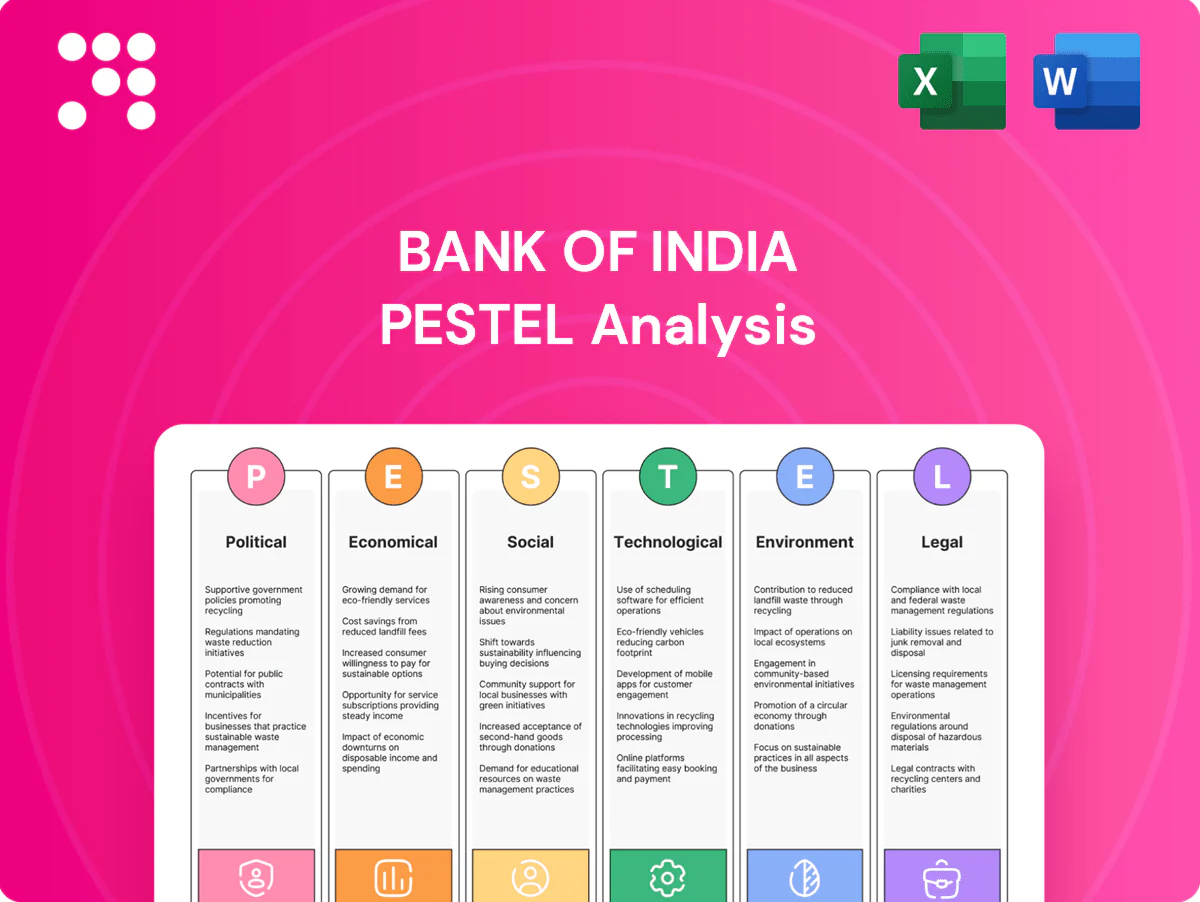
Explore how political shifts, economic cycles, and digital disruption are shaping Bank of India's strategic outlook in our concise PESTLE snapshot; assess regulatory, social, and environmental risks quickly. For a full, actionable breakdown with editable charts and recommendations, purchase the complete PESTLE analysis now.
Political factors

Government ownership and policy alignment
As a public sector bank with government majority ownership (over 50%), Bank of India’s strategy is closely aligned with central government priorities and schemes. Budget allocations, credit guarantees and subsidy programs (notably post-2024 policy pushes) can accelerate portfolio growth but raise execution and compliance demands. Political stability since the 2024 general election supports steady policy direction, though electoral cycles may redirect focus and timelines, and coordination with ministries shapes lending to priority sectors and state-backed projects.
RBI monetary and supervisory stance
RBI policy decisions—repo rate at 6.50% and a systemic liquidity surplus of roughly ₹4–6 lakh crore in FY25—directly influence Bank of India's funding costs, NIMs and credit growth. Macroprudential tools such as higher risk weights and LTV caps on retail/gold loans shift portfolio mix toward lower-yield secured assets. Enhanced supervisory expectations on governance and risk management raise compliance costs but strengthen resilience. Policy transmission variability affects treasury income and loan repricing, compressing short-term margins.

Public sector banking reforms
Government-led consolidation cut PSBs from 27 to 12 by 2019, and combined PSB net profit reached about 1.18 lakh crore in FY23, strengthening market positioning and capital buffers that affect Bank of India’s capital adequacy. Reform pushes on digitization, governance and efficiency (increased digital transactions and cost controls) boost competitiveness. Ongoing privatization/divestment debates and PSU staffing and labor-policy changes shape investor perception and strategic flexibility.

Priority sector and directed lending
Mandates require banks to meet a 40% priority sector lending target with an 18% agriculture sub-target, pushing Bank of India to channel credit and expand branches in rural/MSME areas. These targets support inclusion but can compress yields and increase monitoring and compliance costs. Credit guarantee schemes such as CGTMSE can reduce lender risk if uptake and claim-settlement are efficient. Regional political schemes create localized lending booms and policy risks.
- PSL target: 40% ANBC
- Agriculture sub-target: 18%
- CGTMSE: mitigates MSME risk
- Regional policies: localized opportunities/risks
Geopolitics and international operations
Geopolitics, sanctions regimes and shifting trade policies directly affect Bank of India’s overseas branches and foreign-currency business, altering correspondent-banking access and compliance costs. Bilateral agreements that underpin remittance corridors are vital—India received about 107 billion USD in remittances in 2023 (World Bank), supporting trade finance flows. Political risk in host countries drives capital allocation, compliance spend and exit/entry timing, while global market volatility changes cross-border funding costs and fee income.
- Sanctions/compliance: higher operating costs
- Remittances: $107bn India 2023 — key fee pool
- Political risk: affects capital, market access, exit decisions
Govt majority aligns PSB to central priorities; repo 6.50% and PSL 40% reshape margins
Government majority (>50%) aligns Bank of India to central priorities and schemes, raising execution and compliance demands. RBI policy (repo 6.50%, systemic liquidity surplus ~₹4–6 lakh crore in FY25) shapes funding costs and margins. Mandates—PSL 40% of ANBC, agriculture 18%—plus remittances ($107bn in 2023) and PSB consolidation influence capital allocation and fee pools.
| Factor | Key data |
|---|---|
| Govt ownership | >50% |
| Repo rate | 6.50% |
| Liquidity (FY25) | ₹4–6 lakh crore |
| PSL / Agriculture | 40% / 18% |
| Remittances (India 2023) | $107bn |
| PSB net profit (FY23) | ₹1.18 lakh crore |
What is included in the product
 Detailed Word Document
Explores how macro-environmental forces — Political, Economic, Social, Technological, Environmental, and Legal — uniquely influence Bank of India's operations, risk profile, and growth prospects, with data-driven trends and region-specific regulatory context. Designed to guide executives and investors in spotting threats, opportunities, and strategic responses.

 Customizable Excel Spreadsheet
A concise, visually segmented PESTLE snapshot for Bank of India that’s ready to paste into slides or share across teams, simplifying external risk discussions and allowing quick note additions for regional or business-line context.
Economic factors

Interest rate cycle and inflation
Rate movements (RBI repo at 6.5% as of July 2025) drive Bank of India funding costs, loan yields and treasury mark-to-market gains or losses; duration management is critical to protect NIMs. Elevated CPI (~5% in 2024–25) strains operating costs and borrower repayment capacity. Tightening historically cools credit demand and lifts NPA risk, while easing supports loan growth.
GDP growth and credit demand
India's GDP near 7% in 2024-25 (IMF/WB estimates) boosts demand across retail, MSME, corporate and trade finance, lifting loan volumes. Stronger investment cycles raise term-lending and working-capital utilisation, while public capex expands project finance and supply-chain lending. Credit growth for banks remained robust in 2024-25, supporting fee income. Economic slowdowns compress fees and heighten NPL risk.

Rural economy and monsoon sensitivity
Agriculture accounted for about 18% of India’s GVA in 2023-24, so agricultural output and rural incomes materially influence Bank of India’s priority sector lending and deposit base. Variability in the monsoon raises agri NPAs and restructurings, while the government’s MSPs and subsidies and the ₹16.5 lakh crore agriculture credit focus in 2023-24 help stabilize farmer cash flows. Rural consumption cycles drive retail lending demand and CASA mobilization in seasonal peaks.

Currency and external sector dynamics
- INR range 2024: ~81–83/USD
- Current account FY23‑24: ~0.3% GDP
- Forex reserves: ≈$590bn
- Trade finance exposure sensitive to tariffs and global demand
Asset quality cycle and recovery
Economic stress raises slippages, provisioning and credit costs; Bank of India saw GNPA ~3.2% and PCR ~81% (FY2024), with macro growth at ~7.2% (FY2024) influencing recovery prospects.
Resolution efficiency under IBC affects write-backs and capital; sectoral stress in real estate/infrastructure elevates concentration risk, making counter-cyclical buffers and strict underwriting vital for earnings stability.
- GNPA: 3.2% (FY2024)
- PCR: 81% (FY2024)
- GDP growth: ~7.2% (FY2024)
Govt majority aligns PSB to central priorities; repo 6.50% and PSL 40% reshape margins
Rate movements (RBI repo 6.5% as of Jul 2025) drive funding costs, NIMs and treasury MTM; CPI ~5% (2024–25) pressures borrowers. GDP ~7% (2024–25) and strong capex lift loan demand and fee income but real‑estate/infrastructure stress raises NPA risk. INR 81–83/USD (2024) and forex ≈$590bn shape FX income and hedging needs.
| Metric | Value |
|---|---|
| RBI repo | 6.5% (Jul 2025) |
| CPI | ~5% (2024–25) |
| GDP | ~7% (2024–25) |
| INR | 81–83/USD (2024) |
| Forex reserves | ≈$590bn |
| GNPA | 3.2% (FY2024) |
| PCR | 81% (FY2024) |
Same Document Delivered
Bank of India PESTLE Analysis
The Bank of India PESTLE Analysis preview shown here is the exact document you’ll receive after purchase—fully formatted and ready to use. It contains the complete political, economic, social, technological, legal, and environmental assessment tailored to Bank of India. No placeholders or teasers—this is the final, professionally structured file available for immediate download.

Product Information
Product Information
Shipping & Returns
Shipping & Returns
Description
Your Shortcut to Market Insight Starts Here
Explore how political shifts, economic cycles, and digital disruption are shaping Bank of India's strategic outlook in our concise PESTLE snapshot; assess regulatory, social, and environmental risks quickly. For a full, actionable breakdown with editable charts and recommendations, purchase the complete PESTLE analysis now.
Political factors
Government ownership and policy alignment
As a public sector bank with government majority ownership (over 50%), Bank of India’s strategy is closely aligned with central government priorities and schemes. Budget allocations, credit guarantees and subsidy programs (notably post-2024 policy pushes) can accelerate portfolio growth but raise execution and compliance demands. Political stability since the 2024 general election supports steady policy direction, though electoral cycles may redirect focus and timelines, and coordination with ministries shapes lending to priority sectors and state-backed projects.
RBI monetary and supervisory stance
RBI policy decisions—repo rate at 6.50% and a systemic liquidity surplus of roughly ₹4–6 lakh crore in FY25—directly influence Bank of India's funding costs, NIMs and credit growth. Macroprudential tools such as higher risk weights and LTV caps on retail/gold loans shift portfolio mix toward lower-yield secured assets. Enhanced supervisory expectations on governance and risk management raise compliance costs but strengthen resilience. Policy transmission variability affects treasury income and loan repricing, compressing short-term margins.
Public sector banking reforms
Government-led consolidation cut PSBs from 27 to 12 by 2019, and combined PSB net profit reached about 1.18 lakh crore in FY23, strengthening market positioning and capital buffers that affect Bank of India’s capital adequacy. Reform pushes on digitization, governance and efficiency (increased digital transactions and cost controls) boost competitiveness. Ongoing privatization/divestment debates and PSU staffing and labor-policy changes shape investor perception and strategic flexibility.
Priority sector and directed lending
Mandates require banks to meet a 40% priority sector lending target with an 18% agriculture sub-target, pushing Bank of India to channel credit and expand branches in rural/MSME areas. These targets support inclusion but can compress yields and increase monitoring and compliance costs. Credit guarantee schemes such as CGTMSE can reduce lender risk if uptake and claim-settlement are efficient. Regional political schemes create localized lending booms and policy risks.
- PSL target: 40% ANBC
- Agriculture sub-target: 18%
- CGTMSE: mitigates MSME risk
- Regional policies: localized opportunities/risks
Geopolitics and international operations
Geopolitics, sanctions regimes and shifting trade policies directly affect Bank of India’s overseas branches and foreign-currency business, altering correspondent-banking access and compliance costs. Bilateral agreements that underpin remittance corridors are vital—India received about 107 billion USD in remittances in 2023 (World Bank), supporting trade finance flows. Political risk in host countries drives capital allocation, compliance spend and exit/entry timing, while global market volatility changes cross-border funding costs and fee income.
- Sanctions/compliance: higher operating costs
- Remittances: $107bn India 2023 — key fee pool
- Political risk: affects capital, market access, exit decisions
Govt majority aligns PSB to central priorities; repo 6.50% and PSL 40% reshape margins
Government majority (>50%) aligns Bank of India to central priorities and schemes, raising execution and compliance demands. RBI policy (repo 6.50%, systemic liquidity surplus ~₹4–6 lakh crore in FY25) shapes funding costs and margins. Mandates—PSL 40% of ANBC, agriculture 18%—plus remittances ($107bn in 2023) and PSB consolidation influence capital allocation and fee pools.
| Factor | Key data |
|---|---|
| Govt ownership | >50% |
| Repo rate | 6.50% |
| Liquidity (FY25) | ₹4–6 lakh crore |
| PSL / Agriculture | 40% / 18% |
| Remittances (India 2023) | $107bn |
| PSB net profit (FY23) | ₹1.18 lakh crore |
What is included in the product
Detailed Word Document
Explores how macro-environmental forces — Political, Economic, Social, Technological, Environmental, and Legal — uniquely influence Bank of India's operations, risk profile, and growth prospects, with data-driven trends and region-specific regulatory context. Designed to guide executives and investors in spotting threats, opportunities, and strategic responses.
Customizable Excel Spreadsheet
A concise, visually segmented PESTLE snapshot for Bank of India that’s ready to paste into slides or share across teams, simplifying external risk discussions and allowing quick note additions for regional or business-line context.
Economic factors
Interest rate cycle and inflation
Rate movements (RBI repo at 6.5% as of July 2025) drive Bank of India funding costs, loan yields and treasury mark-to-market gains or losses; duration management is critical to protect NIMs. Elevated CPI (~5% in 2024–25) strains operating costs and borrower repayment capacity. Tightening historically cools credit demand and lifts NPA risk, while easing supports loan growth.
GDP growth and credit demand
India's GDP near 7% in 2024-25 (IMF/WB estimates) boosts demand across retail, MSME, corporate and trade finance, lifting loan volumes. Stronger investment cycles raise term-lending and working-capital utilisation, while public capex expands project finance and supply-chain lending. Credit growth for banks remained robust in 2024-25, supporting fee income. Economic slowdowns compress fees and heighten NPL risk.
Rural economy and monsoon sensitivity
Agriculture accounted for about 18% of India’s GVA in 2023-24, so agricultural output and rural incomes materially influence Bank of India’s priority sector lending and deposit base. Variability in the monsoon raises agri NPAs and restructurings, while the government’s MSPs and subsidies and the ₹16.5 lakh crore agriculture credit focus in 2023-24 help stabilize farmer cash flows. Rural consumption cycles drive retail lending demand and CASA mobilization in seasonal peaks.
Currency and external sector dynamics
- INR range 2024: ~81–83/USD
- Current account FY23‑24: ~0.3% GDP
- Forex reserves: ≈$590bn
- Trade finance exposure sensitive to tariffs and global demand
Asset quality cycle and recovery
Economic stress raises slippages, provisioning and credit costs; Bank of India saw GNPA ~3.2% and PCR ~81% (FY2024), with macro growth at ~7.2% (FY2024) influencing recovery prospects.
Resolution efficiency under IBC affects write-backs and capital; sectoral stress in real estate/infrastructure elevates concentration risk, making counter-cyclical buffers and strict underwriting vital for earnings stability.
- GNPA: 3.2% (FY2024)
- PCR: 81% (FY2024)
- GDP growth: ~7.2% (FY2024)
Govt majority aligns PSB to central priorities; repo 6.50% and PSL 40% reshape margins
Rate movements (RBI repo 6.5% as of Jul 2025) drive funding costs, NIMs and treasury MTM; CPI ~5% (2024–25) pressures borrowers. GDP ~7% (2024–25) and strong capex lift loan demand and fee income but real‑estate/infrastructure stress raises NPA risk. INR 81–83/USD (2024) and forex ≈$590bn shape FX income and hedging needs.
| Metric | Value |
|---|---|
| RBI repo | 6.5% (Jul 2025) |
| CPI | ~5% (2024–25) |
| GDP | ~7% (2024–25) |
| INR | 81–83/USD (2024) |
| Forex reserves | ≈$590bn |
| GNPA | 3.2% (FY2024) |
| PCR | 81% (FY2024) |
Same Document Delivered
Bank of India PESTLE Analysis
The Bank of India PESTLE Analysis preview shown here is the exact document you’ll receive after purchase—fully formatted and ready to use. It contains the complete political, economic, social, technological, legal, and environmental assessment tailored to Bank of India. No placeholders or teasers—this is the final, professionally structured file available for immediate download.