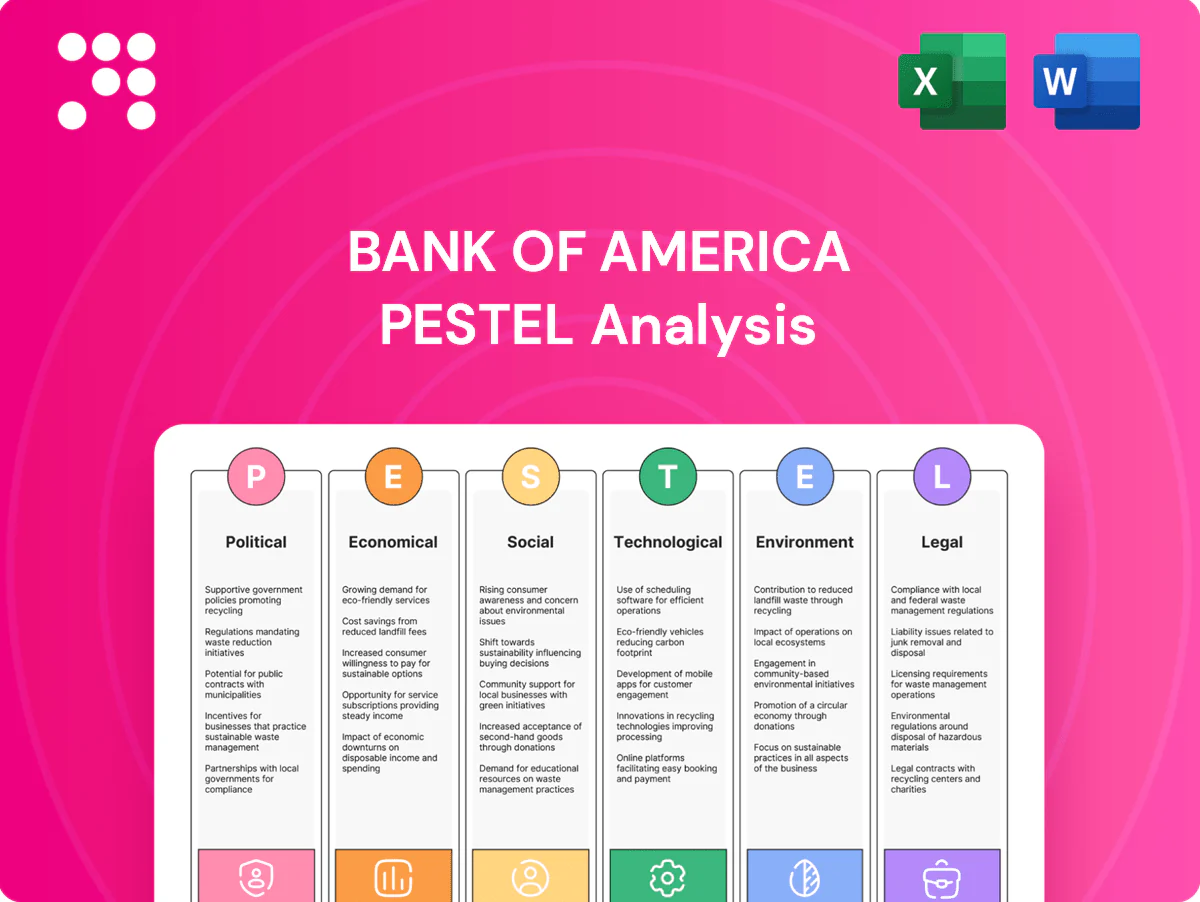
Bank of America PESTLE Analysis

Skip the Research. Get the Strategy.
Unlock strategic clarity with our PESTLE Analysis of Bank of America—three concise sections reveal how politics, economy, tech, and regulation will shape its trajectory; ideal for investors and strategists. This professionally researched report is ready to use in presentations and models. Purchase the full version now to get actionable insights and editable files for immediate impact.
Political factors

Global regulatory divergence
Operating across jurisdictions exposes Bank of America (total assets $3.1 trillion at end‑2024) to differing capital, liquidity and conduct rules; Basel's 4.5% CET1 minimum and U.S. GSIB surcharges up to 4.5% contrast with evolving EU and Asian regimes, raising compliance complexity and cost. Strategic product and booking choices must reflect the strictest regime to avoid arbitrage and penalties, while slow harmonization keeps regulatory friction elevated.
Geopolitical tensions and sanctions
Geopolitical tensions — notably evolving U.S.-China rivalry and sanctions tied to Russia’s 2022 invasion — constrain cross-border flows and raise counterparty risk, with hundreds of Russia-related entities sanctioned since 2022. Sanctions screening and exits from restricted markets have disrupted revenue streams and forced strategic withdrawals. Heightened political risk has materially increased compliance costs and legal exposure. Treasury and trade finance volumes fluctuate with diplomatic shifts.

Election cycles and policy swings
U.S. and key-market elections (U.S. Nov 5, 2024) shape fiscal stimulus, tax prospects and regulatory tone, affecting Bank of America revenue mix. Changes at the Fed (policy rate 5.25–5.50% through 2024–25), Treasury or CFPB can raise supervisory intensity and capital/stress expectations. Policy uncertainty has weighed on corporate investment and deal pipelines, so scenario planning is essential for credit and market-risk posture.

Public sector borrowing and deficits
Rising sovereign debt (US federal debt >34 trillion per TreasuryDirect) steepens and re-prices yield curves, creating mark-to-market stress in bank securities and pressuring Bank of America’s portfolio and NIM as 10-yr yields hovered ~4.1% mid-2025.
- Issuance: alters liquidity and collateral
- Fiscal shifts: change loan demand/credit quality
- Balance-sheet: adapt duration risk
Trade policy and capital controls
Tariffs, export controls and capital movement restrictions reshape supply chains and FX flows, with WTO reporting world merchandise trade volume grew just 1% in 2023, intensifying hedging needs.
Corporate clients may re-domicile or restructure — UNCTAD recorded global FDI around $1.1 trillion in 2023 — altering banking relationships and balance sheets.
Payments, hedging and letters of credit volumes track trade intensity; rapid policy reversals require agile risk and compliance systems at scale.
- Tariffs → supply-chain FX volatility
- FDI $1.1T (2023) → client shifts
- Payments/hedging correlate with trade
- Need agile compliance
Large global bank ($3.1T) faces GSIB surcharges, higher rates and US debt-driven repricing
Operating across jurisdictions exposes Bank of America (assets $3.1T end‑2024) to divergent capital/liquidity rules and GSIB surcharges up to 4.5%, raising compliance costs. Geopolitical tensions and sanctions since 2022 constrain flows and raise counterparty risk. Higher yields (10‑yr ~4.1% mid‑2025) and US debt >$34T reprice securities and pressure NIM.
| Factor | Metric | Implication |
|---|---|---|
| Size | $3.1T (end‑2024) | Higher regulatory scrutiny |
| Rates | 10‑yr ~4.1% (mid‑2025) | MTM losses, NIM pressure |
| Debt | US >$34T | Curve repricing |
What is included in the product
 Detailed Word Document
Explores how macro-environmental factors uniquely affect Bank of America across Political, Economic, Social, Technological, Environmental, and Legal dimensions, with data-backed insights and forward-looking implications. Designed for executives and advisors to identify risks, opportunities, and strategic responses relevant to current market and regulatory dynamics.

 Customizable Excel Spreadsheet
A concise, visually segmented Bank of America PESTLE summary that relieves the pain of information overload by delivering clear external risk insights for quick reference in meetings, slide decks, or cross‑team alignment, with editable notes for regional or business‑line context.
Economic factors

Interest rate cycle sensitivity
Net interest income at Bank of America is tightly linked to Fed policy—with the Fed funds rate near 5.25–5.50% in mid-2025 and a 2s10 curve still ~-40 bps, rapid hikes bolstered NIM but raised deposit betas and drove unrealized AFS/HTM mark-to-market pressure. Subsequent cuts compress spreads yet tend to improve credit quality and loan origination. Asset-liability management must balance duration and liquidity to protect capital and funding costs.
Credit cycle and default trends
Consumer and corporate delinquencies for Bank of America track employment and earnings—US unemployment remained near 3.7% in late 2024, supporting household payments but leaving vulnerability if jobless claims rise. Tightening underwriting has reduced immediate losses but constrains lending and growth. CRE distress and leveraged loan exposure (US leveraged loan market ~2.4 trillion in 2024) require vigilant provisioning. Macro shocks can rapidly reprice risk and capital needs.

Capital markets volatility
Capital markets volatility drives pro-cyclical IPO/M&A pipelines and trading revenues; global IPO volumes remain roughly 50% below 2021 peaks, tightening fee pools between underwriting and advisory. Spikes in volatility boost client flow but compress inventories as VaR limits force dealers to trim positions—institutions have cut inventories by up to ~30% in stress episodes. Diversified product mix cushions Bank of America as fee pools rotate across underwriting, advisory, and sales & trading.

Inflation and consumer behavior
Inflation erodes real incomes—US CPI was 3.4% in 2024—compressing discretionary spending and boosting deposit precautionary balances; higher prices also lift operating costs and wage pressure (average private-sector wage growth ~4% in 2024), prompting demand shifts from discretionary cards to essentials-focused debit and low-fee products and forcing pricing and rewards adjustments to retain engagement.
- Inflation: US CPI 3.4% (2024)
- Wages: ~4% avg. growth (2024)
- Card mix: tilt to debit/essentials
- Strategy: adapt pricing and rewards
FX and global growth dispersion
Divergent growth and rate paths (IMF Apr 2025 WEO: US ~1.9%, euro area ~0.6%, China ~4.5%) continue to drive currency swings that affect client cashflows and Bank of America earnings translation; FX volatility has lifted hedging demand, with FX volatility indices up materially in early 2025. Emerging market slowdowns have reduced cross-border volumes, while balance-sheet hedges are used to stabilize OCI and regulatory capital ratios.
- Divergent growth: US 1.9%, EA 0.6%, China 4.5%
- Higher FX volatility → rising hedging demand
- EM slowdowns ↓ cross-border activity
- Balance-sheet hedges protect OCI and capital
Large global bank ($3.1T) faces GSIB surcharges, higher rates and US debt-driven repricing
Fed funds ~5.25–5.50% (mid‑2025) keeps NIM elevated but raises deposit betas and AFS/HTM mark‑to‑market pressure. US unemployment ~3.7% (late‑2024) supports credit but CRE and leveraged‑loan stress remain risks. US CPI 3.4% (2024) and ~4% wage growth compress real incomes, shifting card mix to debit and low‑fee products.
| Metric | Value |
|---|---|
| Fed funds | 5.25–5.50% |
| US CPI (2024) | 3.4% |
| Unemployment | 3.7% |
| US growth (IMF Apr 2025) | 1.9% |
Same Document Delivered
Bank of America PESTLE Analysis
The Bank of America PESTLE analysis evaluates political, economic, social, technological, legal, and environmental factors shaping the bank’s strategic risks and opportunities. The preview shown here is the exact document you’ll receive after purchase—fully formatted and ready to use. It includes concise insights and actionable implications for investors and strategists.

Original: $10.00
-65%$10.00
$3.50Product Information
Product Information
Shipping & Returns
Shipping & Returns
Description
Skip the Research. Get the Strategy.
Unlock strategic clarity with our PESTLE Analysis of Bank of America—three concise sections reveal how politics, economy, tech, and regulation will shape its trajectory; ideal for investors and strategists. This professionally researched report is ready to use in presentations and models. Purchase the full version now to get actionable insights and editable files for immediate impact.
Political factors
Global regulatory divergence
Operating across jurisdictions exposes Bank of America (total assets $3.1 trillion at end‑2024) to differing capital, liquidity and conduct rules; Basel's 4.5% CET1 minimum and U.S. GSIB surcharges up to 4.5% contrast with evolving EU and Asian regimes, raising compliance complexity and cost. Strategic product and booking choices must reflect the strictest regime to avoid arbitrage and penalties, while slow harmonization keeps regulatory friction elevated.
Geopolitical tensions and sanctions
Geopolitical tensions — notably evolving U.S.-China rivalry and sanctions tied to Russia’s 2022 invasion — constrain cross-border flows and raise counterparty risk, with hundreds of Russia-related entities sanctioned since 2022. Sanctions screening and exits from restricted markets have disrupted revenue streams and forced strategic withdrawals. Heightened political risk has materially increased compliance costs and legal exposure. Treasury and trade finance volumes fluctuate with diplomatic shifts.
Election cycles and policy swings
U.S. and key-market elections (U.S. Nov 5, 2024) shape fiscal stimulus, tax prospects and regulatory tone, affecting Bank of America revenue mix. Changes at the Fed (policy rate 5.25–5.50% through 2024–25), Treasury or CFPB can raise supervisory intensity and capital/stress expectations. Policy uncertainty has weighed on corporate investment and deal pipelines, so scenario planning is essential for credit and market-risk posture.
Public sector borrowing and deficits
Rising sovereign debt (US federal debt >34 trillion per TreasuryDirect) steepens and re-prices yield curves, creating mark-to-market stress in bank securities and pressuring Bank of America’s portfolio and NIM as 10-yr yields hovered ~4.1% mid-2025.
- Issuance: alters liquidity and collateral
- Fiscal shifts: change loan demand/credit quality
- Balance-sheet: adapt duration risk
Trade policy and capital controls
Tariffs, export controls and capital movement restrictions reshape supply chains and FX flows, with WTO reporting world merchandise trade volume grew just 1% in 2023, intensifying hedging needs.
Corporate clients may re-domicile or restructure — UNCTAD recorded global FDI around $1.1 trillion in 2023 — altering banking relationships and balance sheets.
Payments, hedging and letters of credit volumes track trade intensity; rapid policy reversals require agile risk and compliance systems at scale.
- Tariffs → supply-chain FX volatility
- FDI $1.1T (2023) → client shifts
- Payments/hedging correlate with trade
- Need agile compliance
Large global bank ($3.1T) faces GSIB surcharges, higher rates and US debt-driven repricing
Operating across jurisdictions exposes Bank of America (assets $3.1T end‑2024) to divergent capital/liquidity rules and GSIB surcharges up to 4.5%, raising compliance costs. Geopolitical tensions and sanctions since 2022 constrain flows and raise counterparty risk. Higher yields (10‑yr ~4.1% mid‑2025) and US debt >$34T reprice securities and pressure NIM.
| Factor | Metric | Implication |
|---|---|---|
| Size | $3.1T (end‑2024) | Higher regulatory scrutiny |
| Rates | 10‑yr ~4.1% (mid‑2025) | MTM losses, NIM pressure |
| Debt | US >$34T | Curve repricing |
What is included in the product
Detailed Word Document
Explores how macro-environmental factors uniquely affect Bank of America across Political, Economic, Social, Technological, Environmental, and Legal dimensions, with data-backed insights and forward-looking implications. Designed for executives and advisors to identify risks, opportunities, and strategic responses relevant to current market and regulatory dynamics.
Customizable Excel Spreadsheet
A concise, visually segmented Bank of America PESTLE summary that relieves the pain of information overload by delivering clear external risk insights for quick reference in meetings, slide decks, or cross‑team alignment, with editable notes for regional or business‑line context.
Economic factors
Interest rate cycle sensitivity
Net interest income at Bank of America is tightly linked to Fed policy—with the Fed funds rate near 5.25–5.50% in mid-2025 and a 2s10 curve still ~-40 bps, rapid hikes bolstered NIM but raised deposit betas and drove unrealized AFS/HTM mark-to-market pressure. Subsequent cuts compress spreads yet tend to improve credit quality and loan origination. Asset-liability management must balance duration and liquidity to protect capital and funding costs.
Credit cycle and default trends
Consumer and corporate delinquencies for Bank of America track employment and earnings—US unemployment remained near 3.7% in late 2024, supporting household payments but leaving vulnerability if jobless claims rise. Tightening underwriting has reduced immediate losses but constrains lending and growth. CRE distress and leveraged loan exposure (US leveraged loan market ~2.4 trillion in 2024) require vigilant provisioning. Macro shocks can rapidly reprice risk and capital needs.
Capital markets volatility
Capital markets volatility drives pro-cyclical IPO/M&A pipelines and trading revenues; global IPO volumes remain roughly 50% below 2021 peaks, tightening fee pools between underwriting and advisory. Spikes in volatility boost client flow but compress inventories as VaR limits force dealers to trim positions—institutions have cut inventories by up to ~30% in stress episodes. Diversified product mix cushions Bank of America as fee pools rotate across underwriting, advisory, and sales & trading.
Inflation and consumer behavior
Inflation erodes real incomes—US CPI was 3.4% in 2024—compressing discretionary spending and boosting deposit precautionary balances; higher prices also lift operating costs and wage pressure (average private-sector wage growth ~4% in 2024), prompting demand shifts from discretionary cards to essentials-focused debit and low-fee products and forcing pricing and rewards adjustments to retain engagement.
- Inflation: US CPI 3.4% (2024)
- Wages: ~4% avg. growth (2024)
- Card mix: tilt to debit/essentials
- Strategy: adapt pricing and rewards
FX and global growth dispersion
Divergent growth and rate paths (IMF Apr 2025 WEO: US ~1.9%, euro area ~0.6%, China ~4.5%) continue to drive currency swings that affect client cashflows and Bank of America earnings translation; FX volatility has lifted hedging demand, with FX volatility indices up materially in early 2025. Emerging market slowdowns have reduced cross-border volumes, while balance-sheet hedges are used to stabilize OCI and regulatory capital ratios.
- Divergent growth: US 1.9%, EA 0.6%, China 4.5%
- Higher FX volatility → rising hedging demand
- EM slowdowns ↓ cross-border activity
- Balance-sheet hedges protect OCI and capital
Large global bank ($3.1T) faces GSIB surcharges, higher rates and US debt-driven repricing
Fed funds ~5.25–5.50% (mid‑2025) keeps NIM elevated but raises deposit betas and AFS/HTM mark‑to‑market pressure. US unemployment ~3.7% (late‑2024) supports credit but CRE and leveraged‑loan stress remain risks. US CPI 3.4% (2024) and ~4% wage growth compress real incomes, shifting card mix to debit and low‑fee products.
| Metric | Value |
|---|---|
| Fed funds | 5.25–5.50% |
| US CPI (2024) | 3.4% |
| Unemployment | 3.7% |
| US growth (IMF Apr 2025) | 1.9% |
Same Document Delivered
Bank of America PESTLE Analysis
The Bank of America PESTLE analysis evaluates political, economic, social, technological, legal, and environmental factors shaping the bank’s strategic risks and opportunities. The preview shown here is the exact document you’ll receive after purchase—fully formatted and ready to use. It includes concise insights and actionable implications for investors and strategists.