Bank Muscat PESTLE Analysis

Your Competitive Advantage Starts with This Report
Discover how political shifts, economic cycles, and technological change are shaping Bank Muscat’s strategic outlook in our concise PESTLE snapshot. Written for investors and strategists, it highlights risks and growth levers you can act on today. Purchase the full PESTLE to access the complete, editable analysis and make smarter decisions.
Political factors

Stable governance, policy continuity
Oman’s absolute monarchy and the 2021 launch of Vision 2040 provide a predictable policy environment that enables Bank Muscat to pursue multi‑year lending and investment strategies. Steady public‑sector ties and coordinated development agendas support the bank’s role in funding infrastructure as Oman (population ~4.6m) advances diversification. Political stability lowers sovereign risk premia and eases access to funding, though Vision 2040 execution timelines require agile policy alignment.
Vision 2040 and state-led development
Under Vision 2040 the state channels credit toward four priority sectors—SMEs, logistics, tourism and mining—creating sizeable demand for bank lending and advisory tied to public projects and PPPs. Bank Muscat, Oman’s largest bank, can grow by aligning product pipelines and fees with these state-led programs. Execution pace and budget allocations across projects directly shape loan pipelines and fee income, while delays or reprioritisations introduce timing risk.

Regional geopolitics and trade corridors
Gulf tensions and sanctions regimes strain cross-border flows and trade finance, exacerbating the global trade finance gap estimated at about $1.7 trillion by the ICC (2023). Bank Muscat must recalibrate risk appetite for regional clients and commodity exposures, tightening limits and collateral policies. Such disruptions lift compliance and operational costs through enhanced screening and monitoring. Periods of détente can rapidly restore deal flow and boost deposits.

Government relationship and public finance cycles
As a key banker to government entities, Bank Muscat sees funding and liquidity fluctuate with Oman's fiscal cycles; higher oil-driven surpluses (Brent averaged about 86 USD/bbl in 2024) boosted deposits and public spending, while recent revenue softening tightened liquidity. Managing concentration and pricing of government-related deposits is critical, and diversification of wholesale and retail funding mitigates cyclicality.
- Exposure to government deposits
- Brent ~86 USD/bbl (2024)
- Need for diversified funding
Central bank policy stewardship
The Central Bank of Oman’s prudential stance shapes Bank Muscat’s capital, liquidity and lending standards; supervisory guidance affects growth, dividends and risk-weighted assets. Proactive engagement supported approvals for digital pilots in 2024, while tightening cycles in 2024–25 moderated credit growth to mid-single digits.
- Policy influence: capital & liquidity buffers
- Supervision: impacts dividends & RWA
- Engagement: faster product/digital approvals (2024)
- Tightening: credit growth slowed to mid-single digits (2024–25)
Oman Vision 2040 fuels SME, tourism and mining credit but oil and trade-finance risk persist
Oman’s stable monarchy and Vision 2040 create predictable policy support for Bank Muscat’s multi‑year lending, especially in SMEs, logistics, tourism and mining. Regional tensions and ICC’s $1.7T trade‑finance gap (2023) raise compliance and trade risk, while Brent averaged ~86 USD/bbl in 2024 affecting fiscal liquidity. CBO prudence slowed credit growth to mid‑single digits in 2024–25 and enabled faster digital approvals in 2024.
| Metric | Value |
|---|---|
| Oman population | ~4.6m (2025) |
| Brent | ~86 USD/bbl (2024) |
| Credit growth | Mid‑single digits (2024–25) |
What is included in the product
 Detailed Word Document
Explores how macro-environmental factors uniquely impact Bank Muscat across Political, Economic, Social, Technological, Environmental, and Legal dimensions, with each section backed by current regional data and trends to identify risks and opportunities. Designed for executives and investors, the analysis offers detailed, example-driven subpoints and forward-looking insights ready for inclusion in strategy decks and reports.

 Customizable Excel Spreadsheet
A concise, visually segmented Bank Muscat PESTLE summary that relieves meeting prep pain by providing shareable, slide-ready insights in clear language and editable notes for quick team alignment and decision-making.
Economic factors

Oil-linked macro volatility
Oman’s GDP, liquidity and fiscal stance remain tightly tied to hydrocarbons: oil and gas still generate roughly 40% of government revenue and about 30% of exports. Higher Brent (avg $83/bbl in 2024) boosted deposit growth and corporate lending, while price slumps compress margins and raise NPL risk. Bank Muscat must manage cyclical credit and provisioning through active hedging and sectoral diversification.
OMR-USD peg and interest rate transmission
The OMR peg to the USD (1 OMR = 2.6008 USD) directly transmits US rate cycles to Oman, so NIMs, loan demand and funding costs move with global rates; ALM must anticipate duration and repricing gaps across on- and off‑balance sheet positions; maintaining USD market access and FX liquidity remains strategic for Bank Muscat’s wholesale funding and contingency planning.

SME expansion and private-sector growth
Diversification toward services and manufacturing under Oman Vision 2040, which targets raising private-sector contribution to GDP to 65% by 2040, elevates demand for SME finance across cash-flow lending, supply-chain finance and advisory services. Bank Muscat can scale these products, leveraging tailored underwriting and alternative data to improve penetration. Strengthening credit infrastructure and guarantee schemes will be critical to protect risk-adjusted returns.

Tourism, logistics, and infrastructure pipeline
Oman's tourism arrivals rebounded to about 5.2 million in 2023, driving demand for new airports, ports and hospitality projects that create corporate lending and project‑finance opportunities for Bank Muscat. Associated payroll and merchant volumes deepen retail and transaction banking. Execution risk and longer tenors (10–20 years) require rigorous due diligence. Syndications and ECA support can optimize capital structures.
- Corporate lending / project finance opportunities
- Retail & transaction fee growth from payroll/merchant flows
- Execution risk; due diligence on 10–20 year tenors
- Syndication & ECA to de‑risk and optimize capital
Inflation and household leverage dynamics
Rising inflation (Oman avg 3.2% in 2024) erodes household affordability and can lift delinquency rates, pressuring Bank Muscat’s consumer book.
Maintaining conservative DSTI limits and prudent pricing has kept retail NPLs manageable, supporting portfolio quality.
Cross-selling savings and protection products boosts stable fee and deposit income while data-driven early-warning models improve collection effectiveness and cure rates.
- inflation: 3.2% (Oman, 2024)
- policy: DSTI limits preserve asset quality
- revenue: cross-sell stabilizes fee/deposit streams
- operations: EWS analytics reduce losses
Oman Vision 2040 fuels SME, tourism and mining credit but oil and trade-finance risk persist
Oman’s hydrocarbon cycle (oil/gas ~40% of govt revenue, ~30% of exports) drives deposit and corporate lending volatility; Bank Muscat must hedge and diversify. The OMR peg (1 OMR = 2.6008 USD) passes US rate risk to margins and funding. Diversification under Vision 2040 and tourism rebound (5.2m arrivals, 2023) expand SME, retail and project‑finance demand amid 3.2% inflation (2024).
| Metric | Value |
|---|---|
| Hydrocarbon share (govt rev) | ~40% |
| Exports from oil/gas | ~30% |
| Brent (2024 avg) | $83/bbl |
| OMR/USD | 1 = 2.6008 |
| Tourism arrivals (2023) | 5.2m |
| Inflation (2024) | 3.2% |
Same Document Delivered
Bank Muscat PESTLE Analysis
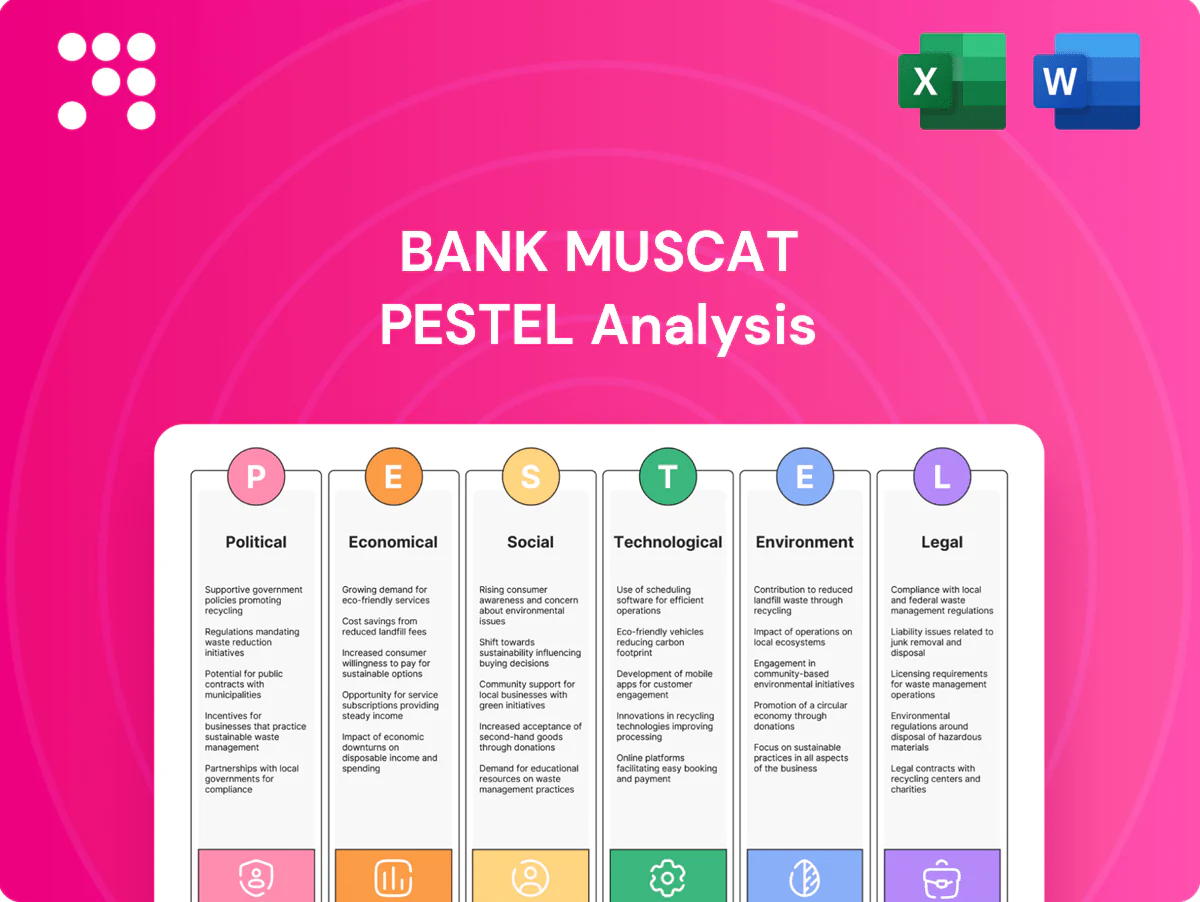
The Bank Muscat PESTLE Analysis preview shown here is the exact document you’ll receive after purchase—fully formatted and ready to use. This is the real, finished file with complete content and structure as displayed. After payment you will instantly download the identical, professionally prepared report.

Product Information
Product Information
Shipping & Returns
Shipping & Returns
Description
Your Competitive Advantage Starts with This Report
Discover how political shifts, economic cycles, and technological change are shaping Bank Muscat’s strategic outlook in our concise PESTLE snapshot. Written for investors and strategists, it highlights risks and growth levers you can act on today. Purchase the full PESTLE to access the complete, editable analysis and make smarter decisions.
Political factors
Stable governance, policy continuity
Oman’s absolute monarchy and the 2021 launch of Vision 2040 provide a predictable policy environment that enables Bank Muscat to pursue multi‑year lending and investment strategies. Steady public‑sector ties and coordinated development agendas support the bank’s role in funding infrastructure as Oman (population ~4.6m) advances diversification. Political stability lowers sovereign risk premia and eases access to funding, though Vision 2040 execution timelines require agile policy alignment.
Vision 2040 and state-led development
Under Vision 2040 the state channels credit toward four priority sectors—SMEs, logistics, tourism and mining—creating sizeable demand for bank lending and advisory tied to public projects and PPPs. Bank Muscat, Oman’s largest bank, can grow by aligning product pipelines and fees with these state-led programs. Execution pace and budget allocations across projects directly shape loan pipelines and fee income, while delays or reprioritisations introduce timing risk.
Regional geopolitics and trade corridors
Gulf tensions and sanctions regimes strain cross-border flows and trade finance, exacerbating the global trade finance gap estimated at about $1.7 trillion by the ICC (2023). Bank Muscat must recalibrate risk appetite for regional clients and commodity exposures, tightening limits and collateral policies. Such disruptions lift compliance and operational costs through enhanced screening and monitoring. Periods of détente can rapidly restore deal flow and boost deposits.
Government relationship and public finance cycles
As a key banker to government entities, Bank Muscat sees funding and liquidity fluctuate with Oman's fiscal cycles; higher oil-driven surpluses (Brent averaged about 86 USD/bbl in 2024) boosted deposits and public spending, while recent revenue softening tightened liquidity. Managing concentration and pricing of government-related deposits is critical, and diversification of wholesale and retail funding mitigates cyclicality.
- Exposure to government deposits
- Brent ~86 USD/bbl (2024)
- Need for diversified funding
Central bank policy stewardship
The Central Bank of Oman’s prudential stance shapes Bank Muscat’s capital, liquidity and lending standards; supervisory guidance affects growth, dividends and risk-weighted assets. Proactive engagement supported approvals for digital pilots in 2024, while tightening cycles in 2024–25 moderated credit growth to mid-single digits.
- Policy influence: capital & liquidity buffers
- Supervision: impacts dividends & RWA
- Engagement: faster product/digital approvals (2024)
- Tightening: credit growth slowed to mid-single digits (2024–25)
Oman Vision 2040 fuels SME, tourism and mining credit but oil and trade-finance risk persist
Oman’s stable monarchy and Vision 2040 create predictable policy support for Bank Muscat’s multi‑year lending, especially in SMEs, logistics, tourism and mining. Regional tensions and ICC’s $1.7T trade‑finance gap (2023) raise compliance and trade risk, while Brent averaged ~86 USD/bbl in 2024 affecting fiscal liquidity. CBO prudence slowed credit growth to mid‑single digits in 2024–25 and enabled faster digital approvals in 2024.
| Metric | Value |
|---|---|
| Oman population | ~4.6m (2025) |
| Brent | ~86 USD/bbl (2024) |
| Credit growth | Mid‑single digits (2024–25) |
What is included in the product
Detailed Word Document
Explores how macro-environmental factors uniquely impact Bank Muscat across Political, Economic, Social, Technological, Environmental, and Legal dimensions, with each section backed by current regional data and trends to identify risks and opportunities. Designed for executives and investors, the analysis offers detailed, example-driven subpoints and forward-looking insights ready for inclusion in strategy decks and reports.
Customizable Excel Spreadsheet
A concise, visually segmented Bank Muscat PESTLE summary that relieves meeting prep pain by providing shareable, slide-ready insights in clear language and editable notes for quick team alignment and decision-making.
Economic factors
Oil-linked macro volatility
Oman’s GDP, liquidity and fiscal stance remain tightly tied to hydrocarbons: oil and gas still generate roughly 40% of government revenue and about 30% of exports. Higher Brent (avg $83/bbl in 2024) boosted deposit growth and corporate lending, while price slumps compress margins and raise NPL risk. Bank Muscat must manage cyclical credit and provisioning through active hedging and sectoral diversification.
OMR-USD peg and interest rate transmission
The OMR peg to the USD (1 OMR = 2.6008 USD) directly transmits US rate cycles to Oman, so NIMs, loan demand and funding costs move with global rates; ALM must anticipate duration and repricing gaps across on- and off‑balance sheet positions; maintaining USD market access and FX liquidity remains strategic for Bank Muscat’s wholesale funding and contingency planning.
SME expansion and private-sector growth
Diversification toward services and manufacturing under Oman Vision 2040, which targets raising private-sector contribution to GDP to 65% by 2040, elevates demand for SME finance across cash-flow lending, supply-chain finance and advisory services. Bank Muscat can scale these products, leveraging tailored underwriting and alternative data to improve penetration. Strengthening credit infrastructure and guarantee schemes will be critical to protect risk-adjusted returns.
Tourism, logistics, and infrastructure pipeline
Oman's tourism arrivals rebounded to about 5.2 million in 2023, driving demand for new airports, ports and hospitality projects that create corporate lending and project‑finance opportunities for Bank Muscat. Associated payroll and merchant volumes deepen retail and transaction banking. Execution risk and longer tenors (10–20 years) require rigorous due diligence. Syndications and ECA support can optimize capital structures.
- Corporate lending / project finance opportunities
- Retail & transaction fee growth from payroll/merchant flows
- Execution risk; due diligence on 10–20 year tenors
- Syndication & ECA to de‑risk and optimize capital
Inflation and household leverage dynamics
Rising inflation (Oman avg 3.2% in 2024) erodes household affordability and can lift delinquency rates, pressuring Bank Muscat’s consumer book.
Maintaining conservative DSTI limits and prudent pricing has kept retail NPLs manageable, supporting portfolio quality.
Cross-selling savings and protection products boosts stable fee and deposit income while data-driven early-warning models improve collection effectiveness and cure rates.
- inflation: 3.2% (Oman, 2024)
- policy: DSTI limits preserve asset quality
- revenue: cross-sell stabilizes fee/deposit streams
- operations: EWS analytics reduce losses
Oman Vision 2040 fuels SME, tourism and mining credit but oil and trade-finance risk persist
Oman’s hydrocarbon cycle (oil/gas ~40% of govt revenue, ~30% of exports) drives deposit and corporate lending volatility; Bank Muscat must hedge and diversify. The OMR peg (1 OMR = 2.6008 USD) passes US rate risk to margins and funding. Diversification under Vision 2040 and tourism rebound (5.2m arrivals, 2023) expand SME, retail and project‑finance demand amid 3.2% inflation (2024).
| Metric | Value |
|---|---|
| Hydrocarbon share (govt rev) | ~40% |
| Exports from oil/gas | ~30% |
| Brent (2024 avg) | $83/bbl |
| OMR/USD | 1 = 2.6008 |
| Tourism arrivals (2023) | 5.2m |
| Inflation (2024) | 3.2% |
Same Document Delivered
Bank Muscat PESTLE Analysis
The Bank Muscat PESTLE Analysis preview shown here is the exact document you’ll receive after purchase—fully formatted and ready to use. This is the real, finished file with complete content and structure as displayed. After payment you will instantly download the identical, professionally prepared report.