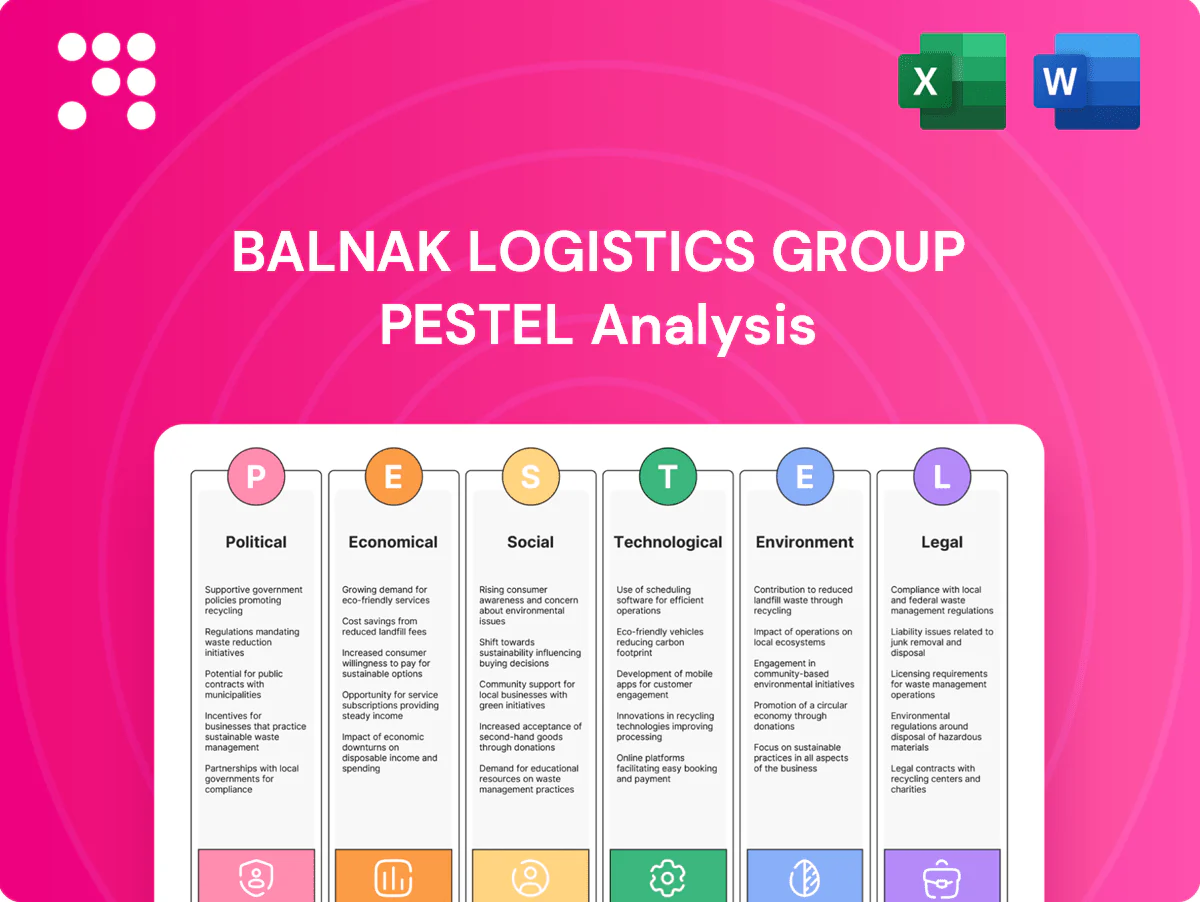
Balnak Logistics Group PESTLE Analysis

Make Smarter Strategic Decisions with a Complete PESTEL View
Gain a competitive edge with our targeted PESTLE Analysis of Balnak Logistics Group—see how political shifts, economic cycles, social trends, technological advances, legal changes, and environmental pressures are shaping future performance. Ideal for investors and strategists, this concise briefing highlights risks and growth levers. Purchase the full report for the complete, ready-to-use insights and downloadable charts.
Political factors

Trade policy and customs alignment
Turkey’s 1995 EU Customs Union alignment governs tariffs, rules of origin and documentation for Balnak’s cross-border flows and the EU accounted for about 38% of Turkey’s goods exports in 2023, concentrating cargo lanes. Shifts in preferential agreements with MENA and CIS can re-route volumes and change cost-to-serve. Active monitoring of tariff updates and e‑customs rollouts reduces clearance delays, while proactive client advisories cut compliance risks and penalties.
Geopolitical corridors and regional stability
Proximity to the Black Sea, Caucasus and Middle East secures growth corridors but exposure to conflict-driven disruptions is high; the Turkish Straits handle roughly 40,000 vessel transits annually, creating concentration risk. Airspace restrictions, port closures or border slowdowns can sharply increase transit times and war-risk insurance. Contingency routing and multimodal options reduce exposure, while scenario planning preserves service continuity for time-critical clients.

Public infrastructure investment
Turkey's accelerating public infrastructure investment in ports, rail links and highways—supporting container throughput above 7 million TEU in 2023—boosts Balnak's reliability and transit competitiveness.
Proximity to logistics hubs and free zones shortens lead times and reduces drayage costs, improving margins on short-haul flows.
Participation in public-private logistics initiatives secures terminal and rail capacity; early engagement affects slot allocation and incentive access.

Government incentives and free zones
Government incentives and free zones can materially lower Balnak Logistics Group’s capex and opex: UAE corporate tax is 9% since June 2023, while qualifying free-zone entities can retain 0% tax if 75%+ revenue is from abroad and conditions are met; free-zone customs regimes typically allow duty exemptions and faster clearance for export-oriented operations.
- Incentives reduce capex/opex
- Free zones streamline customs/duties
- Eligibility: activity, value-add, local hiring
- Must meet ESR and reporting to retain benefits
Sanctions and export-control regimes
Evolving sanctions on Russia, Iran and other jurisdictions since 2022 (EU has adopted 14 Russia packages) force route changes and stricter client screening; dual-use controls mandate robust classification and licensing workflows. Enhanced due diligence prevents facilitation risks for freight forwarding, while centralized screening tools protect reputation and reduce regulatory fines.
- Sanctions: routing/screening
- Dual-use: classification/licensing
- EDD: avoid facilitation
- Centralized screening: reputation/fines
Turkey's EU-linked trade (38%), Straits 40k transits and ports >7m TEU
Turkey’s EU Customs Union alignment concentrates lanes—EU was ~38% of Turkey goods exports in 2023—affecting tariffs and documentation. Strategic corridors (Black Sea, Caucasus, MENA) boost volumes but raise conflict risk; Turkish Straits ~40,000 transits/year. Infrastructure raised container throughput >7.0m TEU in 2023, improving transit times. Sanctions (EU ~14 Russia packages since 2022) and UAE 9% corp tax (since Jun 2023) alter routing and tax planning.
| Factor | Impact | Key data |
|---|---|---|
| EU reliance | Lane concentration | 38% exports (2023) |
| Maritime chokepoints | Disruption risk | Turkish Straits ~40,000 transits/yr |
| Infrastructure | Transit efficiency | >7.0m TEU (2023) |
| Sanctions/tax | Routing & cost | EU 14 Russia packages; UAE tax 9% |
What is included in the product
 Detailed Word Document
Explores how Political, Economic, Social, Technological, Environmental and Legal forces uniquely impact Balnak Logistics Group, with data-backed trends and region-specific regulatory context. Designed for executives and investors, the analysis delivers forward-looking insights, actionable risks and opportunities, and formatting ready for plans, decks or reports.

 Customizable Excel Spreadsheet
A concise, visually segmented PESTLE summary for Balnak Logistics Group that strips complexity into slide-ready insights, editable notes, and shareable snippets to speed alignment and support external risk discussions during planning sessions.
Economic factors

Currency volatility and inflation
TRY volatility and sustained double-digit inflation (over 50% in 2023–24) pressure margins via higher fuel, rent and labor costs; USD/TRY swung roughly from about 20 to around 40 between 2022–25, amplifying FX risk. USD/EUR-denominated contracts and active hedging stabilize cash flows. Index-linked tariffs and fuel surcharges preserve yield, while regular repricing cycles prevent service-level erosion and protect profitability.
Fuel and energy costs
Diesel, marine bunker and electricity account for roughly 25–40% of Balnak Logistics unit costs, with diesel and VLSFO price volatility driving margin swings. Surcharge mechanisms and portfolio hedges plus efficiency programs blunt peaks. Telematics and driver coaching typically cut idle time and fuel use by 10–15% (liters/100 km). Warehouse renewable PPAs can lock 10–15% cheaper energy over 10–15 years.

Global freight cycles and capacity
Ocean and air capacity shocks in 2024 continue to reshape modal mix and transit reliability, with peak-season rate swings of up to 40% and belly-capacity about 12% below 2019 levels. Strategic carrier partnerships and block-space agreements securing 10–20% of slots mitigate disruption. LCL/LTL consolidation can lift asset utilization 15–25% and margins 3–7%. Data-led forecasting pilots cut booking variance ~30% in 2024.

Sector demand diversification
Balnak Logistics Group's exposure across FMCG, automotive, textiles and e-commerce cushions cyclical swings while e-commerce accounted for about 23% of global retail sales in 2024, supporting steady volume growth. Vertical-specific services such as VMI, JIT and temperature control raise switching costs and support higher margins. Cross-selling warehousing with transport expands wallet share and strengthens revenue resilience, improving working-capital planning.
- Sector mix: FMCG/auto/textiles/e-commerce
- E‑commerce: ~23% global retail (2024)
- Services: VMI, JIT, cold chain = higher retention
- Cross-sell: warehousing + transport = larger wallet
Interest rates and capex
- Higher financing: policy rate 5.25–5.50% (Jul 2025)
- Capex alternatives: leasing, pay-per-use robotics, grants
- ROIC hurdle: ~12–15% to prioritize lanes/nodes
- Investment timing: dynamic NPV and scenario stress tests
Turkey's EU-linked trade (38%), Straits 40k transits and ports >7m TEU
Balnak faces TRY volatility and >50% inflation (2023–24) with USD/TRY ~20→40 (2022–25), raising FX and input-cost risk; USD/EUR contracts and hedges stabilize cash flows. Fuel/electricity are ~25–40% of unit costs; telematics cut fuel use 10–15%. High rates (US Fed 5.25–5.50% Jul 2025) lift financing costs, driving leasing and pay-per-use adoption.
| Metric | Value |
|---|---|
| Inflation (TR) | >50% (23–24) |
| USD/TRY | ~20→40 (22–25) |
| Fuel/electricity | 25–40% unit costs |
| Fuel saving | 10–15% |
| Fed rate | 5.25–5.50% (Jul 2025) |
Same Document Delivered
Balnak Logistics Group PESTLE Analysis
The Balnak Logistics Group PESTLE Analysis provides a concise review of political, economic, social, technological, legal and environmental factors affecting the business. The preview shown here is the exact document you’ll receive after purchase—fully formatted and ready to use. No placeholders or edits are needed.

Original: $10.00
-65%$10.00
$3.50Product Information
Product Information
Shipping & Returns
Shipping & Returns
Description
Make Smarter Strategic Decisions with a Complete PESTEL View
Gain a competitive edge with our targeted PESTLE Analysis of Balnak Logistics Group—see how political shifts, economic cycles, social trends, technological advances, legal changes, and environmental pressures are shaping future performance. Ideal for investors and strategists, this concise briefing highlights risks and growth levers. Purchase the full report for the complete, ready-to-use insights and downloadable charts.
Political factors
Trade policy and customs alignment
Turkey’s 1995 EU Customs Union alignment governs tariffs, rules of origin and documentation for Balnak’s cross-border flows and the EU accounted for about 38% of Turkey’s goods exports in 2023, concentrating cargo lanes. Shifts in preferential agreements with MENA and CIS can re-route volumes and change cost-to-serve. Active monitoring of tariff updates and e‑customs rollouts reduces clearance delays, while proactive client advisories cut compliance risks and penalties.
Geopolitical corridors and regional stability
Proximity to the Black Sea, Caucasus and Middle East secures growth corridors but exposure to conflict-driven disruptions is high; the Turkish Straits handle roughly 40,000 vessel transits annually, creating concentration risk. Airspace restrictions, port closures or border slowdowns can sharply increase transit times and war-risk insurance. Contingency routing and multimodal options reduce exposure, while scenario planning preserves service continuity for time-critical clients.
Public infrastructure investment
Turkey's accelerating public infrastructure investment in ports, rail links and highways—supporting container throughput above 7 million TEU in 2023—boosts Balnak's reliability and transit competitiveness.
Proximity to logistics hubs and free zones shortens lead times and reduces drayage costs, improving margins on short-haul flows.
Participation in public-private logistics initiatives secures terminal and rail capacity; early engagement affects slot allocation and incentive access.
Government incentives and free zones
Government incentives and free zones can materially lower Balnak Logistics Group’s capex and opex: UAE corporate tax is 9% since June 2023, while qualifying free-zone entities can retain 0% tax if 75%+ revenue is from abroad and conditions are met; free-zone customs regimes typically allow duty exemptions and faster clearance for export-oriented operations.
- Incentives reduce capex/opex
- Free zones streamline customs/duties
- Eligibility: activity, value-add, local hiring
- Must meet ESR and reporting to retain benefits
Sanctions and export-control regimes
Evolving sanctions on Russia, Iran and other jurisdictions since 2022 (EU has adopted 14 Russia packages) force route changes and stricter client screening; dual-use controls mandate robust classification and licensing workflows. Enhanced due diligence prevents facilitation risks for freight forwarding, while centralized screening tools protect reputation and reduce regulatory fines.
- Sanctions: routing/screening
- Dual-use: classification/licensing
- EDD: avoid facilitation
- Centralized screening: reputation/fines
Turkey's EU-linked trade (38%), Straits 40k transits and ports >7m TEU
Turkey’s EU Customs Union alignment concentrates lanes—EU was ~38% of Turkey goods exports in 2023—affecting tariffs and documentation. Strategic corridors (Black Sea, Caucasus, MENA) boost volumes but raise conflict risk; Turkish Straits ~40,000 transits/year. Infrastructure raised container throughput >7.0m TEU in 2023, improving transit times. Sanctions (EU ~14 Russia packages since 2022) and UAE 9% corp tax (since Jun 2023) alter routing and tax planning.
| Factor | Impact | Key data |
|---|---|---|
| EU reliance | Lane concentration | 38% exports (2023) |
| Maritime chokepoints | Disruption risk | Turkish Straits ~40,000 transits/yr |
| Infrastructure | Transit efficiency | >7.0m TEU (2023) |
| Sanctions/tax | Routing & cost | EU 14 Russia packages; UAE tax 9% |
What is included in the product
Detailed Word Document
Explores how Political, Economic, Social, Technological, Environmental and Legal forces uniquely impact Balnak Logistics Group, with data-backed trends and region-specific regulatory context. Designed for executives and investors, the analysis delivers forward-looking insights, actionable risks and opportunities, and formatting ready for plans, decks or reports.
Customizable Excel Spreadsheet
A concise, visually segmented PESTLE summary for Balnak Logistics Group that strips complexity into slide-ready insights, editable notes, and shareable snippets to speed alignment and support external risk discussions during planning sessions.
Economic factors
Currency volatility and inflation
TRY volatility and sustained double-digit inflation (over 50% in 2023–24) pressure margins via higher fuel, rent and labor costs; USD/TRY swung roughly from about 20 to around 40 between 2022–25, amplifying FX risk. USD/EUR-denominated contracts and active hedging stabilize cash flows. Index-linked tariffs and fuel surcharges preserve yield, while regular repricing cycles prevent service-level erosion and protect profitability.
Fuel and energy costs
Diesel, marine bunker and electricity account for roughly 25–40% of Balnak Logistics unit costs, with diesel and VLSFO price volatility driving margin swings. Surcharge mechanisms and portfolio hedges plus efficiency programs blunt peaks. Telematics and driver coaching typically cut idle time and fuel use by 10–15% (liters/100 km). Warehouse renewable PPAs can lock 10–15% cheaper energy over 10–15 years.
Global freight cycles and capacity
Ocean and air capacity shocks in 2024 continue to reshape modal mix and transit reliability, with peak-season rate swings of up to 40% and belly-capacity about 12% below 2019 levels. Strategic carrier partnerships and block-space agreements securing 10–20% of slots mitigate disruption. LCL/LTL consolidation can lift asset utilization 15–25% and margins 3–7%. Data-led forecasting pilots cut booking variance ~30% in 2024.
Sector demand diversification
Balnak Logistics Group's exposure across FMCG, automotive, textiles and e-commerce cushions cyclical swings while e-commerce accounted for about 23% of global retail sales in 2024, supporting steady volume growth. Vertical-specific services such as VMI, JIT and temperature control raise switching costs and support higher margins. Cross-selling warehousing with transport expands wallet share and strengthens revenue resilience, improving working-capital planning.
- Sector mix: FMCG/auto/textiles/e-commerce
- E‑commerce: ~23% global retail (2024)
- Services: VMI, JIT, cold chain = higher retention
- Cross-sell: warehousing + transport = larger wallet
Interest rates and capex
- Higher financing: policy rate 5.25–5.50% (Jul 2025)
- Capex alternatives: leasing, pay-per-use robotics, grants
- ROIC hurdle: ~12–15% to prioritize lanes/nodes
- Investment timing: dynamic NPV and scenario stress tests
Turkey's EU-linked trade (38%), Straits 40k transits and ports >7m TEU
Balnak faces TRY volatility and >50% inflation (2023–24) with USD/TRY ~20→40 (2022–25), raising FX and input-cost risk; USD/EUR contracts and hedges stabilize cash flows. Fuel/electricity are ~25–40% of unit costs; telematics cut fuel use 10–15%. High rates (US Fed 5.25–5.50% Jul 2025) lift financing costs, driving leasing and pay-per-use adoption.
| Metric | Value |
|---|---|
| Inflation (TR) | >50% (23–24) |
| USD/TRY | ~20→40 (22–25) |
| Fuel/electricity | 25–40% unit costs |
| Fuel saving | 10–15% |
| Fed rate | 5.25–5.50% (Jul 2025) |
Same Document Delivered
Balnak Logistics Group PESTLE Analysis
The Balnak Logistics Group PESTLE Analysis provides a concise review of political, economic, social, technological, legal and environmental factors affecting the business. The preview shown here is the exact document you’ll receive after purchase—fully formatted and ready to use. No placeholders or edits are needed.