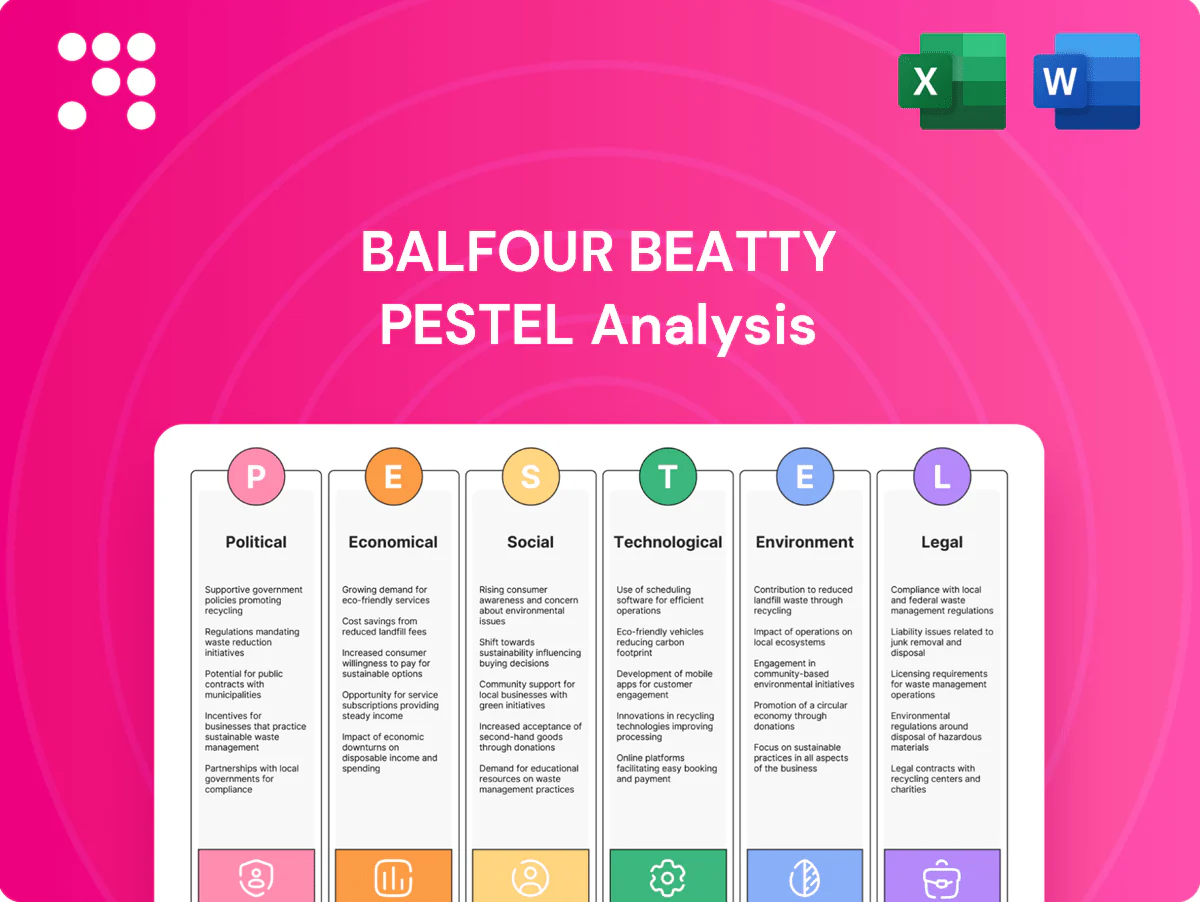
Balfour Beatty PESTLE Analysis

Plan Smarter. Present Sharper. Compete Stronger.
Discover how political shifts, economic cycles, and technological advances are reshaping Balfour Beatty’s prospects in our concise PESTLE analysis. Packed with actionable insights for investors, strategists, and advisors, this briefing highlights regulatory risks, sustainability pressures, and market opportunities. Purchase the full report to access the complete, editable breakdown and make smarter, faster decisions.
Political factors

UK infrastructure policy
UK government infrastructure priorities (public+private investment c.£600bn over the next decade) drive clear pipeline visibility for transport, health and education projects, boosting Balfour Beatty bidding opportunities. Post-election policy shifts can reallocate capital or accelerate PFI/PPP models, altering risk and financing structures. Devolution to 38 mayoral combined authorities changes procurement routes and local content rules. Active stakeholder engagement with central and local authorities is critical to win flagship programmes.
US federal and state funding
The IIJA (Infrastructure Investment and Jobs Act) commits roughly $1.2 trillion in federal funding, including about $550 billion in new infrastructure investment, underpinning multi-year highways, transit and water projects that support Balfour Beatty bid pipelines. Changing congressional control could reallocate funds, tighten Buy America rules and extend approval timelines, affecting cash flows. State DOT bond issuances and gubernatorial priorities shift bidding cadence and margins, while federal permitting reform can either accelerate or stall megaproject starts.

Hong Kong public works agenda
Hong Kong's Capital Works Programme commitments—supporting rail (MTR network ~272 km), aviation and social infrastructure—drive contract demand and pipeline sizing. Political sensitivities and deeper Mainland integration within the Greater Bay Area (population ~86 million) increase scrutiny on approvals and oversight. Heightened public value-for-money review is shifting contract forms and risk transfer, while cross-border standards alignment raises design and compliance costs.

Geopolitics and supply chains
Trade tensions and sanctions reshape material costs and sourcing for Balfour Beatty, with steel tariffs such as the US Section 232 levy at 25% directly affecting bid assumptions. US and allied export controls on advanced chips and telecom equipment tightened in 2022–23, complicating smart infrastructure procurement. Diversifying suppliers and regional inventories is needed to preserve schedule certainty and budget resilience.
- Tariffs: US steel Section 232 at 25% impacts cost estimates
- Export controls: 2022–23 chip and telecom restrictions add procurement complexity
- Mitigation: supplier diversification and regional stocking to protect schedules
Public-private partnership climate
Political appetite for PPPs varies by market and sector, affecting Balfour Beatty's project pipeline; projects often reference concession terms of 25+ years and the company is listed on LSE under BBY. Policy support for user-fee or availability-payment models directly shapes bankability and private investment. Transparency and governance expectations rise bid competitiveness and long-term concessions need stable regulatory frameworks to protect returns.
- Market variance: appetite by sector
- Payment model: user-fee vs availability
- Governance: transparency impacts bids
- Concessions: 25+ year stability required
UK £600bn, US $1.2tn pipelines fuel bids; tariffs squeeze
Government infrastructure pipelines (UK £600bn next decade) and US IIJA funding ($1.2tn, $550bn new) provide multi-year bid visibility; policy shifts and devolution change procurement and financing risk. Hong Kong/GBA integration (pop ~86m) raises approvals and compliance costs. Trade measures (US steel Section 232 25%) and export controls pressure sourcing and margins.
| Region | Political factor | Impact | Key stat |
|---|---|---|---|
| UK | Infrastructure priority | Pipeline visibility | £600bn |
| US | IIJA funding | Project backlog | $1.2tn ($550bn new) |
| HK/GBA | Integration scrutiny | Compliance cost | Population ~86m |
| Global | Tariffs/controls | Material + procurement risk | US steel 25% |
What is included in the product
 Detailed Word Document
Explores how macro-environmental forces uniquely impact Balfour Beatty across Political, Economic, Social, Technological, Environmental, and Legal dimensions, with each section supported by up-to-date data and industry trends. Designed for executives and investors, the analysis offers detailed sub-points, forward-looking insights, and practical examples to inform strategy, risk management, and funding decisions.

 Customizable Excel Spreadsheet
A concise Balfour Beatty PESTLE summary that highlights key external risks and opportunities, enabling quick alignment in meetings and streamlined decision-making.
Economic factors

Cyclical demand and GDP
Infrastructure spend closely tracks fiscal stimulus and macro cycles in the UK, US and HK, with the US IIJA worth c.1.2 trillion dollars and the UK’s long‑term pipeline cited at c.600 billion pounds, driving project flows. Economic slowdowns can defer award timing while recoveries compress tender windows and raise margin pressure. A strong, diversified backlog mix cushions revenue volatility. Scenario planning across regions informs headcount and plant allocation.
Inflation and input costs
Material and labor inflation since 2021 has pressured margins and heightened contract risk for Balfour Beatty, with pressures easing but persisting into 2024; indexation clauses and hedging remain vital in fixed‑price work. Supply‑chain volatility, while GSCPI returned near pre‑pandemic levels in 2024, still forces earlier procurement and alternative specs. Robust cost controls and stricter bid selectivity improve outcomes.

Interest rates and financing
Higher borrowing costs—UK Bank Rate at 5.25% and 10-year gilt yields around 4% in 2024—increase Balfour Beatty’s WACC, raising hurdle rates for investments and concession bids. Tighter debt markets curb project finance appetite and reduce refinancing gains, prompting some public clients to defer schemes as borrowing costs rise. A strong balance sheet and joint-venture partners help secure competitive financing structures.

Currency fluctuations
Sterling, US dollar and HKD exposures materially influence Balfour Beatty’s reported revenue and profit as translation effects move with GBP/USD ~1.27 and HKD/USD ~7.84 (July 2025). Local operating costs provide natural hedges that reduce translation volatility. FX swings raise imported equipment costs and contingency needs; treasury policies and OTC derivatives are used to stabilise cash flows.
- FX rates: GBP/USD ~1.27; HKD/USD ~7.84
- Natural local-cost hedges reduce P&L translation
- Treasury/derivatives mitigate imported-cost and cash-flow volatility
Labor market tightness
Skilled trades and engineering shortages push up wage bills and subcontractor rates—UK construction pay rose about 8% y/y in 2024, squeezing margins and lifting tender prices; productivity programs and digital construction are required to protect margins. Apprenticeships and training pipelines expand delivery capacity, while workforce planning must align with regional award outlooks and local labour market tightness.
UK £600bn, US $1.2tn pipelines fuel bids; tariffs squeeze
Infrastructure pipelines (US IIJA ~$1.2tn; UK ~£600bn) drive project flow but are timing-sensitive to cycles; slowdowns defer awards while recoveries compress tenders. Inflation and labour tightness (UK construction pay +8% y/y 2024) pressure margins; indexation, hedging and productivity uplift are vital. Higher rates (Bank Rate 5.25%; 10y gilt ~4%) raise WACC and constrain financing, FX (GBP/USD ~1.27; HKD/USD ~7.84) affects reported results.
| Metric | Value |
|---|---|
| US IIJA | $1.2tn |
| UK pipeline | £600bn |
| UK Bank Rate | 5.25% |
| 10y gilt | ~4% |
| GBP/USD | ~1.27 |
| HKD/USD | ~7.84 |
| Construction pay (UK) | +8% y/y 2024 |
Preview Before You Purchase
Balfour Beatty PESTLE Analysis
The Balfour Beatty PESTLE Analysis provides a concise review of political, economic, social, technological, legal and environmental factors affecting the company, with actionable implications for strategy and risk. The preview shown here is the exact document you’ll receive after purchase—fully formatted and ready to use. Use it immediately to inform investment or strategic decisions.

Product Information
Product Information
Shipping & Returns
Shipping & Returns
Description
Plan Smarter. Present Sharper. Compete Stronger.
Discover how political shifts, economic cycles, and technological advances are reshaping Balfour Beatty’s prospects in our concise PESTLE analysis. Packed with actionable insights for investors, strategists, and advisors, this briefing highlights regulatory risks, sustainability pressures, and market opportunities. Purchase the full report to access the complete, editable breakdown and make smarter, faster decisions.
Political factors
UK infrastructure policy
UK government infrastructure priorities (public+private investment c.£600bn over the next decade) drive clear pipeline visibility for transport, health and education projects, boosting Balfour Beatty bidding opportunities. Post-election policy shifts can reallocate capital or accelerate PFI/PPP models, altering risk and financing structures. Devolution to 38 mayoral combined authorities changes procurement routes and local content rules. Active stakeholder engagement with central and local authorities is critical to win flagship programmes.
US federal and state funding
The IIJA (Infrastructure Investment and Jobs Act) commits roughly $1.2 trillion in federal funding, including about $550 billion in new infrastructure investment, underpinning multi-year highways, transit and water projects that support Balfour Beatty bid pipelines. Changing congressional control could reallocate funds, tighten Buy America rules and extend approval timelines, affecting cash flows. State DOT bond issuances and gubernatorial priorities shift bidding cadence and margins, while federal permitting reform can either accelerate or stall megaproject starts.
Hong Kong public works agenda
Hong Kong's Capital Works Programme commitments—supporting rail (MTR network ~272 km), aviation and social infrastructure—drive contract demand and pipeline sizing. Political sensitivities and deeper Mainland integration within the Greater Bay Area (population ~86 million) increase scrutiny on approvals and oversight. Heightened public value-for-money review is shifting contract forms and risk transfer, while cross-border standards alignment raises design and compliance costs.
Geopolitics and supply chains
Trade tensions and sanctions reshape material costs and sourcing for Balfour Beatty, with steel tariffs such as the US Section 232 levy at 25% directly affecting bid assumptions. US and allied export controls on advanced chips and telecom equipment tightened in 2022–23, complicating smart infrastructure procurement. Diversifying suppliers and regional inventories is needed to preserve schedule certainty and budget resilience.
- Tariffs: US steel Section 232 at 25% impacts cost estimates
- Export controls: 2022–23 chip and telecom restrictions add procurement complexity
- Mitigation: supplier diversification and regional stocking to protect schedules
Public-private partnership climate
Political appetite for PPPs varies by market and sector, affecting Balfour Beatty's project pipeline; projects often reference concession terms of 25+ years and the company is listed on LSE under BBY. Policy support for user-fee or availability-payment models directly shapes bankability and private investment. Transparency and governance expectations rise bid competitiveness and long-term concessions need stable regulatory frameworks to protect returns.
- Market variance: appetite by sector
- Payment model: user-fee vs availability
- Governance: transparency impacts bids
- Concessions: 25+ year stability required
UK £600bn, US $1.2tn pipelines fuel bids; tariffs squeeze
Government infrastructure pipelines (UK £600bn next decade) and US IIJA funding ($1.2tn, $550bn new) provide multi-year bid visibility; policy shifts and devolution change procurement and financing risk. Hong Kong/GBA integration (pop ~86m) raises approvals and compliance costs. Trade measures (US steel Section 232 25%) and export controls pressure sourcing and margins.
| Region | Political factor | Impact | Key stat |
|---|---|---|---|
| UK | Infrastructure priority | Pipeline visibility | £600bn |
| US | IIJA funding | Project backlog | $1.2tn ($550bn new) |
| HK/GBA | Integration scrutiny | Compliance cost | Population ~86m |
| Global | Tariffs/controls | Material + procurement risk | US steel 25% |
What is included in the product
Detailed Word Document
Explores how macro-environmental forces uniquely impact Balfour Beatty across Political, Economic, Social, Technological, Environmental, and Legal dimensions, with each section supported by up-to-date data and industry trends. Designed for executives and investors, the analysis offers detailed sub-points, forward-looking insights, and practical examples to inform strategy, risk management, and funding decisions.
Customizable Excel Spreadsheet
A concise Balfour Beatty PESTLE summary that highlights key external risks and opportunities, enabling quick alignment in meetings and streamlined decision-making.
Economic factors
Cyclical demand and GDP
Infrastructure spend closely tracks fiscal stimulus and macro cycles in the UK, US and HK, with the US IIJA worth c.1.2 trillion dollars and the UK’s long‑term pipeline cited at c.600 billion pounds, driving project flows. Economic slowdowns can defer award timing while recoveries compress tender windows and raise margin pressure. A strong, diversified backlog mix cushions revenue volatility. Scenario planning across regions informs headcount and plant allocation.
Inflation and input costs
Material and labor inflation since 2021 has pressured margins and heightened contract risk for Balfour Beatty, with pressures easing but persisting into 2024; indexation clauses and hedging remain vital in fixed‑price work. Supply‑chain volatility, while GSCPI returned near pre‑pandemic levels in 2024, still forces earlier procurement and alternative specs. Robust cost controls and stricter bid selectivity improve outcomes.
Interest rates and financing
Higher borrowing costs—UK Bank Rate at 5.25% and 10-year gilt yields around 4% in 2024—increase Balfour Beatty’s WACC, raising hurdle rates for investments and concession bids. Tighter debt markets curb project finance appetite and reduce refinancing gains, prompting some public clients to defer schemes as borrowing costs rise. A strong balance sheet and joint-venture partners help secure competitive financing structures.
Currency fluctuations
Sterling, US dollar and HKD exposures materially influence Balfour Beatty’s reported revenue and profit as translation effects move with GBP/USD ~1.27 and HKD/USD ~7.84 (July 2025). Local operating costs provide natural hedges that reduce translation volatility. FX swings raise imported equipment costs and contingency needs; treasury policies and OTC derivatives are used to stabilise cash flows.
- FX rates: GBP/USD ~1.27; HKD/USD ~7.84
- Natural local-cost hedges reduce P&L translation
- Treasury/derivatives mitigate imported-cost and cash-flow volatility
Labor market tightness
Skilled trades and engineering shortages push up wage bills and subcontractor rates—UK construction pay rose about 8% y/y in 2024, squeezing margins and lifting tender prices; productivity programs and digital construction are required to protect margins. Apprenticeships and training pipelines expand delivery capacity, while workforce planning must align with regional award outlooks and local labour market tightness.
UK £600bn, US $1.2tn pipelines fuel bids; tariffs squeeze
Infrastructure pipelines (US IIJA ~$1.2tn; UK ~£600bn) drive project flow but are timing-sensitive to cycles; slowdowns defer awards while recoveries compress tenders. Inflation and labour tightness (UK construction pay +8% y/y 2024) pressure margins; indexation, hedging and productivity uplift are vital. Higher rates (Bank Rate 5.25%; 10y gilt ~4%) raise WACC and constrain financing, FX (GBP/USD ~1.27; HKD/USD ~7.84) affects reported results.
| Metric | Value |
|---|---|
| US IIJA | $1.2tn |
| UK pipeline | £600bn |
| UK Bank Rate | 5.25% |
| 10y gilt | ~4% |
| GBP/USD | ~1.27 |
| HKD/USD | ~7.84 |
| Construction pay (UK) | +8% y/y 2024 |
Preview Before You Purchase
Balfour Beatty PESTLE Analysis
The Balfour Beatty PESTLE Analysis provides a concise review of political, economic, social, technological, legal and environmental factors affecting the company, with actionable implications for strategy and risk. The preview shown here is the exact document you’ll receive after purchase—fully formatted and ready to use. Use it immediately to inform investment or strategic decisions.