Azenta PESTLE Analysis

Your Shortcut to Market Insight Starts Here
Discover how political shifts, economic cycles, social trends, technological advances, legal changes, and environmental pressures shape Azenta’s strategic path in our concise PESTLE snapshot—perfect for investors and strategists. Dive deeper with the full, ready-to-use PESTLE analysis to unlock actionable insights and download immediately.
Political factors

Public R&D funding priorities
Government grants and budget allocations—NIH budget ~ $50B (FY2024) and EU Horizon Europe €95.5B (2021–27)—directly drive demand for genomic services and biobanking. Pandemic preparedness and oncology initiatives (including ARPA-H and expanded cancer mission funding) accelerate project pipelines and utilization. Cuts or reallocations can delay procurements and reduce lab throughput. Monitoring NIH, Horizon and APAC R&D programs helps forecast volume shifts.
Trade policy and export controls
Controls on genomics tools, reagents and biological materials (tightened in US/EU export rules since 2022–24) disrupt cross-border workflows and can trigger biosecurity restrictions that limit sample movement. Tariffs and customs frictions — average applied tariff ~2.9% in 2023 (WTO) — raise costs and elongate lead times. Diversifying suppliers and rigorous compliant documentation reduce delays and duty surprises.

Health policy and procurement
National healthcare strategies—driven by over 70 national genomic programs globally—directly shape sequencing adoption and population screening priorities, influencing Azenta demand mix. Centralized procurement in many markets can pressure pricing while stabilizing volumes and contract length. Reimbursement rules determine which test menus scale and influence lab throughput economics. Active engagement with public health agencies enhances pipeline visibility and planning.

Geopolitical supply chain risk
Regional tensions such as the 2022 Russia–Ukraine conflict have shown how quickly cold-chain logistics and critical components can be disrupted, creating fulfillment uncertainty from sanctions and sudden regulatory shifts. Azenta mitigates risk through nearshoring and multi-sourcing strategies and by holding inventory buffers for high-value biological samples to avoid single-point failures.
- 2022 Russia–Ukraine: demonstrated cold-chain disruptions
- Nearshoring/multi-sourcing: reduces single-point risk
- Inventory buffers: critical for high-value samples
- Sanctions/regulatory shifts: drive fulfillment uncertainty
Data localization mandates
Some countries require in-country storage/processing of genomic data—notably China (PIPL 2021) and jurisdictions with strict transfer rules under the EU GDPR—forcing local data centers and compliant workflows; Russia and Indonesia also maintain localization measures. Fragmentation raises operating complexity and drives up deployment and compliance costs for providers like Azenta. Standardized cloud-to-edge architectures enable scalable, auditable compliance across jurisdictions.
- China: PIPL 2021 requires strict controls on cross-border personal data
- EU: GDPR limits transfers without adequate safeguards
- Result: local data centers + standardized architectures reduce per-jurisdiction overhead
R&D funding and regulation reshape sequencing supply chains, raising costs and delays
Government R&D budgets (NIH ~$50B FY2024; Horizon Europe €95.5B 2021–27) drive sequencing/biobank demand; procurement shifts alter volumes. Export controls (tightened 2022–24) and average applied tariff ~2.9% (WTO 2023) raise costs and delay cross-border flows. Data localization (China PIPL 2021; EU GDPR) and Russia–Ukraine 2022 cold-chain shocks increase compliance and fulfillment complexity.
| Factor | Key stat | Impact |
|---|---|---|
| R&D budgets | NIH ~$50B | Raises demand/contract volume |
| Export controls/tariffs | Tariff ~2.9% | Cost + lead-time risk |
| Data localization | PIPL 2021, GDPR | Local infra + compliance costs |
| Geo-conflict | Russia–Ukraine 2022 | Cold-chain disruption |
What is included in the product
 Detailed Word Document
Explores how macro-environmental forces uniquely impact Azenta across Political, Economic, Social, Technological, Environmental, and Legal dimensions, with data-driven trends and region/industry-specific examples; designed for executives and investors to identify risks, opportunities, and forward-looking scenarios for strategic planning.

 Customizable Excel Spreadsheet
A concise, visually segmented PESTLE summary for Azenta that’s easily dropped into presentations or shared across teams, enabling quick alignment and focused discussion on external risks and market positioning.
Economic factors

Biopharma R&D spending cycles
Global biopharma R&D spend is roughly USD 200 billion annually (2023–24), and funding expansions directly increase sample volumes and project starts, boosting demand for Azenta's sequencing and storage services. Slowdowns or pipeline setbacks commonly defer sequencing and storage decisions, pressuring short-term utilization. A late-stage program mix shifts margins and capacity planning, while close alignment with top sponsors—which account for about 40% of outsourced spend—stabilizes revenue.
Interest rates and capex
Higher interest rates—US federal funds near 5.25–5.50% in 2024–25—constrain customer capex for Azenta's automation systems, slowing large upfront purchases. Opex-friendly models (SaaS, managed services) gain traction as customers shift to subscription and pay-per-use. Lower rates or cuts can unlock deferred upgrades; flexible financing and leasing preserve equipment demand by lowering upfront costs.

Currency fluctuations
Azenta's global revenues and overseas cost bases expose earnings to FX volatility; with the US dollar trade-weighted index around 103.5 in July 2025, currency swings can materially affect reported results.
A stronger dollar compresses translated sales from international subsidiaries while reducing import costs for inputs and capital equipment, improving gross margins on imported goods.
Management uses natural hedging (matching currency cash flows) and financial hedges (forwards/options) to smooth quarterly results, and contracts increasingly include FX pass-through or indexed pricing clauses to protect margins.

Industry consolidation
M&A among CROs, CDMOs and biobanks (eg Thermo Fisher’s $17.4B purchase of PPD in 2021 and Danaher’s $21.4B Cytiva deal) shifts buying power toward mega-providers; larger buyers demand integrated, standardized platforms and workflows, expanding cross-selling across ecosystems while post-merger vendor rationalization raises contract retention risk.
- Consolidation examples: Thermo Fisher $17.4B; Danaher $21.4B
- Buyer demand: integrated, standardized platforms
- Risk: higher vendor rationalization and contract churn
Cost containment pressures
Cost containment pressures force payers and sponsors to demand demonstrated efficiency and measurable value, making transparent total cost of ownership and automation-driven productivity gains key sales levers for Azenta; bundled services and outcome-based pricing offer differentiation while operational excellence preserves margins in competitive bids.
- Payers demand value
- Transparent TCO wins
- Bundled/outcome pricing differentiates
- Operational excellence protects margins
R&D funding and regulation reshape sequencing supply chains, raising costs and delays
Global biopharma R&D ~USD 200B (2023–24) drives demand for Azenta services while top sponsors account for ~40% of outsourced spend, stabilizing revenue. US fed funds 5.25–5.50% (2024–25) shifts buyers to Opex models; flexible financing preserves equipment demand. USD TWI ~103.5 (Jul 2025) adds FX risk; M&A (Thermo 17.4B, Danaher 21.4B) concentrates buyer power.
| Metric | Value |
|---|---|
| Biopharma R&D | ~USD 200B (2023–24) |
| Top sponsors share | ~40% |
| US rates | 5.25–5.50% (2024–25) |
| USD TWI | 103.5 (Jul 2025) |
| Major M&A | Thermo 17.4B; Danaher 21.4B |
Preview the Actual Deliverable
Azenta PESTLE Analysis
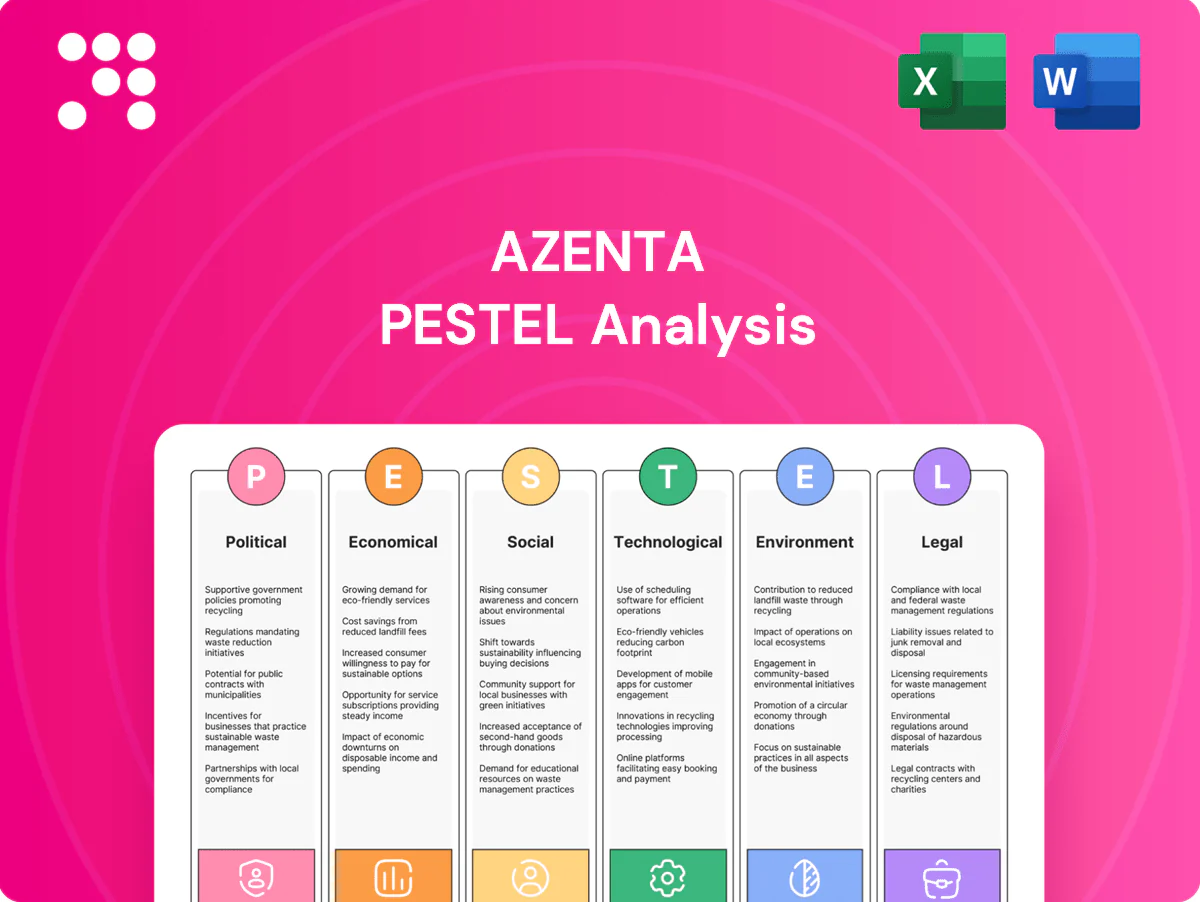
The preview shown here is the exact Azenta PESTLE Analysis document you’ll receive after purchase—fully formatted and ready to use.
No placeholders or teasers: the layout, content, and structure visible are the final file delivered exactly as shown and available for immediate download after payment.

Product Information
Product Information
Shipping & Returns
Shipping & Returns
Description
Your Shortcut to Market Insight Starts Here
Discover how political shifts, economic cycles, social trends, technological advances, legal changes, and environmental pressures shape Azenta’s strategic path in our concise PESTLE snapshot—perfect for investors and strategists. Dive deeper with the full, ready-to-use PESTLE analysis to unlock actionable insights and download immediately.
Political factors
Public R&D funding priorities
Government grants and budget allocations—NIH budget ~ $50B (FY2024) and EU Horizon Europe €95.5B (2021–27)—directly drive demand for genomic services and biobanking. Pandemic preparedness and oncology initiatives (including ARPA-H and expanded cancer mission funding) accelerate project pipelines and utilization. Cuts or reallocations can delay procurements and reduce lab throughput. Monitoring NIH, Horizon and APAC R&D programs helps forecast volume shifts.
Trade policy and export controls
Controls on genomics tools, reagents and biological materials (tightened in US/EU export rules since 2022–24) disrupt cross-border workflows and can trigger biosecurity restrictions that limit sample movement. Tariffs and customs frictions — average applied tariff ~2.9% in 2023 (WTO) — raise costs and elongate lead times. Diversifying suppliers and rigorous compliant documentation reduce delays and duty surprises.
Health policy and procurement
National healthcare strategies—driven by over 70 national genomic programs globally—directly shape sequencing adoption and population screening priorities, influencing Azenta demand mix. Centralized procurement in many markets can pressure pricing while stabilizing volumes and contract length. Reimbursement rules determine which test menus scale and influence lab throughput economics. Active engagement with public health agencies enhances pipeline visibility and planning.
Geopolitical supply chain risk
Regional tensions such as the 2022 Russia–Ukraine conflict have shown how quickly cold-chain logistics and critical components can be disrupted, creating fulfillment uncertainty from sanctions and sudden regulatory shifts. Azenta mitigates risk through nearshoring and multi-sourcing strategies and by holding inventory buffers for high-value biological samples to avoid single-point failures.
- 2022 Russia–Ukraine: demonstrated cold-chain disruptions
- Nearshoring/multi-sourcing: reduces single-point risk
- Inventory buffers: critical for high-value samples
- Sanctions/regulatory shifts: drive fulfillment uncertainty
Data localization mandates
Some countries require in-country storage/processing of genomic data—notably China (PIPL 2021) and jurisdictions with strict transfer rules under the EU GDPR—forcing local data centers and compliant workflows; Russia and Indonesia also maintain localization measures. Fragmentation raises operating complexity and drives up deployment and compliance costs for providers like Azenta. Standardized cloud-to-edge architectures enable scalable, auditable compliance across jurisdictions.
- China: PIPL 2021 requires strict controls on cross-border personal data
- EU: GDPR limits transfers without adequate safeguards
- Result: local data centers + standardized architectures reduce per-jurisdiction overhead
R&D funding and regulation reshape sequencing supply chains, raising costs and delays
Government R&D budgets (NIH ~$50B FY2024; Horizon Europe €95.5B 2021–27) drive sequencing/biobank demand; procurement shifts alter volumes. Export controls (tightened 2022–24) and average applied tariff ~2.9% (WTO 2023) raise costs and delay cross-border flows. Data localization (China PIPL 2021; EU GDPR) and Russia–Ukraine 2022 cold-chain shocks increase compliance and fulfillment complexity.
| Factor | Key stat | Impact |
|---|---|---|
| R&D budgets | NIH ~$50B | Raises demand/contract volume |
| Export controls/tariffs | Tariff ~2.9% | Cost + lead-time risk |
| Data localization | PIPL 2021, GDPR | Local infra + compliance costs |
| Geo-conflict | Russia–Ukraine 2022 | Cold-chain disruption |
What is included in the product
Detailed Word Document
Explores how macro-environmental forces uniquely impact Azenta across Political, Economic, Social, Technological, Environmental, and Legal dimensions, with data-driven trends and region/industry-specific examples; designed for executives and investors to identify risks, opportunities, and forward-looking scenarios for strategic planning.
Customizable Excel Spreadsheet
A concise, visually segmented PESTLE summary for Azenta that’s easily dropped into presentations or shared across teams, enabling quick alignment and focused discussion on external risks and market positioning.
Economic factors
Biopharma R&D spending cycles
Global biopharma R&D spend is roughly USD 200 billion annually (2023–24), and funding expansions directly increase sample volumes and project starts, boosting demand for Azenta's sequencing and storage services. Slowdowns or pipeline setbacks commonly defer sequencing and storage decisions, pressuring short-term utilization. A late-stage program mix shifts margins and capacity planning, while close alignment with top sponsors—which account for about 40% of outsourced spend—stabilizes revenue.
Interest rates and capex
Higher interest rates—US federal funds near 5.25–5.50% in 2024–25—constrain customer capex for Azenta's automation systems, slowing large upfront purchases. Opex-friendly models (SaaS, managed services) gain traction as customers shift to subscription and pay-per-use. Lower rates or cuts can unlock deferred upgrades; flexible financing and leasing preserve equipment demand by lowering upfront costs.
Currency fluctuations
Azenta's global revenues and overseas cost bases expose earnings to FX volatility; with the US dollar trade-weighted index around 103.5 in July 2025, currency swings can materially affect reported results.
A stronger dollar compresses translated sales from international subsidiaries while reducing import costs for inputs and capital equipment, improving gross margins on imported goods.
Management uses natural hedging (matching currency cash flows) and financial hedges (forwards/options) to smooth quarterly results, and contracts increasingly include FX pass-through or indexed pricing clauses to protect margins.
Industry consolidation
M&A among CROs, CDMOs and biobanks (eg Thermo Fisher’s $17.4B purchase of PPD in 2021 and Danaher’s $21.4B Cytiva deal) shifts buying power toward mega-providers; larger buyers demand integrated, standardized platforms and workflows, expanding cross-selling across ecosystems while post-merger vendor rationalization raises contract retention risk.
- Consolidation examples: Thermo Fisher $17.4B; Danaher $21.4B
- Buyer demand: integrated, standardized platforms
- Risk: higher vendor rationalization and contract churn
Cost containment pressures
Cost containment pressures force payers and sponsors to demand demonstrated efficiency and measurable value, making transparent total cost of ownership and automation-driven productivity gains key sales levers for Azenta; bundled services and outcome-based pricing offer differentiation while operational excellence preserves margins in competitive bids.
- Payers demand value
- Transparent TCO wins
- Bundled/outcome pricing differentiates
- Operational excellence protects margins
R&D funding and regulation reshape sequencing supply chains, raising costs and delays
Global biopharma R&D ~USD 200B (2023–24) drives demand for Azenta services while top sponsors account for ~40% of outsourced spend, stabilizing revenue. US fed funds 5.25–5.50% (2024–25) shifts buyers to Opex models; flexible financing preserves equipment demand. USD TWI ~103.5 (Jul 2025) adds FX risk; M&A (Thermo 17.4B, Danaher 21.4B) concentrates buyer power.
| Metric | Value |
|---|---|
| Biopharma R&D | ~USD 200B (2023–24) |
| Top sponsors share | ~40% |
| US rates | 5.25–5.50% (2024–25) |
| USD TWI | 103.5 (Jul 2025) |
| Major M&A | Thermo 17.4B; Danaher 21.4B |
Preview the Actual Deliverable
Azenta PESTLE Analysis
The preview shown here is the exact Azenta PESTLE Analysis document you’ll receive after purchase—fully formatted and ready to use.
No placeholders or teasers: the layout, content, and structure visible are the final file delivered exactly as shown and available for immediate download after payment.