Aviat Networks PESTLE Analysis

Plan Smarter. Present Sharper. Compete Stronger.
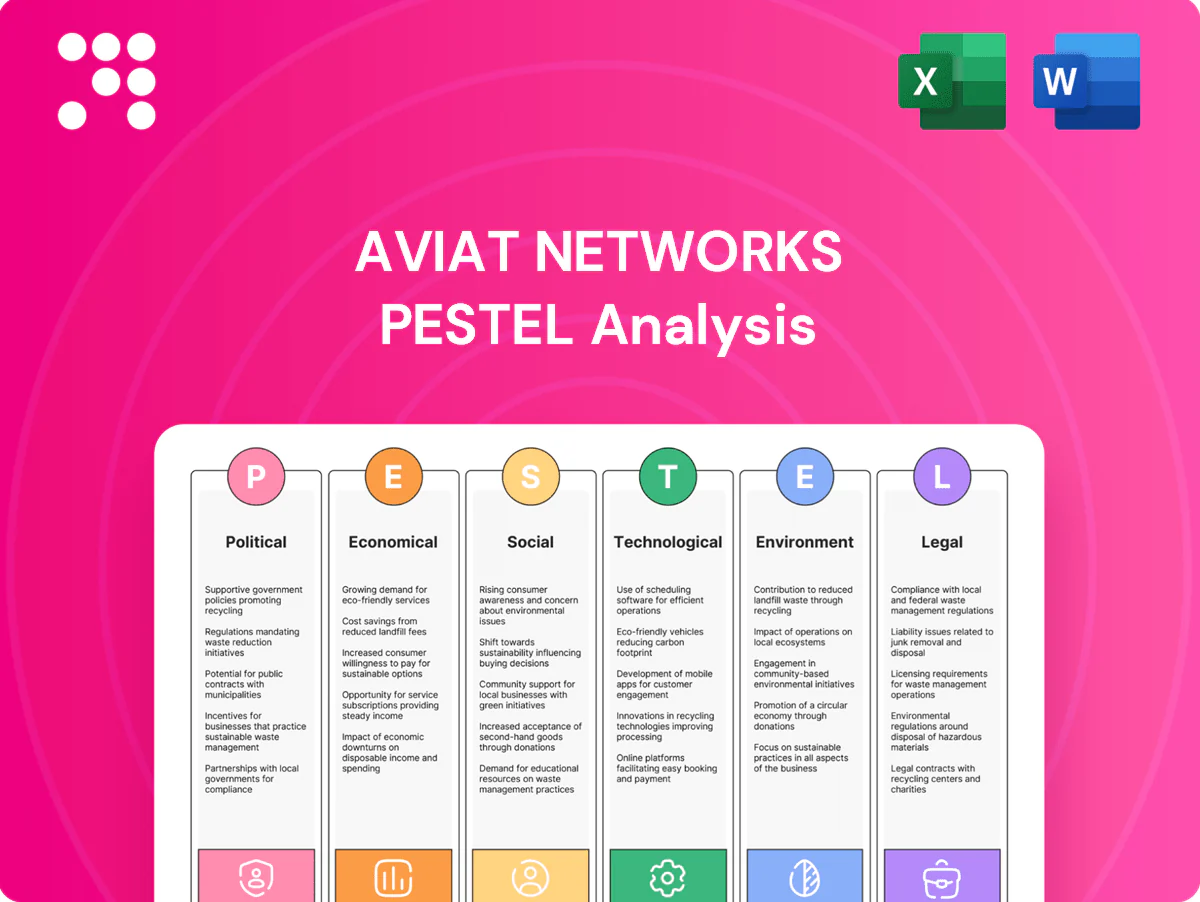
Our PESTLE Analysis of Aviat Networks reveals how political shifts, regulatory pressures, economic cycles, social trends, technological advances, and environmental factors converge to shape strategic risk and opportunity. Ideal for investors and strategists, it highlights actionable implications and competitive signals. Purchase the full report to access the complete, editable breakdown and implement data-driven decisions today.
Political factors

Spectrum policy & allocation
National regulators control microwave bands (commonly 6–80 GHz) through licensing models and fees; WRC-23 outcomes shaped harmonization and spectrum rights, supporting high-capacity backhaul that enables multi-Gbps links and higher margins. Delays or re-farming to 5G/6G access reduce available backhaul channels and constrain Aviat’s product offerings, while cross-border harmonization (e.g., CEPT, FCC/Ofcom alignment) lowers deployment costs.
Government funding priorities
Public programs such as the US BEAD program, which allocates 42.45 billion dollars for broadband deployment, directly boost demand for Aviat Networks microwave backhaul in rural and critical-infrastructure projects. Shifts in budgets and election cycles can delay rollouts and concentrate spending windows, while fiscal austerity risks cutbacks. Defense and public-safety procurements tied to the roughly 858 billion dollar US defense budget are important but cyclical, and earmarked subsidies often produce lumpy, tender-driven order intake.

Trade policy & export controls
Tariffs, sanctions and export restrictions shape Aviat Networks sourcing and addressable markets, with FY2024 revenue reported at $295M and sales across 120+ countries increasing exposure to trade measures. EAR and ITAR regimes constrain sales to sensitive regions and defense customers, limiting exports to sanctioned states like Russia and designated Chinese entities. Retaliatory trade actions can raise component costs or delay deliveries, while diversified manufacturing sites and multi-channel distribution mitigate geopolitical shocks.

Public-private partnerships
Public-private partnership frameworks shape Aviat Networks procurement and risk-sharing, often shifting lifecycle risks to vendors and altering contract lengths; delayed approvals commonly extend project timelines by 6–12 months, increasing working capital needs.
Transparent tendering expands bid pools and can compress pricing, pressuring gross margins while boosting volume opportunity; localization clauses frequently require local assembly or equity partners.
- PPP risk transfer: contract lengths, warranties
- Approval delays: +6–12 months working capital
- Pricing pressure: tighter margins from transparent tenders
- Localization: local assembly/partner mandates
Political stability & security
Installations in emerging or conflict-prone areas face high disruption risk; Uppsala reported 56 armed conflicts in 2023, increasing outage and repair exposures. Regime changes can rapidly re-prioritize connectivity projects and contracts, while rising global military spending (SIPRI: $2.24 trillion in 2023) heightens border tension spillovers that affect cross-border links and logistics. Insurance and contingency planning, including political-risk cover and spare-path redundancy, become essential for protecting revenue and capex.
- Disruption risk: 56 armed conflicts (Uppsala, 2023)
- Geopolitical pressure: $2.24T global military spending (SIPRI, 2023)
- Mitigation: political-risk insurance, redundancy, supply-chain contingency
WRC-23 and regulations unlock multi-Gbps backhaul; BEAD $42.45B, FY2024 $295M
Regulatory spectrum decisions and WRC-23 harmonization enable multi-Gbps backhaul but re-farming to 5G/6G and licensing delays constrain offerings and deployment timing. US BEAD $42.45B and FY2024 revenue $295M drive demand, while sanctions, 120+ country sales and 56 conflicts (Uppsala 2023) raise geopolitical risk.
| Metric | Value |
|---|---|
| BEAD | $42.45B |
| FY2024 revenue | $295M |
| Markets | 120+ countries |
| Armed conflicts | 56 (Uppsala 2023) |
| Global mil. spend | $2.24T (SIPRI 2023) |
What is included in the product
 Detailed Word Document
Explores how external macro-environmental factors uniquely affect Aviat Networks across Political, Economic, Social, Technological, Environmental, and Legal dimensions, with each section backed by sector data and current trends to surface actionable risks and opportunities. Designed for executives and investors to inform strategy, scenario planning, and capital decisions.

 Customizable Excel Spreadsheet
A concise, visually segmented PESTLE summary for Aviat Networks that eases stakeholder alignment and risk discussions, can be dropped into slides or shared across teams, and includes editable notes for tailoring insights to region or business line.
Economic factors

Carrier capex cycles
Mobile operators’ backhaul spending tracks subscriber growth and technology cycles, with 5G subscriptions surpassing 1 billion by end-2022 (Ericsson). 5G densification raises microwave demand where fiber is uneconomic. Macro slowdowns defer capex and lengthen sales cycles. Vendor financing can tip competitive wins by easing operator budget constraints.
Interest rates & cost of capital
Higher interest rates (US fed funds ~5.25–5.50% mid‑2025, 10‑yr ~4.0%) lift WACC for Aviat and its customers, compressing project ROI and making telecom investments harder to justify. Elevated financing costs reduce PPP and rural build viability, often pushing required IRRs above typical 8–12% thresholds and delaying deployments. Rate declines can unlock deferred projects, and interest/FX hedges are essential for long‑lead hardware procurement.

FX and global revenue mix
Multi-currency sales—with roughly 60% of Aviat Networks revenue generated outside the US—expose margins to FX volatility as a stronger USD erodes reported international revenues. A persistently strong USD since 2022 has weighed on competitiveness in price-sensitive markets. Local-currency contracts containing USD-denominated components create cash-flow mismatches; natural hedges, FX pass-through pricing clauses and forward contracts are therefore key risk mitigants.

Supply chain & component inflation
RF semiconductors, antennas and specialty ICs saw constrained supply with lead times around 16–20 weeks in 2024 (industry supplier surveys), causing cost inflation that can compress gross margins if not passed to customers; dual-sourcing and design-for-supply have become standard resiliency measures, while lead-time variability directly disrupts shipment timing and revenue recognition.
- Supply: RF/IC lead times ~16–20 weeks (2024)
- Margin risk: component cost inflation squeezes gross margins
- Mitigation: dual-sourcing, design-for-supply
- Impact: lead-time variability affects revenue recognition
Competitive pricing dynamics
Competitive pricing pressure on Aviat Networks intensifies as multinational OEMs and nimble regional specialists undercut unit prices, forcing bids toward total cost of ownership rather than headline price alone.
Advanced software features, managed-service SLAs and lifecycle services are key margin defenders, enabling premium pricing for demonstrated uptime and lower operational expense.
Industry consolidation among suppliers and operators can shift bargaining power, compressing margins where scale concentrates and opening premium niches where differentiation remains.
- Price pressure: multinationals vs regional specialists
- TCO focus: acquisition + OPEX wins deals
- Defensive levers: software, SLAs, services
- Consolidation: changes supplier/customer bargaining
WRC-23 and regulations unlock multi-Gbps backhaul; BEAD $42.45B, FY2024 $295M
Mobile backhaul tied to 5G densification; 5G >1B subs end‑2022, deployments boost microwave demand. Higher rates (US fed funds 5.25–5.50% mid‑2025; 10yr ≈4.0%) raise WACC and delay capex; ~60% revenue outside US exposes FX risk. RF/IC lead times ~16–20 weeks (2024), squeezing margins.
| Metric | Value |
|---|---|
| 5G subs | >1B (end‑2022) |
| Fed funds | 5.25–5.50% (mid‑2025) |
| Intl revenue | ~60% |
| RF lead times | 16–20 wks (2024) |
Preview the Actual Deliverable
Aviat Networks PESTLE Analysis
The Aviat Networks PESTLE Analysis preview shown here is the exact document you’ll receive after purchase—fully formatted and ready to use. This is the final version with complete political, economic, social, technological, legal, and environmental insights. No placeholders or teasers—download the same file immediately after checkout.

Product Information
Product Information
Shipping & Returns
Shipping & Returns
Description
Plan Smarter. Present Sharper. Compete Stronger.
Our PESTLE Analysis of Aviat Networks reveals how political shifts, regulatory pressures, economic cycles, social trends, technological advances, and environmental factors converge to shape strategic risk and opportunity. Ideal for investors and strategists, it highlights actionable implications and competitive signals. Purchase the full report to access the complete, editable breakdown and implement data-driven decisions today.
Political factors
Spectrum policy & allocation
National regulators control microwave bands (commonly 6–80 GHz) through licensing models and fees; WRC-23 outcomes shaped harmonization and spectrum rights, supporting high-capacity backhaul that enables multi-Gbps links and higher margins. Delays or re-farming to 5G/6G access reduce available backhaul channels and constrain Aviat’s product offerings, while cross-border harmonization (e.g., CEPT, FCC/Ofcom alignment) lowers deployment costs.
Government funding priorities
Public programs such as the US BEAD program, which allocates 42.45 billion dollars for broadband deployment, directly boost demand for Aviat Networks microwave backhaul in rural and critical-infrastructure projects. Shifts in budgets and election cycles can delay rollouts and concentrate spending windows, while fiscal austerity risks cutbacks. Defense and public-safety procurements tied to the roughly 858 billion dollar US defense budget are important but cyclical, and earmarked subsidies often produce lumpy, tender-driven order intake.
Trade policy & export controls
Tariffs, sanctions and export restrictions shape Aviat Networks sourcing and addressable markets, with FY2024 revenue reported at $295M and sales across 120+ countries increasing exposure to trade measures. EAR and ITAR regimes constrain sales to sensitive regions and defense customers, limiting exports to sanctioned states like Russia and designated Chinese entities. Retaliatory trade actions can raise component costs or delay deliveries, while diversified manufacturing sites and multi-channel distribution mitigate geopolitical shocks.
Public-private partnerships
Public-private partnership frameworks shape Aviat Networks procurement and risk-sharing, often shifting lifecycle risks to vendors and altering contract lengths; delayed approvals commonly extend project timelines by 6–12 months, increasing working capital needs.
Transparent tendering expands bid pools and can compress pricing, pressuring gross margins while boosting volume opportunity; localization clauses frequently require local assembly or equity partners.
- PPP risk transfer: contract lengths, warranties
- Approval delays: +6–12 months working capital
- Pricing pressure: tighter margins from transparent tenders
- Localization: local assembly/partner mandates
Political stability & security
Installations in emerging or conflict-prone areas face high disruption risk; Uppsala reported 56 armed conflicts in 2023, increasing outage and repair exposures. Regime changes can rapidly re-prioritize connectivity projects and contracts, while rising global military spending (SIPRI: $2.24 trillion in 2023) heightens border tension spillovers that affect cross-border links and logistics. Insurance and contingency planning, including political-risk cover and spare-path redundancy, become essential for protecting revenue and capex.
- Disruption risk: 56 armed conflicts (Uppsala, 2023)
- Geopolitical pressure: $2.24T global military spending (SIPRI, 2023)
- Mitigation: political-risk insurance, redundancy, supply-chain contingency
WRC-23 and regulations unlock multi-Gbps backhaul; BEAD $42.45B, FY2024 $295M
Regulatory spectrum decisions and WRC-23 harmonization enable multi-Gbps backhaul but re-farming to 5G/6G and licensing delays constrain offerings and deployment timing. US BEAD $42.45B and FY2024 revenue $295M drive demand, while sanctions, 120+ country sales and 56 conflicts (Uppsala 2023) raise geopolitical risk.
| Metric | Value |
|---|---|
| BEAD | $42.45B |
| FY2024 revenue | $295M |
| Markets | 120+ countries |
| Armed conflicts | 56 (Uppsala 2023) |
| Global mil. spend | $2.24T (SIPRI 2023) |
What is included in the product
Detailed Word Document
Explores how external macro-environmental factors uniquely affect Aviat Networks across Political, Economic, Social, Technological, Environmental, and Legal dimensions, with each section backed by sector data and current trends to surface actionable risks and opportunities. Designed for executives and investors to inform strategy, scenario planning, and capital decisions.
Customizable Excel Spreadsheet
A concise, visually segmented PESTLE summary for Aviat Networks that eases stakeholder alignment and risk discussions, can be dropped into slides or shared across teams, and includes editable notes for tailoring insights to region or business line.
Economic factors
Carrier capex cycles
Mobile operators’ backhaul spending tracks subscriber growth and technology cycles, with 5G subscriptions surpassing 1 billion by end-2022 (Ericsson). 5G densification raises microwave demand where fiber is uneconomic. Macro slowdowns defer capex and lengthen sales cycles. Vendor financing can tip competitive wins by easing operator budget constraints.
Interest rates & cost of capital
Higher interest rates (US fed funds ~5.25–5.50% mid‑2025, 10‑yr ~4.0%) lift WACC for Aviat and its customers, compressing project ROI and making telecom investments harder to justify. Elevated financing costs reduce PPP and rural build viability, often pushing required IRRs above typical 8–12% thresholds and delaying deployments. Rate declines can unlock deferred projects, and interest/FX hedges are essential for long‑lead hardware procurement.
FX and global revenue mix
Multi-currency sales—with roughly 60% of Aviat Networks revenue generated outside the US—expose margins to FX volatility as a stronger USD erodes reported international revenues. A persistently strong USD since 2022 has weighed on competitiveness in price-sensitive markets. Local-currency contracts containing USD-denominated components create cash-flow mismatches; natural hedges, FX pass-through pricing clauses and forward contracts are therefore key risk mitigants.
Supply chain & component inflation
RF semiconductors, antennas and specialty ICs saw constrained supply with lead times around 16–20 weeks in 2024 (industry supplier surveys), causing cost inflation that can compress gross margins if not passed to customers; dual-sourcing and design-for-supply have become standard resiliency measures, while lead-time variability directly disrupts shipment timing and revenue recognition.
- Supply: RF/IC lead times ~16–20 weeks (2024)
- Margin risk: component cost inflation squeezes gross margins
- Mitigation: dual-sourcing, design-for-supply
- Impact: lead-time variability affects revenue recognition
Competitive pricing dynamics
Competitive pricing pressure on Aviat Networks intensifies as multinational OEMs and nimble regional specialists undercut unit prices, forcing bids toward total cost of ownership rather than headline price alone.
Advanced software features, managed-service SLAs and lifecycle services are key margin defenders, enabling premium pricing for demonstrated uptime and lower operational expense.
Industry consolidation among suppliers and operators can shift bargaining power, compressing margins where scale concentrates and opening premium niches where differentiation remains.
- Price pressure: multinationals vs regional specialists
- TCO focus: acquisition + OPEX wins deals
- Defensive levers: software, SLAs, services
- Consolidation: changes supplier/customer bargaining
WRC-23 and regulations unlock multi-Gbps backhaul; BEAD $42.45B, FY2024 $295M
Mobile backhaul tied to 5G densification; 5G >1B subs end‑2022, deployments boost microwave demand. Higher rates (US fed funds 5.25–5.50% mid‑2025; 10yr ≈4.0%) raise WACC and delay capex; ~60% revenue outside US exposes FX risk. RF/IC lead times ~16–20 weeks (2024), squeezing margins.
| Metric | Value |
|---|---|
| 5G subs | >1B (end‑2022) |
| Fed funds | 5.25–5.50% (mid‑2025) |
| Intl revenue | ~60% |
| RF lead times | 16–20 wks (2024) |
Preview the Actual Deliverable
Aviat Networks PESTLE Analysis
The Aviat Networks PESTLE Analysis preview shown here is the exact document you’ll receive after purchase—fully formatted and ready to use. This is the final version with complete political, economic, social, technological, legal, and environmental insights. No placeholders or teasers—download the same file immediately after checkout.