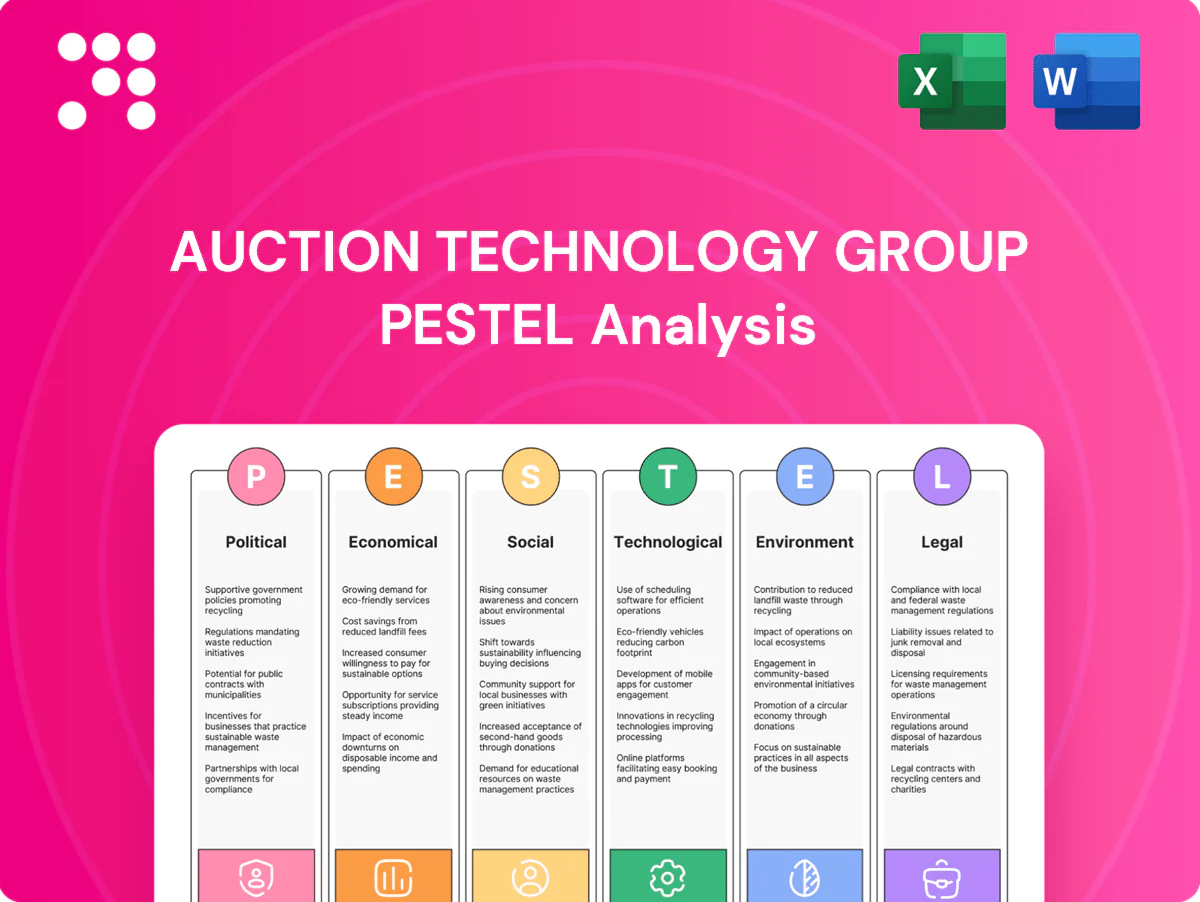
Auction Technology Group PESTLE Analysis

Make Smarter Strategic Decisions with a Complete PESTEL View
Discover how political, economic, social, technological, legal, and environmental forces are shaping Auction Technology Group's strategic path in our concise PESTLE overview. Perfect for investors and strategists seeking actionable context. Purchase the full PESTLE analysis to get the complete, ready-to-use intelligence instantly.
Political factors

Cross-border trade and tariffs
ATG’s marketplaces depend on international bidders and sellers, so tariff regimes and customs policies—including the UK standard VAT rate of 20% (2024)—are material to transaction flow. Shifts in trade relations can change buyer fees, extend shipping times and compress realized hammer prices. Monitoring tariff updates allows ATG to refine catalog targeting and logistics guidance for consignors. Proactive guidance helps preserve conversion rates during policy volatility.
Government digital agendas
National pushes like the EU Recovery and Resilience Facility (€723.8bn) and the fact that SMEs comprise 99% of EU businesses expand ATG’s addressable base of professional auctioneers. Public grants and digital vouchers reduce onboarding friction and raise e-commerce adoption. ATG can align training and integrations to grant-backed programs, accelerating platform penetration in priority verticals.

Sanctions and geopolitical risk
Sanctions lists such as OFAC s SDN (over 16,000 entries by 2024) directly constrain bidder eligibility and cross-border payment flows, forcing platform-level exclusions. Conflict-driven restrictions can depress demand for assets tied to sanctioned regions or sectors. Robust screening and geo-fencing preserve marketplace integrity, while rapid policy response safeguards licences and banking relationships.

Public procurement and surplus disposal
Government asset disposal policies materially affect volumes in industrial and consumer surplus; public procurement represents about 12% of global GDP (roughly 11 trillion USD in 2023), so policy shifts can swing lot supply materially. Transparent online auctions are preferred for auditability, and ATG can market compliance-ready tools to capture public-sector workflows, diversifying supply and stabilizing lot intake across cycles.
- Policy impact: large potential supply pool
- Auditability: online auctions preferred
- ATG edge: compliance-ready tooling
- Outcome: diversified, more stable lot intake
Tax policy on digital services
- Tax rates: UK 20%, AU 10%, EU 17–27%
- Requires precise cross-border remittance
- Automation reduces errors and disputes
- Tax-inclusive pricing supports bidder trust
Political risks: VAT 20%, SDN > 16,000
Political risks—tariffs/VAT (UK 20% 2024), sanctions (OFAC SDN >16,000 entries 2024) and trade shifts—alter bidder eligibility, fees and hammer prices. Public programmes (EU RRF €723.8bn) and government disposals (public procurement ~12% global GDP ≈ $11tn 2023) expand supply and SME onboarding. ATG mitigates via tax automation, sanctions screening and compliance tooling.
| Factor | Metric | Impact |
|---|---|---|
| Tax | UK VAT 20% | Pricing/fees |
| Sanctions | SDN>16,000 | Eligibility |
What is included in the product
 Detailed Word Document
Explores how macro-environmental factors uniquely affect Auction Technology Group across Political, Economic, Social, Technological, Environmental and Legal dimensions, with data-driven subpoints and region‑specific examples; designed to inform executives, investors and strategists with forward‑looking insights for risk mitigation and opportunity capture.

 Customizable Excel Spreadsheet
A concise PESTLE summary for Auction Technology Group, visually segmented by category and easily dropped into presentations to speed alignment on regulatory, economic and technological risks; editable notes let teams tailor insights by region or business line for faster decision-making.
Economic factors

Business cycle sensitivity
Capital equipment and collectibles demand tracks macro swings: the global art and collectibles market was about $50bn in 2023 (Art Basel/UBS), so downturns bring more forced sales and higher supply while buyer liquidity tightens. ATG-like platforms see fee mix drift toward distressed assets and lower take rates as buyers bargain. Diversification across verticals cushions revenue volatility by spreading exposure to countercyclical categories.
Interest rates and credit
Financing costs shape bidders' willingness to pay for high-ticket lots; UK Bank Rate hovered near 5.25% in 2024–25, raising borrowing costs for leverage-driven buyers. Higher rates dampen such purchases and elevate reserve miss risk for ATG’s premium auctions. Offering financing partners and pre-approval can sustain clearance, while transparent cost calculators and APR illustrations boost bidder confidence and reduce dropouts.

FX volatility
Global bidder pools create FX-driven price arbitrage and risk against a backdrop of $7.5 trillion average daily FX turnover (BIS, 2022), meaning currency swings can materially change effective hammer prices and shipping costs for Auction Technology Group transactions. Multi-currency pricing and active hedging reduce bid abandonment and margin erosion. Real-time FX display has been shown to increase cross-border conversion by improving price transparency.

SME digitization and consolidation
Independent auction houses are modernizing and consolidating, driven by SMEs that make up ~99% of UK businesses (UK Gov 2023); ATG can capture value via software subscriptions, payments and marketing services as houses outsource tech. Bundled solutions lift ARPU and retention while M&A cycles expand inventory and buyer reach, increasing marketplace liquidity.
- Subscriptions: recurring revenue
- Payments: higher take-rates
- Marketing: better buyer acquisition
- M&A: scale inventory & reach
Logistics and shipping costs
Logistics and shipping costs materially affect ATG buyers: last-mile can account for up to 53% of delivery cost (McKinsey), raising total cost of ownership and lowering willingness to bid. Transparent shipping estimates cut checkout abandonment (Baymard: extra costs cause ~49% of abandons). Carrier partnerships can secure 5-12% rate improvements and SLAs; embedded logistics reduce cart drop-off by up to 20%.
- Last-mile = up to 53% of delivery cost
- Extra/late shipping costs ≈ 49% of cart abandons
- Carrier deals can save 5-12% and improve SLAs
- Embedded logistics can cut cart drop-off ≈ 20%
Political risks: VAT 20%, SDN > 16,000
Macro cycles, rates and FX change buyer liquidity and take-rates: art market ≈$50bn (2023), UK Bank Rate ≈5.25% (2024–25), FX turnover $7.5trn (BIS 2022). Logistics and SME consolidation shift revenue to subscriptions, payments and logistics.
| Metric | Value |
|---|---|
| Art market (2023) | $50bn |
| UK Bank Rate (2024–25) | ≈5.25% |
| FX turnover (2022) | $7.5trn/day |
| UK SMEs (2023) | ~99% |
| Last-mile cost | up to 53% |
| Cart abandons | ~49% |
Preview the Actual Deliverable
Auction Technology Group PESTLE Analysis
This Auction Technology Group PESTLE Analysis preview is the exact, fully formatted document you’ll receive after purchase—no placeholders or edits. The content, layout, and structure shown here are final and ready to download immediately after checkout. Use it as-is for strategic planning, presentations, or investment review.

Original: $10.00
-65%$10.00
$3.50Product Information
Product Information
Shipping & Returns
Shipping & Returns
Description
Make Smarter Strategic Decisions with a Complete PESTEL View
Discover how political, economic, social, technological, legal, and environmental forces are shaping Auction Technology Group's strategic path in our concise PESTLE overview. Perfect for investors and strategists seeking actionable context. Purchase the full PESTLE analysis to get the complete, ready-to-use intelligence instantly.
Political factors
Cross-border trade and tariffs
ATG’s marketplaces depend on international bidders and sellers, so tariff regimes and customs policies—including the UK standard VAT rate of 20% (2024)—are material to transaction flow. Shifts in trade relations can change buyer fees, extend shipping times and compress realized hammer prices. Monitoring tariff updates allows ATG to refine catalog targeting and logistics guidance for consignors. Proactive guidance helps preserve conversion rates during policy volatility.
Government digital agendas
National pushes like the EU Recovery and Resilience Facility (€723.8bn) and the fact that SMEs comprise 99% of EU businesses expand ATG’s addressable base of professional auctioneers. Public grants and digital vouchers reduce onboarding friction and raise e-commerce adoption. ATG can align training and integrations to grant-backed programs, accelerating platform penetration in priority verticals.
Sanctions and geopolitical risk
Sanctions lists such as OFAC s SDN (over 16,000 entries by 2024) directly constrain bidder eligibility and cross-border payment flows, forcing platform-level exclusions. Conflict-driven restrictions can depress demand for assets tied to sanctioned regions or sectors. Robust screening and geo-fencing preserve marketplace integrity, while rapid policy response safeguards licences and banking relationships.
Public procurement and surplus disposal
Government asset disposal policies materially affect volumes in industrial and consumer surplus; public procurement represents about 12% of global GDP (roughly 11 trillion USD in 2023), so policy shifts can swing lot supply materially. Transparent online auctions are preferred for auditability, and ATG can market compliance-ready tools to capture public-sector workflows, diversifying supply and stabilizing lot intake across cycles.
- Policy impact: large potential supply pool
- Auditability: online auctions preferred
- ATG edge: compliance-ready tooling
- Outcome: diversified, more stable lot intake
Tax policy on digital services
- Tax rates: UK 20%, AU 10%, EU 17–27%
- Requires precise cross-border remittance
- Automation reduces errors and disputes
- Tax-inclusive pricing supports bidder trust
Political risks: VAT 20%, SDN > 16,000
Political risks—tariffs/VAT (UK 20% 2024), sanctions (OFAC SDN >16,000 entries 2024) and trade shifts—alter bidder eligibility, fees and hammer prices. Public programmes (EU RRF €723.8bn) and government disposals (public procurement ~12% global GDP ≈ $11tn 2023) expand supply and SME onboarding. ATG mitigates via tax automation, sanctions screening and compliance tooling.
| Factor | Metric | Impact |
|---|---|---|
| Tax | UK VAT 20% | Pricing/fees |
| Sanctions | SDN>16,000 | Eligibility |
What is included in the product
Detailed Word Document
Explores how macro-environmental factors uniquely affect Auction Technology Group across Political, Economic, Social, Technological, Environmental and Legal dimensions, with data-driven subpoints and region‑specific examples; designed to inform executives, investors and strategists with forward‑looking insights for risk mitigation and opportunity capture.
Customizable Excel Spreadsheet
A concise PESTLE summary for Auction Technology Group, visually segmented by category and easily dropped into presentations to speed alignment on regulatory, economic and technological risks; editable notes let teams tailor insights by region or business line for faster decision-making.
Economic factors
Business cycle sensitivity
Capital equipment and collectibles demand tracks macro swings: the global art and collectibles market was about $50bn in 2023 (Art Basel/UBS), so downturns bring more forced sales and higher supply while buyer liquidity tightens. ATG-like platforms see fee mix drift toward distressed assets and lower take rates as buyers bargain. Diversification across verticals cushions revenue volatility by spreading exposure to countercyclical categories.
Interest rates and credit
Financing costs shape bidders' willingness to pay for high-ticket lots; UK Bank Rate hovered near 5.25% in 2024–25, raising borrowing costs for leverage-driven buyers. Higher rates dampen such purchases and elevate reserve miss risk for ATG’s premium auctions. Offering financing partners and pre-approval can sustain clearance, while transparent cost calculators and APR illustrations boost bidder confidence and reduce dropouts.
FX volatility
Global bidder pools create FX-driven price arbitrage and risk against a backdrop of $7.5 trillion average daily FX turnover (BIS, 2022), meaning currency swings can materially change effective hammer prices and shipping costs for Auction Technology Group transactions. Multi-currency pricing and active hedging reduce bid abandonment and margin erosion. Real-time FX display has been shown to increase cross-border conversion by improving price transparency.
SME digitization and consolidation
Independent auction houses are modernizing and consolidating, driven by SMEs that make up ~99% of UK businesses (UK Gov 2023); ATG can capture value via software subscriptions, payments and marketing services as houses outsource tech. Bundled solutions lift ARPU and retention while M&A cycles expand inventory and buyer reach, increasing marketplace liquidity.
- Subscriptions: recurring revenue
- Payments: higher take-rates
- Marketing: better buyer acquisition
- M&A: scale inventory & reach
Logistics and shipping costs
Logistics and shipping costs materially affect ATG buyers: last-mile can account for up to 53% of delivery cost (McKinsey), raising total cost of ownership and lowering willingness to bid. Transparent shipping estimates cut checkout abandonment (Baymard: extra costs cause ~49% of abandons). Carrier partnerships can secure 5-12% rate improvements and SLAs; embedded logistics reduce cart drop-off by up to 20%.
- Last-mile = up to 53% of delivery cost
- Extra/late shipping costs ≈ 49% of cart abandons
- Carrier deals can save 5-12% and improve SLAs
- Embedded logistics can cut cart drop-off ≈ 20%
Political risks: VAT 20%, SDN > 16,000
Macro cycles, rates and FX change buyer liquidity and take-rates: art market ≈$50bn (2023), UK Bank Rate ≈5.25% (2024–25), FX turnover $7.5trn (BIS 2022). Logistics and SME consolidation shift revenue to subscriptions, payments and logistics.
| Metric | Value |
|---|---|
| Art market (2023) | $50bn |
| UK Bank Rate (2024–25) | ≈5.25% |
| FX turnover (2022) | $7.5trn/day |
| UK SMEs (2023) | ~99% |
| Last-mile cost | up to 53% |
| Cart abandons | ~49% |
Preview the Actual Deliverable
Auction Technology Group PESTLE Analysis
This Auction Technology Group PESTLE Analysis preview is the exact, fully formatted document you’ll receive after purchase—no placeholders or edits. The content, layout, and structure shown here are final and ready to download immediately after checkout. Use it as-is for strategic planning, presentations, or investment review.











