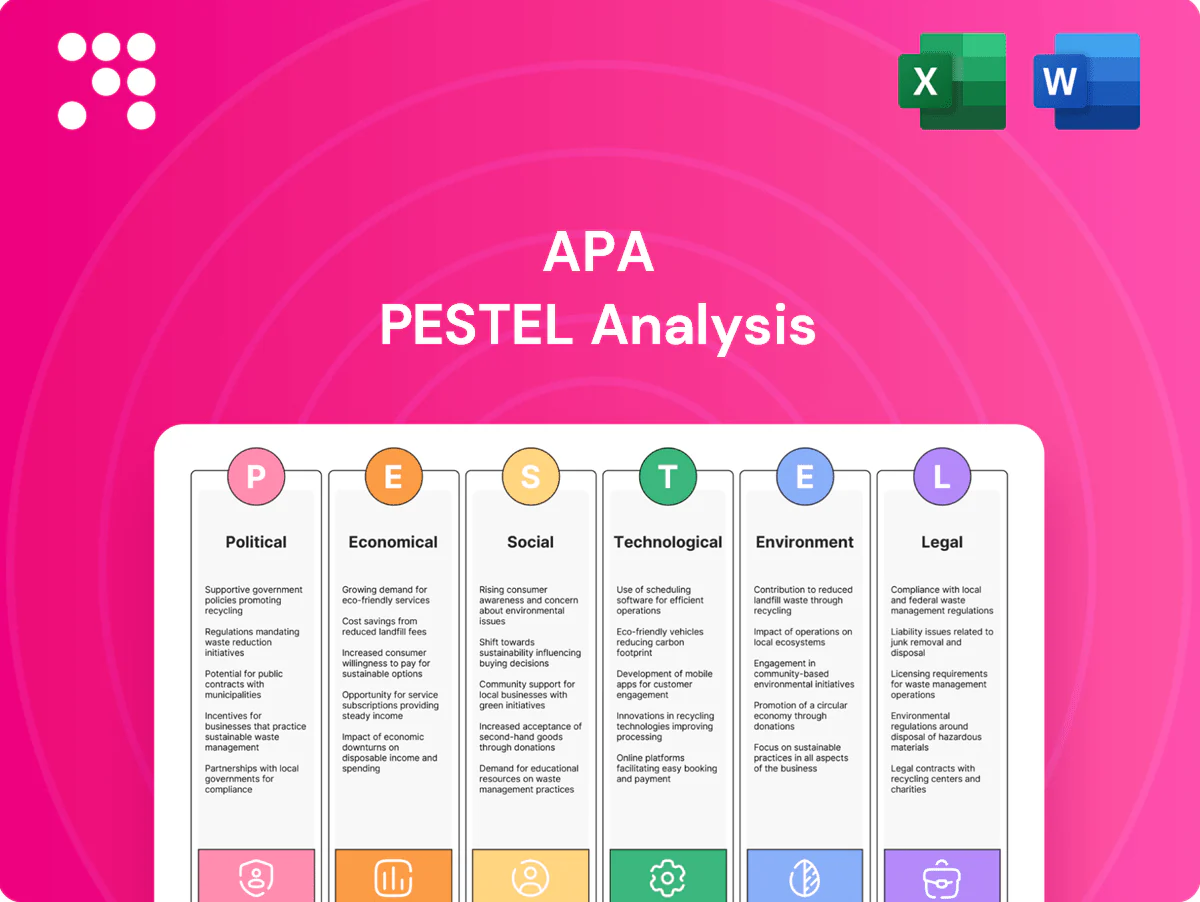
APA PESTLE Analysis

Skip the Research. Get the Strategy.
Discover how political shifts, economic trends, and technological advances shape APA's strategic outlook in our concise PESTLE snapshot. This expert analysis highlights risks and growth levers investors and strategists need to know. Purchase the full PESTLE for detailed, actionable insights and ready-to-use charts.
Political factors

Regime stability in Egypt
Operations in Egypt depend on government stability and security dynamics; with a population of about 104 million and 2024 real GDP growth near 3.6%, policy shifts matter for market demand. Changes in cabinet priorities or subsidy reforms following the 2022 IMF $3 billion arrangement can alter licensing timelines and payment cycles. Heightened regional tensions risk disrupting field logistics and personnel safety. APA must keep strong in-country relationships and contingency plans.
US federal and state energy policy
Permitting timelines, leasing policy and infrastructure approvals—especially in the Permian, which supplies roughly 40% of US crude—directly drive basin development pace and can add months to project startups. Political shifts at the federal level have recently prompted revisions to methane and flaring rules and could change royalty frameworks, affecting operating costs and cash flow. State regimes such as Texas and New Mexico produce regulatory variability in compliance and enforcement. Policy certainty improves capital planning and cost management for upstream investors.

UK North Sea fiscal regime
The UK has repeatedly adjusted windfall taxes and investment allowances since 2022, materially shifting project IRRs; recent policy moves have increased headline fiscal take and reduced investor returns. Changes directly affect project economics and decommissioning timing given UK decommissioning liabilities of roughly £60bn. Political debates between energy security and climate targets create policy volatility. APA must model fiscal sensitivities across scenarios for its UK portfolio.

International sanctions and trade
Sanctions and export controls (OFAC lists ~12,000 SDNs as of 2025) can block equipment procurement and service contracts, delaying projects and raising replacement costs. Currency repatriation rules and capital controls reduce free cash flow from foreign operations and can inflate financing costs. Diplomatic ties shape PSC renewals and bid access, while robust compliance programs are essential to prevent disruptions and heavy penalties.
- Procurement risk: blocked exports
- Cashflow: repatriation limits, capital controls
- Market access: diplomacy-driven PSC renewals
- Controls: compliance programs to avoid fines
Resource nationalism and licensing
Resource nationalism drives governments to renegotiate terms, tighten local‑content requirements (commonly 30–50% in hydrocarbons and minerals) or delay approvals, while competitive bid rounds increasingly favor state firms or consortiums aligned with national priorities. Stability clauses and arbitration — ICSID has registered over 1,800 cases as of 2024 — help mitigate investor risk, and long‑term alignment with host‑country goals improves contract durability.
- Renegotiation risk: higher local content/approval delays
- Bid preference: state firms or national consortiums
- Mitigation: stability clauses + ICSID/arbitration
- Durability: alignment with host‑country objectives
Energy risks: Egypt stability, Permian regulation, UK fiscal drain and 12,000 OFAC SDNs
Operations hinge on host‑state stability, subsidy reform (IMF $3bn 2022) and Egypt demand (pop ~104M; 2024 real GDP ~3.6%).
US policy/regulation alters Permian timing (Permian ~40% US crude) and methane/flaring costs; state variance (TX/NM) affects compliance.
UK windfall taxes and ~£60bn decommissioning liabilities raise fiscal risk; OFAC ~12,000 SDNs (2025) constrain procurement.
| Region | Risk | Metric |
|---|---|---|
| Egypt | Stability/subsidies | Pop 104M; GDP 3.6% (2024) |
| Permian | Regulatory delays | ~40% US crude |
| UK | Fiscal take | £60bn decommissioning |
| Sanctions | Procurement | OFAC ~12,000 SDNs (2025) |
What is included in the product
 Detailed Word Document
Explores how external macro-environmental factors uniquely affect the APA across six dimensions—Political, Economic, Social, Technological, Environmental, and Legal—backed by data and trends to identify threats and opportunities for executives, investors, and strategists; formatted for direct use in plans, decks, and scenario planning.

 Customizable Excel Spreadsheet
Concise, visually segmented APA PESTLE summaries streamline strategic meetings by highlighting external risks and opportunities at a glance, while editable notes and shareable formats make it easy to tailor insights to specific regions, business lines, or client reports.
Economic factors

Oil and gas price volatility
Realized oil and gas prices directly drive cash flow, investment cadence and shareholder returns—Brent averaged about 87 USD/bbl and Henry Hub roughly 3.2 USD/MMBtu in 2024, shaping 2024 capex plans. Macro shocks and OPEC+ supply moves (multi-hundred kb/d cuts in 2024) can swing benchmarks rapidly. Hedging smooths earnings but caps upside, and flexible capital allocation proved essential in downcycles.
Service cost inflation
Rigs, frac crews and tubulars exhibit cyclical cost inflation tied to activity; Baker Hughes reported a US rig count near 700 in 2024, correlating with rising dayrates and crew premiums. Supply-chain bottlenecks have lengthened lead times and pushed AFE budgets materially higher for 2023–24 projects. Vendor consolidation—Schlumberger, Halliburton, Baker Hughes dominating—raises pricing power. Multi-year contracts and equipment standardization have been used to mitigate cost volatility.

Exchange rates and repatriation
FX movements (GBP/USD ~1.28 and USD/EGP ~45 as of July 2025) shift Egyptian and UK costs when reporting in USD, directly affecting margins. Timing of cash repatriation constrains liquidity and debt service, especially with EGP volatility after 2022 liberalizations. Higher Egyptian inflation (~30–35% in 2024) reduces real project returns versus UK inflation ~3–4%. Natural hedges and disciplined treasury policies (forward covers, netting) lower earnings volatility.

Capital market conditions
Capital market conditions—with the federal funds rate at 5.25–5.50% (July 2025)—drive credit spreads and equity risk premiums that set hurdle rates and limit buyback capacity; investor preference for free cash flow over growth shifts strategy toward cash-generative projects; access to low-cost capital enables countercyclical investment when available; covenant headroom cushions downside risk.
- Credit spreads/ERP set hurdle rates
- FCF preference favors returns over growth
- Low-cost capital enables countercyclical moves
- Covenant headroom = downturn resilience
Global demand and energy mix
- Oil demand ~100 mb/d (2024)
- Renewables ≈30% electricity (2023)
- Gas transition role; ~1%/yr demand growth to 2030
Energy risks: Egypt stability, Permian regulation, UK fiscal drain and 12,000 OFAC SDNs
Realized oil/gas prices (Brent ~$87/bbl, HH ~$3.2/MMBtu in 2024) dictate cash flow, capex and hedging; OPEC+ cuts move benchmarks. Cost inflation from activity (US rigs ~700 in 2024) and vendor consolidation raises AFE. FX (GBP/USD 1.28; USD/EGP 45 Jul 2025) and Fed funds 5.25–5.50% set margins and hurdle rates.
| Metric | Value |
|---|---|
| Brent (2024) | $87/bbl |
| HH (2024) | $3.2/MMBtu |
| US rigs (2024) | ~700 |
| Fed funds (Jul 2025) | 5.25–5.50% |
Full Version Awaits
APA PESTLE Analysis
The preview shown here is the exact APA-formatted PESTLE Analysis you’ll receive after purchase—fully formatted and ready to use. The layout, content, and citations visible are included in the final file with no placeholders or teasers. After payment you’ll download this same, professionally structured document.

Product Information
Product Information
Shipping & Returns
Shipping & Returns
Description
Skip the Research. Get the Strategy.
Discover how political shifts, economic trends, and technological advances shape APA's strategic outlook in our concise PESTLE snapshot. This expert analysis highlights risks and growth levers investors and strategists need to know. Purchase the full PESTLE for detailed, actionable insights and ready-to-use charts.
Political factors
Regime stability in Egypt
Operations in Egypt depend on government stability and security dynamics; with a population of about 104 million and 2024 real GDP growth near 3.6%, policy shifts matter for market demand. Changes in cabinet priorities or subsidy reforms following the 2022 IMF $3 billion arrangement can alter licensing timelines and payment cycles. Heightened regional tensions risk disrupting field logistics and personnel safety. APA must keep strong in-country relationships and contingency plans.
US federal and state energy policy
Permitting timelines, leasing policy and infrastructure approvals—especially in the Permian, which supplies roughly 40% of US crude—directly drive basin development pace and can add months to project startups. Political shifts at the federal level have recently prompted revisions to methane and flaring rules and could change royalty frameworks, affecting operating costs and cash flow. State regimes such as Texas and New Mexico produce regulatory variability in compliance and enforcement. Policy certainty improves capital planning and cost management for upstream investors.
UK North Sea fiscal regime
The UK has repeatedly adjusted windfall taxes and investment allowances since 2022, materially shifting project IRRs; recent policy moves have increased headline fiscal take and reduced investor returns. Changes directly affect project economics and decommissioning timing given UK decommissioning liabilities of roughly £60bn. Political debates between energy security and climate targets create policy volatility. APA must model fiscal sensitivities across scenarios for its UK portfolio.
International sanctions and trade
Sanctions and export controls (OFAC lists ~12,000 SDNs as of 2025) can block equipment procurement and service contracts, delaying projects and raising replacement costs. Currency repatriation rules and capital controls reduce free cash flow from foreign operations and can inflate financing costs. Diplomatic ties shape PSC renewals and bid access, while robust compliance programs are essential to prevent disruptions and heavy penalties.
- Procurement risk: blocked exports
- Cashflow: repatriation limits, capital controls
- Market access: diplomacy-driven PSC renewals
- Controls: compliance programs to avoid fines
Resource nationalism and licensing
Resource nationalism drives governments to renegotiate terms, tighten local‑content requirements (commonly 30–50% in hydrocarbons and minerals) or delay approvals, while competitive bid rounds increasingly favor state firms or consortiums aligned with national priorities. Stability clauses and arbitration — ICSID has registered over 1,800 cases as of 2024 — help mitigate investor risk, and long‑term alignment with host‑country goals improves contract durability.
- Renegotiation risk: higher local content/approval delays
- Bid preference: state firms or national consortiums
- Mitigation: stability clauses + ICSID/arbitration
- Durability: alignment with host‑country objectives
Energy risks: Egypt stability, Permian regulation, UK fiscal drain and 12,000 OFAC SDNs
Operations hinge on host‑state stability, subsidy reform (IMF $3bn 2022) and Egypt demand (pop ~104M; 2024 real GDP ~3.6%).
US policy/regulation alters Permian timing (Permian ~40% US crude) and methane/flaring costs; state variance (TX/NM) affects compliance.
UK windfall taxes and ~£60bn decommissioning liabilities raise fiscal risk; OFAC ~12,000 SDNs (2025) constrain procurement.
| Region | Risk | Metric |
|---|---|---|
| Egypt | Stability/subsidies | Pop 104M; GDP 3.6% (2024) |
| Permian | Regulatory delays | ~40% US crude |
| UK | Fiscal take | £60bn decommissioning |
| Sanctions | Procurement | OFAC ~12,000 SDNs (2025) |
What is included in the product
Detailed Word Document
Explores how external macro-environmental factors uniquely affect the APA across six dimensions—Political, Economic, Social, Technological, Environmental, and Legal—backed by data and trends to identify threats and opportunities for executives, investors, and strategists; formatted for direct use in plans, decks, and scenario planning.
Customizable Excel Spreadsheet
Concise, visually segmented APA PESTLE summaries streamline strategic meetings by highlighting external risks and opportunities at a glance, while editable notes and shareable formats make it easy to tailor insights to specific regions, business lines, or client reports.
Economic factors
Oil and gas price volatility
Realized oil and gas prices directly drive cash flow, investment cadence and shareholder returns—Brent averaged about 87 USD/bbl and Henry Hub roughly 3.2 USD/MMBtu in 2024, shaping 2024 capex plans. Macro shocks and OPEC+ supply moves (multi-hundred kb/d cuts in 2024) can swing benchmarks rapidly. Hedging smooths earnings but caps upside, and flexible capital allocation proved essential in downcycles.
Service cost inflation
Rigs, frac crews and tubulars exhibit cyclical cost inflation tied to activity; Baker Hughes reported a US rig count near 700 in 2024, correlating with rising dayrates and crew premiums. Supply-chain bottlenecks have lengthened lead times and pushed AFE budgets materially higher for 2023–24 projects. Vendor consolidation—Schlumberger, Halliburton, Baker Hughes dominating—raises pricing power. Multi-year contracts and equipment standardization have been used to mitigate cost volatility.
Exchange rates and repatriation
FX movements (GBP/USD ~1.28 and USD/EGP ~45 as of July 2025) shift Egyptian and UK costs when reporting in USD, directly affecting margins. Timing of cash repatriation constrains liquidity and debt service, especially with EGP volatility after 2022 liberalizations. Higher Egyptian inflation (~30–35% in 2024) reduces real project returns versus UK inflation ~3–4%. Natural hedges and disciplined treasury policies (forward covers, netting) lower earnings volatility.
Capital market conditions
Capital market conditions—with the federal funds rate at 5.25–5.50% (July 2025)—drive credit spreads and equity risk premiums that set hurdle rates and limit buyback capacity; investor preference for free cash flow over growth shifts strategy toward cash-generative projects; access to low-cost capital enables countercyclical investment when available; covenant headroom cushions downside risk.
- Credit spreads/ERP set hurdle rates
- FCF preference favors returns over growth
- Low-cost capital enables countercyclical moves
- Covenant headroom = downturn resilience
Global demand and energy mix
- Oil demand ~100 mb/d (2024)
- Renewables ≈30% electricity (2023)
- Gas transition role; ~1%/yr demand growth to 2030
Energy risks: Egypt stability, Permian regulation, UK fiscal drain and 12,000 OFAC SDNs
Realized oil/gas prices (Brent ~$87/bbl, HH ~$3.2/MMBtu in 2024) dictate cash flow, capex and hedging; OPEC+ cuts move benchmarks. Cost inflation from activity (US rigs ~700 in 2024) and vendor consolidation raises AFE. FX (GBP/USD 1.28; USD/EGP 45 Jul 2025) and Fed funds 5.25–5.50% set margins and hurdle rates.
| Metric | Value |
|---|---|
| Brent (2024) | $87/bbl |
| HH (2024) | $3.2/MMBtu |
| US rigs (2024) | ~700 |
| Fed funds (Jul 2025) | 5.25–5.50% |
Full Version Awaits
APA PESTLE Analysis
The preview shown here is the exact APA-formatted PESTLE Analysis you’ll receive after purchase—fully formatted and ready to use. The layout, content, and citations visible are included in the final file with no placeholders or teasers. After payment you’ll download this same, professionally structured document.