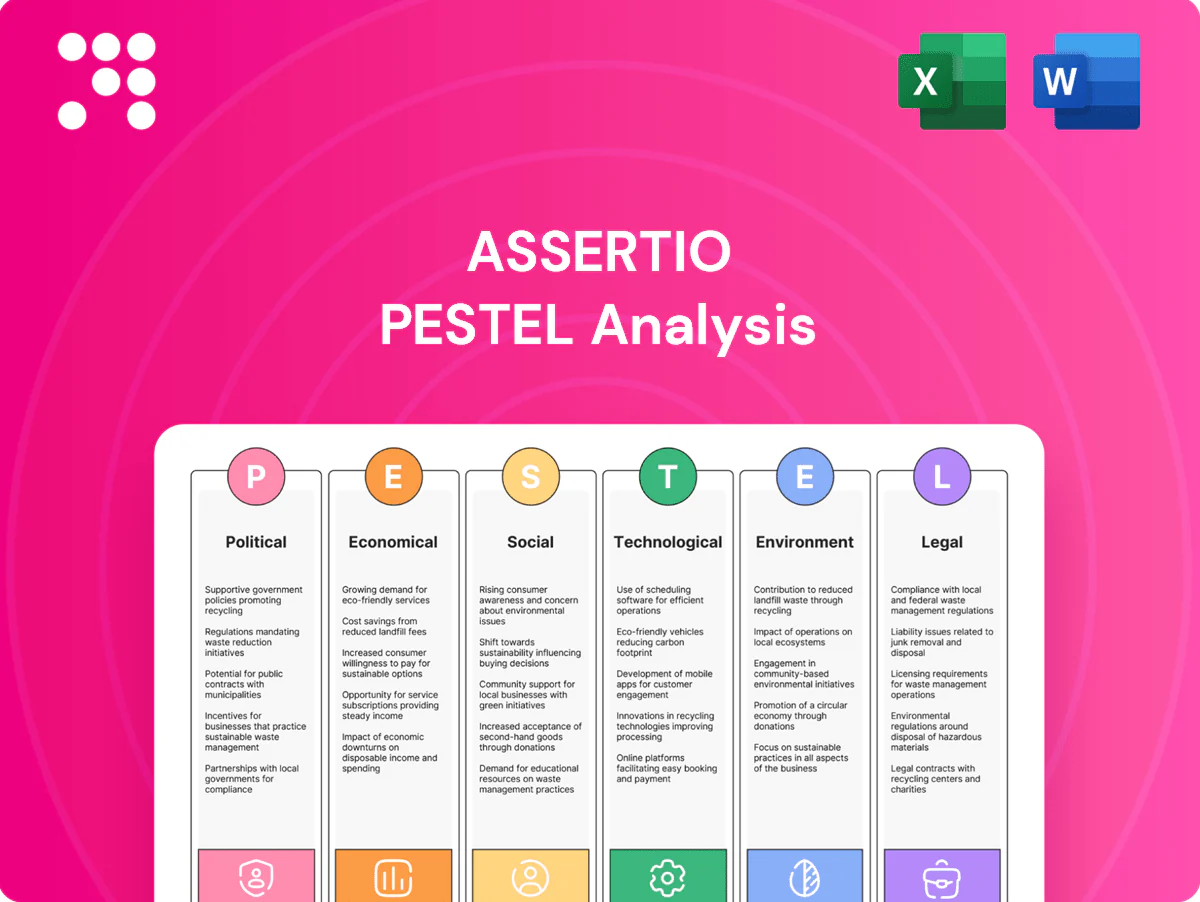
Assertio PESTLE Analysis

Your Shortcut to Market Insight Starts Here
Unlock strategic clarity with our Assertio PESTLE Analysis — three concise sections reveal how political, economic, social, technological, legal, and environmental trends shape the company. Use these insights to refine forecasts and de-risk decisions. Purchase the full report for a complete, ready-to-use breakdown and immediate download.
Political factors

Drug pricing reforms
Government actions on price negotiation and inflation penalties can compress margins on specialty drugs: the Inflation Reduction Act begins Medicare price negotiations with an initial list of 10 drugs in 2026 and requires manufacturers to repay increases above CPI as rebates. State-level caps and affordability laws further pressure list and net prices. Assertio must sharpen contracting strategies and value narratives to offset policy-driven price cuts, while shifting political timelines heighten forecasting risk for acquisitions and launches.
PBM and rebate scrutiny
Heightened oversight of PBMs—with the three largest (CVS Caremark, OptumRx, Cigna/Express Scripts) covering roughly 80–90% of US lives—increases risk that changes to spread pricing or rebate transparency (federal proposals in 2023–24 and over 30 state PBM laws to date) will shift negotiating power and net pricing. Assertio’s specialty-focused contracting with neurology and pain prescribers may need realignment as formulary tiering and prior authorization burdens change.

Healthcare reform and coverage
Medicaid expansion and ACA adjustments reshape payer mix—Medicaid/CHIP enrollment totaled about 92 million in 2024, shifting volumes from commercial plans and compressing ASP reimbursements for neurology/pain products. Coverage stability for chronic neurologic and pain conditions remains politically sensitive, with prior authorization and formulary changes common. Assertio’s unit volumes and gross-to-net allowances can swing materially with eligibility and benefit design. Election cycles (notably 2024) amplify funding and coverage-rule volatility.

Trade and supply chain policy
Tariffs, export controls and geopolitical tensions disrupt API and component sourcing; over 60% of global APIs are sourced from China and India, increasing Assertio’s supply risk and freight costs. Emerging US onshoring incentives and tax credits can shift CAPEX and unit economics. Resilience depends on diversified suppliers, higher safety stock, and Buy American compliance affecting hospital-channel competitiveness.
- Tariff/export risk: raises input costs
- Onshoring incentives: alter CAPEX
- Diversified suppliers + inventory: key resilience
- Buy American: affects hospital sales
Grants and innovation incentives
Grants, R&D tax credits and the US orphan drug program (25% clinical cost credit plus 7-year US market exclusivity) materially de-risk Assertio’s pipeline additions and lower effective development cost. Political emphasis on neuroscience and non-opioid pain research (targeted NIH and foundation grants) favors specialty portfolios, but accessing incentives requires tailored R&D and regulatory strategies. Policy reversals or funding cuts can sharply reduce program attractiveness mid-cycle.
- ORTC: 25% clinical credit
- US orphan exclusivity: 7 years
- Requires targeted R&D/regulatory plans
- Risk: policy or budget reversals
IRA drug negotiation, PBM leverage, Medicaid growth and API supply risks reshape pharma margins
Medicare negotiation (IRA) starts with 10 drugs in 2026 and CPI rebates threaten specialty margins; PBMs cover ~80–90% of US lives changing negotiating leverage. Medicaid enrollment ~92M (2024) shifts payer mix and compresses ASPs. >60% of APIs sourced from China/India raises supply risk; orphan credit 25% and 7-year US exclusivity de-risk R&D.
| Metric | Value |
|---|---|
| Medicare negotiation start | 2026 (10 drugs) |
| PBM coverage | 80–90% lives |
| Medicaid enrollment | ~92M (2024) |
| API sourcing | >60% China/India |
| Orphan incentives | 25% credit; 7y exclusivity |
What is included in the product
 Detailed Word Document
Explores how macro-environmental forces — Political, Economic, Social, Technological, Environmental, and Legal — uniquely impact Assertio, with data-driven insights, scenario-ready recommendations, and industry-specific examples to guide executives, investors, and strategists in identifying risks and opportunities.

 Customizable Excel Spreadsheet
A concise, visually segmented Assertio PESTLE summary that can be dropped into presentations, shared across teams, and annotated for local context—helping quickly align stakeholders on external risks and market positioning during planning sessions.
Economic factors

Interest rates and financing
Higher policy rates (Fed funds ~5.25–5.50% in 2024, 10‑yr Treasury ~4.5%) raise Assertio’s WACC, reducing affordability of M&A central to its growth strategy. Rising yields and BBB corporate spreads (roughly 150–250bps in 2024) increase debt service, tightening cash for licensing and co‑promotion. Wider valuation spreads can both block deals and create buy opportunities; timing with rate cycles is therefore critical.
Reimbursement pressure
Net price erosion from payer pressure—now often double-digit—directly compresses Assertio’s specialty margins and profitability. Hospital purchasing committees increasingly demand cost-effectiveness and outcomes data, raising formulary hurdles. Assertio must bolster HEOR and contracting to sustain access and mitigate rebate-driven losses. A shift toward public payers typically widens gross-to-net discounts, further pressuring net revenues.

Inflation and COGS
Input cost inflation across APIs, packaging and logistics has materially eroded Assertio’s gross margins, with long lead times in tendered channels preventing rapid price pass-through and amplifying margin squeeze.
To mitigate, Assertio requires hedging, dual sourcing and productivity programs to stabilize COGS and supply; normalization of inflation would relieve working capital stress and reduce procurement volatility.

Generic and biosimilar competition
Patent expiries and step edits drive rapid switches to lower-cost alternatives, with generic entrants typically capturing ~80–90% of prescriptions within 6–12 months; FDA had approved about 40 biosimilars by 2024, increasing downward pressure. Assertio’s differentiated positioning must prove measurable clinical or operational value to sustain premium uptake; lifecycle management and line extensions can slow share loss, while pricing corridors tighten during economic slowdowns.
- Generics capture ~80–90% of volume in 6–12 months
- ~40 FDA biosimilars approved by 2024
- Lifecycle/line extensions can preserve premium share
- Pricing corridors narrow in downturns
Demand elasticity in pain care
Demand elasticity in pain care is low for chronic patients but co-pay sensitivity remains high, with about 25% of US adults reporting cost-related nonadherence in 2023–24 (KFF). Economic downturns raise pharmacy abandonment and deferments; Assertio can mitigate via patient support and affordability programs to protect adherence and revenues. Cash-pay segments historically contract in recessions, reducing premium-priced demand.
- Cost-driven nonadherence ~25% (KFF 2023–24)
- Patient support programs offset abandonment risk
- Cash-pay demand shrinks in recessions
IRA drug negotiation, PBM leverage, Medicaid growth and API supply risks reshape pharma margins
Higher rates (Fed 5.25–5.50% 2024; 10y ~4.5%) raise WACC and debt costs; BBB spreads ~150–250bps tighten M&A and licensing. Payer pressure/price erosion and ~25% cost-related nonadherence (KFF 2023–24) compress specialty margins. Generics capture ~80–90% in 6–12 months; ~40 biosimilars approved by 2024 accelerate price declines.
| Metric | Value |
|---|---|
| Fed funds (2024) | 5.25–5.50% |
| 10y Treasury | ~4.5% |
| BBB spread | 150–250bps |
| Nonadherence | ~25% |
| Generics uptake | 80–90% (6–12m) |
| Biosimilars | ~40 by 2024 |
Preview the Actual Deliverable
Assertio PESTLE Analysis
The preview shown here is the exact Assertio PESTLE Analysis document you’ll receive after purchase—fully formatted and ready to use. The layout, content, and structure visible are identical to the downloadable file with no placeholders or surprises. After payment you’ll instantly get this final, professionally structured file.

Product Information
Product Information
Shipping & Returns
Shipping & Returns
Description
Your Shortcut to Market Insight Starts Here
Unlock strategic clarity with our Assertio PESTLE Analysis — three concise sections reveal how political, economic, social, technological, legal, and environmental trends shape the company. Use these insights to refine forecasts and de-risk decisions. Purchase the full report for a complete, ready-to-use breakdown and immediate download.
Political factors
Drug pricing reforms
Government actions on price negotiation and inflation penalties can compress margins on specialty drugs: the Inflation Reduction Act begins Medicare price negotiations with an initial list of 10 drugs in 2026 and requires manufacturers to repay increases above CPI as rebates. State-level caps and affordability laws further pressure list and net prices. Assertio must sharpen contracting strategies and value narratives to offset policy-driven price cuts, while shifting political timelines heighten forecasting risk for acquisitions and launches.
PBM and rebate scrutiny
Heightened oversight of PBMs—with the three largest (CVS Caremark, OptumRx, Cigna/Express Scripts) covering roughly 80–90% of US lives—increases risk that changes to spread pricing or rebate transparency (federal proposals in 2023–24 and over 30 state PBM laws to date) will shift negotiating power and net pricing. Assertio’s specialty-focused contracting with neurology and pain prescribers may need realignment as formulary tiering and prior authorization burdens change.
Healthcare reform and coverage
Medicaid expansion and ACA adjustments reshape payer mix—Medicaid/CHIP enrollment totaled about 92 million in 2024, shifting volumes from commercial plans and compressing ASP reimbursements for neurology/pain products. Coverage stability for chronic neurologic and pain conditions remains politically sensitive, with prior authorization and formulary changes common. Assertio’s unit volumes and gross-to-net allowances can swing materially with eligibility and benefit design. Election cycles (notably 2024) amplify funding and coverage-rule volatility.
Trade and supply chain policy
Tariffs, export controls and geopolitical tensions disrupt API and component sourcing; over 60% of global APIs are sourced from China and India, increasing Assertio’s supply risk and freight costs. Emerging US onshoring incentives and tax credits can shift CAPEX and unit economics. Resilience depends on diversified suppliers, higher safety stock, and Buy American compliance affecting hospital-channel competitiveness.
- Tariff/export risk: raises input costs
- Onshoring incentives: alter CAPEX
- Diversified suppliers + inventory: key resilience
- Buy American: affects hospital sales
Grants and innovation incentives
Grants, R&D tax credits and the US orphan drug program (25% clinical cost credit plus 7-year US market exclusivity) materially de-risk Assertio’s pipeline additions and lower effective development cost. Political emphasis on neuroscience and non-opioid pain research (targeted NIH and foundation grants) favors specialty portfolios, but accessing incentives requires tailored R&D and regulatory strategies. Policy reversals or funding cuts can sharply reduce program attractiveness mid-cycle.
- ORTC: 25% clinical credit
- US orphan exclusivity: 7 years
- Requires targeted R&D/regulatory plans
- Risk: policy or budget reversals
IRA drug negotiation, PBM leverage, Medicaid growth and API supply risks reshape pharma margins
Medicare negotiation (IRA) starts with 10 drugs in 2026 and CPI rebates threaten specialty margins; PBMs cover ~80–90% of US lives changing negotiating leverage. Medicaid enrollment ~92M (2024) shifts payer mix and compresses ASPs. >60% of APIs sourced from China/India raises supply risk; orphan credit 25% and 7-year US exclusivity de-risk R&D.
| Metric | Value |
|---|---|
| Medicare negotiation start | 2026 (10 drugs) |
| PBM coverage | 80–90% lives |
| Medicaid enrollment | ~92M (2024) |
| API sourcing | >60% China/India |
| Orphan incentives | 25% credit; 7y exclusivity |
What is included in the product
Detailed Word Document
Explores how macro-environmental forces — Political, Economic, Social, Technological, Environmental, and Legal — uniquely impact Assertio, with data-driven insights, scenario-ready recommendations, and industry-specific examples to guide executives, investors, and strategists in identifying risks and opportunities.
Customizable Excel Spreadsheet
A concise, visually segmented Assertio PESTLE summary that can be dropped into presentations, shared across teams, and annotated for local context—helping quickly align stakeholders on external risks and market positioning during planning sessions.
Economic factors
Interest rates and financing
Higher policy rates (Fed funds ~5.25–5.50% in 2024, 10‑yr Treasury ~4.5%) raise Assertio’s WACC, reducing affordability of M&A central to its growth strategy. Rising yields and BBB corporate spreads (roughly 150–250bps in 2024) increase debt service, tightening cash for licensing and co‑promotion. Wider valuation spreads can both block deals and create buy opportunities; timing with rate cycles is therefore critical.
Reimbursement pressure
Net price erosion from payer pressure—now often double-digit—directly compresses Assertio’s specialty margins and profitability. Hospital purchasing committees increasingly demand cost-effectiveness and outcomes data, raising formulary hurdles. Assertio must bolster HEOR and contracting to sustain access and mitigate rebate-driven losses. A shift toward public payers typically widens gross-to-net discounts, further pressuring net revenues.
Inflation and COGS
Input cost inflation across APIs, packaging and logistics has materially eroded Assertio’s gross margins, with long lead times in tendered channels preventing rapid price pass-through and amplifying margin squeeze.
To mitigate, Assertio requires hedging, dual sourcing and productivity programs to stabilize COGS and supply; normalization of inflation would relieve working capital stress and reduce procurement volatility.
Generic and biosimilar competition
Patent expiries and step edits drive rapid switches to lower-cost alternatives, with generic entrants typically capturing ~80–90% of prescriptions within 6–12 months; FDA had approved about 40 biosimilars by 2024, increasing downward pressure. Assertio’s differentiated positioning must prove measurable clinical or operational value to sustain premium uptake; lifecycle management and line extensions can slow share loss, while pricing corridors tighten during economic slowdowns.
- Generics capture ~80–90% of volume in 6–12 months
- ~40 FDA biosimilars approved by 2024
- Lifecycle/line extensions can preserve premium share
- Pricing corridors narrow in downturns
Demand elasticity in pain care
Demand elasticity in pain care is low for chronic patients but co-pay sensitivity remains high, with about 25% of US adults reporting cost-related nonadherence in 2023–24 (KFF). Economic downturns raise pharmacy abandonment and deferments; Assertio can mitigate via patient support and affordability programs to protect adherence and revenues. Cash-pay segments historically contract in recessions, reducing premium-priced demand.
- Cost-driven nonadherence ~25% (KFF 2023–24)
- Patient support programs offset abandonment risk
- Cash-pay demand shrinks in recessions
IRA drug negotiation, PBM leverage, Medicaid growth and API supply risks reshape pharma margins
Higher rates (Fed 5.25–5.50% 2024; 10y ~4.5%) raise WACC and debt costs; BBB spreads ~150–250bps tighten M&A and licensing. Payer pressure/price erosion and ~25% cost-related nonadherence (KFF 2023–24) compress specialty margins. Generics capture ~80–90% in 6–12 months; ~40 biosimilars approved by 2024 accelerate price declines.
| Metric | Value |
|---|---|
| Fed funds (2024) | 5.25–5.50% |
| 10y Treasury | ~4.5% |
| BBB spread | 150–250bps |
| Nonadherence | ~25% |
| Generics uptake | 80–90% (6–12m) |
| Biosimilars | ~40 by 2024 |
Preview the Actual Deliverable
Assertio PESTLE Analysis
The preview shown here is the exact Assertio PESTLE Analysis document you’ll receive after purchase—fully formatted and ready to use. The layout, content, and structure visible are identical to the downloadable file with no placeholders or surprises. After payment you’ll instantly get this final, professionally structured file.