ASR PESTLE Analysis

Your Shortcut to Market Insight Starts Here
Get a strategic edge with our ASR PESTLE Analysis—three to five actionable insights on how political, economic, social, technological, legal and environmental forces will shape ASR’s outlook. Ideal for investors and strategists, this ready-to-use report saves time and sharpens decisions. Purchase the full analysis to access the complete, editable deep-dive and start planning with confidence.
Political factors

EU and Dutch policy
EU and Dutch policies (EU market ~447 million, NL ~17.8 million) materially shape insurance pricing, capital regimes (eg Solvency II recalibrations) and consumer protections, affecting ASR product margins. Coalition shifts directly affect healthcare, pension and housing measures that drive claims and liabilities. ASR must track policy cycles to anticipate product and balance-sheet impacts and engage proactively with regulators to mitigate policy shock.
Healthcare reform dynamics
Dutch healthcare adjustments—affecting premiums, risk equalization and market rules—matter materially as health spending is about ≈12% of GDP (OECD, 2023) and average basic-premium was around €125–€135/month in 2024. Any redesign of the basic package or reimbursement rules would directly reprice ASR health portfolios and reserve needs. Political pressure on affordability and solidarity could compress margins via premium caps or redistributed risk pools. Robust scenario planning is therefore essential to maintain sustainable pricing and service levels.

Pension framework changes
The Dutch shift from DB to DC-like pension schemes is changing demand for pension products and administration, impacting providers as the €2.0 trillion Dutch pension market repositions. Political timelines and regulatory details (implementation phased 2023–2028) materially affect asset flows and guarantee levels, altering risk transfer economics. ASR must adapt propositions and communication for employers and 3.7m participants to retain flows. Policy delays can defer fee and consolidation revenues.

Housing and mortgage policy
- Tag: LTV 100% (NL since 2018)
- Tag: avg mortgage rate ~4% (2024)
- Tag: policy-driven demand volatility
- Tag: adjust ASR mortgage exposure
Geopolitics and sanctions
EU has adopted more than 15 sanction packages since February 2022, constraining investment universes and pressuring reinsurance capacity as carriers withdraw or limit exposures; political risk has driven spikes in volatility and wider credit spreads across affected sovereigns and corporates. Compliance burdens for screening and reporting have risen materially, making portfolio diversification and strict sanction controls essential.
- Sanctions: 15+ EU packages since Feb 2022
- Impact: reduced reinsurance appetite and higher market volatility
- Risk: wider credit spreads in sanctioned jurisdictions
- Action: robust screening, reporting, diversification
EU/NL policy, health and pension reforms tighten insurer margins and raise compliance risk
EU/NL policy (EU pop ~447M; NL ~17.8M) reshapes pricing, Solvency II capital and consumer rules, affecting ASR margins. Dutch health (≈12% GDP; basic premium €125–€135/mo in 2024) and pension reforms (NL market ≈€2.0tn; 2023–28 phase‑in) drive liabilities and product demand. Mortgage rules (LTV 100% since 2018; avg new rate ≈4% in 2024) and 15+ EU sanctions since Feb 2022 amplify market, reinsurance and compliance risk.
| Tag | Value |
|---|---|
| EU pop | ≈447M |
| NL pop | ≈17.8M |
| Health spend | ≈12% GDP |
| Basic premium 2024 | €125–€135/mo |
| Pension market | ≈€2.0tn |
| LTV | 100% (since 2018) |
| Avg mortgage rate 2024 | ≈4% |
| EU sanctions | 15+ since Feb 2022 |
What is included in the product
 Detailed Word Document
Explores how Political, Economic, Social, Technological, Environmental and Legal forces uniquely affect the ASR, with data-driven subpoints and region-specific examples. Designed for executives and investors, it offers forward-looking insights ready for plans or decks.

 Customizable Excel Spreadsheet
Condenses ASR's full PESTLE into a clean, shareable summary segmented by category for quick reference in meetings or presentations, with editable notes for regional or business-specific context.
Economic factors

Interest rate volatility
Interest rate volatility drives investment income, reserve discounting and solvency metrics; ECB deposit rate near 4.0% and EUR 10y yields around 3.5% in H1 2025 boosted reinvestment yields for ASR while increasing unrealised losses on long-duration bonds. Rising rates support higher reinvestment yields but depress asset valuations. Dutch mortgage demand and lapse rates fell after rate spikes, so rigorous ALM discipline is critical to stabilise capital and earnings.
Inflation and claims
Elevated inflation lifts repair and medical costs, squeezing loss ratios as input prices rose through 2024 while inflation remained above many central banks targets (often above 3%). Indexation of benefits and wages increases expense bases and pricing pressure. Persistent inflation complicates long-tail reserving and reserve adequacy. Tight pricing governance and supplier management, plus active cost indexing, help protect margins against sustained cost inflation and 4%+ policy rates.

Growth and employment
Netherlands real GDP growth moderated to about 1.5% in 2024 while unemployment stayed low near 3.5% (CBS/CPB), supporting premium growth in SME and retail lines. A tight labor market underpins pension contributions and group benefits funding. Economic slowdowns elevate lapse risk and mortgage credit risk as households tighten spending. Diversified distribution channels mitigate these cyclical impacts for ASR.

Property and CAT risk
Storms and floods drive spikes in non-life claims and weighed global insured catastrophe losses at about USD 125bn in 2023 (Swiss Re sigma 2024), pressuring ASR underwriting margins. Residential real estate cycles alter mortgage LTVs and collateral strength—price corrections in 2022–24 tightened LTV buffers for Dutch portfolios. Reinsurance pricing hardened post-heavy-loss years, rising roughly 15–25% in core layers in 2023–24, pushing ASR to dynamically adjust risk appetite and reinsurance towers to smooth volatility.
- Insured CAT losses ~USD 125bn (2023)
- Reinsurance rates +15–25% (2023–24)
- House-price downturns reduced mortgage LTV cushions
- Dynamic reinsurance optimization to stabilize P&L
Competitive consolidation
M&A among insurers and banks is concentrating distribution and pricing power, with European insurance deal value exceeding €40bn in 2024, tightening margin pressure on midsized players.
Scale advantages force bigger tech investments and lower unit costs; ASR must preserve cost leadership while keeping distinct product and service propositions.
Selective acquisitions can deepen ASR’s capabilities and reach, targeting bolt-on deals that improve customer distribution and digital platforms.
- 2024 European insurance M&A > €40bn
- Focus: cost leadership, tech investment
- Strategy: selective bolt-on acquisitions
EU/NL policy, health and pension reforms tighten insurer margins and raise compliance risk
Interest-rate volatility (ECB depo ~4.0%, EUR 10y ~3.5% H1 2025) boosts reinvestment yields but raises unrealised bond losses and solvency sensitivity. Persistent inflation (>3% through 2024) increases claim and expense inflation, stressing reserves. Dutch GDP ~1.5% (2024) and unemployment ~3.5% support premiums but elevate lapse and credit risk in downturns.
| Metric | Value |
|---|---|
| ECB deposit rate | ~4.0% (H1 2025) |
| EUR 10y | ~3.5% (H1 2025) |
| NL GDP (2024) | ~1.5% |
| Unemployment NL (2024) | ~3.5% |
| Insured CAT losses | ~USD 125bn (2023) |
| Reinsurance pricing | +15–25% (2023–24) |
| EU insurance M&A (2024) | >€40bn |
Preview the Actual Deliverable
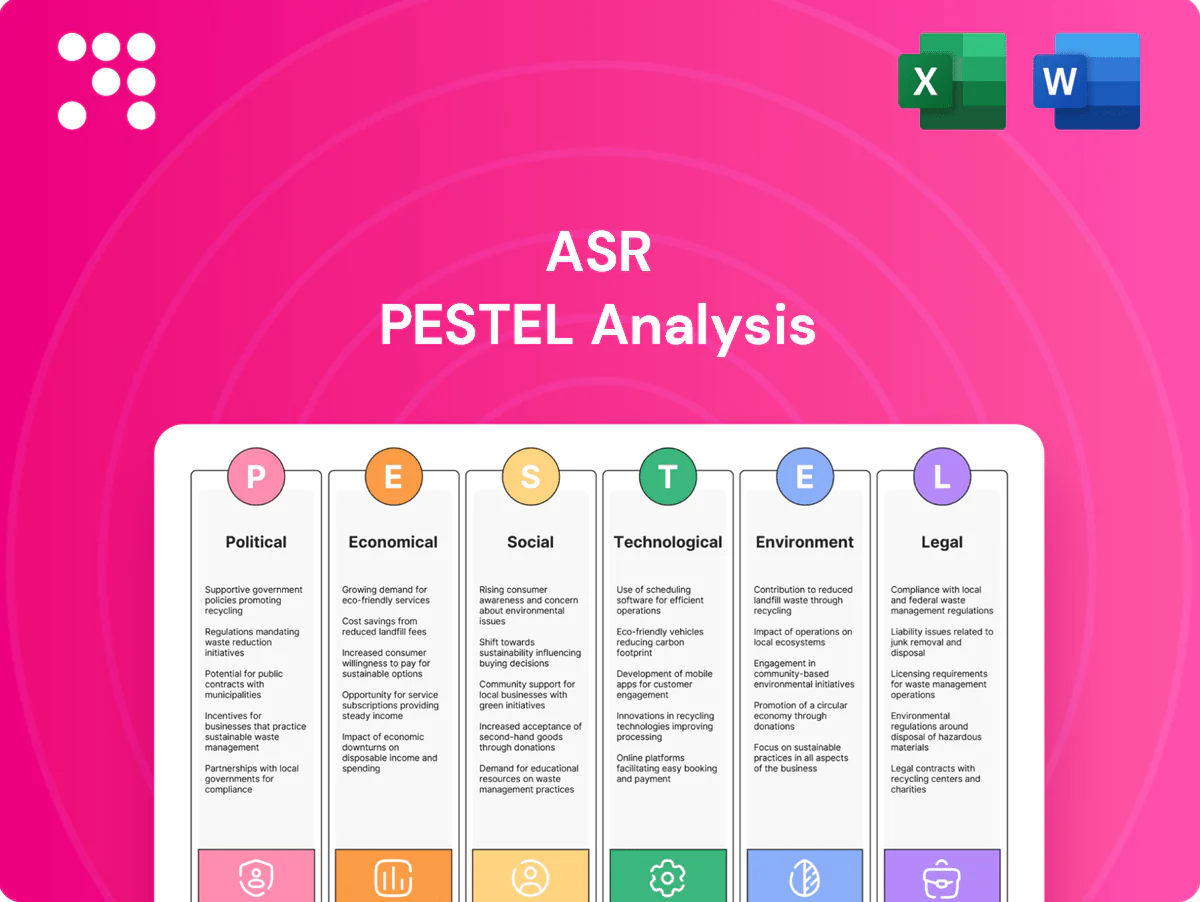
ASR PESTLE Analysis
The preview shown here is the exact ASR PESTLE Analysis document you’ll receive after purchase—fully formatted, professionally structured and ready to use with no placeholders or surprises.

Original: $10.00
-65%$10.00
$3.50Product Information
Product Information
Shipping & Returns
Shipping & Returns
Description
Your Shortcut to Market Insight Starts Here
Get a strategic edge with our ASR PESTLE Analysis—three to five actionable insights on how political, economic, social, technological, legal and environmental forces will shape ASR’s outlook. Ideal for investors and strategists, this ready-to-use report saves time and sharpens decisions. Purchase the full analysis to access the complete, editable deep-dive and start planning with confidence.
Political factors
EU and Dutch policy
EU and Dutch policies (EU market ~447 million, NL ~17.8 million) materially shape insurance pricing, capital regimes (eg Solvency II recalibrations) and consumer protections, affecting ASR product margins. Coalition shifts directly affect healthcare, pension and housing measures that drive claims and liabilities. ASR must track policy cycles to anticipate product and balance-sheet impacts and engage proactively with regulators to mitigate policy shock.
Healthcare reform dynamics
Dutch healthcare adjustments—affecting premiums, risk equalization and market rules—matter materially as health spending is about ≈12% of GDP (OECD, 2023) and average basic-premium was around €125–€135/month in 2024. Any redesign of the basic package or reimbursement rules would directly reprice ASR health portfolios and reserve needs. Political pressure on affordability and solidarity could compress margins via premium caps or redistributed risk pools. Robust scenario planning is therefore essential to maintain sustainable pricing and service levels.
Pension framework changes
The Dutch shift from DB to DC-like pension schemes is changing demand for pension products and administration, impacting providers as the €2.0 trillion Dutch pension market repositions. Political timelines and regulatory details (implementation phased 2023–2028) materially affect asset flows and guarantee levels, altering risk transfer economics. ASR must adapt propositions and communication for employers and 3.7m participants to retain flows. Policy delays can defer fee and consolidation revenues.
Housing and mortgage policy
- Tag: LTV 100% (NL since 2018)
- Tag: avg mortgage rate ~4% (2024)
- Tag: policy-driven demand volatility
- Tag: adjust ASR mortgage exposure
Geopolitics and sanctions
EU has adopted more than 15 sanction packages since February 2022, constraining investment universes and pressuring reinsurance capacity as carriers withdraw or limit exposures; political risk has driven spikes in volatility and wider credit spreads across affected sovereigns and corporates. Compliance burdens for screening and reporting have risen materially, making portfolio diversification and strict sanction controls essential.
- Sanctions: 15+ EU packages since Feb 2022
- Impact: reduced reinsurance appetite and higher market volatility
- Risk: wider credit spreads in sanctioned jurisdictions
- Action: robust screening, reporting, diversification
EU/NL policy, health and pension reforms tighten insurer margins and raise compliance risk
EU/NL policy (EU pop ~447M; NL ~17.8M) reshapes pricing, Solvency II capital and consumer rules, affecting ASR margins. Dutch health (≈12% GDP; basic premium €125–€135/mo in 2024) and pension reforms (NL market ≈€2.0tn; 2023–28 phase‑in) drive liabilities and product demand. Mortgage rules (LTV 100% since 2018; avg new rate ≈4% in 2024) and 15+ EU sanctions since Feb 2022 amplify market, reinsurance and compliance risk.
| Tag | Value |
|---|---|
| EU pop | ≈447M |
| NL pop | ≈17.8M |
| Health spend | ≈12% GDP |
| Basic premium 2024 | €125–€135/mo |
| Pension market | ≈€2.0tn |
| LTV | 100% (since 2018) |
| Avg mortgage rate 2024 | ≈4% |
| EU sanctions | 15+ since Feb 2022 |
What is included in the product
Detailed Word Document
Explores how Political, Economic, Social, Technological, Environmental and Legal forces uniquely affect the ASR, with data-driven subpoints and region-specific examples. Designed for executives and investors, it offers forward-looking insights ready for plans or decks.
Customizable Excel Spreadsheet
Condenses ASR's full PESTLE into a clean, shareable summary segmented by category for quick reference in meetings or presentations, with editable notes for regional or business-specific context.
Economic factors
Interest rate volatility
Interest rate volatility drives investment income, reserve discounting and solvency metrics; ECB deposit rate near 4.0% and EUR 10y yields around 3.5% in H1 2025 boosted reinvestment yields for ASR while increasing unrealised losses on long-duration bonds. Rising rates support higher reinvestment yields but depress asset valuations. Dutch mortgage demand and lapse rates fell after rate spikes, so rigorous ALM discipline is critical to stabilise capital and earnings.
Inflation and claims
Elevated inflation lifts repair and medical costs, squeezing loss ratios as input prices rose through 2024 while inflation remained above many central banks targets (often above 3%). Indexation of benefits and wages increases expense bases and pricing pressure. Persistent inflation complicates long-tail reserving and reserve adequacy. Tight pricing governance and supplier management, plus active cost indexing, help protect margins against sustained cost inflation and 4%+ policy rates.
Growth and employment
Netherlands real GDP growth moderated to about 1.5% in 2024 while unemployment stayed low near 3.5% (CBS/CPB), supporting premium growth in SME and retail lines. A tight labor market underpins pension contributions and group benefits funding. Economic slowdowns elevate lapse risk and mortgage credit risk as households tighten spending. Diversified distribution channels mitigate these cyclical impacts for ASR.
Property and CAT risk
Storms and floods drive spikes in non-life claims and weighed global insured catastrophe losses at about USD 125bn in 2023 (Swiss Re sigma 2024), pressuring ASR underwriting margins. Residential real estate cycles alter mortgage LTVs and collateral strength—price corrections in 2022–24 tightened LTV buffers for Dutch portfolios. Reinsurance pricing hardened post-heavy-loss years, rising roughly 15–25% in core layers in 2023–24, pushing ASR to dynamically adjust risk appetite and reinsurance towers to smooth volatility.
- Insured CAT losses ~USD 125bn (2023)
- Reinsurance rates +15–25% (2023–24)
- House-price downturns reduced mortgage LTV cushions
- Dynamic reinsurance optimization to stabilize P&L
Competitive consolidation
M&A among insurers and banks is concentrating distribution and pricing power, with European insurance deal value exceeding €40bn in 2024, tightening margin pressure on midsized players.
Scale advantages force bigger tech investments and lower unit costs; ASR must preserve cost leadership while keeping distinct product and service propositions.
Selective acquisitions can deepen ASR’s capabilities and reach, targeting bolt-on deals that improve customer distribution and digital platforms.
- 2024 European insurance M&A > €40bn
- Focus: cost leadership, tech investment
- Strategy: selective bolt-on acquisitions
EU/NL policy, health and pension reforms tighten insurer margins and raise compliance risk
Interest-rate volatility (ECB depo ~4.0%, EUR 10y ~3.5% H1 2025) boosts reinvestment yields but raises unrealised bond losses and solvency sensitivity. Persistent inflation (>3% through 2024) increases claim and expense inflation, stressing reserves. Dutch GDP ~1.5% (2024) and unemployment ~3.5% support premiums but elevate lapse and credit risk in downturns.
| Metric | Value |
|---|---|
| ECB deposit rate | ~4.0% (H1 2025) |
| EUR 10y | ~3.5% (H1 2025) |
| NL GDP (2024) | ~1.5% |
| Unemployment NL (2024) | ~3.5% |
| Insured CAT losses | ~USD 125bn (2023) |
| Reinsurance pricing | +15–25% (2023–24) |
| EU insurance M&A (2024) | >€40bn |
Preview the Actual Deliverable
ASR PESTLE Analysis
The preview shown here is the exact ASR PESTLE Analysis document you’ll receive after purchase—fully formatted, professionally structured and ready to use with no placeholders or surprises.