Array Networks PESTLE Analysis

Your Shortcut to Market Insight Starts Here
Unlock strategic clarity with our PESTLE Analysis of Array Networks—3–5 sentence snapshot revealing political, economic, social, technological, legal, and environmental forces shaping its prospects. Ideal for investors and strategists, this concise briefing highlights key risks and opportunities. Purchase the full report for detailed, actionable insights and ready-to-use charts to inform your decisions.
Political factors

Geopolitical tensions and trade policy
Array’s hardware and software supply chains are sensitive to export controls and tariffs, including US Section 301 measures covering roughly $250 billion of Chinese imports at up to 25% duties. Shifts in US‑China relations and export controls (eg. post‑2022 chip rules) can disrupt component sourcing, pricing and delivery timelines. US procurement shifts and CHIPS Act funding of $52.7 billion may favor domestic vendors, reshaping competition; proactive multi‑country sourcing and policy monitoring mitigate disruption.
Public sector digital initiatives
National programs for secure e-government and critical infrastructure—covered across 193 UN member states—drive rising demand for ADCs and secure access, as governments prioritize resilient services. Preferred vendor lists and local content rules increasingly gate eligibility in many markets. Aligning certifications and local partnerships measurably boosts tender success. Tailored compliance and support models are key to improving win-rate.

Data sovereignty policies
Regional mandates to keep data in-country—now enacted or proposed in over 60 countries by 2024—reshape deployment of virtual ADCs and gateways, making local cloud regions and on-prem appliances key differentiators. Array Networks must prioritize product roadmaps for localization and sovereign cloud integrations to address compliance-driven procurement in finance and government; failure to adapt risks exclusion from these regulated sectors.

Cybersecurity national strategies
Government zero trust frameworks such as U.S. OMB M-22-09 and NIST SP 800-207 drive demand for secure access gateways, improving procurement outcomes and audit credibility; aligning to these guidelines shortens RFP cycles. Participation in standards bodies shapes Array Networks roadmap, and certifying to government baselines (FedRAMP 500+ authorized services as of 2024) accelerates adoption.
- Policy alignment: zero trust (OMB M-22-09)
- Standards: NIST SP 800-207 informs roadmap
- Certifications: FedRAMP 500+ services (2024)
- Impact: faster RFPs, stronger audit credibility
Sanctions and restricted entities
Deals with sanctioned organizations pose legal and reputational risks for Array Networks; OFAC's SDN list exceeded 8,000 entries in 2024, increasing screening scope and compliance costs. Screening customers, partners and end-users is essential to avoid multimillion-dollar enforcement actions; global enforcement fines tied to sanctions and export controls intensified in 2023–24. Licensing controls on encryption in 20+ jurisdictions can limit feature availability, so robust governance reduces exposure.
- Sanctions scope: OFAC SDN >8,000 (2024)
- Encryption controls: 20+ jurisdictions
- Higher screening = lower enforcement risk
- Noncompliance can trigger multimillion-dollar fines
Export controls, CHIPS funding and data localization drive supply risk and compliance costs
Export controls, tariffs and US‑China tensions (eg. Section 301, post‑2022 chip rules) raise sourcing and cost risk; CHIPS Act $52.7B favors domestic suppliers.
Data localization in 60+ countries (2024) and government zero trust mandates (OMB M‑22‑09, NIST SP 800‑207) drive on‑prem and sovereign cloud demand.
Sanctions screening (OFAC SDN >8,000 in 2024) and encryption export rules (20+ jurisdictions) increase compliance costs and procurement barriers.
| Metric | 2024 Value |
|---|---|
| CHIPS Act | $52.7B |
| Data localization laws | 60+ countries |
| OFAC SDN list | >8,000 |
What is included in the product
 Detailed Word Document
Explores how external macro-environmental factors uniquely affect Array Networks across Political, Economic, Social, Technological, Environmental, and Legal dimensions, with each category expanded into actionable sub-points. Every section is backed by current data and forward-looking insights to help executives, investors, and strategists identify risks, opportunities, and scenario-based responses.

 Customizable Excel Spreadsheet
A concise, visually segmented PESTLE summary for Array Networks that simplifies external risk and market positioning into a slide-ready format. Easily editable and shareable for quick alignment across teams, ideal for meetings, strategy sessions, and client reports.
Economic factors

IT spending cycles and macro growth
Enterprise capex-to-opex shifts meaningfully slow ADC refresh cycles—Gartner estimated global IT spending near US$5.4 trillion in 2024 with single-digit growth, so customers often defer projects in downturns while ramping upgrades in recoveries which drive consolidation and optimization buys.
Slowdowns delayed appliance refreshes in 2023–24, but rebound periods accelerate platform consolidation and higher-value software subscriptions.
Offering subscription licensing and flexible financing (rental/consumption models) cushions revenue volatility and, combined with a pipeline diversified across finance, telco, cloud and government verticals, stabilizes demand mix.
Cloud cost optimization trends
Customers demand better performance per dollar for hybrid apps, pushing adoption of virtual ADCs that consolidate functions to reduce bandwidth and compute costs. 66% of organizations cite cost optimization as their top cloud initiative (Flexera 2024), fueling interest in software-based ADCs. Transparent pricing and autoscaling features help defend perceived value. ROI proofs shorten sales cycles in budget-tight environments by demonstrating payback and TCO improvements.

Currency fluctuations
Currency fluctuations materially affect Array Networks' international pricing and can compress hardware/software margins when local currencies weaken against the US dollar; 2024 saw elevated FX volatility (USD trade-weighted index annual volatility near 8%), increasing pass-through risk. Quoting in local currency and leveraging natural hedges from multi-region revenue streams helps stabilize reported revenue. Multi-region billing and cost localization—shifting manufacturing, support and payroll to lower-cost jurisdictions—reduces FX exposure and preserves competitiveness.

Supplier and component costs
ASIC, NIC and memory price swings materially affect Array Networks hardware margins: DRAM ASPs fell about 12% YoY in 2024 while NAND declined ~8%, offset by NIC price increases near 5% and ASIC lead times of ~20–24 weeks into 2025; design for component flexibility mitigates shortages and margin shocks.
- Strategic inventory planning preserves delivery SLAs
- Long-term vendor contracts secure pricing
- Component-flexible designs reduce sourcing risk
Competitive pricing pressure
Competitive pricing pressure from large incumbents such as F5 and cloud-native ADCs from AWS and Azure is compressing average selling prices, forcing Array Networks to compete on throughput, advanced security features, and total cost of ownership to preserve value. Bundling support, analytics and services helps defend margin while selective targeting of verticals and enterprise segments reduces exposure to head-to-head price wars.
Export controls, CHIPS funding and data localization drive supply risk and compliance costs
Enterprise IT spend ~US$5.4T in 2024 with single-digit growth; capex-to-opex shift and 66% citing cost optimization (Flexera 2024) slow refreshes but boost virtual ADCs and subscriptions. FX volatility (USD TWI vol ~8% in 2024) and component swings (DRAM -12% YoY, NAND -8%, NIC +5%; ASIC lead times 20–24 weeks) pressure margins; flexible licensing, local pricing and vendor contracts mitigate risk.
| Metric | 2024/2025 |
|---|---|
| Global IT spend | US$5.4T (2024) |
| Cost optimization priority | 66% (Flexera 2024) |
| USD vol | ~8% (2024) |
| DRAM/NAND/NIC | -12% / -8% / +5% (2024) |
Preview Before You Purchase
Array Networks PESTLE Analysis
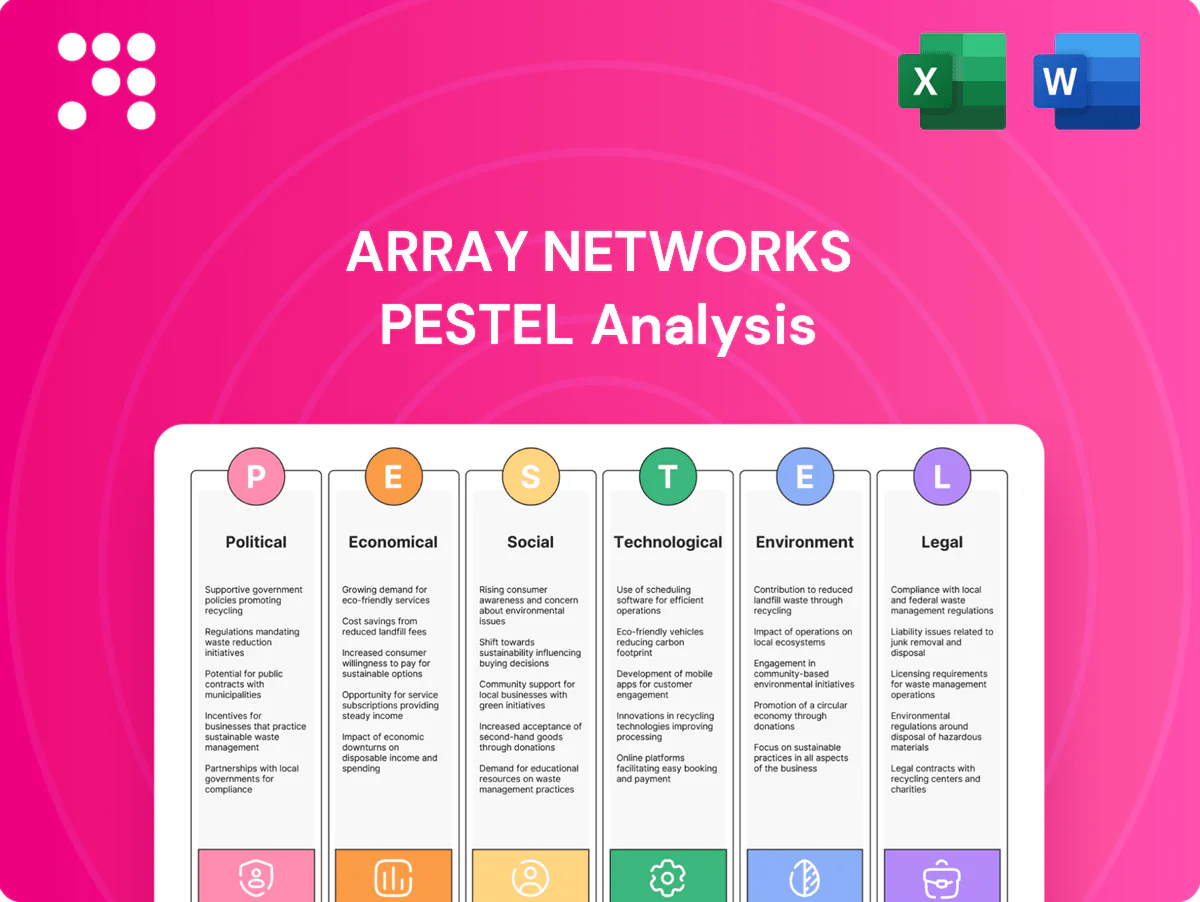
This Array Networks PESTLE Analysis preview is the exact document you’ll receive after purchase—fully formatted, professionally structured, and ready to use. It contains detailed Political, Economic, Social, Technological, Legal and Environmental assessments tailored to Array Networks. No placeholders or teasers—what you see is what you’ll download instantly after checkout.

Original: $10.00
-65%$10.00
$3.50Product Information
Product Information
Shipping & Returns
Shipping & Returns
Description
Your Shortcut to Market Insight Starts Here
Unlock strategic clarity with our PESTLE Analysis of Array Networks—3–5 sentence snapshot revealing political, economic, social, technological, legal, and environmental forces shaping its prospects. Ideal for investors and strategists, this concise briefing highlights key risks and opportunities. Purchase the full report for detailed, actionable insights and ready-to-use charts to inform your decisions.
Political factors
Geopolitical tensions and trade policy
Array’s hardware and software supply chains are sensitive to export controls and tariffs, including US Section 301 measures covering roughly $250 billion of Chinese imports at up to 25% duties. Shifts in US‑China relations and export controls (eg. post‑2022 chip rules) can disrupt component sourcing, pricing and delivery timelines. US procurement shifts and CHIPS Act funding of $52.7 billion may favor domestic vendors, reshaping competition; proactive multi‑country sourcing and policy monitoring mitigate disruption.
Public sector digital initiatives
National programs for secure e-government and critical infrastructure—covered across 193 UN member states—drive rising demand for ADCs and secure access, as governments prioritize resilient services. Preferred vendor lists and local content rules increasingly gate eligibility in many markets. Aligning certifications and local partnerships measurably boosts tender success. Tailored compliance and support models are key to improving win-rate.
Data sovereignty policies
Regional mandates to keep data in-country—now enacted or proposed in over 60 countries by 2024—reshape deployment of virtual ADCs and gateways, making local cloud regions and on-prem appliances key differentiators. Array Networks must prioritize product roadmaps for localization and sovereign cloud integrations to address compliance-driven procurement in finance and government; failure to adapt risks exclusion from these regulated sectors.
Cybersecurity national strategies
Government zero trust frameworks such as U.S. OMB M-22-09 and NIST SP 800-207 drive demand for secure access gateways, improving procurement outcomes and audit credibility; aligning to these guidelines shortens RFP cycles. Participation in standards bodies shapes Array Networks roadmap, and certifying to government baselines (FedRAMP 500+ authorized services as of 2024) accelerates adoption.
- Policy alignment: zero trust (OMB M-22-09)
- Standards: NIST SP 800-207 informs roadmap
- Certifications: FedRAMP 500+ services (2024)
- Impact: faster RFPs, stronger audit credibility
Sanctions and restricted entities
Deals with sanctioned organizations pose legal and reputational risks for Array Networks; OFAC's SDN list exceeded 8,000 entries in 2024, increasing screening scope and compliance costs. Screening customers, partners and end-users is essential to avoid multimillion-dollar enforcement actions; global enforcement fines tied to sanctions and export controls intensified in 2023–24. Licensing controls on encryption in 20+ jurisdictions can limit feature availability, so robust governance reduces exposure.
- Sanctions scope: OFAC SDN >8,000 (2024)
- Encryption controls: 20+ jurisdictions
- Higher screening = lower enforcement risk
- Noncompliance can trigger multimillion-dollar fines
Export controls, CHIPS funding and data localization drive supply risk and compliance costs
Export controls, tariffs and US‑China tensions (eg. Section 301, post‑2022 chip rules) raise sourcing and cost risk; CHIPS Act $52.7B favors domestic suppliers.
Data localization in 60+ countries (2024) and government zero trust mandates (OMB M‑22‑09, NIST SP 800‑207) drive on‑prem and sovereign cloud demand.
Sanctions screening (OFAC SDN >8,000 in 2024) and encryption export rules (20+ jurisdictions) increase compliance costs and procurement barriers.
| Metric | 2024 Value |
|---|---|
| CHIPS Act | $52.7B |
| Data localization laws | 60+ countries |
| OFAC SDN list | >8,000 |
What is included in the product
Detailed Word Document
Explores how external macro-environmental factors uniquely affect Array Networks across Political, Economic, Social, Technological, Environmental, and Legal dimensions, with each category expanded into actionable sub-points. Every section is backed by current data and forward-looking insights to help executives, investors, and strategists identify risks, opportunities, and scenario-based responses.
Customizable Excel Spreadsheet
A concise, visually segmented PESTLE summary for Array Networks that simplifies external risk and market positioning into a slide-ready format. Easily editable and shareable for quick alignment across teams, ideal for meetings, strategy sessions, and client reports.
Economic factors
IT spending cycles and macro growth
Enterprise capex-to-opex shifts meaningfully slow ADC refresh cycles—Gartner estimated global IT spending near US$5.4 trillion in 2024 with single-digit growth, so customers often defer projects in downturns while ramping upgrades in recoveries which drive consolidation and optimization buys.
Slowdowns delayed appliance refreshes in 2023–24, but rebound periods accelerate platform consolidation and higher-value software subscriptions.
Offering subscription licensing and flexible financing (rental/consumption models) cushions revenue volatility and, combined with a pipeline diversified across finance, telco, cloud and government verticals, stabilizes demand mix.
Cloud cost optimization trends
Customers demand better performance per dollar for hybrid apps, pushing adoption of virtual ADCs that consolidate functions to reduce bandwidth and compute costs. 66% of organizations cite cost optimization as their top cloud initiative (Flexera 2024), fueling interest in software-based ADCs. Transparent pricing and autoscaling features help defend perceived value. ROI proofs shorten sales cycles in budget-tight environments by demonstrating payback and TCO improvements.
Currency fluctuations
Currency fluctuations materially affect Array Networks' international pricing and can compress hardware/software margins when local currencies weaken against the US dollar; 2024 saw elevated FX volatility (USD trade-weighted index annual volatility near 8%), increasing pass-through risk. Quoting in local currency and leveraging natural hedges from multi-region revenue streams helps stabilize reported revenue. Multi-region billing and cost localization—shifting manufacturing, support and payroll to lower-cost jurisdictions—reduces FX exposure and preserves competitiveness.
Supplier and component costs
ASIC, NIC and memory price swings materially affect Array Networks hardware margins: DRAM ASPs fell about 12% YoY in 2024 while NAND declined ~8%, offset by NIC price increases near 5% and ASIC lead times of ~20–24 weeks into 2025; design for component flexibility mitigates shortages and margin shocks.
- Strategic inventory planning preserves delivery SLAs
- Long-term vendor contracts secure pricing
- Component-flexible designs reduce sourcing risk
Competitive pricing pressure
Competitive pricing pressure from large incumbents such as F5 and cloud-native ADCs from AWS and Azure is compressing average selling prices, forcing Array Networks to compete on throughput, advanced security features, and total cost of ownership to preserve value. Bundling support, analytics and services helps defend margin while selective targeting of verticals and enterprise segments reduces exposure to head-to-head price wars.
Export controls, CHIPS funding and data localization drive supply risk and compliance costs
Enterprise IT spend ~US$5.4T in 2024 with single-digit growth; capex-to-opex shift and 66% citing cost optimization (Flexera 2024) slow refreshes but boost virtual ADCs and subscriptions. FX volatility (USD TWI vol ~8% in 2024) and component swings (DRAM -12% YoY, NAND -8%, NIC +5%; ASIC lead times 20–24 weeks) pressure margins; flexible licensing, local pricing and vendor contracts mitigate risk.
| Metric | 2024/2025 |
|---|---|
| Global IT spend | US$5.4T (2024) |
| Cost optimization priority | 66% (Flexera 2024) |
| USD vol | ~8% (2024) |
| DRAM/NAND/NIC | -12% / -8% / +5% (2024) |
Preview Before You Purchase
Array Networks PESTLE Analysis
This Array Networks PESTLE Analysis preview is the exact document you’ll receive after purchase—fully formatted, professionally structured, and ready to use. It contains detailed Political, Economic, Social, Technological, Legal and Environmental assessments tailored to Array Networks. No placeholders or teasers—what you see is what you’ll download instantly after checkout.