Aritzia PESTLE Analysis

Your Competitive Advantage Starts with This Report
Spot how political shifts, consumer trends, and sustainability pressures are reshaping Aritzia’s growth outlook in our concise PESTLE snapshot—perfect for investors and strategists. Dive deeper into regulatory risks, economic drivers, and tech opportunities with the full report. Purchase now to get the complete, ready-to-use analysis instantly.
Political factors

Trade policy, tariffs, and duties
Shifts in import tariffs on apparel and accessories directly raise landed costs and compress margins across Aritzia’s vertically integrated model, where textile duty rates can reach up to 32% for certain categories.
U.S.–Canada trade dynamics and the U.S. de minimis threshold of 800 USD reshape sourcing economics and order frequency, prompting shifts in distribution and pricing strategy.
Monitoring duty rates on textiles, leather and trims, plus proactive tariff engineering and diversified country-of-origin plans, mitigates tariff shocks and protects margin planning.
Geopolitical supply chain risk
Political instability in sourcing countries can halt fabric mills, cut-and-sew capacity and logistics corridors, while sanctions or port congestion tied to geopolitical tensions have extended apparel lead times by weeks in recent Red Sea and China port disruptions. Aritzia’s centralized design control and vendor selection enable rapid volume rebalancing across suppliers. Dual sourcing and nearshoring options strengthen resilience; Aritzia operated 119 stores as of 2024 while scaling supply flexibility.

Government support and industrial policy
Canadian industrial policy—including the Strategic Innovation Fund (SIF, C$7.2B) and SR&ED tax incentives (refundable federal credit up to 35% on qualifying CCPC R&D spending, subject to limits)—can cut Aritzia’s capex for product development, clean-tech and distribution; retail recovery grants and tax credits support store buildouts and omnichannel upgrades, and readiness for grant eligibility speeds access to funds.

Minimum wage and labor politics
Regional minimum wage hikes—set provincially in Canada and by states in the US (US federal minimum wage remains 7.25 USD/hr)—raise boutique staffing and distribution labor expenses, pressuring margins for Aritzia, which operates mainly across Canada and the US. Political debates on living wages and scheduling protections can force changes to staffing models.
- Align staffing efficiency with curated service
- Use labor analytics to balance coverage, productivity, satisfaction
- Monitor provincial/state wage policy changes
Public health and cross-border mobility
Policy shifts on public health or border controls can materially alter store traffic, staffing flexibility and supply timing; Aritzia (FY24 revenue CAD 1.44B, over 110 stores) is exposed in marquee tourist hubs. International arrivals recovered to about 90% of 2019 levels in 2024, so visa and travel rules directly affect sales. Preparedness via inventory agility and scenario planning preserves service levels.
- Policy impact: store traffic, staffing, supply
- Tourism: affects flagship sales; visas matter
- Agility: inventory & staffing readiness
- Scenario planning: maintain service levels
Tariff hikes and US–Canada rules boost landed costs, spur nearshoring and dual sourcing
Shifts in apparel tariffs (textile duties up to 32%) and U.S.–Canada trade rules (de minimis USD 800) raise landed costs and reshape sourcing for Aritzia (FY24 revenue CAD 1.44B; 119 stores). Political instability and port disruptions lengthened lead times; nearshoring/dual sourcing mitigates risk. Wage policy changes (provincial/state; US federal USD 7.25/hr) and Canadian incentives (SIF C$7.2B; SR&ED up to 35%) affect margins and capex.
| Metric | Value |
|---|---|
| FY24 revenue | CAD 1.44B |
| Stores (2024) | 119 |
| Textile duty | Up to 32% |
| US de minimis | USD 800 |
| Intl arrivals (2024) | ~90% of 2019 |
| SIF | C$7.2B |
| SR&ED | Refundable up to 35% |
| US federal min wage | USD 7.25/hr |
What is included in the product
 Detailed Word Document
Explores how Political, Economic, Social, Technological, Environmental and Legal forces uniquely affect Aritzia, combining data-driven trends and region-specific regulation to identify threats, opportunities and scenario-based implications; crafted for executives, investors and strategists and formatted for direct inclusion in plans, decks and reports.

 Customizable Excel Spreadsheet
Condensed Aritzia PESTLE analysis that’s visually segmented for quick reference, easily dropped into presentations or shared across teams to align strategy fast. Editable notes let users tailor risks and opportunities by region or product, supporting rapid decision-making during planning sessions.
Economic factors

Consumer spending and discretionary cycles
Women’s fashion is highly sensitive to income expectations and savings behavior—US personal saving rates averaged about 3% in 2023, compressing discretionary spend and pressuring basket size and full‑price sell‑through in downcycles while upcycles reward newness and premiumization.
Aritzia’s premium brand mix and clienteling-focused stores help defend conversion during softer demand, and disciplined open-to-buy (OTB) and inventory control materially reduce markdown risk.
Inflation and input cost volatility
Fabric, trims, freight and wage inflation compress Aritzia’s gross margins despite CAD 1.5bn revenue in FY2024 and a gross margin near 59%, forcing tighter vendor negotiations, calendar optimization and cost engineering to protect margin targets. Price architecture must mirror perceived value to avoid eroding brand equity while preserving margin. Hedging logistics contracts and locking carrier capacity stabilize input cost volatility. Negotiated vendor terms reduced unit costs in recent sourcing cycles.

Currency fluctuations (CAD, USD, others)
FX swings materially affect Aritzia’s sourcing costs and revenue translation between Canadian and U.S. operations; USD/CAD traded around 1.36 in mid-2025, so a stronger USD can lift Canadian-reported sales from U.S. stores while increasing import costs for goods priced in USD. Balanced currency exposure and active hedging policies are used to reduce earnings volatility. Pricing localization across markets prevents cross-border arbitrage and preserves margins.

Interest rates and capital access
Higher borrowing costs (Bank of Canada policy rate 5.00% as of July 2025) raise lease liability present values, increase distribution and working capital carry, and push store ROIC hurdles higher, tightening site-selection discipline; inventory turn and cash-conversion improvements become central, while disciplined capex sequencing preserves liquidity and optionality.
- Rate: 5.00% (BoC, Jul 2025)
- Higher lease PV and carry
- Stricter ROIC thresholds
- Focus: inventory turns, CCC
- Sequenced, disciplined capex
Labor markets and productivity
Tight retail labor markets are driving wage pressure and higher training costs for Aritzia, alongside the need for productivity tools and process simplification to maintain boutique service levels. Incentive-linked clienteling programs can boost ATS and UPT, while higher retention reduces onboarding spend and protects the customer experience. Aritzia reported FY2024 revenue C$1.62B and continues store-led growth, making labor efficiency critical.
- Labor: rising wage costs & training
- Productivity: tech + process simplification essential
- Incentives: clienteling → higher ATS/UPT
- Retention: lowers onboarding, preserves boutique service
Tariff hikes and US–Canada rules boost landed costs, spur nearshoring and dual sourcing
Consumer discretionary sensitivity pressures basket size despite Aritzia’s premium positioning; FY2024 revenue C$1.62B and gross margin ~59% provide buffer but require tight OTB and vendor negotiation. Input inflation (fabric, freight, wages) and FX volatility (USD/CAD ~1.36 mid-2025) compress margins while BoC rate 5.00% (Jul 2025) raises lease PV and ROIC hurdles.
| Metric | Value |
|---|---|
| FY2024 Revenue | C$1.62B |
| Gross margin | ~59% |
| USD/CAD | ~1.36 (mid-2025) |
| BoC rate | 5.00% (Jul 2025) |
Preview the Actual Deliverable
Aritzia PESTLE Analysis
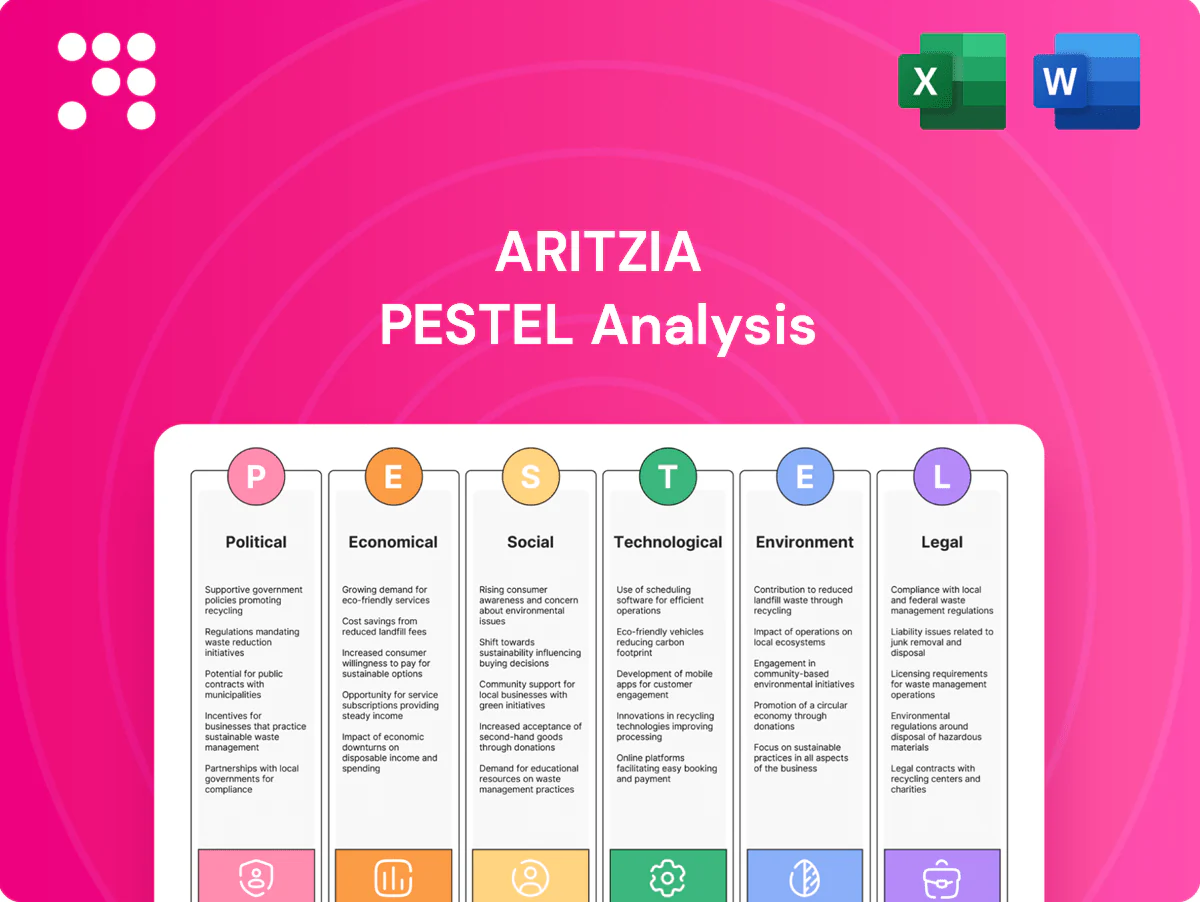
This Aritzia PESTLE Analysis provides a concise, professional assessment of political, economic, social, technological, legal and environmental factors affecting the company. The content and structure shown in the preview is the same document you’ll download after payment. No placeholders or teasers—this file is fully formatted and ready to use.

Product Information
Product Information
Shipping & Returns
Shipping & Returns
Description
Your Competitive Advantage Starts with This Report
Spot how political shifts, consumer trends, and sustainability pressures are reshaping Aritzia’s growth outlook in our concise PESTLE snapshot—perfect for investors and strategists. Dive deeper into regulatory risks, economic drivers, and tech opportunities with the full report. Purchase now to get the complete, ready-to-use analysis instantly.
Political factors
Trade policy, tariffs, and duties
Shifts in import tariffs on apparel and accessories directly raise landed costs and compress margins across Aritzia’s vertically integrated model, where textile duty rates can reach up to 32% for certain categories.
U.S.–Canada trade dynamics and the U.S. de minimis threshold of 800 USD reshape sourcing economics and order frequency, prompting shifts in distribution and pricing strategy.
Monitoring duty rates on textiles, leather and trims, plus proactive tariff engineering and diversified country-of-origin plans, mitigates tariff shocks and protects margin planning.
Geopolitical supply chain risk
Political instability in sourcing countries can halt fabric mills, cut-and-sew capacity and logistics corridors, while sanctions or port congestion tied to geopolitical tensions have extended apparel lead times by weeks in recent Red Sea and China port disruptions. Aritzia’s centralized design control and vendor selection enable rapid volume rebalancing across suppliers. Dual sourcing and nearshoring options strengthen resilience; Aritzia operated 119 stores as of 2024 while scaling supply flexibility.
Government support and industrial policy
Canadian industrial policy—including the Strategic Innovation Fund (SIF, C$7.2B) and SR&ED tax incentives (refundable federal credit up to 35% on qualifying CCPC R&D spending, subject to limits)—can cut Aritzia’s capex for product development, clean-tech and distribution; retail recovery grants and tax credits support store buildouts and omnichannel upgrades, and readiness for grant eligibility speeds access to funds.
Minimum wage and labor politics
Regional minimum wage hikes—set provincially in Canada and by states in the US (US federal minimum wage remains 7.25 USD/hr)—raise boutique staffing and distribution labor expenses, pressuring margins for Aritzia, which operates mainly across Canada and the US. Political debates on living wages and scheduling protections can force changes to staffing models.
- Align staffing efficiency with curated service
- Use labor analytics to balance coverage, productivity, satisfaction
- Monitor provincial/state wage policy changes
Public health and cross-border mobility
Policy shifts on public health or border controls can materially alter store traffic, staffing flexibility and supply timing; Aritzia (FY24 revenue CAD 1.44B, over 110 stores) is exposed in marquee tourist hubs. International arrivals recovered to about 90% of 2019 levels in 2024, so visa and travel rules directly affect sales. Preparedness via inventory agility and scenario planning preserves service levels.
- Policy impact: store traffic, staffing, supply
- Tourism: affects flagship sales; visas matter
- Agility: inventory & staffing readiness
- Scenario planning: maintain service levels
Tariff hikes and US–Canada rules boost landed costs, spur nearshoring and dual sourcing
Shifts in apparel tariffs (textile duties up to 32%) and U.S.–Canada trade rules (de minimis USD 800) raise landed costs and reshape sourcing for Aritzia (FY24 revenue CAD 1.44B; 119 stores). Political instability and port disruptions lengthened lead times; nearshoring/dual sourcing mitigates risk. Wage policy changes (provincial/state; US federal USD 7.25/hr) and Canadian incentives (SIF C$7.2B; SR&ED up to 35%) affect margins and capex.
| Metric | Value |
|---|---|
| FY24 revenue | CAD 1.44B |
| Stores (2024) | 119 |
| Textile duty | Up to 32% |
| US de minimis | USD 800 |
| Intl arrivals (2024) | ~90% of 2019 |
| SIF | C$7.2B |
| SR&ED | Refundable up to 35% |
| US federal min wage | USD 7.25/hr |
What is included in the product
Detailed Word Document
Explores how Political, Economic, Social, Technological, Environmental and Legal forces uniquely affect Aritzia, combining data-driven trends and region-specific regulation to identify threats, opportunities and scenario-based implications; crafted for executives, investors and strategists and formatted for direct inclusion in plans, decks and reports.
Customizable Excel Spreadsheet
Condensed Aritzia PESTLE analysis that’s visually segmented for quick reference, easily dropped into presentations or shared across teams to align strategy fast. Editable notes let users tailor risks and opportunities by region or product, supporting rapid decision-making during planning sessions.
Economic factors
Consumer spending and discretionary cycles
Women’s fashion is highly sensitive to income expectations and savings behavior—US personal saving rates averaged about 3% in 2023, compressing discretionary spend and pressuring basket size and full‑price sell‑through in downcycles while upcycles reward newness and premiumization.
Aritzia’s premium brand mix and clienteling-focused stores help defend conversion during softer demand, and disciplined open-to-buy (OTB) and inventory control materially reduce markdown risk.
Inflation and input cost volatility
Fabric, trims, freight and wage inflation compress Aritzia’s gross margins despite CAD 1.5bn revenue in FY2024 and a gross margin near 59%, forcing tighter vendor negotiations, calendar optimization and cost engineering to protect margin targets. Price architecture must mirror perceived value to avoid eroding brand equity while preserving margin. Hedging logistics contracts and locking carrier capacity stabilize input cost volatility. Negotiated vendor terms reduced unit costs in recent sourcing cycles.
Currency fluctuations (CAD, USD, others)
FX swings materially affect Aritzia’s sourcing costs and revenue translation between Canadian and U.S. operations; USD/CAD traded around 1.36 in mid-2025, so a stronger USD can lift Canadian-reported sales from U.S. stores while increasing import costs for goods priced in USD. Balanced currency exposure and active hedging policies are used to reduce earnings volatility. Pricing localization across markets prevents cross-border arbitrage and preserves margins.
Interest rates and capital access
Higher borrowing costs (Bank of Canada policy rate 5.00% as of July 2025) raise lease liability present values, increase distribution and working capital carry, and push store ROIC hurdles higher, tightening site-selection discipline; inventory turn and cash-conversion improvements become central, while disciplined capex sequencing preserves liquidity and optionality.
- Rate: 5.00% (BoC, Jul 2025)
- Higher lease PV and carry
- Stricter ROIC thresholds
- Focus: inventory turns, CCC
- Sequenced, disciplined capex
Labor markets and productivity
Tight retail labor markets are driving wage pressure and higher training costs for Aritzia, alongside the need for productivity tools and process simplification to maintain boutique service levels. Incentive-linked clienteling programs can boost ATS and UPT, while higher retention reduces onboarding spend and protects the customer experience. Aritzia reported FY2024 revenue C$1.62B and continues store-led growth, making labor efficiency critical.
- Labor: rising wage costs & training
- Productivity: tech + process simplification essential
- Incentives: clienteling → higher ATS/UPT
- Retention: lowers onboarding, preserves boutique service
Tariff hikes and US–Canada rules boost landed costs, spur nearshoring and dual sourcing
Consumer discretionary sensitivity pressures basket size despite Aritzia’s premium positioning; FY2024 revenue C$1.62B and gross margin ~59% provide buffer but require tight OTB and vendor negotiation. Input inflation (fabric, freight, wages) and FX volatility (USD/CAD ~1.36 mid-2025) compress margins while BoC rate 5.00% (Jul 2025) raises lease PV and ROIC hurdles.
| Metric | Value |
|---|---|
| FY2024 Revenue | C$1.62B |
| Gross margin | ~59% |
| USD/CAD | ~1.36 (mid-2025) |
| BoC rate | 5.00% (Jul 2025) |
Preview the Actual Deliverable
Aritzia PESTLE Analysis
This Aritzia PESTLE Analysis provides a concise, professional assessment of political, economic, social, technological, legal and environmental factors affecting the company. The content and structure shown in the preview is the same document you’ll download after payment. No placeholders or teasers—this file is fully formatted and ready to use.