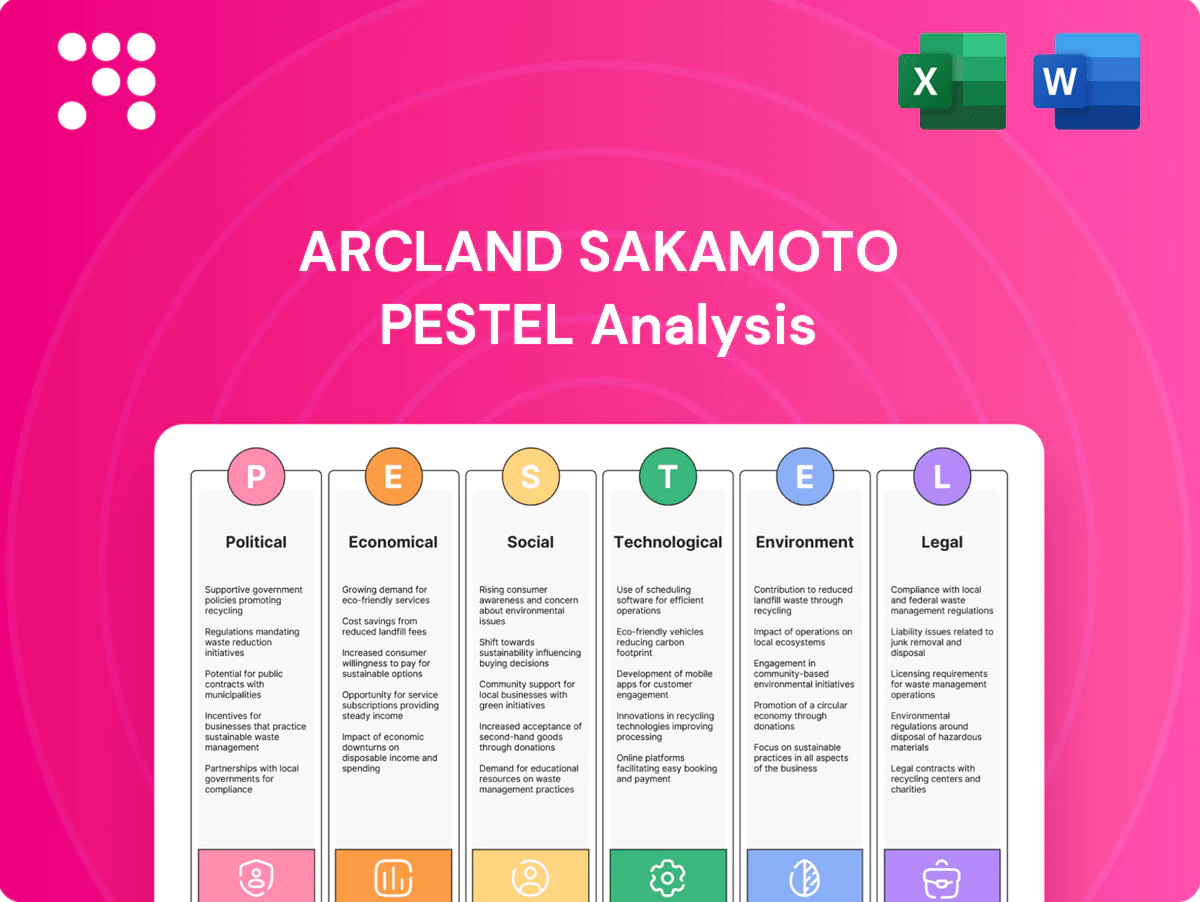
Arcland Sakamoto PESTLE Analysis

Make Smarter Strategic Decisions with a Complete PESTEL View
Discover how political shifts, economic cycles, and emerging technologies are shaping Arcland Sakamoto’s strategic outlook in our concise PESTLE overview. This analysis highlights regulatory risks, consumer trends, and environmental pressures that could impact performance. Buy the full PESTLE report to access detailed, actionable insights and ready-to-use slides for investment or strategy decisions.
Political factors

Local zoning and permits
Expansion of home centers in Japan hinges on municipal zoning, land-use approvals, and community consultations; delays or restrictive ordinances can raise site acquisition costs and elongate payback periods. Proactive stakeholder engagement and early public hearings help secure large-format footprints and parking. Aligning store formats with regional revitalization goals can unlock municipal support and incentives.
Trade policy and import tariffs
Many of Arcland Sakamoto’s tools, hardware and seasonal goods are imported, exposing margins to tariff changes and customs delays; Japan’s applied MFN tariff simple average was 2.6% (WTO, 2021). Japan’s participation in CPTPP and RCEP (effective 2022) can lower landed costs and expand assortment via preferential rates, while geopolitical tensions with key Asian suppliers risk supply shocks. Diversifying suppliers improves negotiating power and reduces policy concentration risk.

Disaster preparedness initiatives
Japan’s national and local disaster-readiness policies, highlighted by Disaster Prevention Day (Sept 1) and FY2024 preparedness campaigns, spur consistent retail demand for generators, water, tools and building materials. Government subsidies and public-awareness drives shape seasonal assortments and inventory positioning for home-improvement chains. Retailers that align with official preparedness efforts gain foot traffic, brand trust and opportunities to coordinate with authorities for emergency supply contracts.

Rural revitalization and subsidies
Policies to revitalize regional economies in Japan expand opportunities for Arcland Sakamoto to open local stores and create jobs, while subsidies for SMEs and agriculture increase demand for farm and gardening equipment. Participation in regional supply chains strengthens community ties and sourcing resilience. Tailoring formats to local needs improves political goodwill and eases permitting.
Labor and immigration policy
Retail staffing at Arcland Sakamoto is highly sensitive to part-time rules, foreign labor and training programs; easing work-visa pathways that pushed Japan's foreign workforce past 2.0 million in 2024 can ease logistics and in-store shortages. The national average hourly minimum wage rose to about 962 yen in 2024, pressuring store-level profitability; workforce planning must anticipate periodic regulatory adjustments.
- Foreign workers >2.0M (2024)
- Avg min wage ~962 yen (2024)
- Effects: staffing relief vs margin pressure
- Action: flexible staffing, training investment
Zoning, trade deals and labor shifts reshape Japan retail rollout and costs
Municipal zoning, permitting and regional revitalization policies strongly affect Arcland Sakamoto’s store rollout, site costs and eligibility for local incentives. Trade deals (CPTPP/RCEP effective 2022) and Japan’s 2.6% MFN tariff (WTO 2021) influence import costs; geopolitical risk remains. Disaster-preparedness programs (ongoing, FY2024) and rising labor rules (foreign workforce >2.0M, avg min wage ~962 yen in 2024) shape assortment and staffing.
| Factor | Metric |
|---|---|
| MFN tariff | 2.6% (WTO 2021) |
| CPTPP/RCEP | Preferential rates (since 2022) |
| Foreign workers | >2.0M (2024) |
| Avg min wage | ~962 yen (2024) |
What is included in the product
 Detailed Word Document
Explores how Political, Economic, Social, Technological, Environmental and Legal forces uniquely affect Arcland Sakamoto, with data-backed trends and region-specific examples to identify risks and opportunities; designed for executives and investors seeking actionable, forward-looking strategy inputs.

 Customizable Excel Spreadsheet
A concise, visually segmented PESTLE summary for Arcland Sakamoto that streamlines external risk assessment, is easy to drop into presentations, editable for local context, and quickly shareable for team alignment.
Economic factors

Consumer spending and confidence
DIY and home-improvement demand for Arcland Sakamoto closely follows household income and sentiment; Japan real household spending rose about 1.5% in 2024, supporting steady DIY sales in that period.
During economic slowdowns consumers shift toward value and private labels—retailers saw private-label penetration climb roughly 2–3 percentage points in 2024—raising pricing pressure.
Promotional intensity increases when confidence softens (Cabinet Office consumer confidence near mid-30s in 2025), compressing gross margins; focusing on essentials and loyalty programs can stabilize purchase frequency and lifetime value.
Housing starts and renovation cycles
New builds (~780,000 housing starts in 2024 per MLIT) plus an annual renovation market near 3 trillion yen sustain demand for lumber, tools and fixtures, while maintenance cycles drive recurring sales. With roughly 45% of Japan’s housing stock older than 30 years, repair and retrofit volumes remain elevated. Expanded government energy‑efficiency subsidies (budget increases in 2024 exceeding 200 billion yen) can spur upgrades. Monitoring monthly construction indicators guides inventory and staffing.

Exchange rate and import costs
A weaker yen—around ¥150–¥160 per USD in 2023–24—raises Arcland Sakamoto’s costs for imported tools and materials, squeezing retail price points. Hedging strategies and multi-currency sourcing have been used to reduce FX volatility and protect margins. Passing higher costs to customers risks demand elasticity in price-sensitive segments. Expanding private-label lines provides a buffer by improving gross-margin control.

Inflation and interest rates
Input inflation in materials, logistics and energy has compressed Arcland Sakamoto gross margins; Japan core CPI averaged about 2.6% in 2024 and 10-year JGB yields rose toward 0.8% by mid-2025, increasing borrowing costs for capex and DC upgrades. BOJ normalization has pushed corporate financing costs higher, while price architecture and pack-size strategies preserve value perception. Energy-saving investments with typical 3–5 year paybacks can offset utility cost inflation.
- Input inflation: materials/logistics/energy up, squeezing margins
- Macro: core CPI ~2.6% (2024); 10y JGB ~0.8% (mid-2025)
- Financing: higher borrowing costs impact capex/DC upgrades
- Mitigation: pricing/pack-size and energy-saving investments (3–5yr payback)
Labor market tightness
Low unemployment in Japan (about 2.5% in 2024) and an over-65 population near 29% intensify wage pressure for Arcland Sakamoto retail associates and drivers; nominal wages rose roughly 2–3% in 2024, shortening payback on automation and process redesign investments. Investment in training and clear career paths reduces turnover and hiring costs, while partnerships with staffing agencies smooth seasonal peaks.
- Unemployment ~2.5% (2024)
- 65+ population ~29% (2024)
- Wage rises ~2–3% (2024)
- Automation ROI improved
- Staffing agencies for seasonality
Zoning, trade deals and labor shifts reshape Japan retail rollout and costs
Economic demand tied to household spending (+1.5% 2024), housing starts ~780,000 (2024) and 45% homes >30 yrs sustain DIY/renovation; core CPI ~2.6% (2024) and 10y JGB ~0.8% (mid-2025) squeeze margins while weaker yen (~¥150–160/USD) raises import costs; low unemployment ~2.5% and 65+ ~29% push wages +2–3% (2024), boosting automation ROI.
| Metric | Value |
|---|---|
| Household spending | +1.5% (2024) |
| Housing starts | ~780,000 (2024) |
| Core CPI | 2.6% (2024) |
| 10y JGB | 0.8% (mid-2025) |
| Yen | ¥150–160/USD (2023–24) |
| Unemployment | 2.5% (2024) |
Preview Before You Purchase
Arcland Sakamoto PESTLE Analysis
The preview shown here is the exact Arcland Sakamoto PESTLE Analysis you’ll receive after purchase—fully formatted and ready to use. It includes political, economic, social, technological, legal, and environmental insights as displayed. No placeholders or surprises; download the final file instantly after payment.

Original: $10.00
-65%$10.00
$3.50Product Information
Product Information
Shipping & Returns
Shipping & Returns
Description
Make Smarter Strategic Decisions with a Complete PESTEL View
Discover how political shifts, economic cycles, and emerging technologies are shaping Arcland Sakamoto’s strategic outlook in our concise PESTLE overview. This analysis highlights regulatory risks, consumer trends, and environmental pressures that could impact performance. Buy the full PESTLE report to access detailed, actionable insights and ready-to-use slides for investment or strategy decisions.
Political factors
Local zoning and permits
Expansion of home centers in Japan hinges on municipal zoning, land-use approvals, and community consultations; delays or restrictive ordinances can raise site acquisition costs and elongate payback periods. Proactive stakeholder engagement and early public hearings help secure large-format footprints and parking. Aligning store formats with regional revitalization goals can unlock municipal support and incentives.
Trade policy and import tariffs
Many of Arcland Sakamoto’s tools, hardware and seasonal goods are imported, exposing margins to tariff changes and customs delays; Japan’s applied MFN tariff simple average was 2.6% (WTO, 2021). Japan’s participation in CPTPP and RCEP (effective 2022) can lower landed costs and expand assortment via preferential rates, while geopolitical tensions with key Asian suppliers risk supply shocks. Diversifying suppliers improves negotiating power and reduces policy concentration risk.
Disaster preparedness initiatives
Japan’s national and local disaster-readiness policies, highlighted by Disaster Prevention Day (Sept 1) and FY2024 preparedness campaigns, spur consistent retail demand for generators, water, tools and building materials. Government subsidies and public-awareness drives shape seasonal assortments and inventory positioning for home-improvement chains. Retailers that align with official preparedness efforts gain foot traffic, brand trust and opportunities to coordinate with authorities for emergency supply contracts.
Rural revitalization and subsidies
Policies to revitalize regional economies in Japan expand opportunities for Arcland Sakamoto to open local stores and create jobs, while subsidies for SMEs and agriculture increase demand for farm and gardening equipment. Participation in regional supply chains strengthens community ties and sourcing resilience. Tailoring formats to local needs improves political goodwill and eases permitting.
Labor and immigration policy
Retail staffing at Arcland Sakamoto is highly sensitive to part-time rules, foreign labor and training programs; easing work-visa pathways that pushed Japan's foreign workforce past 2.0 million in 2024 can ease logistics and in-store shortages. The national average hourly minimum wage rose to about 962 yen in 2024, pressuring store-level profitability; workforce planning must anticipate periodic regulatory adjustments.
- Foreign workers >2.0M (2024)
- Avg min wage ~962 yen (2024)
- Effects: staffing relief vs margin pressure
- Action: flexible staffing, training investment
Zoning, trade deals and labor shifts reshape Japan retail rollout and costs
Municipal zoning, permitting and regional revitalization policies strongly affect Arcland Sakamoto’s store rollout, site costs and eligibility for local incentives. Trade deals (CPTPP/RCEP effective 2022) and Japan’s 2.6% MFN tariff (WTO 2021) influence import costs; geopolitical risk remains. Disaster-preparedness programs (ongoing, FY2024) and rising labor rules (foreign workforce >2.0M, avg min wage ~962 yen in 2024) shape assortment and staffing.
| Factor | Metric |
|---|---|
| MFN tariff | 2.6% (WTO 2021) |
| CPTPP/RCEP | Preferential rates (since 2022) |
| Foreign workers | >2.0M (2024) |
| Avg min wage | ~962 yen (2024) |
What is included in the product
Detailed Word Document
Explores how Political, Economic, Social, Technological, Environmental and Legal forces uniquely affect Arcland Sakamoto, with data-backed trends and region-specific examples to identify risks and opportunities; designed for executives and investors seeking actionable, forward-looking strategy inputs.
Customizable Excel Spreadsheet
A concise, visually segmented PESTLE summary for Arcland Sakamoto that streamlines external risk assessment, is easy to drop into presentations, editable for local context, and quickly shareable for team alignment.
Economic factors
Consumer spending and confidence
DIY and home-improvement demand for Arcland Sakamoto closely follows household income and sentiment; Japan real household spending rose about 1.5% in 2024, supporting steady DIY sales in that period.
During economic slowdowns consumers shift toward value and private labels—retailers saw private-label penetration climb roughly 2–3 percentage points in 2024—raising pricing pressure.
Promotional intensity increases when confidence softens (Cabinet Office consumer confidence near mid-30s in 2025), compressing gross margins; focusing on essentials and loyalty programs can stabilize purchase frequency and lifetime value.
Housing starts and renovation cycles
New builds (~780,000 housing starts in 2024 per MLIT) plus an annual renovation market near 3 trillion yen sustain demand for lumber, tools and fixtures, while maintenance cycles drive recurring sales. With roughly 45% of Japan’s housing stock older than 30 years, repair and retrofit volumes remain elevated. Expanded government energy‑efficiency subsidies (budget increases in 2024 exceeding 200 billion yen) can spur upgrades. Monitoring monthly construction indicators guides inventory and staffing.
Exchange rate and import costs
A weaker yen—around ¥150–¥160 per USD in 2023–24—raises Arcland Sakamoto’s costs for imported tools and materials, squeezing retail price points. Hedging strategies and multi-currency sourcing have been used to reduce FX volatility and protect margins. Passing higher costs to customers risks demand elasticity in price-sensitive segments. Expanding private-label lines provides a buffer by improving gross-margin control.
Inflation and interest rates
Input inflation in materials, logistics and energy has compressed Arcland Sakamoto gross margins; Japan core CPI averaged about 2.6% in 2024 and 10-year JGB yields rose toward 0.8% by mid-2025, increasing borrowing costs for capex and DC upgrades. BOJ normalization has pushed corporate financing costs higher, while price architecture and pack-size strategies preserve value perception. Energy-saving investments with typical 3–5 year paybacks can offset utility cost inflation.
- Input inflation: materials/logistics/energy up, squeezing margins
- Macro: core CPI ~2.6% (2024); 10y JGB ~0.8% (mid-2025)
- Financing: higher borrowing costs impact capex/DC upgrades
- Mitigation: pricing/pack-size and energy-saving investments (3–5yr payback)
Labor market tightness
Low unemployment in Japan (about 2.5% in 2024) and an over-65 population near 29% intensify wage pressure for Arcland Sakamoto retail associates and drivers; nominal wages rose roughly 2–3% in 2024, shortening payback on automation and process redesign investments. Investment in training and clear career paths reduces turnover and hiring costs, while partnerships with staffing agencies smooth seasonal peaks.
- Unemployment ~2.5% (2024)
- 65+ population ~29% (2024)
- Wage rises ~2–3% (2024)
- Automation ROI improved
- Staffing agencies for seasonality
Zoning, trade deals and labor shifts reshape Japan retail rollout and costs
Economic demand tied to household spending (+1.5% 2024), housing starts ~780,000 (2024) and 45% homes >30 yrs sustain DIY/renovation; core CPI ~2.6% (2024) and 10y JGB ~0.8% (mid-2025) squeeze margins while weaker yen (~¥150–160/USD) raises import costs; low unemployment ~2.5% and 65+ ~29% push wages +2–3% (2024), boosting automation ROI.
| Metric | Value |
|---|---|
| Household spending | +1.5% (2024) |
| Housing starts | ~780,000 (2024) |
| Core CPI | 2.6% (2024) |
| 10y JGB | 0.8% (mid-2025) |
| Yen | ¥150–160/USD (2023–24) |
| Unemployment | 2.5% (2024) |
Preview Before You Purchase
Arcland Sakamoto PESTLE Analysis
The preview shown here is the exact Arcland Sakamoto PESTLE Analysis you’ll receive after purchase—fully formatted and ready to use. It includes political, economic, social, technological, legal, and environmental insights as displayed. No placeholders or surprises; download the final file instantly after payment.