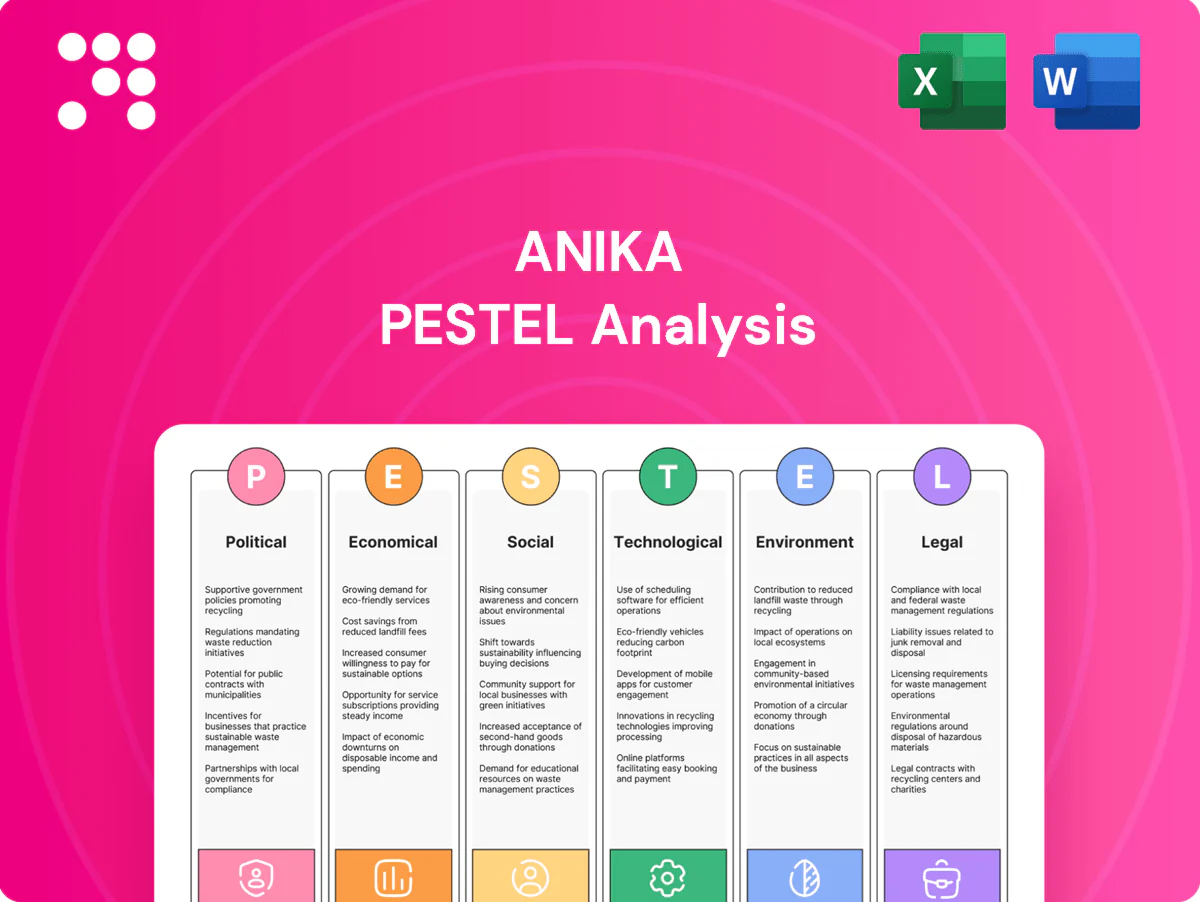
Anika PESTLE Analysis

Your Shortcut to Market Insight Starts Here
Unlock strategic advantage with our targeted PESTLE analysis of Anika—revealing political, economic, social, technological, legal and environmental forces shaping its trajectory. Ideal for investors, consultants, and planners, it turns external trends into actionable strategy. Purchase the full report for the complete, editable deep-dive and instant download.
Political factors

Healthcare reimbursement policy shifts
Changes in national reimbursement frameworks directly influence adoption and pricing of HA-based orthopedic and pain products; with Medicare covering about 67 million beneficiaries in 2024, favorable CMS/insurer decisions materially affect U.S. uptake. Favorable coverage for viscosupplementation and regenerative therapies can boost procedure volumes in the roughly $1.0B viscosupplementation market. Cuts or step-therapy mandates delay uptake and compress margins, so close engagement with HTA bodies and payers is critical to maintain access.
Regulatory harmonization and approvals
Variations between FDA, EU MDR (implemented May 2021) and other regimes can lengthen time-to-market by 12–24 months and raise development costs by up to 40%, impacting Anika’s tissue-regeneration timelines. Stricter clinical-evidence demands under EU MDR increase trial complexity and sample sizes for orthobiologics. FDA Breakthrough Device pathways offer accelerated review and may shorten approval times materially for sports-medicine indications. A proactive regulatory strategy mitigates launch delays and revenue risk.

Trade policy and supply chain geopolitics
Tariffs of roughly 5–25% on biotech inputs and medical devices can materially elevate COGS for HA raw materials and components. Export controls and customs bottlenecks have been shown to increase delivery lead times by up to 30%, disrupting access to key orthopedic markets. Concentration risk is acute—China and a few Asian suppliers account for about 40% of certain device components—so diversifying manufacturing and suppliers reduces vulnerability. Government incentives and grants running into the billions in the US/EU are already reshaping footprint decisions.

Public health priorities and funding
Government focus on musculoskeletal health—affecting 1.71 billion people per WHO 2019—boosts funding for non-opioid pain solutions; US HEAL Initiative has mobilized over $1 billion for alternatives. Pandemic elective-surgery backlogs (~28.4M cancellations in 2020, COVIDSurg) alter timing. Grants and partnerships accelerate wound-healing/tissue-repair R&D; budget shifts could reprioritize chronic pain programs.
- WHO: 1.71B affected
- COVIDSurg: ~28.4M cancellations
- HEAL: >$1B
- More grants/public–private partnerships
Procurement practices in public systems
Tendering rules, reference pricing and value-based procurement in national systems (public procurement ≈12% of GDP) drive share and price, with competitive tenders cutting prices 20–40% in recent EU hospital procurements. Demonstrating cost-effectiveness versus corticosteroids or surgery is essential given HTA thresholds (eg £20–30k/QALY). Real-world evidence secures formulary wins; 3–5 year framework agreements stabilize demand but compress pricing and margins.
- Tendering rules — price pressure, 20–40% cuts
- Reference/VBP — HTA thresholds £20–30k/QALY
- RWE — increases formulary success
- Frameworks 3–5 yrs — demand stability, margin squeeze
Reimbursement, HTA and regulatory delays cut viscosupplement uptake and pricing
Reimbursement shifts (Medicare ~67M beneficiaries in 2024) and HTA/payer coverage materially affect uptake and pricing in the ~$1.0B viscosupplementation market; cuts/step therapy delay adoption. Regulatory divergence (EU MDR, FDA) can add 12–24 months and ~40% higher development costs. Tariffs (5–25%) and ~40% supplier concentration raise COGS and lead times. Tendering/VBP drive 20–40% price cuts; HTA ~£20–30k/QALY.
| Metric | 2024/25 Value |
|---|---|
| Medicare beneficiaries | ~67M (2024) |
| Viscosupplementation market | ~$1.0B |
| Regulatory delay | 12–24 months |
| Dev cost increase | ~40% |
| Tariffs | 5–25% |
| Supplier concentration | ~40% |
| Tender price cuts | 20–40% |
| HTA threshold | £20–30k/QALY |
What is included in the product
 Detailed Word Document
Explores how external macro-environmental factors uniquely affect Anika across Political, Economic, Social, Technological, Environmental, and Legal dimensions, with data-backed trends and regional regulatory context. Designed for executives, consultants, and entrepreneurs, it provides detailed subpoints, forward-looking insights and clean formatting ready for business plans, pitch decks, and investor materials.

 Customizable Excel Spreadsheet
Visually segmented by PESTLE categories for rapid interpretation, the Anika PESTLE Analysis provides a concise, editable summary that can be dropped into presentations or shared across teams to streamline risk discussions and strategic alignment.
Economic factors

Macroeconomic cycles and hospital budgets
Economic slowdowns compress elective orthopedics volumes—severe downturns can cut procedures by up to ~48% (April 2020 benchmark), reducing device demand. Hospital CAPEX and OPEX constraints force deferral of new sports-medicine product adoption as facilities prioritize essentials. Deferred-care rebounds have produced 20–30% catch-up demand in post-downturn phases. Pricing discipline and tiered portfolios help navigate budget swings.
Inflation and input cost pressures
Inflation raises costs for HA fermentation, sterile packaging and logistics as US CPI averaged about 3.4% in 2024 and global container rates remain roughly 20% above pre‑pandemic levels despite falling from 2022 peaks. Wage inflation in healthcare ran near 4.6% in 2024, eroding provider willingness to adopt premium therapies. Strategic sourcing and productivity initiatives can protect margins, while selective price increases risk payer pushback and utilization controls.

Currency fluctuations in global sales
FX volatility materially affects reported revenue and procurement affordability across regions; for peer specialty chemical firms, currency swings have driven reported revenue variances of 2–6% annually. A strong dollar (DXY ~104–106 in H1 2025) has damped ex-US demand for HA products by raising local prices. Natural hedging via localized costs and pricing offsets some exposure. Active hedging programs cut earnings variability and smooth quarterly EPS.

Payer mix and out-of-pocket dynamics
Shifts among public, private and self-pay funding change volumes and price realization for viscosupplementation; Medicare and Medicaid together account for roughly 37% of US health spending (CMS 2023) while Medicare Advantage enrollment reached about 50% in 2024, altering contract mix. High deductibles (average single deductible $1,763 in employer plans, KFF 2024) can delay elective injections; patient assistance programs and bundled pricing sustain throughput. Payer outcome-based clauses increasingly tie revenue to measured clinical results.
- Payer mix: public ~37% of spending (CMS 2023)
- MA penetration: ~50% (2024)
- Avg deductible: $1,763 (KFF 2024)
- Bundled/pricing & assistance sustain volumes
- Outcome clauses tie reimbursement to performance
M&A and partnership opportunities
Consolidation in orthopedics and sports medicine is shifting channel power toward larger OEMs, with medtech M&A activity up about 8% in 2024; this concentrates negotiating leverage on distribution and hospital formularies. Acquisitions can rapidly expand HA and regenerative portfolios across indications and regions, supporting access to markets where the regenerative market was estimated near $25bn in 2023. Co-development deals with biotech partners distribute R&D risk and reduce cash burn, but integration execution determines actual synergy capture and ROI.
- Consolidation: increases channel leverage
- Acquisitions: expand indications/regional reach
- Co-development: spreads R&D risk
- Integration: key to capturing synergies and ROI
Reimbursement, HTA and regulatory delays cut viscosupplement uptake and pricing
Economic cycles cut elective ortho volumes (up to ~48% April 2020); post-downturn catch-up 20–30% boosts demand. Inflation raised input costs (US CPI ~3.4% 2024; healthcare wages ~4.6% 2024) while FX (DXY ~104–106 H1 2025) and consolidation shift margin and pricing power. Payer mix (Medicare/Medicaid ~37% CMS 2023; MA ~50% 2024) and high deductibles ($1,763 KFF 2024) constrain uptake.
| Metric | Value |
|---|---|
| Elective drop (peak) | ~48% (Apr 2020) |
| Post-downturn rebound | 20–30% |
| US CPI 2024 | 3.4% |
| Healthcare wages 2024 | 4.6% |
| DXY H1 2025 | 104–106 |
| Medicare/Medicaid | ~37% (CMS 2023) |
| MA penetration | ~50% (2024) |
| Avg deductible | $1,763 (KFF 2024) |
Same Document Delivered
Anika PESTLE Analysis
The preview shown here is the exact Anika PESTLE Analysis document you’ll receive after purchase—fully formatted and ready to use. This is the real file, delivered exactly as displayed with no placeholders or surprises. The layout, content, and structure visible here are exactly what you’ll download immediately after buying.

Product Information
Product Information
Shipping & Returns
Shipping & Returns
Description
Your Shortcut to Market Insight Starts Here
Unlock strategic advantage with our targeted PESTLE analysis of Anika—revealing political, economic, social, technological, legal and environmental forces shaping its trajectory. Ideal for investors, consultants, and planners, it turns external trends into actionable strategy. Purchase the full report for the complete, editable deep-dive and instant download.
Political factors
Healthcare reimbursement policy shifts
Changes in national reimbursement frameworks directly influence adoption and pricing of HA-based orthopedic and pain products; with Medicare covering about 67 million beneficiaries in 2024, favorable CMS/insurer decisions materially affect U.S. uptake. Favorable coverage for viscosupplementation and regenerative therapies can boost procedure volumes in the roughly $1.0B viscosupplementation market. Cuts or step-therapy mandates delay uptake and compress margins, so close engagement with HTA bodies and payers is critical to maintain access.
Regulatory harmonization and approvals
Variations between FDA, EU MDR (implemented May 2021) and other regimes can lengthen time-to-market by 12–24 months and raise development costs by up to 40%, impacting Anika’s tissue-regeneration timelines. Stricter clinical-evidence demands under EU MDR increase trial complexity and sample sizes for orthobiologics. FDA Breakthrough Device pathways offer accelerated review and may shorten approval times materially for sports-medicine indications. A proactive regulatory strategy mitigates launch delays and revenue risk.
Trade policy and supply chain geopolitics
Tariffs of roughly 5–25% on biotech inputs and medical devices can materially elevate COGS for HA raw materials and components. Export controls and customs bottlenecks have been shown to increase delivery lead times by up to 30%, disrupting access to key orthopedic markets. Concentration risk is acute—China and a few Asian suppliers account for about 40% of certain device components—so diversifying manufacturing and suppliers reduces vulnerability. Government incentives and grants running into the billions in the US/EU are already reshaping footprint decisions.
Public health priorities and funding
Government focus on musculoskeletal health—affecting 1.71 billion people per WHO 2019—boosts funding for non-opioid pain solutions; US HEAL Initiative has mobilized over $1 billion for alternatives. Pandemic elective-surgery backlogs (~28.4M cancellations in 2020, COVIDSurg) alter timing. Grants and partnerships accelerate wound-healing/tissue-repair R&D; budget shifts could reprioritize chronic pain programs.
- WHO: 1.71B affected
- COVIDSurg: ~28.4M cancellations
- HEAL: >$1B
- More grants/public–private partnerships
Procurement practices in public systems
Tendering rules, reference pricing and value-based procurement in national systems (public procurement ≈12% of GDP) drive share and price, with competitive tenders cutting prices 20–40% in recent EU hospital procurements. Demonstrating cost-effectiveness versus corticosteroids or surgery is essential given HTA thresholds (eg £20–30k/QALY). Real-world evidence secures formulary wins; 3–5 year framework agreements stabilize demand but compress pricing and margins.
- Tendering rules — price pressure, 20–40% cuts
- Reference/VBP — HTA thresholds £20–30k/QALY
- RWE — increases formulary success
- Frameworks 3–5 yrs — demand stability, margin squeeze
Reimbursement, HTA and regulatory delays cut viscosupplement uptake and pricing
Reimbursement shifts (Medicare ~67M beneficiaries in 2024) and HTA/payer coverage materially affect uptake and pricing in the ~$1.0B viscosupplementation market; cuts/step therapy delay adoption. Regulatory divergence (EU MDR, FDA) can add 12–24 months and ~40% higher development costs. Tariffs (5–25%) and ~40% supplier concentration raise COGS and lead times. Tendering/VBP drive 20–40% price cuts; HTA ~£20–30k/QALY.
| Metric | 2024/25 Value |
|---|---|
| Medicare beneficiaries | ~67M (2024) |
| Viscosupplementation market | ~$1.0B |
| Regulatory delay | 12–24 months |
| Dev cost increase | ~40% |
| Tariffs | 5–25% |
| Supplier concentration | ~40% |
| Tender price cuts | 20–40% |
| HTA threshold | £20–30k/QALY |
What is included in the product
Detailed Word Document
Explores how external macro-environmental factors uniquely affect Anika across Political, Economic, Social, Technological, Environmental, and Legal dimensions, with data-backed trends and regional regulatory context. Designed for executives, consultants, and entrepreneurs, it provides detailed subpoints, forward-looking insights and clean formatting ready for business plans, pitch decks, and investor materials.
Customizable Excel Spreadsheet
Visually segmented by PESTLE categories for rapid interpretation, the Anika PESTLE Analysis provides a concise, editable summary that can be dropped into presentations or shared across teams to streamline risk discussions and strategic alignment.
Economic factors
Macroeconomic cycles and hospital budgets
Economic slowdowns compress elective orthopedics volumes—severe downturns can cut procedures by up to ~48% (April 2020 benchmark), reducing device demand. Hospital CAPEX and OPEX constraints force deferral of new sports-medicine product adoption as facilities prioritize essentials. Deferred-care rebounds have produced 20–30% catch-up demand in post-downturn phases. Pricing discipline and tiered portfolios help navigate budget swings.
Inflation and input cost pressures
Inflation raises costs for HA fermentation, sterile packaging and logistics as US CPI averaged about 3.4% in 2024 and global container rates remain roughly 20% above pre‑pandemic levels despite falling from 2022 peaks. Wage inflation in healthcare ran near 4.6% in 2024, eroding provider willingness to adopt premium therapies. Strategic sourcing and productivity initiatives can protect margins, while selective price increases risk payer pushback and utilization controls.
Currency fluctuations in global sales
FX volatility materially affects reported revenue and procurement affordability across regions; for peer specialty chemical firms, currency swings have driven reported revenue variances of 2–6% annually. A strong dollar (DXY ~104–106 in H1 2025) has damped ex-US demand for HA products by raising local prices. Natural hedging via localized costs and pricing offsets some exposure. Active hedging programs cut earnings variability and smooth quarterly EPS.
Payer mix and out-of-pocket dynamics
Shifts among public, private and self-pay funding change volumes and price realization for viscosupplementation; Medicare and Medicaid together account for roughly 37% of US health spending (CMS 2023) while Medicare Advantage enrollment reached about 50% in 2024, altering contract mix. High deductibles (average single deductible $1,763 in employer plans, KFF 2024) can delay elective injections; patient assistance programs and bundled pricing sustain throughput. Payer outcome-based clauses increasingly tie revenue to measured clinical results.
- Payer mix: public ~37% of spending (CMS 2023)
- MA penetration: ~50% (2024)
- Avg deductible: $1,763 (KFF 2024)
- Bundled/pricing & assistance sustain volumes
- Outcome clauses tie reimbursement to performance
M&A and partnership opportunities
Consolidation in orthopedics and sports medicine is shifting channel power toward larger OEMs, with medtech M&A activity up about 8% in 2024; this concentrates negotiating leverage on distribution and hospital formularies. Acquisitions can rapidly expand HA and regenerative portfolios across indications and regions, supporting access to markets where the regenerative market was estimated near $25bn in 2023. Co-development deals with biotech partners distribute R&D risk and reduce cash burn, but integration execution determines actual synergy capture and ROI.
- Consolidation: increases channel leverage
- Acquisitions: expand indications/regional reach
- Co-development: spreads R&D risk
- Integration: key to capturing synergies and ROI
Reimbursement, HTA and regulatory delays cut viscosupplement uptake and pricing
Economic cycles cut elective ortho volumes (up to ~48% April 2020); post-downturn catch-up 20–30% boosts demand. Inflation raised input costs (US CPI ~3.4% 2024; healthcare wages ~4.6% 2024) while FX (DXY ~104–106 H1 2025) and consolidation shift margin and pricing power. Payer mix (Medicare/Medicaid ~37% CMS 2023; MA ~50% 2024) and high deductibles ($1,763 KFF 2024) constrain uptake.
| Metric | Value |
|---|---|
| Elective drop (peak) | ~48% (Apr 2020) |
| Post-downturn rebound | 20–30% |
| US CPI 2024 | 3.4% |
| Healthcare wages 2024 | 4.6% |
| DXY H1 2025 | 104–106 |
| Medicare/Medicaid | ~37% (CMS 2023) |
| MA penetration | ~50% (2024) |
| Avg deductible | $1,763 (KFF 2024) |
Same Document Delivered
Anika PESTLE Analysis
The preview shown here is the exact Anika PESTLE Analysis document you’ll receive after purchase—fully formatted and ready to use. This is the real file, delivered exactly as displayed with no placeholders or surprises. The layout, content, and structure visible here are exactly what you’ll download immediately after buying.