Amicus Therapeutics PESTLE Analysis

Plan Smarter. Present Sharper. Compete Stronger.
Unlock strategic clarity with our PESTLE Analysis of Amicus Therapeutics—spot regulatory, economic, and technological forces shaping its pipeline and commercial prospects. Perfect for investors and strategists, it turns external risk into actionable insight. Purchase the full, downloadable report now to inform smarter decisions.
Political factors

Orphan policy stability
Global orphan-drug frameworks—notably 7-year market exclusivity in the US and 10 years in the EU and Japan—shape incentives, timelines and pricing for rare-disease therapies; the orphan sector generated about $220 billion in sales in 2024. Changes to ODA rules in the US, EU or Japan can compress ROI and pricing latitude, so monitoring policy reviews and sustained regulator dialogue plus robust patient-impact evidence is essential to defend favorable provisions.
Reimbursement politics
National health budgets and HTA priorities (e.g., NICE thresholds ~20–30k GBP/QALY, HST programs up to ~100k GBP/QALY) heavily influence access to high-cost rare-disease drugs. Political pressure to curb specialty spend—specialty medicines accounted for roughly 50% of US drug spend in 2023 (IQVIA)—tightens coverage criteria. Demonstrating long-term value and budget-impact mitigation is essential in price and access negotiations. Cross-border reference pricing across 27 EU states adds pricing complexity.

Geopolitics and supply chains
Trade tensions, export controls, and sanctions can disrupt APIs, viral vectors, and specialized inputs, noting China and India supply about 70% of global APIs, heightening sourcing risk for Amicus.
Regionalization policies are driving dual sourcing and localized manufacturing, with many biopharma moving to 2–6 month on‑shore buffer inventories to ensure continuity.
Governments increasingly incentivize domestic production of strategic medicines, making proactive supply mapping a critical risk-reduction tool.

Regulatory alignment
Divergent FDA (priority review 6 months; standard ~10 months) and EMA (centralized ~210 days) pathways shape Amicus trial timelines—Galafold was EMA-approved 2016 and FDA 2018—while convergence on surrogate endpoints in rare disease guidance has shortened launches. Early scientific advice and coordinated global filings optimize development and labeling. Plan post-approval commitments early; FDA long-term follow-up for gene therapies can reach 15 years.
- Regulatory timing: FDA 6–10m, EMA ~210d
- Real-world: Galafold EMA 2016, FDA 2018
- Endpoint convergence speeds launches
- Plan post-approval (eg 15y LTFU)
Advocacy group influence
Patient organizations shape legislative agendas and access decisions in rare diseases, with about 7,000 distinct conditions affecting roughly 300 million people worldwide, driving policy focus. Collaboration with advocates can boost trial recruitment and relevance of endpoints, improving study enrollment and regulatory acceptance. Transparent engagement builds credibility with payers and regulators, and sustained advocacy helps preserve premium pricing where unmet need is high.
- Patient reach: ~300M global
- Conditions: ~7,000 rare diseases
- Benefits: better recruitment, endpoint relevance
- Outcome: stronger pricing and access
Orphan drug market $220B, supply risks, HTA limits and divergent FDA/EMA review times
Political factors: orphan exclusivity (US 7y, EU/Japan 10y) and $220B orphan sales 2024 drive pricing; HTA thresholds (NICE 20–30k GBP/QALY; HST up to 100k) and specialty drugs ~50% of US drug spend 2023 constrain access; supply risks from China/India ~70% of APIs plus trade controls; onshoring incentives and divergent FDA/EMA review times (FDA 6–10m; EMA ~210d) affect timelines.
| Metric | Value |
|---|---|
| Orphan sales 2024 | $220B |
| NICE threshold | 20–30k GBP/QALY |
| Specialty share US 2023 | ~50% |
| API supply | ~70% China/India |
What is included in the product
 Detailed Word Document
Explores how macro-environmental factors uniquely affect Amicus Therapeutics across Political, Economic, Social, Technological, Environmental and Legal dimensions, with data-backed trends and forward-looking insights to help executives, investors and strategists identify threats, opportunities and scenario-driven responses.

 Customizable Excel Spreadsheet
A concise, visually segmented PESTLE summary of Amicus Therapeutics that highlights key regulatory, market and technological risks and opportunities, easily droppable into presentations and shareable for quick cross‑team alignment.
Economic factors

Pricing and affordability
High per-patient costs for Amicus therapies have driven payer pushback and managed-access schemes; outcomes-based contracts are being pursued to protect list pricing while smoothing budget impact. Robust real-world effectiveness data from post-market studies strengthens reimbursement cases. International reference pricing remains a continued risk that can compress margins over time.
Capital and interest rates
Biotech valuations and funding costs track rate cycles and risk appetite; with the US federal funds target at 5.25–5.50% and 10-year Treasury near 4.5% in mid-2025, higher rates raise WACC and compress NPVs of Amicuss pipeline and post-approval cash flows. Non-dilutive instruments and disciplined R&D spend extend runway, while milestone-tied partnerships and upfronts smooth financing needs and reduce dilution risk.

FX and global mix
Revenues across the US, EU and Japan expose Amicus to currency volatility versus the US dollar, affecting reported top-line and margins. Natural hedging arises because a portion of R&D, manufacturing and SG&A are incurred in local currencies, reducing net FX exposure. Active hedging programs target protection of near-term margins and cash flow stability. Geographic diversification across major markets smooths revenue volatility and supports predictable cash generation.

Market concentration
Market concentration in Amicus Therapeutics centers on therapies for rare diseases like Fabry, whose prevalence is estimated at 1:40,000–1:117,000, meaning small patient pools and label breadth (adults/adolescents with amenable mutations for migalastat) directly constrain revenue scalability. Diagnosis and treatment rates drive addressable market; geographic and age expansion diversifies demand while new entrants can quickly erode niche share.
- Prevalence: 1:40,000–1:117,000
- Label breadth: adults/adolescents (migalastat)
- Risk: rapid share erosion from competitors
- Growth lever: geographic/age expansion
M&A and partnerships
Mergers, acquisitions and partnerships give Amicus pipeline optionality, technology access and regional reach while balancing risk through upfront payments versus milestone-driven structures to align incentives. Disciplined integration preserves scientific focus and culture, and active portfolio pruning improves capital efficiency and prioritization.
- pipeline optionality
- upfronts vs milestones
- integration discipline
- portfolio pruning
Orphan drug market $220B, supply risks, HTA limits and divergent FDA/EMA review times
High per-patient prices prompt payer pushback and outcomes-based contracts; international reference pricing and small Fabry prevalence (1:40,000–1:117,000) limit revenue scaling. Higher rates (Fed funds 5.25–5.50% mid-2025; 10y Treasury ~4.5%) raise WACC and compress NPVs. Currency volatility makes geographic expansion, milestone financing and partnerships key to margin stability.
| Metric | Value |
|---|---|
| Fed funds (mid-2025) | 5.25–5.50% |
| 10y Treasury | ~4.5% |
| Fabry prevalence | 1:40,000–1:117,000 |
Same Document Delivered
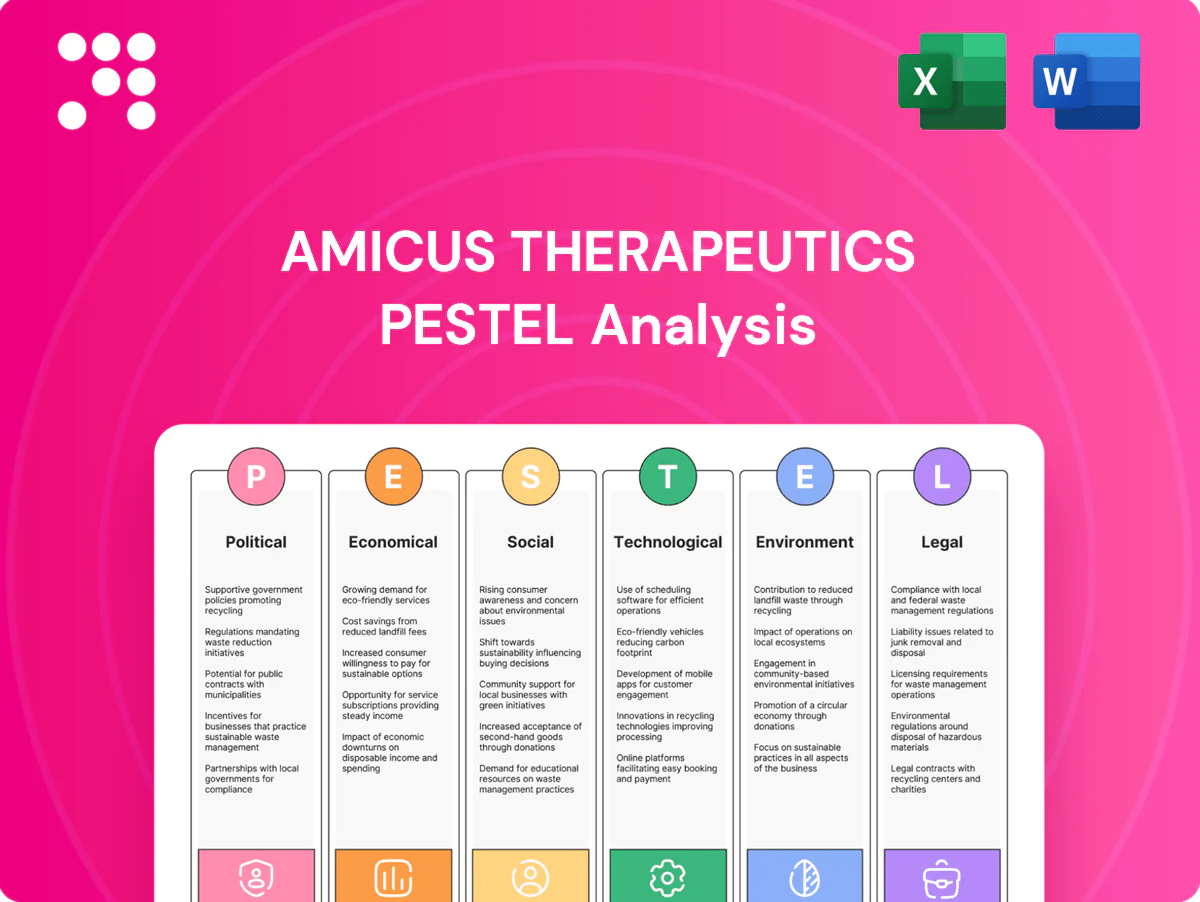
Amicus Therapeutics PESTLE Analysis
The Amicus Therapeutics PESTLE Analysis preview shown here is the exact document you’ll receive after purchase—fully formatted and ready to use. It provides comprehensive political, economic, social, technological, legal, and environmental insights specific to Amicus Therapeutics. No placeholders or teasers—this is the final, professional file you’ll download immediately after checkout.

Original: $10.00
-65%$10.00
$3.50Product Information
Product Information
Shipping & Returns
Shipping & Returns
Description
Plan Smarter. Present Sharper. Compete Stronger.
Unlock strategic clarity with our PESTLE Analysis of Amicus Therapeutics—spot regulatory, economic, and technological forces shaping its pipeline and commercial prospects. Perfect for investors and strategists, it turns external risk into actionable insight. Purchase the full, downloadable report now to inform smarter decisions.
Political factors
Orphan policy stability
Global orphan-drug frameworks—notably 7-year market exclusivity in the US and 10 years in the EU and Japan—shape incentives, timelines and pricing for rare-disease therapies; the orphan sector generated about $220 billion in sales in 2024. Changes to ODA rules in the US, EU or Japan can compress ROI and pricing latitude, so monitoring policy reviews and sustained regulator dialogue plus robust patient-impact evidence is essential to defend favorable provisions.
Reimbursement politics
National health budgets and HTA priorities (e.g., NICE thresholds ~20–30k GBP/QALY, HST programs up to ~100k GBP/QALY) heavily influence access to high-cost rare-disease drugs. Political pressure to curb specialty spend—specialty medicines accounted for roughly 50% of US drug spend in 2023 (IQVIA)—tightens coverage criteria. Demonstrating long-term value and budget-impact mitigation is essential in price and access negotiations. Cross-border reference pricing across 27 EU states adds pricing complexity.
Geopolitics and supply chains
Trade tensions, export controls, and sanctions can disrupt APIs, viral vectors, and specialized inputs, noting China and India supply about 70% of global APIs, heightening sourcing risk for Amicus.
Regionalization policies are driving dual sourcing and localized manufacturing, with many biopharma moving to 2–6 month on‑shore buffer inventories to ensure continuity.
Governments increasingly incentivize domestic production of strategic medicines, making proactive supply mapping a critical risk-reduction tool.
Regulatory alignment
Divergent FDA (priority review 6 months; standard ~10 months) and EMA (centralized ~210 days) pathways shape Amicus trial timelines—Galafold was EMA-approved 2016 and FDA 2018—while convergence on surrogate endpoints in rare disease guidance has shortened launches. Early scientific advice and coordinated global filings optimize development and labeling. Plan post-approval commitments early; FDA long-term follow-up for gene therapies can reach 15 years.
- Regulatory timing: FDA 6–10m, EMA ~210d
- Real-world: Galafold EMA 2016, FDA 2018
- Endpoint convergence speeds launches
- Plan post-approval (eg 15y LTFU)
Advocacy group influence
Patient organizations shape legislative agendas and access decisions in rare diseases, with about 7,000 distinct conditions affecting roughly 300 million people worldwide, driving policy focus. Collaboration with advocates can boost trial recruitment and relevance of endpoints, improving study enrollment and regulatory acceptance. Transparent engagement builds credibility with payers and regulators, and sustained advocacy helps preserve premium pricing where unmet need is high.
- Patient reach: ~300M global
- Conditions: ~7,000 rare diseases
- Benefits: better recruitment, endpoint relevance
- Outcome: stronger pricing and access
Orphan drug market $220B, supply risks, HTA limits and divergent FDA/EMA review times
Political factors: orphan exclusivity (US 7y, EU/Japan 10y) and $220B orphan sales 2024 drive pricing; HTA thresholds (NICE 20–30k GBP/QALY; HST up to 100k) and specialty drugs ~50% of US drug spend 2023 constrain access; supply risks from China/India ~70% of APIs plus trade controls; onshoring incentives and divergent FDA/EMA review times (FDA 6–10m; EMA ~210d) affect timelines.
| Metric | Value |
|---|---|
| Orphan sales 2024 | $220B |
| NICE threshold | 20–30k GBP/QALY |
| Specialty share US 2023 | ~50% |
| API supply | ~70% China/India |
What is included in the product
Detailed Word Document
Explores how macro-environmental factors uniquely affect Amicus Therapeutics across Political, Economic, Social, Technological, Environmental and Legal dimensions, with data-backed trends and forward-looking insights to help executives, investors and strategists identify threats, opportunities and scenario-driven responses.
Customizable Excel Spreadsheet
A concise, visually segmented PESTLE summary of Amicus Therapeutics that highlights key regulatory, market and technological risks and opportunities, easily droppable into presentations and shareable for quick cross‑team alignment.
Economic factors
Pricing and affordability
High per-patient costs for Amicus therapies have driven payer pushback and managed-access schemes; outcomes-based contracts are being pursued to protect list pricing while smoothing budget impact. Robust real-world effectiveness data from post-market studies strengthens reimbursement cases. International reference pricing remains a continued risk that can compress margins over time.
Capital and interest rates
Biotech valuations and funding costs track rate cycles and risk appetite; with the US federal funds target at 5.25–5.50% and 10-year Treasury near 4.5% in mid-2025, higher rates raise WACC and compress NPVs of Amicuss pipeline and post-approval cash flows. Non-dilutive instruments and disciplined R&D spend extend runway, while milestone-tied partnerships and upfronts smooth financing needs and reduce dilution risk.
FX and global mix
Revenues across the US, EU and Japan expose Amicus to currency volatility versus the US dollar, affecting reported top-line and margins. Natural hedging arises because a portion of R&D, manufacturing and SG&A are incurred in local currencies, reducing net FX exposure. Active hedging programs target protection of near-term margins and cash flow stability. Geographic diversification across major markets smooths revenue volatility and supports predictable cash generation.
Market concentration
Market concentration in Amicus Therapeutics centers on therapies for rare diseases like Fabry, whose prevalence is estimated at 1:40,000–1:117,000, meaning small patient pools and label breadth (adults/adolescents with amenable mutations for migalastat) directly constrain revenue scalability. Diagnosis and treatment rates drive addressable market; geographic and age expansion diversifies demand while new entrants can quickly erode niche share.
- Prevalence: 1:40,000–1:117,000
- Label breadth: adults/adolescents (migalastat)
- Risk: rapid share erosion from competitors
- Growth lever: geographic/age expansion
M&A and partnerships
Mergers, acquisitions and partnerships give Amicus pipeline optionality, technology access and regional reach while balancing risk through upfront payments versus milestone-driven structures to align incentives. Disciplined integration preserves scientific focus and culture, and active portfolio pruning improves capital efficiency and prioritization.
- pipeline optionality
- upfronts vs milestones
- integration discipline
- portfolio pruning
Orphan drug market $220B, supply risks, HTA limits and divergent FDA/EMA review times
High per-patient prices prompt payer pushback and outcomes-based contracts; international reference pricing and small Fabry prevalence (1:40,000–1:117,000) limit revenue scaling. Higher rates (Fed funds 5.25–5.50% mid-2025; 10y Treasury ~4.5%) raise WACC and compress NPVs. Currency volatility makes geographic expansion, milestone financing and partnerships key to margin stability.
| Metric | Value |
|---|---|
| Fed funds (mid-2025) | 5.25–5.50% |
| 10y Treasury | ~4.5% |
| Fabry prevalence | 1:40,000–1:117,000 |
Same Document Delivered
Amicus Therapeutics PESTLE Analysis
The Amicus Therapeutics PESTLE Analysis preview shown here is the exact document you’ll receive after purchase—fully formatted and ready to use. It provides comprehensive political, economic, social, technological, legal, and environmental insights specific to Amicus Therapeutics. No placeholders or teasers—this is the final, professional file you’ll download immediately after checkout.