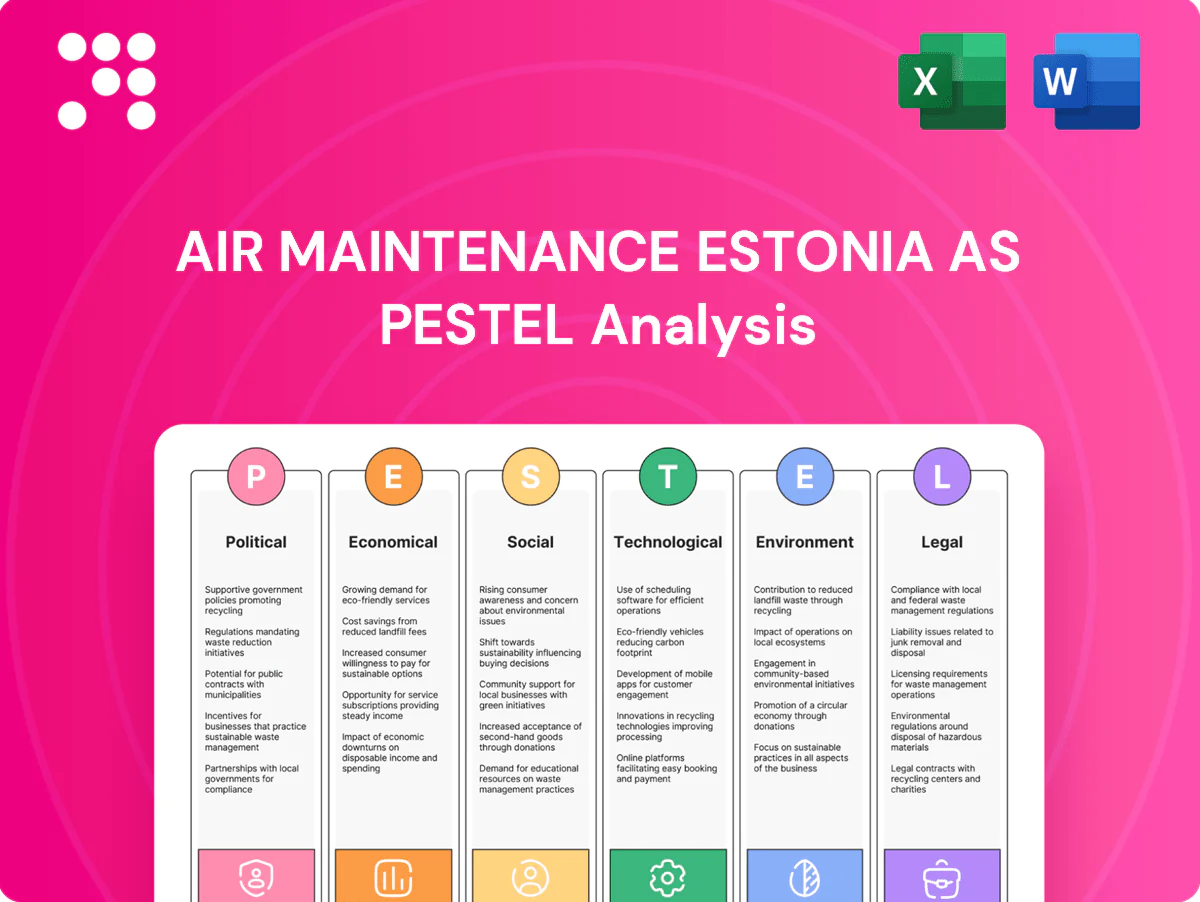
Air Maintenance Estonia AS PESTLE Analysis

Your Shortcut to Market Insight Starts Here
Gain a competitive edge with our PESTLE Analysis of Air Maintenance Estonia AS—uncover political, economic, social, technological, legal, and environmental trends shaping its future and strategic risks you can act on. Buy the full report for instantly downloadable, actionable intelligence.
Political factors

EU aviation policy alignment
EU membership anchors Air Maintenance Estonia under EASA oversight and 27-state single-market access, with EASA rules applying across 30+ cooperating states to streamline certification. Harmonized regulations ease cross-border maintenance contracts with EU carriers—EU aviation handled roughly 1.1 billion passengers in 2024, sustaining high MRO demand. Shifts in safety rules or state aid policies can raise compliance costs and alter competitiveness. Monitoring EU Transport White Papers and the 2024 Sustainable and Smart Mobility updates helps anticipate regulatory direction.
Baltic regional security context
Estonia’s NATO and EU membership since 2004 underpins stability but raises geopolitical sensitivity in the Baltic regional security context. Heightened tensions can force rerouting of flights and push up insurance and fuel hedging costs for carriers. Air Maintenance Estonia must embed contingency plans for supply‑chain and airspace disruptions in BCPs. Proximity to Nordic markets (Tallinn–Helsinki ~80 km) provides a strategic buffer.

Sanctions and export controls
EU aviation sanctions introduced in 2022 ban export of aircraft parts and services to Russia/Belarus, contributing to about 1,000 Western-built aircraft effectively isolated and constraining parts sourcing and customer mix. Compliance requires strict component traceability and screening of dual-use items. AME must vet clients and vendors to avoid secondary sanctions exposure. Diversifying toward EU, Middle East and Africa fleets offsets lost Russian demand.

Government support and incentives
Estonia offers 0% corporate tax on reinvested profits, strong digitalization grants and targeted training incentives that lower upfront MRO IT and tooling costs; Enterprise Estonia and EU programmes routinely co-finance projects (co-funding up to 50% on many calls), enabling faster MRO upskilling and automation adoption in 2024–2025. Predictable tax treatment supports multi-year capacity investments and workforce development planning.
- 0% reinvested profit tax
- Grants often co-finance up to 50% of projects
- Digitalization and training incentives available via EAS/EU
- Policy emphasis on high-value manufacturing aids MRO upskilling
Bilateral air services and traffic rights
Airline network decisions hinge on bilateral air service agreements, directly influencing AME’s line and base maintenance demand through route frequency and aircraft rotations.
Open Skies arrangements, notably the EU–US Air Transport Agreement (2008), tend to boost carrier presence in the region; changes in overflight permissions can quickly reshape base maintenance scheduling and AOG response plans. AME benefits from Tallinn’s access to EU carriers since Estonia joined the EU in 2004 (EU: 27 states).
- Route rights influence MRO workload and utilization
- Open Skies (EU–US 2008) increases carrier entries
- Overflight rule shifts alter base maintenance timing
- EU membership (2004) secures access to 27-state carrier pool
EU oversight, tax breaks and grants boost MRO growth despite parts risk from barred aircraft
EU/EASA oversight (1.1bn EU pax 2024) secures market access; 0% reinvested profit tax and grants (≤50% co‑funding) lower MRO capex; ~1,000 Western aircraft barred from Russia/Belarus raises parts risk; NATO/EU membership (since 2004) stable but geopolitically sensitive; Tallinn–Helsinki ~80 km aids Nordic access.
| Item | Value (2024/25) |
|---|---|
| EU passengers | 1.1bn (2024) |
| Reinvested profit tax | 0% |
| Grant co‑funding | Up to 50% |
| Isolated aircraft | ~1,000 |
What is included in the product
 Detailed Word Document
Explores how Political, Economic, Social, Technological, Environmental and Legal forces uniquely affect Air Maintenance Estonia AS, combining data-driven trends and region-specific regulation to identify risks, opportunities and forward-looking scenarios for executives, investors and strategists.

 Customizable Excel Spreadsheet
Visually segmented PESTLE summary for Air Maintenance Estonia AS that streamlines external risk assessment and market-position discussions, delivering slide-ready text and editable notes for quick sharing across teams and client reports.
Economic factors

Cyclical airline demand
MRO volumes closely track passenger and cargo cycles; IATA reported global passenger demand returned to pre-pandemic levels in 2024, increasing line maintenance as fleet utilization rose. The global commercial MRO market was about $90B in 2023, and downturns shift activity toward heavy checks. AME should balance line versus base work and pursue long-term PBH or capacity-reservation contracts to stabilize revenue.
Cost base and wage dynamics
Labor is the dominant MRO cost; Statistics Estonia reports average gross monthly wage 2024 at 1,834 EUR, keeping Baltic pay well below many Western European MRO markets where senior technicians often earn above 4,000 EUR/month. Inflation (Estonia ~3.5% in 2024) and reported technician scarcity pressure margins, while digital productivity tools and shift optimization (efficiency gains reported in industry studies) and transparent pricing escalators help preserve the cost advantage and hedge inflation risk.

EUR–USD exposure on parts
Many MRO components are invoiced in USD while Air Maintenance Estonia bills largely in EUR, and with EUR–USD averaging about 1.09 in 2024 this FX mismatch can compress margins on USD-priced materials. Active hedging programs and contractual USD passthrough clauses are used to mitigate exposure and stabilize input costs. Strategic pooling of inventory and rotable management reduce reliance on spot USD purchases and limit short-term FX-driven cost shocks.

Energy and facility costs
Hangar heating and power materially drive OPEX in Estonia’s cold climate; industrial electricity averaged about €0.12/kWh in 2024 and energy-related costs commonly account for roughly 8–12% of MRO operating expenses. Volatile wholesale prices force procurement strategies and efficiency retrofits; on-site renewables or PPAs have reduced net energy spend by 10–25% in comparable Northern European MROs. Energy KPIs such as kWh/job and €/job map directly to job profitability and margin control.
- 2024 industrial electricity ~€0.12/kWh
- Energy share of OPEX 8–12%
- On-site renewables/PPAs can cut costs 10–25%
- Key KPIs: kWh/job, €/job
Competitive landscape in CEE MRO
AME faces strong competition from Polish, Lithuanian and Balkan MROs on 737/A320 base and line checks; proximity, median TAT of 48–72 hours versus regional 72–120 hours and on-time performance drive wins beyond price. 2024 regional capacity utilization approached ~80% at peaks, lifting spot rates by up to 10–15% and creating premium for available slots; bundling niche CAMO services can raise wallet share materially.
- Competitors: Poland, Lithuania, Balkans
- TAT edge: 48–72h vs 72–120h
- 2024 peak utilization ~80%
- Peak rate uplift: up to 10–15%
- CAMO bundling increases wallet share
EU oversight, tax breaks and grants boost MRO growth despite parts risk from barred aircraft
MRO demand rebounded to pre‑COVID levels (global MRO ~$90B in 2023), lifting line work and slot value; peak regional utilization ~80% in 2024 pushed spot rates +10–15%. Estonian wage advantage (avg gross €1,834/mo in 2024) offsets inflation (~3.5% 2024) and technician scarcity; energy (€0.12/kWh) and USD-priced parts (EUR–USD ~1.09) remain key margin risks mitigated by hedging and PPAs.
| Metric | Value |
|---|---|
| Global MRO 2023 | $90B |
| Estonia wage 2024 | €1,834/mo |
| Electricity 2024 | €0.12/kWh |
| EUR–USD 2024 | 1.09 |
| Peak util. 2024 | ~80% |
Same Document Delivered
Air Maintenance Estonia AS PESTLE Analysis
The preview shown here is the exact PESTLE Analysis of Air Maintenance Estonia AS you’ll receive after purchase—fully formatted and ready to use. It covers Political, Economic, Social, Technological, Legal and Environmental factors in the same structure and depth as the final file. No placeholders or teasers—this is the real, finished document available for immediate download.

Product Information
Product Information
Shipping & Returns
Shipping & Returns
Description
Your Shortcut to Market Insight Starts Here
Gain a competitive edge with our PESTLE Analysis of Air Maintenance Estonia AS—uncover political, economic, social, technological, legal, and environmental trends shaping its future and strategic risks you can act on. Buy the full report for instantly downloadable, actionable intelligence.
Political factors
EU aviation policy alignment
EU membership anchors Air Maintenance Estonia under EASA oversight and 27-state single-market access, with EASA rules applying across 30+ cooperating states to streamline certification. Harmonized regulations ease cross-border maintenance contracts with EU carriers—EU aviation handled roughly 1.1 billion passengers in 2024, sustaining high MRO demand. Shifts in safety rules or state aid policies can raise compliance costs and alter competitiveness. Monitoring EU Transport White Papers and the 2024 Sustainable and Smart Mobility updates helps anticipate regulatory direction.
Baltic regional security context
Estonia’s NATO and EU membership since 2004 underpins stability but raises geopolitical sensitivity in the Baltic regional security context. Heightened tensions can force rerouting of flights and push up insurance and fuel hedging costs for carriers. Air Maintenance Estonia must embed contingency plans for supply‑chain and airspace disruptions in BCPs. Proximity to Nordic markets (Tallinn–Helsinki ~80 km) provides a strategic buffer.
Sanctions and export controls
EU aviation sanctions introduced in 2022 ban export of aircraft parts and services to Russia/Belarus, contributing to about 1,000 Western-built aircraft effectively isolated and constraining parts sourcing and customer mix. Compliance requires strict component traceability and screening of dual-use items. AME must vet clients and vendors to avoid secondary sanctions exposure. Diversifying toward EU, Middle East and Africa fleets offsets lost Russian demand.
Government support and incentives
Estonia offers 0% corporate tax on reinvested profits, strong digitalization grants and targeted training incentives that lower upfront MRO IT and tooling costs; Enterprise Estonia and EU programmes routinely co-finance projects (co-funding up to 50% on many calls), enabling faster MRO upskilling and automation adoption in 2024–2025. Predictable tax treatment supports multi-year capacity investments and workforce development planning.
- 0% reinvested profit tax
- Grants often co-finance up to 50% of projects
- Digitalization and training incentives available via EAS/EU
- Policy emphasis on high-value manufacturing aids MRO upskilling
Bilateral air services and traffic rights
Airline network decisions hinge on bilateral air service agreements, directly influencing AME’s line and base maintenance demand through route frequency and aircraft rotations.
Open Skies arrangements, notably the EU–US Air Transport Agreement (2008), tend to boost carrier presence in the region; changes in overflight permissions can quickly reshape base maintenance scheduling and AOG response plans. AME benefits from Tallinn’s access to EU carriers since Estonia joined the EU in 2004 (EU: 27 states).
- Route rights influence MRO workload and utilization
- Open Skies (EU–US 2008) increases carrier entries
- Overflight rule shifts alter base maintenance timing
- EU membership (2004) secures access to 27-state carrier pool
EU oversight, tax breaks and grants boost MRO growth despite parts risk from barred aircraft
EU/EASA oversight (1.1bn EU pax 2024) secures market access; 0% reinvested profit tax and grants (≤50% co‑funding) lower MRO capex; ~1,000 Western aircraft barred from Russia/Belarus raises parts risk; NATO/EU membership (since 2004) stable but geopolitically sensitive; Tallinn–Helsinki ~80 km aids Nordic access.
| Item | Value (2024/25) |
|---|---|
| EU passengers | 1.1bn (2024) |
| Reinvested profit tax | 0% |
| Grant co‑funding | Up to 50% |
| Isolated aircraft | ~1,000 |
What is included in the product
Detailed Word Document
Explores how Political, Economic, Social, Technological, Environmental and Legal forces uniquely affect Air Maintenance Estonia AS, combining data-driven trends and region-specific regulation to identify risks, opportunities and forward-looking scenarios for executives, investors and strategists.
Customizable Excel Spreadsheet
Visually segmented PESTLE summary for Air Maintenance Estonia AS that streamlines external risk assessment and market-position discussions, delivering slide-ready text and editable notes for quick sharing across teams and client reports.
Economic factors
Cyclical airline demand
MRO volumes closely track passenger and cargo cycles; IATA reported global passenger demand returned to pre-pandemic levels in 2024, increasing line maintenance as fleet utilization rose. The global commercial MRO market was about $90B in 2023, and downturns shift activity toward heavy checks. AME should balance line versus base work and pursue long-term PBH or capacity-reservation contracts to stabilize revenue.
Cost base and wage dynamics
Labor is the dominant MRO cost; Statistics Estonia reports average gross monthly wage 2024 at 1,834 EUR, keeping Baltic pay well below many Western European MRO markets where senior technicians often earn above 4,000 EUR/month. Inflation (Estonia ~3.5% in 2024) and reported technician scarcity pressure margins, while digital productivity tools and shift optimization (efficiency gains reported in industry studies) and transparent pricing escalators help preserve the cost advantage and hedge inflation risk.
EUR–USD exposure on parts
Many MRO components are invoiced in USD while Air Maintenance Estonia bills largely in EUR, and with EUR–USD averaging about 1.09 in 2024 this FX mismatch can compress margins on USD-priced materials. Active hedging programs and contractual USD passthrough clauses are used to mitigate exposure and stabilize input costs. Strategic pooling of inventory and rotable management reduce reliance on spot USD purchases and limit short-term FX-driven cost shocks.
Energy and facility costs
Hangar heating and power materially drive OPEX in Estonia’s cold climate; industrial electricity averaged about €0.12/kWh in 2024 and energy-related costs commonly account for roughly 8–12% of MRO operating expenses. Volatile wholesale prices force procurement strategies and efficiency retrofits; on-site renewables or PPAs have reduced net energy spend by 10–25% in comparable Northern European MROs. Energy KPIs such as kWh/job and €/job map directly to job profitability and margin control.
- 2024 industrial electricity ~€0.12/kWh
- Energy share of OPEX 8–12%
- On-site renewables/PPAs can cut costs 10–25%
- Key KPIs: kWh/job, €/job
Competitive landscape in CEE MRO
AME faces strong competition from Polish, Lithuanian and Balkan MROs on 737/A320 base and line checks; proximity, median TAT of 48–72 hours versus regional 72–120 hours and on-time performance drive wins beyond price. 2024 regional capacity utilization approached ~80% at peaks, lifting spot rates by up to 10–15% and creating premium for available slots; bundling niche CAMO services can raise wallet share materially.
- Competitors: Poland, Lithuania, Balkans
- TAT edge: 48–72h vs 72–120h
- 2024 peak utilization ~80%
- Peak rate uplift: up to 10–15%
- CAMO bundling increases wallet share
EU oversight, tax breaks and grants boost MRO growth despite parts risk from barred aircraft
MRO demand rebounded to pre‑COVID levels (global MRO ~$90B in 2023), lifting line work and slot value; peak regional utilization ~80% in 2024 pushed spot rates +10–15%. Estonian wage advantage (avg gross €1,834/mo in 2024) offsets inflation (~3.5% 2024) and technician scarcity; energy (€0.12/kWh) and USD-priced parts (EUR–USD ~1.09) remain key margin risks mitigated by hedging and PPAs.
| Metric | Value |
|---|---|
| Global MRO 2023 | $90B |
| Estonia wage 2024 | €1,834/mo |
| Electricity 2024 | €0.12/kWh |
| EUR–USD 2024 | 1.09 |
| Peak util. 2024 | ~80% |
Same Document Delivered
Air Maintenance Estonia AS PESTLE Analysis
The preview shown here is the exact PESTLE Analysis of Air Maintenance Estonia AS you’ll receive after purchase—fully formatted and ready to use. It covers Political, Economic, Social, Technological, Legal and Environmental factors in the same structure and depth as the final file. No placeholders or teasers—this is the real, finished document available for immediate download.