Ambipar PESTLE Analysis

Your Shortcut to Market Insight Starts Here
Explore how political, economic, social, technological, legal and environmental forces are shaping Ambipar’s strategy and risk profile in this concise PESTLE snapshot. Ideal for investors and advisors seeking timely external insights. Purchase the full PESTLE for a complete, actionable breakdown and downloadable templates to inform decisions now.
Political factors

Cross-border regulatory alignment
Ambipar operates in 14 countries with differing waste and emergency-response regulations, complicating cross-border mobilization. Policy harmonization in blocs such as Mercosur or the EU could streamline permits and hazardous-material movement, cutting administrative lead times. Regulatory misalignment increases compliance costs and delays response mobilization. Active government relations and standards mapping are therefore critical.
Public environmental spending priorities
Shifts in government budgets for disaster preparedness and waste infrastructure directly affect Ambipar’s contract pipeline, as pro-climate administrations expand remediation and circular economy programs while austerity or political turnover can defer projects. Diversifying operations across Brazil, Mexico and the US smooths exposure to single-country budget cycles. Recent policy shifts in Latin America and North America have increased public tenders for remediation and emergency response services.

Geopolitical disruption and logistics
Conflicts, sanctions and port bottlenecks complicate waste exports, equipment sourcing and emergency deployments; the 2021 Suez Canal blockage cost global trade an estimated $9.6 billion per day and similar chokepoints raise response delays. Political risk can reroute assets and pushed regional marine insurance/war-risk premiums up to 300% in 2022–23. Scenario planning ensures continuity, and localizing suppliers where feasible reduces exposure.

Incentives for circular economy
Disaster management policy frameworks
National emergency plans and mutual aid agreements, such as EMAC which includes all 50 US states and territories, define response protocols and vendor eligibility, enabling Ambipar to qualify quickly under pre-approved frameworks that accelerate mobilization during incidents. Political scrutiny after major incidents often prompts regulatory tightening; maintaining certifications and regular drills sustains readiness and market access.
- EMAC: covers 50 states/territories
- Pre-approved frameworks: faster mobilization
- Post-incident scrutiny: tighter standards
- Certifications/drills: sustain readiness
Divergent cross-border waste rules, budget shifts and insurance spikes reshape project economics
Ambipar’s operations span 14 countries with divergent waste/emergency rules, raising compliance costs and cross‑border delays; policy harmonization (eg EU/Mercosur) would cut lead times. Shifts in public budgets and EPR/subsidy programs (US IRA ~369 billion USD) materially affect project pipelines and IRRs. Political disruptions, port chokepoints (Suez ~9.6B USD/day 2021) and insurance spikes (war-risk +300% 2022–23) heighten contingency needs.
| Metric | Value |
|---|---|
| Countries | 14 |
| US IRA | ~369B USD |
| EMAC coverage | 50 states/territories |
| Suez cost | ~9.6B USD/day (2021) |
| War-risk prem. | up to +300% (2022–23) |
What is included in the product
 Detailed Word Document
Explores how Political, Economic, Social, Technological, Environmental and Legal forces uniquely affect Ambipar, combining data-backed trends and region- and industry-specific examples to identify risks and opportunities; designed for executives and investors with forward-looking insights ready for reports and pitches.

 Customizable Excel Spreadsheet
Ambipar PESTLE provides a clean, segmented summary of external risks and opportunities for quick reference in meetings or presentations. It’s easily shareable and editable so teams can align fast and adapt insights to region-specific response plans.
Economic factors

Industrial production and waste volumes
Manufacturing cycles drive hazardous and non-hazardous waste generation, directly scaling Ambipar’s collection, treatment and valorization demand as industrial throughput rises. Economic slowdowns lower routine waste volumes but often increase remediation work from idled or decommissioned assets, preserving service demand. Ambipar’s diversified portfolio across oil & gas, mining and industrial services helps stabilize revenues across these production swings.
Commodity price cycles
Recycled outputs compete with virgin metals, plastics and fuels, so commodity cycles directly affect Ambipar recovery margins; LME copper traded near $9,500/ton and Brent averaged about $85/barrel in 2024, improving valorization economics during strong markets. Price dips, however, compress margins and can hurt profitability unless sales are hedged or price-contracted. Flexible offtake agreements mitigate downside risk and smooth cashflow.

Inflation and cost pass-through
Energy, transport and labor inflation — Brazil's IPCA was 5.79% in 2023 — lift operating costs for fleets and treatment plants, squeezing margins on fixed-price contracts. Indexed contracts enable pass-through of fuel and wage rises, while fixed-price deals compress EBITDA. Ambipar's procurement scale can secure better fuel and input rates, and continuous pricing reviews help protect operating margins.

FX volatility in global operations
Multi-currency revenues and costs expose Ambipar to FX swings; emerging-market currency volatility rose notably in 2024, with median annual moves near 9% (IMF/World Bank aggregates), so depreciations can materially erode foreign earnings on consolidation. Ambipar mitigates P&L noise via natural hedging and derivatives, and increasingly uses local financing to align cash flows with currency.
- Exposure: multi-currency ops
- Impact: ~9% median EM FX moves (2024)
- Mitigation: natural hedges + derivatives
- Funding: local financing to match cash flows
Capex and financing conditions
Interest rates directly shape feasibility of Ambipar’s new facilities and specialized equipment, as higher borrowing costs reduce project NPV; tighter credit conditions raise WACC and can delay expansion. Access to green financing and sustainability-linked loans can lower Ambipar’s cost of capital, while strong pipeline visibility justifies near-term capex despite cyclical funding constraints.
- Interest sensitivity
- Higher WACC delays projects
- Green financing reduces spreads
- Pipeline supports investment
Divergent cross-border waste rules, budget shifts and insurance spikes reshape project economics
Manufacturing cycles scale Ambipar’s waste services; Brent ~85$/b (2024) and LME copper ~9,500$/t improved valorization margins. Brazil IPCA 5.79% (2023) and ~9% median EM FX moves (2024) raise costs and FX risk; natural hedges, derivatives and local financing mitigate. Higher interest raises WACC and can delay capex; green financing lowers spreads.
| Metric | Value | Impact | Mitigation |
|---|---|---|---|
| Copper | ~9,500$/t | ↑recovery margin | offtake contracts |
| Brent | ~85$/b | ↑valorization economics | fuel contracts |
| IPCA | 5.79% | ↑Opex | indexed contracts |
| EM FX | ~9% | FX risk | hedges/local debt |
| Interest | market | ↑WACC | green loans |
Full Version Awaits
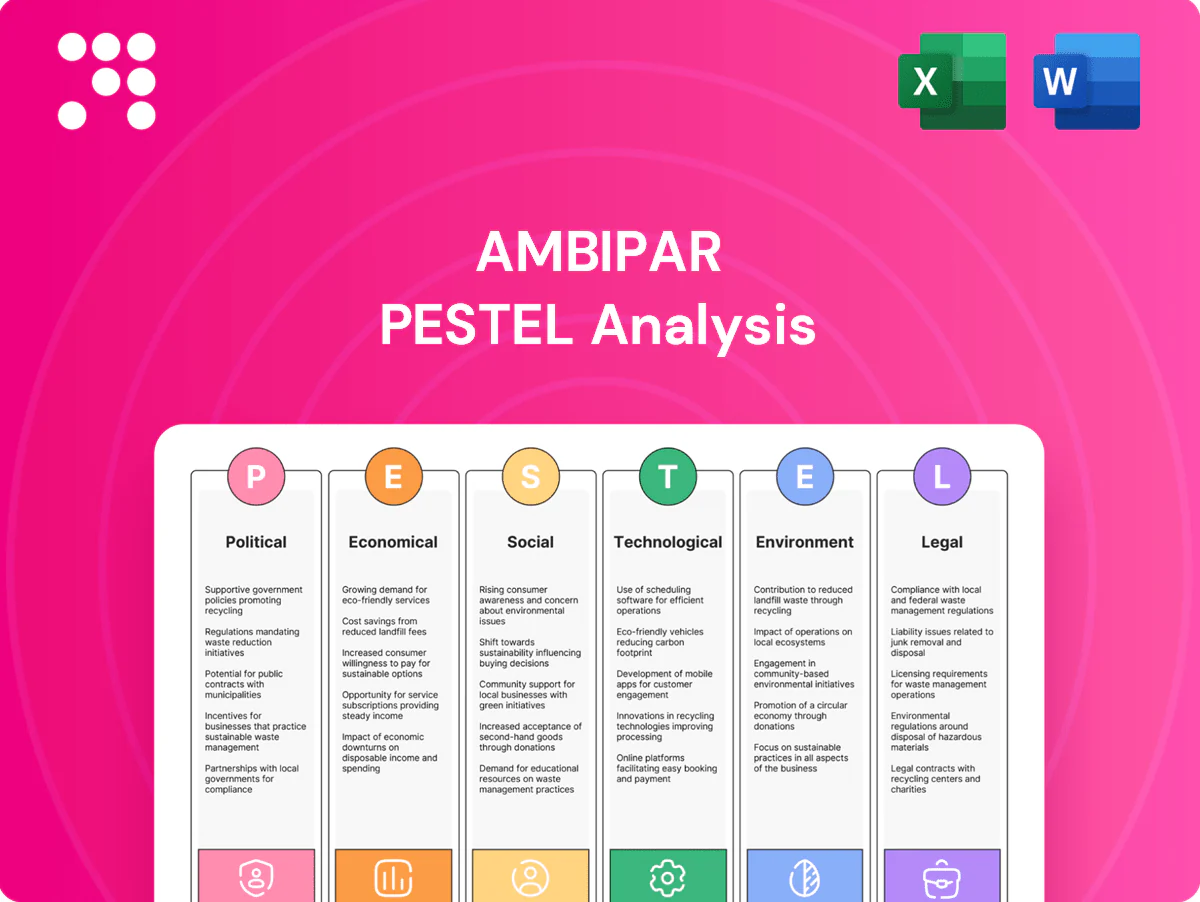
Ambipar PESTLE Analysis
The preview shown here is the exact Ambipar PESTLE Analysis document you’ll receive after purchase—fully formatted, professionally structured, and ready to use. This screenshot reflects the real file with complete content, not a teaser or placeholder. After payment you’ll instantly download the same finished document, preserving layout and analysis as displayed.

Original: $10.00
-65%$10.00
$3.50Product Information
Product Information
Shipping & Returns
Shipping & Returns
Description
Your Shortcut to Market Insight Starts Here
Explore how political, economic, social, technological, legal and environmental forces are shaping Ambipar’s strategy and risk profile in this concise PESTLE snapshot. Ideal for investors and advisors seeking timely external insights. Purchase the full PESTLE for a complete, actionable breakdown and downloadable templates to inform decisions now.
Political factors
Cross-border regulatory alignment
Ambipar operates in 14 countries with differing waste and emergency-response regulations, complicating cross-border mobilization. Policy harmonization in blocs such as Mercosur or the EU could streamline permits and hazardous-material movement, cutting administrative lead times. Regulatory misalignment increases compliance costs and delays response mobilization. Active government relations and standards mapping are therefore critical.
Public environmental spending priorities
Shifts in government budgets for disaster preparedness and waste infrastructure directly affect Ambipar’s contract pipeline, as pro-climate administrations expand remediation and circular economy programs while austerity or political turnover can defer projects. Diversifying operations across Brazil, Mexico and the US smooths exposure to single-country budget cycles. Recent policy shifts in Latin America and North America have increased public tenders for remediation and emergency response services.
Geopolitical disruption and logistics
Conflicts, sanctions and port bottlenecks complicate waste exports, equipment sourcing and emergency deployments; the 2021 Suez Canal blockage cost global trade an estimated $9.6 billion per day and similar chokepoints raise response delays. Political risk can reroute assets and pushed regional marine insurance/war-risk premiums up to 300% in 2022–23. Scenario planning ensures continuity, and localizing suppliers where feasible reduces exposure.
Incentives for circular economy
Disaster management policy frameworks
National emergency plans and mutual aid agreements, such as EMAC which includes all 50 US states and territories, define response protocols and vendor eligibility, enabling Ambipar to qualify quickly under pre-approved frameworks that accelerate mobilization during incidents. Political scrutiny after major incidents often prompts regulatory tightening; maintaining certifications and regular drills sustains readiness and market access.
- EMAC: covers 50 states/territories
- Pre-approved frameworks: faster mobilization
- Post-incident scrutiny: tighter standards
- Certifications/drills: sustain readiness
Divergent cross-border waste rules, budget shifts and insurance spikes reshape project economics
Ambipar’s operations span 14 countries with divergent waste/emergency rules, raising compliance costs and cross‑border delays; policy harmonization (eg EU/Mercosur) would cut lead times. Shifts in public budgets and EPR/subsidy programs (US IRA ~369 billion USD) materially affect project pipelines and IRRs. Political disruptions, port chokepoints (Suez ~9.6B USD/day 2021) and insurance spikes (war-risk +300% 2022–23) heighten contingency needs.
| Metric | Value |
|---|---|
| Countries | 14 |
| US IRA | ~369B USD |
| EMAC coverage | 50 states/territories |
| Suez cost | ~9.6B USD/day (2021) |
| War-risk prem. | up to +300% (2022–23) |
What is included in the product
Detailed Word Document
Explores how Political, Economic, Social, Technological, Environmental and Legal forces uniquely affect Ambipar, combining data-backed trends and region- and industry-specific examples to identify risks and opportunities; designed for executives and investors with forward-looking insights ready for reports and pitches.
Customizable Excel Spreadsheet
Ambipar PESTLE provides a clean, segmented summary of external risks and opportunities for quick reference in meetings or presentations. It’s easily shareable and editable so teams can align fast and adapt insights to region-specific response plans.
Economic factors
Industrial production and waste volumes
Manufacturing cycles drive hazardous and non-hazardous waste generation, directly scaling Ambipar’s collection, treatment and valorization demand as industrial throughput rises. Economic slowdowns lower routine waste volumes but often increase remediation work from idled or decommissioned assets, preserving service demand. Ambipar’s diversified portfolio across oil & gas, mining and industrial services helps stabilize revenues across these production swings.
Commodity price cycles
Recycled outputs compete with virgin metals, plastics and fuels, so commodity cycles directly affect Ambipar recovery margins; LME copper traded near $9,500/ton and Brent averaged about $85/barrel in 2024, improving valorization economics during strong markets. Price dips, however, compress margins and can hurt profitability unless sales are hedged or price-contracted. Flexible offtake agreements mitigate downside risk and smooth cashflow.
Inflation and cost pass-through
Energy, transport and labor inflation — Brazil's IPCA was 5.79% in 2023 — lift operating costs for fleets and treatment plants, squeezing margins on fixed-price contracts. Indexed contracts enable pass-through of fuel and wage rises, while fixed-price deals compress EBITDA. Ambipar's procurement scale can secure better fuel and input rates, and continuous pricing reviews help protect operating margins.
FX volatility in global operations
Multi-currency revenues and costs expose Ambipar to FX swings; emerging-market currency volatility rose notably in 2024, with median annual moves near 9% (IMF/World Bank aggregates), so depreciations can materially erode foreign earnings on consolidation. Ambipar mitigates P&L noise via natural hedging and derivatives, and increasingly uses local financing to align cash flows with currency.
- Exposure: multi-currency ops
- Impact: ~9% median EM FX moves (2024)
- Mitigation: natural hedges + derivatives
- Funding: local financing to match cash flows
Capex and financing conditions
Interest rates directly shape feasibility of Ambipar’s new facilities and specialized equipment, as higher borrowing costs reduce project NPV; tighter credit conditions raise WACC and can delay expansion. Access to green financing and sustainability-linked loans can lower Ambipar’s cost of capital, while strong pipeline visibility justifies near-term capex despite cyclical funding constraints.
- Interest sensitivity
- Higher WACC delays projects
- Green financing reduces spreads
- Pipeline supports investment
Divergent cross-border waste rules, budget shifts and insurance spikes reshape project economics
Manufacturing cycles scale Ambipar’s waste services; Brent ~85$/b (2024) and LME copper ~9,500$/t improved valorization margins. Brazil IPCA 5.79% (2023) and ~9% median EM FX moves (2024) raise costs and FX risk; natural hedges, derivatives and local financing mitigate. Higher interest raises WACC and can delay capex; green financing lowers spreads.
| Metric | Value | Impact | Mitigation |
|---|---|---|---|
| Copper | ~9,500$/t | ↑recovery margin | offtake contracts |
| Brent | ~85$/b | ↑valorization economics | fuel contracts |
| IPCA | 5.79% | ↑Opex | indexed contracts |
| EM FX | ~9% | FX risk | hedges/local debt |
| Interest | market | ↑WACC | green loans |
Full Version Awaits
Ambipar PESTLE Analysis
The preview shown here is the exact Ambipar PESTLE Analysis document you’ll receive after purchase—fully formatted, professionally structured, and ready to use. This screenshot reflects the real file with complete content, not a teaser or placeholder. After payment you’ll instantly download the same finished document, preserving layout and analysis as displayed.