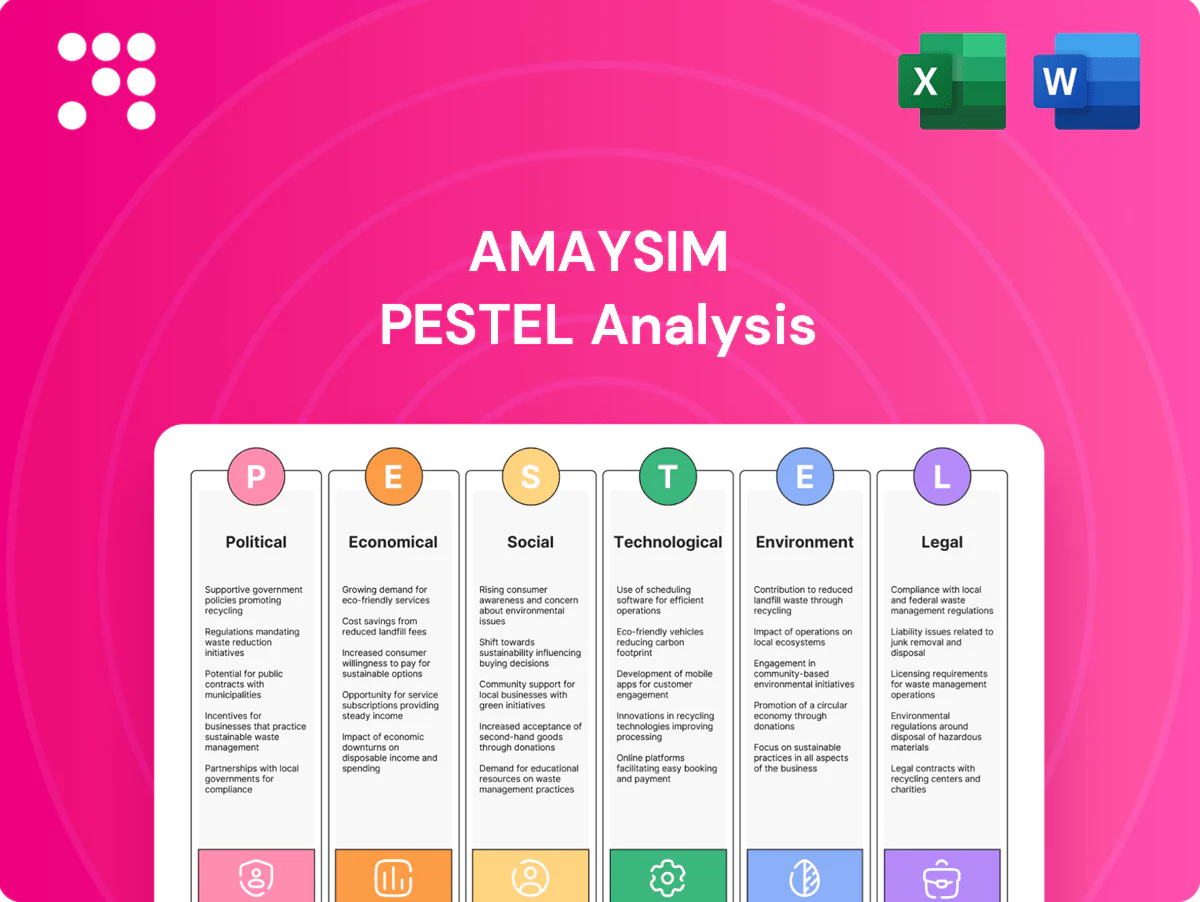
amaysim PESTLE Analysis

Your Competitive Advantage Starts with This Report
Our PESTLE Analysis for amaysim breaks down political, economic, social, technological, legal and environmental forces shaping its telecom strategy, revealing regulatory risks, market opportunities and tech-driven shifts. Ideal for investors and strategists, it translates external trends into actionable recommendations. Purchase the full report to access the complete, editable analysis and make more informed decisions.
Political factors

Telecommunications policy stability
Australian federal policy sets the competitive framework for MVNOs and wholesale access, which underpins amaysim’s pricing and product planning; Australia had about 31.6 million mobile connections (ACMA 2023) giving MVNOs meaningful scale. Policy stability enables predictable margins, but post‑election shifts can change regulatory oversight or wholesale fees, so amaysim must monitor ACCC and Department consultations to anticipate changes.
ACCC competition oversight
The ACCC actively scrutinises mobile pricing, mergers and wholesale access terms in Australia, where Telstra, Optus and Vodafone held roughly 41%, 31% and 23% mobile market share respectively (2023–24 industry data). Pro‑competition rulings can lower Optus wholesale rates and materially benefit MVNOs like amaysim; adverse rulings or reduced scrutiny would further consolidate network power. amaysim’s advocacy and submissions to the ACCC can shape those outcomes.

Spectrum and network investment incentives
While Amaysim does not hold spectrum, government incentives such as the Mobile Black Spot Program (AUD 220m in funding to date) materially affect Optus rollout economics and therefore Amaysim’s MVNO experience. Policies that accelerated 5G and regional upgrades—Optus reporting c.85% 5G population coverage by 2024—can lift MVNO service quality and ARPU potential. Conversely, regulatory burdens or mandated network investments can be passed through as higher wholesale rates, directly impacting Amaysim offers and margins.

Foreign investment and trade relations
Rules on foreign ownership and critical infrastructure shape amaysim’s partner and supplier risk; any tightening raises procurement complexity and equipment costs, while stable relations ease handset/SIM logistics and roaming. MVNO exposure is indirect via host-network dependencies; Optus acquired amaysim for A$250m in Dec 2022, tying amaysim to Optus’ geopolitical supply profile.
- foreign-ownership: FIRB scrutiny on telecoms
- supply-chain: equipment/cost sensitivity
- logistics: roaming/handset flows depend on trade ties
- host-dependency: MVNO risk via parent network
Digital inclusion and regional funding
Government programs to reduce the digital divide influence coverage and affordability, directing subsidies and vouchers that can boost prepaid uptake; Optus reported about 98.6% 4G population coverage in 2024, shaping Amaysim’s service footprint. Targeted regional funding lifts local service quality where Amaysim depends on Optus infrastructure and participation builds brand goodwill and customer growth.
- Policy-driven subsidies -> higher prepaid adoption
- Regional funds -> improved Optus-backed service quality
- Participation -> brand goodwill and customer base expansion
Regulatory shifts and telco consolidation in Australia materially reshape MVNO wholesale margins
Federal policy and ACCC oversight shape MVNO wholesale terms and pricing; Australia had c.31.6m mobile connections (ACMA 2023) and Telstra/Optus/Vodafone market shares ~41%/31%/23% (2023–24), so regulatory shifts materially affect amaysim margins. Optus’ network improvements (c.85% 5G population, 98.6% 4G in 2024) and programs like Mobile Black Spot (AUD220m) change service quality and prepaid uptake. Optus’ Dec 2022 acquisition of amaysim (A$250m) links amaysim to host-network and foreign‑ownership risks.
| Political factor | Metric | Value / Impact |
|---|---|---|
| Market scale | Connections | 31.6m (ACMA 2023) |
| Market concentration | Share | Telstra 41% / Optus 31% / Vodafone 23% (2023–24) |
| Network coverage | 5G / 4G | c.85% 5G / 98.6% 4G (Optus, 2024) |
| Policy funding | Mobile Black Spot | AUD220m total |
| Corporate linkage | Acquisition | amaysim acquired by Optus for A$250m (Dec 2022) |
What is included in the product
 Detailed Word Document
Explores how external macro-environmental factors uniquely affect amaysim across Political, Economic, Social, Technological, Environmental and Legal dimensions, with data-backed, region-specific trends and regulatory context to help executives, consultants and investors identify threats, opportunities and forward-looking scenarios for strategic planning, funding and competitive positioning.

 Customizable Excel Spreadsheet
A concise, visually segmented PESTLE summary of amaysim that highlights external risks and opportunities for quick inclusion in presentations or strategy sessions, editable for local context and easily shareable across teams.
Economic factors

Consumer spending and inflation
Inflation pressures—Australian CPI eased to about 3.4% in 2024—are driving consumers toward value prepaid plans, boosting demand in the prepaid segment which represents roughly 30% of mobile subscribers. Cost-of-living stress is compressing ARPU and raising churn as customers downshift data tiers, evident in industry ARPU declines in 2024. Amaysim can capture share with flexible pricing but faces margin squeeze; aggressive hedging and lean operations are therefore essential.
Wholesale access costs
amaysim’s MVNO economics hinge on Optus wholesale pricing—Optus holds roughly a 30% share of Australia’s mobile market—so changes in data and voice termination fees directly swing retail margins. Negotiating scale and traffic-mix discounts (higher-data, lower-voice ratios) can materially lower unit cost per GB and per-minute, while transparent pass-through pricing cushions revenue volatility for amaysim’s plans.

Market competition and price wars
Australia’s mobile market is intensely competitive—Telstra ~40–45% share, Optus ~25–30%, Vodafone ~15–20% and MVNOs/sub-brands making up roughly 15–20%—driving frequent price promotions that erode ARPU (industry average ~AUD40/month) and shorten customer lifetimes. amaysim counters commoditization through simple plans and add-ons, while strict control of customer acquisition costs (often a few hundred AUD per net add) is essential to preserve profitability.

Unemployment and migration trends
Employment levels (around 4% unemployment in Australia in 2024) influence prepaid churn and top-up frequency as income shocks reduce reloads and can elevate bad-debt risk even on prepaid via deferred top-ups. Net overseas migration (about 500,000 in 2022–23) and strong student inflows drive SIM activations and international calling demand. Seasonal patterns inform inventory and marketing timing.
- Employment: unemployment ~4% (2024)
- Migration: NOM ~500,000 (2022–23)
- Risk: slowdowns → deferred top-ups
- Seasonality: guides inventory & marketing
Currency and import costs
Exchange-rate moves directly raise costs for SIMs, routers and fixed-wireless CPE that are typically dollar- or euro-priced; the Australian dollar averaged about 0.67 USD in 2024, so a weaker AUD increases imported-hardware and some platform-licensing expenses for amaysim.
- Hedging and extended vendor terms can smooth cost volatility
- Price points must be adjusted to reflect currency-driven margin pressure
Regulatory shifts and telco consolidation in Australia materially reshape MVNO wholesale margins
Inflation eased to ~3.4% in 2024, pushing consumers to value prepaid plans and compressing ARPU (~AUD40/mo), increasing churn. amaysim’s margins depend on Optus wholesale pricing (Optus ~30% share), so unit-cost moves and AUD volatility (AUD ≈0.67 USD in 2024) materially affect profitability. Employment (~4% unemployment 2024) and NOM (~500k 2022–23) drive prepaid demand and seasonal SIM activations.
| Indicator | 2024/2023 value | Relevance to amaysim |
|---|---|---|
| CPI | ~3.4% (2024) | shifts demand to low-cost plans |
| ARPU | ~AUD40/mo | margin pressure |
| Unemployment | ~4% (2024) | affects top-ups/churn |
| NOM | ~500,000 (2022–23) | boosts SIM activations |
| AUD/USD | ~0.67 (2024) | imported CPE cost risk |
Same Document Delivered
amaysim PESTLE Analysis
The amaysim PESTLE Analysis provides a concise assessment of political, economic, social, technological, legal and environmental factors affecting the company. The preview shown here is the exact document you’ll receive after purchase—fully formatted and ready to use. It’s structured for immediate application in strategy or investment decisions.

Original: $10.00
-65%$10.00
$3.50Product Information
Product Information
Shipping & Returns
Shipping & Returns
Description
Your Competitive Advantage Starts with This Report
Our PESTLE Analysis for amaysim breaks down political, economic, social, technological, legal and environmental forces shaping its telecom strategy, revealing regulatory risks, market opportunities and tech-driven shifts. Ideal for investors and strategists, it translates external trends into actionable recommendations. Purchase the full report to access the complete, editable analysis and make more informed decisions.
Political factors
Telecommunications policy stability
Australian federal policy sets the competitive framework for MVNOs and wholesale access, which underpins amaysim’s pricing and product planning; Australia had about 31.6 million mobile connections (ACMA 2023) giving MVNOs meaningful scale. Policy stability enables predictable margins, but post‑election shifts can change regulatory oversight or wholesale fees, so amaysim must monitor ACCC and Department consultations to anticipate changes.
ACCC competition oversight
The ACCC actively scrutinises mobile pricing, mergers and wholesale access terms in Australia, where Telstra, Optus and Vodafone held roughly 41%, 31% and 23% mobile market share respectively (2023–24 industry data). Pro‑competition rulings can lower Optus wholesale rates and materially benefit MVNOs like amaysim; adverse rulings or reduced scrutiny would further consolidate network power. amaysim’s advocacy and submissions to the ACCC can shape those outcomes.
Spectrum and network investment incentives
While Amaysim does not hold spectrum, government incentives such as the Mobile Black Spot Program (AUD 220m in funding to date) materially affect Optus rollout economics and therefore Amaysim’s MVNO experience. Policies that accelerated 5G and regional upgrades—Optus reporting c.85% 5G population coverage by 2024—can lift MVNO service quality and ARPU potential. Conversely, regulatory burdens or mandated network investments can be passed through as higher wholesale rates, directly impacting Amaysim offers and margins.
Foreign investment and trade relations
Rules on foreign ownership and critical infrastructure shape amaysim’s partner and supplier risk; any tightening raises procurement complexity and equipment costs, while stable relations ease handset/SIM logistics and roaming. MVNO exposure is indirect via host-network dependencies; Optus acquired amaysim for A$250m in Dec 2022, tying amaysim to Optus’ geopolitical supply profile.
- foreign-ownership: FIRB scrutiny on telecoms
- supply-chain: equipment/cost sensitivity
- logistics: roaming/handset flows depend on trade ties
- host-dependency: MVNO risk via parent network
Digital inclusion and regional funding
Government programs to reduce the digital divide influence coverage and affordability, directing subsidies and vouchers that can boost prepaid uptake; Optus reported about 98.6% 4G population coverage in 2024, shaping Amaysim’s service footprint. Targeted regional funding lifts local service quality where Amaysim depends on Optus infrastructure and participation builds brand goodwill and customer growth.
- Policy-driven subsidies -> higher prepaid adoption
- Regional funds -> improved Optus-backed service quality
- Participation -> brand goodwill and customer base expansion
Regulatory shifts and telco consolidation in Australia materially reshape MVNO wholesale margins
Federal policy and ACCC oversight shape MVNO wholesale terms and pricing; Australia had c.31.6m mobile connections (ACMA 2023) and Telstra/Optus/Vodafone market shares ~41%/31%/23% (2023–24), so regulatory shifts materially affect amaysim margins. Optus’ network improvements (c.85% 5G population, 98.6% 4G in 2024) and programs like Mobile Black Spot (AUD220m) change service quality and prepaid uptake. Optus’ Dec 2022 acquisition of amaysim (A$250m) links amaysim to host-network and foreign‑ownership risks.
| Political factor | Metric | Value / Impact |
|---|---|---|
| Market scale | Connections | 31.6m (ACMA 2023) |
| Market concentration | Share | Telstra 41% / Optus 31% / Vodafone 23% (2023–24) |
| Network coverage | 5G / 4G | c.85% 5G / 98.6% 4G (Optus, 2024) |
| Policy funding | Mobile Black Spot | AUD220m total |
| Corporate linkage | Acquisition | amaysim acquired by Optus for A$250m (Dec 2022) |
What is included in the product
Detailed Word Document
Explores how external macro-environmental factors uniquely affect amaysim across Political, Economic, Social, Technological, Environmental and Legal dimensions, with data-backed, region-specific trends and regulatory context to help executives, consultants and investors identify threats, opportunities and forward-looking scenarios for strategic planning, funding and competitive positioning.
Customizable Excel Spreadsheet
A concise, visually segmented PESTLE summary of amaysim that highlights external risks and opportunities for quick inclusion in presentations or strategy sessions, editable for local context and easily shareable across teams.
Economic factors
Consumer spending and inflation
Inflation pressures—Australian CPI eased to about 3.4% in 2024—are driving consumers toward value prepaid plans, boosting demand in the prepaid segment which represents roughly 30% of mobile subscribers. Cost-of-living stress is compressing ARPU and raising churn as customers downshift data tiers, evident in industry ARPU declines in 2024. Amaysim can capture share with flexible pricing but faces margin squeeze; aggressive hedging and lean operations are therefore essential.
Wholesale access costs
amaysim’s MVNO economics hinge on Optus wholesale pricing—Optus holds roughly a 30% share of Australia’s mobile market—so changes in data and voice termination fees directly swing retail margins. Negotiating scale and traffic-mix discounts (higher-data, lower-voice ratios) can materially lower unit cost per GB and per-minute, while transparent pass-through pricing cushions revenue volatility for amaysim’s plans.
Market competition and price wars
Australia’s mobile market is intensely competitive—Telstra ~40–45% share, Optus ~25–30%, Vodafone ~15–20% and MVNOs/sub-brands making up roughly 15–20%—driving frequent price promotions that erode ARPU (industry average ~AUD40/month) and shorten customer lifetimes. amaysim counters commoditization through simple plans and add-ons, while strict control of customer acquisition costs (often a few hundred AUD per net add) is essential to preserve profitability.
Unemployment and migration trends
Employment levels (around 4% unemployment in Australia in 2024) influence prepaid churn and top-up frequency as income shocks reduce reloads and can elevate bad-debt risk even on prepaid via deferred top-ups. Net overseas migration (about 500,000 in 2022–23) and strong student inflows drive SIM activations and international calling demand. Seasonal patterns inform inventory and marketing timing.
- Employment: unemployment ~4% (2024)
- Migration: NOM ~500,000 (2022–23)
- Risk: slowdowns → deferred top-ups
- Seasonality: guides inventory & marketing
Currency and import costs
Exchange-rate moves directly raise costs for SIMs, routers and fixed-wireless CPE that are typically dollar- or euro-priced; the Australian dollar averaged about 0.67 USD in 2024, so a weaker AUD increases imported-hardware and some platform-licensing expenses for amaysim.
- Hedging and extended vendor terms can smooth cost volatility
- Price points must be adjusted to reflect currency-driven margin pressure
Regulatory shifts and telco consolidation in Australia materially reshape MVNO wholesale margins
Inflation eased to ~3.4% in 2024, pushing consumers to value prepaid plans and compressing ARPU (~AUD40/mo), increasing churn. amaysim’s margins depend on Optus wholesale pricing (Optus ~30% share), so unit-cost moves and AUD volatility (AUD ≈0.67 USD in 2024) materially affect profitability. Employment (~4% unemployment 2024) and NOM (~500k 2022–23) drive prepaid demand and seasonal SIM activations.
| Indicator | 2024/2023 value | Relevance to amaysim |
|---|---|---|
| CPI | ~3.4% (2024) | shifts demand to low-cost plans |
| ARPU | ~AUD40/mo | margin pressure |
| Unemployment | ~4% (2024) | affects top-ups/churn |
| NOM | ~500,000 (2022–23) | boosts SIM activations |
| AUD/USD | ~0.67 (2024) | imported CPE cost risk |
Same Document Delivered
amaysim PESTLE Analysis
The amaysim PESTLE Analysis provides a concise assessment of political, economic, social, technological, legal and environmental factors affecting the company. The preview shown here is the exact document you’ll receive after purchase—fully formatted and ready to use. It’s structured for immediate application in strategy or investment decisions.











