Masraf Al Rayan PESTLE Analysis

Plan Smarter. Present Sharper. Compete Stronger.
Our PESTLE analysis of Masraf Al Rayan reveals how political shifts, economic cycles, social trends, technological adoption, legal changes, and environmental pressures shape its strategic outlook. Ideal for investors and strategists seeking actionable external intelligence. Purchase the full, ready-to-use report for deep insights and immediate application.
Political factors

Qatar state stability
Stable governance in Qatar underpins banking certainty and supports Masraf Al Rayan’s long-term investment commitments, backed by the Qatar Investment Authority estimated at about USD 450 billion in 2024. State-led development agendas channel deposits and lending into public projects, sustaining sector credit growth near 6% in 2024. Any cabinet or policy reshuffle can shift sector priorities and credit allocation, so continuity aids multi-year balance sheet planning for the bank.
Regional geopolitics risk
Periodic GCC tensions — notably the Qatar diplomatic rift (June 5, 2017–January 5, 2021) — have in the past disrupted correspondent banking and cross‑border funding, while heightened risk premiums can push sukuk funding costs and require larger liquidity buffers; Masraf Al Rayan and peers have sustained regulatory LCRs above 100% in 2024. Diplomatic normalization since 2020–21 has boosted trade flows and fee income potential, and the bank must keep contingency plans for rapid regional shifts.

Public spending cycle
Hydrocarbon-driven fiscal capacity in Qatar underpins large infrastructure outlays that feed Masraf Al Rayan’s corporate lending pipeline; state CAPEX expansions in 2024 supported asset growth as the bank reported roughly QAR 182bn in total assets at year-end 2024. Delays or accelerations in state projects directly affect asset growth and NIM via the bank’s pricing power on corporate mandates. Large government deposit movements shift system liquidity and influence short-term funding costs. Close alignment with national programs secures anchor mandates and stabilizes funding flows.

Vision 2030 diversification
Vision 2030’s push to diversify Qatar’s economy into SMEs, tourism, logistics, health and education opens significant financing opportunities; non-hydrocarbon sectors accounted for over 50% of GDP in 2023. Policy incentives and subsidies can catalyze Sharia-compliant product innovation, while the execution pace will drive credit demand and shift risk profiles. Masraf Al Rayan can position as the preferred bank for these priority sectors.
- Sector focus: SMEs, tourism, logistics, health, education
- 2023 fact: non-hydrocarbon >50% of GDP
- Implication: higher credit demand, evolving risk mix
- Opportunity: lead Sharia-compliant product supply
Sovereign–bank linkage
Sovereign–bank linkage: implicit state support for Masraf Al Rayan underpins depositor confidence but concentrates exposures to public-sector counterparties; Masraf Al Rayan reported total assets of QAR 136.3bn (FY2023), heightening sensitivity to sovereign stress. Sovereign ratings (Qatar: S&P AA-/Stable, Fitch AA/Stable, Moody’s A1/Stable) directly influence the bank’s funding spreads and market access. Policy directives on priority sectors affect pricing and asset allocation, requiring balanced portfolio governance to manage concentration risk.
- Implicit support: confidence vs concentration
- Sovereign ratings drive funding spreads
- Policy directives shape pricing/allocation
- Governance needed to limit public‑sector concentration
Stable Qatari backing and strong liquidity underpin bank funding amid Vision 2030 credit shift
Stable Qatari governance and implicit sovereign support (S&P AA-/Stable, Fitch AA/Stable, Moody’s A1/Stable) underpin Masraf Al Rayan’s funding and depositor confidence, while state CAPEX and Vision 2030 diversify credit demand. Key 2024 metrics: bank assets ~QAR 182bn, system credit growth ~6%, banks maintaining LCRs >100%. Regional diplomatic stability reduces correspondent banking risk but contingency plans remain necessary.
| Indicator | Value (2023/2024) | Implication |
|---|---|---|
| Sovereign ratings | S&P AA-/Fitch AA/Moody’s A1 | Funding spreads, market access |
| Masraf Al Rayan assets | ~QAR 182bn (2024) | Scale, sovereign linkage |
| Non-hydrocarbon GDP | >50% (2023) | New sector lending |
| System credit growth | ~6% (2024) | Credit demand trend |
| Liquidity | LCRs >100% (2024) | Funding resilience |
What is included in the product
 Detailed Word Document
Explores how Political, Economic, Social, Technological, Environmental and Legal forces uniquely impact Masraf Al Rayan, combining data-driven insights and regional regulatory context to identify risks and opportunities; designed for executives and investors, it offers forward-looking scenarios, actionable sub-points and clean formatting ready for reports and strategy planning.

 Customizable Excel Spreadsheet
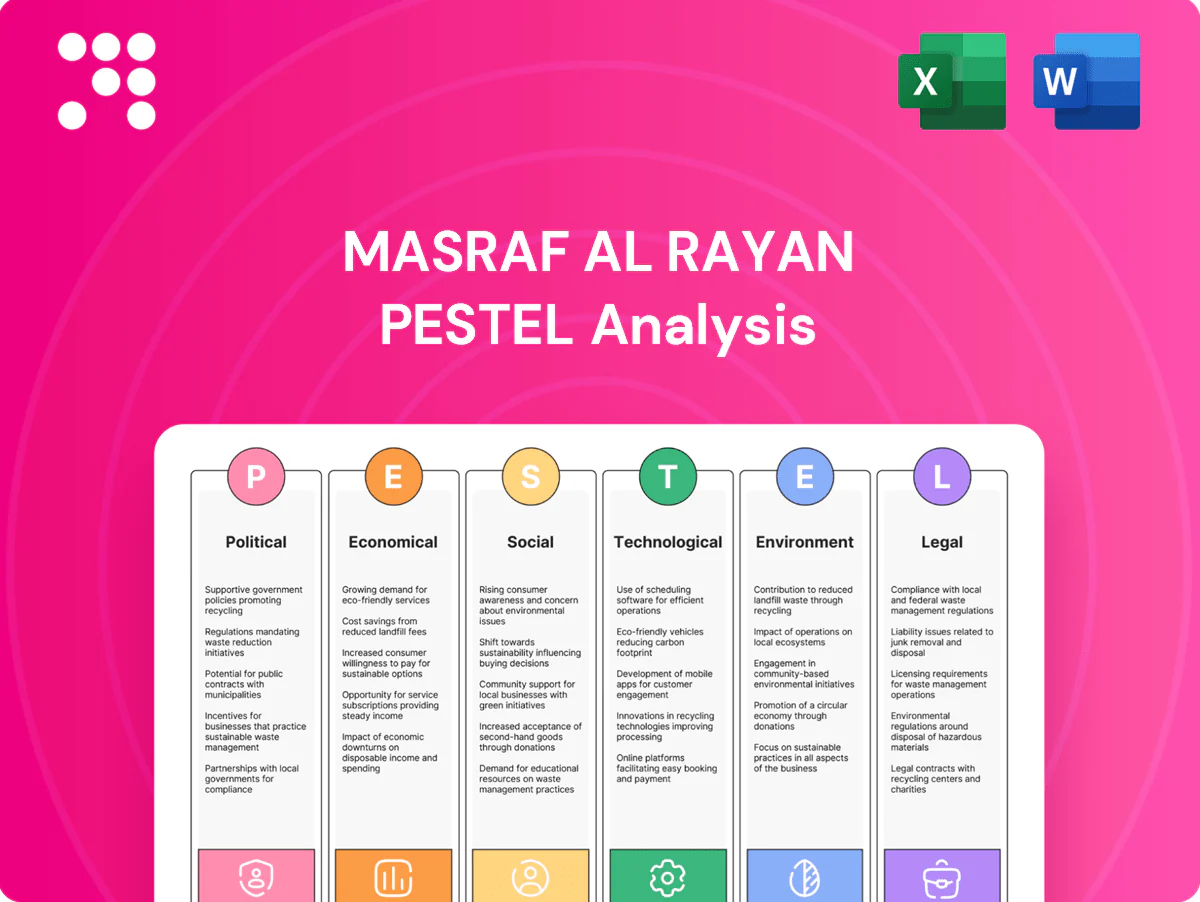
A concise, visually segmented PESTLE summary of Masraf Al Rayan that’s easily dropped into presentations or shared across teams, enabling quick alignment on external risks, regulatory impacts, and market positioning while allowing users to annotate for local context.
Economic factors

Hydrocarbon price cycle
Brent around 80–90 USD/bbl and JKM LNG near 10–15 USD/MMBtu in mid-2025 drive GCC GDP, liquidity and Qatar public capex, directly supporting Masraf Al Rayan deposit growth and loan demand; hydrocarbons still underpin roughly half of Qatar’s fiscal resources. High prices compress credit risk and bolster asset quality, while downturns (stress tests) reveal borrower vulnerability. Treasury yields and sukuk issuance volumes track the cycle, and diversifying non‑oil income reduces earnings volatility for the bank.
USD peg and rates
The Qatari riyal’s USD peg transmits US rate cycles to local profit rates, with the US federal funds target at 5.25–5.50% as of July 2025 driving higher domestic funding costs.
Higher rates can expand margins on low-cost deposits but tighten borrower affordability and credit demand.
Repricing gaps require active ALM to protect NIM, and Sharia-compliant financing must use competitive profit-rate benchmarks aligned with market rates.

Inflation and cost base
Import-driven inflation (Qatar CPI ~3.2% in 2024) raises operating costs and squeezes consumer affordability given food and goods import dependency (>90%), so tight pricing discipline and digital efficiency gains are crucial to defend cost-to-income. Fee-based income rose to about 24% of operating income in 2024, cushioning revenue when lending slows. Careful underwriting and stress-testing help mitigate erosion as real estate price growth cooled to ~2% in 2024.

Real estate and construction
Real estate cycles materially affect Masraf Al Rayan through collateral valuation and NPL paths; Qatar banking NPLs averaged about 1.8% in 2024, underscoring sensitivity to price swings. Large project pipelines in Doha offer project finance and working-capital earnings, while oversupply pockets necessitate conservative LTVs and rigorous stress tests. A granular loan portfolio limits sector shock transmission and concentration risk.
- Property cycles→collateral & NPLs
- Project pipeline→project finance, WC
- Oversupply→conservative LTVs & stress tests
- Portfolio granularity→reduced shock transmission
SME and trade growth
SME formalization and expanding regional trade corridors are increasing demand for Islamic working capital and trade finance as businesses scale cross-border; SMEs account for about 90% of firms and 50% of employment globally (World Bank). Tailored Takaful links boost client propositions, while limited credit-data depth mandates robust alternative scoring; the global SME financing gap is estimated at $5.2tn (IFC, 2020). Supply-chain finance can unlock secure yield and de-risk exposures.
- SMEs ~90% firms, 50% employment (World Bank)
- SME financing gap $5.2tn (IFC, 2020)
- Focus: Islamic working capital, Takaful, alternative scoring, SCF
Stable Qatari backing and strong liquidity underpin bank funding amid Vision 2030 credit shift
Brent ~80–90 USD/bbl and JKM ~10–15 USD/MMBtu (mid‑2025) support Qatari capex, deposits and loan demand; Qatar CPI ~3.2% (2024) and US Fed 5.25–5.50% (Jul 2025) transmit via the USD peg, lifting funding costs and NIM volatility. Real estate growth ~2% (2024) with banking NPLs ~1.8% (2024) demands conservative LTVs and stress tests; fee income ~24% (2024) cushions revenue.
| Metric | Value | Implication |
|---|---|---|
| Brent | 80–90 USD/bbl | Supports deposits, capex |
| Fed rate | 5.25–5.50% | Higher funding costs |
| CPI (Qatar) | 3.2% (2024) | Cost pressure |
| NPLs | 1.8% (2024) | Credit sensitivity |
| Fee income | 24% (2024) | Revenue buffer |
Preview Before You Purchase
Masraf Al Rayan PESTLE Analysis
The preview shown here is the exact Masraf Al Rayan PESTLE Analysis you’ll receive after purchase—fully formatted and ready to use. This document contains the complete political, economic, social, technological, legal, and environmental assessment as displayed, with no placeholders or edits needed. After checkout you’ll instantly download this same, professionally structured file.

Original: $10.00
-65%$10.00
$3.50Product Information
Product Information
Shipping & Returns
Shipping & Returns
Description
Plan Smarter. Present Sharper. Compete Stronger.
Our PESTLE analysis of Masraf Al Rayan reveals how political shifts, economic cycles, social trends, technological adoption, legal changes, and environmental pressures shape its strategic outlook. Ideal for investors and strategists seeking actionable external intelligence. Purchase the full, ready-to-use report for deep insights and immediate application.
Political factors
Qatar state stability
Stable governance in Qatar underpins banking certainty and supports Masraf Al Rayan’s long-term investment commitments, backed by the Qatar Investment Authority estimated at about USD 450 billion in 2024. State-led development agendas channel deposits and lending into public projects, sustaining sector credit growth near 6% in 2024. Any cabinet or policy reshuffle can shift sector priorities and credit allocation, so continuity aids multi-year balance sheet planning for the bank.
Regional geopolitics risk
Periodic GCC tensions — notably the Qatar diplomatic rift (June 5, 2017–January 5, 2021) — have in the past disrupted correspondent banking and cross‑border funding, while heightened risk premiums can push sukuk funding costs and require larger liquidity buffers; Masraf Al Rayan and peers have sustained regulatory LCRs above 100% in 2024. Diplomatic normalization since 2020–21 has boosted trade flows and fee income potential, and the bank must keep contingency plans for rapid regional shifts.
Public spending cycle
Hydrocarbon-driven fiscal capacity in Qatar underpins large infrastructure outlays that feed Masraf Al Rayan’s corporate lending pipeline; state CAPEX expansions in 2024 supported asset growth as the bank reported roughly QAR 182bn in total assets at year-end 2024. Delays or accelerations in state projects directly affect asset growth and NIM via the bank’s pricing power on corporate mandates. Large government deposit movements shift system liquidity and influence short-term funding costs. Close alignment with national programs secures anchor mandates and stabilizes funding flows.
Vision 2030 diversification
Vision 2030’s push to diversify Qatar’s economy into SMEs, tourism, logistics, health and education opens significant financing opportunities; non-hydrocarbon sectors accounted for over 50% of GDP in 2023. Policy incentives and subsidies can catalyze Sharia-compliant product innovation, while the execution pace will drive credit demand and shift risk profiles. Masraf Al Rayan can position as the preferred bank for these priority sectors.
- Sector focus: SMEs, tourism, logistics, health, education
- 2023 fact: non-hydrocarbon >50% of GDP
- Implication: higher credit demand, evolving risk mix
- Opportunity: lead Sharia-compliant product supply
Sovereign–bank linkage
Sovereign–bank linkage: implicit state support for Masraf Al Rayan underpins depositor confidence but concentrates exposures to public-sector counterparties; Masraf Al Rayan reported total assets of QAR 136.3bn (FY2023), heightening sensitivity to sovereign stress. Sovereign ratings (Qatar: S&P AA-/Stable, Fitch AA/Stable, Moody’s A1/Stable) directly influence the bank’s funding spreads and market access. Policy directives on priority sectors affect pricing and asset allocation, requiring balanced portfolio governance to manage concentration risk.
- Implicit support: confidence vs concentration
- Sovereign ratings drive funding spreads
- Policy directives shape pricing/allocation
- Governance needed to limit public‑sector concentration
Stable Qatari backing and strong liquidity underpin bank funding amid Vision 2030 credit shift
Stable Qatari governance and implicit sovereign support (S&P AA-/Stable, Fitch AA/Stable, Moody’s A1/Stable) underpin Masraf Al Rayan’s funding and depositor confidence, while state CAPEX and Vision 2030 diversify credit demand. Key 2024 metrics: bank assets ~QAR 182bn, system credit growth ~6%, banks maintaining LCRs >100%. Regional diplomatic stability reduces correspondent banking risk but contingency plans remain necessary.
| Indicator | Value (2023/2024) | Implication |
|---|---|---|
| Sovereign ratings | S&P AA-/Fitch AA/Moody’s A1 | Funding spreads, market access |
| Masraf Al Rayan assets | ~QAR 182bn (2024) | Scale, sovereign linkage |
| Non-hydrocarbon GDP | >50% (2023) | New sector lending |
| System credit growth | ~6% (2024) | Credit demand trend |
| Liquidity | LCRs >100% (2024) | Funding resilience |
What is included in the product
Detailed Word Document
Explores how Political, Economic, Social, Technological, Environmental and Legal forces uniquely impact Masraf Al Rayan, combining data-driven insights and regional regulatory context to identify risks and opportunities; designed for executives and investors, it offers forward-looking scenarios, actionable sub-points and clean formatting ready for reports and strategy planning.
Customizable Excel Spreadsheet
A concise, visually segmented PESTLE summary of Masraf Al Rayan that’s easily dropped into presentations or shared across teams, enabling quick alignment on external risks, regulatory impacts, and market positioning while allowing users to annotate for local context.
Economic factors
Hydrocarbon price cycle
Brent around 80–90 USD/bbl and JKM LNG near 10–15 USD/MMBtu in mid-2025 drive GCC GDP, liquidity and Qatar public capex, directly supporting Masraf Al Rayan deposit growth and loan demand; hydrocarbons still underpin roughly half of Qatar’s fiscal resources. High prices compress credit risk and bolster asset quality, while downturns (stress tests) reveal borrower vulnerability. Treasury yields and sukuk issuance volumes track the cycle, and diversifying non‑oil income reduces earnings volatility for the bank.
USD peg and rates
The Qatari riyal’s USD peg transmits US rate cycles to local profit rates, with the US federal funds target at 5.25–5.50% as of July 2025 driving higher domestic funding costs.
Higher rates can expand margins on low-cost deposits but tighten borrower affordability and credit demand.
Repricing gaps require active ALM to protect NIM, and Sharia-compliant financing must use competitive profit-rate benchmarks aligned with market rates.
Inflation and cost base
Import-driven inflation (Qatar CPI ~3.2% in 2024) raises operating costs and squeezes consumer affordability given food and goods import dependency (>90%), so tight pricing discipline and digital efficiency gains are crucial to defend cost-to-income. Fee-based income rose to about 24% of operating income in 2024, cushioning revenue when lending slows. Careful underwriting and stress-testing help mitigate erosion as real estate price growth cooled to ~2% in 2024.
Real estate and construction
Real estate cycles materially affect Masraf Al Rayan through collateral valuation and NPL paths; Qatar banking NPLs averaged about 1.8% in 2024, underscoring sensitivity to price swings. Large project pipelines in Doha offer project finance and working-capital earnings, while oversupply pockets necessitate conservative LTVs and rigorous stress tests. A granular loan portfolio limits sector shock transmission and concentration risk.
- Property cycles→collateral & NPLs
- Project pipeline→project finance, WC
- Oversupply→conservative LTVs & stress tests
- Portfolio granularity→reduced shock transmission
SME and trade growth
SME formalization and expanding regional trade corridors are increasing demand for Islamic working capital and trade finance as businesses scale cross-border; SMEs account for about 90% of firms and 50% of employment globally (World Bank). Tailored Takaful links boost client propositions, while limited credit-data depth mandates robust alternative scoring; the global SME financing gap is estimated at $5.2tn (IFC, 2020). Supply-chain finance can unlock secure yield and de-risk exposures.
- SMEs ~90% firms, 50% employment (World Bank)
- SME financing gap $5.2tn (IFC, 2020)
- Focus: Islamic working capital, Takaful, alternative scoring, SCF
Stable Qatari backing and strong liquidity underpin bank funding amid Vision 2030 credit shift
Brent ~80–90 USD/bbl and JKM ~10–15 USD/MMBtu (mid‑2025) support Qatari capex, deposits and loan demand; Qatar CPI ~3.2% (2024) and US Fed 5.25–5.50% (Jul 2025) transmit via the USD peg, lifting funding costs and NIM volatility. Real estate growth ~2% (2024) with banking NPLs ~1.8% (2024) demands conservative LTVs and stress tests; fee income ~24% (2024) cushions revenue.
| Metric | Value | Implication |
|---|---|---|
| Brent | 80–90 USD/bbl | Supports deposits, capex |
| Fed rate | 5.25–5.50% | Higher funding costs |
| CPI (Qatar) | 3.2% (2024) | Cost pressure |
| NPLs | 1.8% (2024) | Credit sensitivity |
| Fee income | 24% (2024) | Revenue buffer |
Preview Before You Purchase
Masraf Al Rayan PESTLE Analysis
The preview shown here is the exact Masraf Al Rayan PESTLE Analysis you’ll receive after purchase—fully formatted and ready to use. This document contains the complete political, economic, social, technological, legal, and environmental assessment as displayed, with no placeholders or edits needed. After checkout you’ll instantly download this same, professionally structured file.