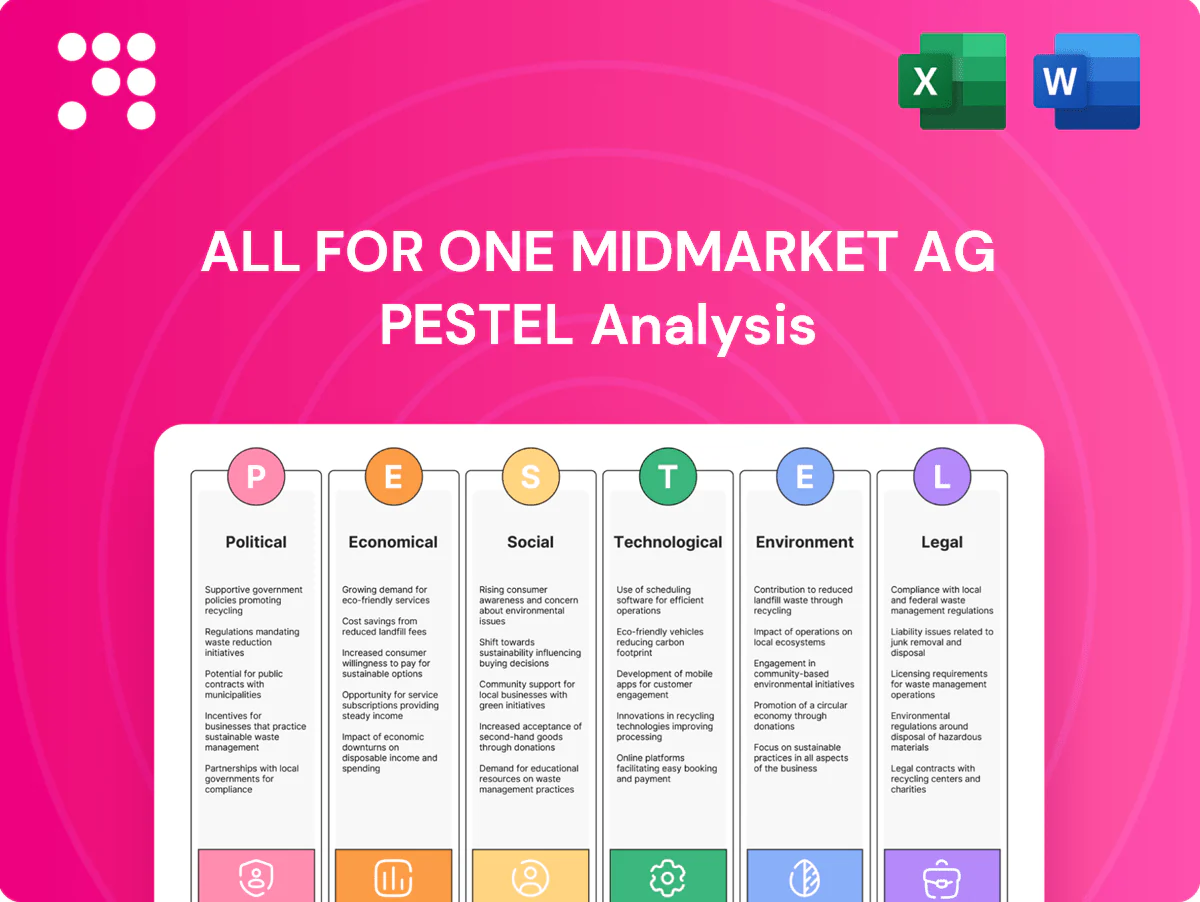
All for One Midmarket AG PESTLE Analysis

Your Shortcut to Market Insight Starts Here
Discover how political shifts, economic trends, and emerging technologies are reshaping All for One Midmarket AG’s strategic landscape in our focused PESTLE Analysis. This concise briefing highlights key risks and opportunities to inform smarter decisions. Buy the full report for the complete, actionable breakdown and immediate download.
Political factors

EU digitalization agendas favor SME IT spending
EU agendas (Digital Europe €7.588bn; Recovery and Resilience Facility €723.8bn) and 25m SMEs (99% of EU firms) drive cloud/ERP modernization, lifting consulting and managed services demand. Germany’s digital and subsidy schemes accelerate projects in All for One’s markets. Prioritizing eligibility and co-funding know-how is a sales lever, but dependence on public budgets creates timing and approval risks.
Data sovereignty and cloud policy (Gaia-X, EU cloud rules)
Growing emphasis on sovereign cloud (Gaia-X has 300+ members as of 2024) and EU data policy across 27 member states shapes All for One Midmarket AG hosting and partner-stack choices. Alignment with EU-trusted offerings and EU-region deployments from major hyperscalers (AWS, Azure, GCP) can be a market differentiator. Missteps risk losing public-sector and regulated-industry contracts. Early certification and reference projects shorten procurement cycles and reduce friction.

Geopolitical tensions and vendor concentration risks
US-EU policy shifts and supply constraints can ripple through vendor roadmaps and pricing—Microsoft reported FY24 revenue of $211.9B and the top three cloud providers held about 65% market share in 2024, concentrating risks. Clients increasingly demand resilient architectures and multi-cloud options to hedge vendor or geopolitical shocks. All for One can commercialize geopolitical-risk mitigation as a service. Vendor lobbying and regulatory outcomes may change discount structures and compress partner margins.

Public procurement and local-provider preference
Eurostat reports public procurement accounts for roughly 14% of EU GDP, and many DACH tenders favor regional presence, local language and documented compliance. All for One Midmarket AGs German‑speaking footprint and local track record strengthen bid competitiveness. Effective capacity planning and framework contracts are needed to match procurement cycles; delays can extend sales cycles and strain working capital.
- Regional presence: advantage in DACH tenders
- Language & compliance: higher win probability
- Procurement cycles: require capacity planning
- Framework contracts: reduce bid-to-revenue lag
- Risk: delays stretch sales cycles and working capital
Industrial policy and manufacturing competitiveness
DACH industrial policy and manufacturing competitiveness initiatives, with manufacturing accounting for about 20% of Germany’s GDP and SMEs representing 99% of EU firms, push energy transition and automation that accelerate IT/OT convergence. SMEs modernizing production increasingly require SAP S/4HANA, MES and IoT integrations, creating demand where All for One can position as execution partner to expand wallet share. Policy reversals or funding cuts could slow program pipelines and deal velocity.
- Policy push: DACH manufacturing ~20% GDP
- SME market: 99% of EU firms
- Tech need: S/4HANA + MES + IoT
- Risk: funding cuts slow pipelines
EU funds and Gaia-X accelerate cloud/ERP modernization; sovereign cloud, hyperscalers shape demand
EU digital funds (Digital Europe €7.588bn; RRF €723.8bn) and 25m SMEs (99% of firms) drive cloud/ERP modernization, boosting All for One’s services but creating public‑budget timing risks. Sovereign cloud push (Gaia‑X 300+ members in 2024) and ~65% hyperscaler concentration force EU‑region hosting and multi‑cloud offers. Public procurement (~14% of EU GDP) and DACH manufacturing (~20% of German GDP) favor local certified partners.
| Indicator | Value |
|---|---|
| Digital Europe | €7.588bn |
| RRF | €723.8bn |
| Gaia‑X members (2024) | 300+ |
| Hyperscaler share (2024) | ~65% |
| Public procurement | ~14% EU GDP |
What is included in the product
 Detailed Word Document
Explores how political, economic, social, technological, environmental and legal forces uniquely affect All for One Midmarket AG, combining data-driven trends and region/industry specifics to identify risks, opportunities and scenario-based strategic actions for executives, investors and consultants.

 Customizable Excel Spreadsheet
A concise, visually segmented PESTLE summary for All for One Midmarket AG that’s editable for local context, drop-ready for presentations, and easily shareable to speed team alignment and planning.
Economic factors

SME capex cycles and IT budgets
Mittelstand capex is highly sensitive to GDP cycles (Germany GDP growth 2024 forecast 0.6% per IMF WEO July 2024), energy-cost swings and export demand; high energy prices in 2022–23 prompted many firms to defer investment. Deferred projects often shift from transformation to run-cost optimization, boosting need for maintenance and managed services. Flexible pricing and modular roadmaps preserve utilisation and stabilise revenue via recurring contracts.
Consulting labor inflation and utilization
Wage pressure for SAP, cloud and security specialists drove double-digit salary growth in 2024, elevating delivery costs and compressing margins. Tight bench and utilization management, targeting c.75–85% billable utilization, is critical to preserve profitability. Nearshore capabilities often deliver 20–35% lower labor costs versus onshore, smoothing cost curves. Strict rate-card discipline and value-based pricing lifts realized rates 3–6% to offset inflation.

Interest rates and financing of digital projects
Higher ECB policy rates around 3.75–4.00% in 2024–25 pushed average euro‑area SME loan rates toward ~6%+, making leasing and financing for S/4HANA and infrastructure materially costlier. As rates normalize, delayed S/4HANA and cloud migration demand can release, increasing project intake. Offering vendor financing or lender partnerships can convert stalled decisions by smoothing cashflows. Pipeline forecasts must stress‑test scenarios for rate paths and credit spreads.

Currency exposure in DACH and global vendors
Revenue is generated mainly in EUR/CHF while key licenses and hyperscaler bills are priced in USD, creating periodic FX mismatches that can compress service margins if unhedged. All for One Midmarket mitigates volatility via hedging programs and contract indexation tied to FX or CPI. Transparent pass-through and clear currency clauses preserve client trust during rate swings.
- EUR/CHF revenue base vs USD cost exposure
- Hedging and indexation reduce margin risk
- Contract clauses for currency allocation
- Transparent pass-through maintains trust
Market consolidation and M&A opportunities
Fragmented IT services market drives roll-ups; All for One Midmarket AG can scale via M&A to match peers after reporting ~€1.08bn revenue in FY2024, while European IT deal activity stayed robust in 2024 with strategic tuck‑ins for cloud, cyber and AI capabilities.
Acquisitions add scarce skills (cyber, data, AI) and regional coverage, but integration discipline determines synergy capture and client retention; valuation multiples in 2024 tracked growth visibility and talent depth (typical EV/EBITDA ~9–12x).
- Fragmentation -> roll-ups
- Buy skills: cyber, data, AI
- Integration = synergy + retention
- Multiples reflect growth & talent
EU funds and Gaia-X accelerate cloud/ERP modernization; sovereign cloud, hyperscalers shape demand
German 2024 GDP +0.6% (IMF WEO Jul 2024); Mittelstand capex sensitive to energy/export swings; deferred projects boost maintenance/managed services. 2024 double‑digit wage inflation for SAP/cloud/security raises delivery costs; nearshore saves 20–35%. ECB rates ~3.75–4.00% (2024–25) lift SME loan rates ~6%+, delaying S/4HANA spend; AfO FY2024 rev ~€1.08bn.
| Metric | Value |
|---|---|
| GDP 2024 (DE) | +0.6% |
| AfO Revenue FY2024 | €1.08bn |
| ECB policy rate | 3.75–4.00% |
| SME loan rate | ~6%+ |
| Nearshore saving | 20–35% |
| EV/EBITDA 2024 | 9–12x |
Same Document Delivered
All for One Midmarket AG PESTLE Analysis
The All for One Midmarket AG PESTLE Analysis preview shown here is the exact document you’ll receive after purchase—fully formatted and ready to use. It provides comprehensive political, economic, social, technological, legal and environmental insights tailored to midmarket strategy. No placeholders or teasers—this is the final, downloadable file.

Product Information
Product Information
Shipping & Returns
Shipping & Returns
Description
Your Shortcut to Market Insight Starts Here
Discover how political shifts, economic trends, and emerging technologies are reshaping All for One Midmarket AG’s strategic landscape in our focused PESTLE Analysis. This concise briefing highlights key risks and opportunities to inform smarter decisions. Buy the full report for the complete, actionable breakdown and immediate download.
Political factors
EU digitalization agendas favor SME IT spending
EU agendas (Digital Europe €7.588bn; Recovery and Resilience Facility €723.8bn) and 25m SMEs (99% of EU firms) drive cloud/ERP modernization, lifting consulting and managed services demand. Germany’s digital and subsidy schemes accelerate projects in All for One’s markets. Prioritizing eligibility and co-funding know-how is a sales lever, but dependence on public budgets creates timing and approval risks.
Data sovereignty and cloud policy (Gaia-X, EU cloud rules)
Growing emphasis on sovereign cloud (Gaia-X has 300+ members as of 2024) and EU data policy across 27 member states shapes All for One Midmarket AG hosting and partner-stack choices. Alignment with EU-trusted offerings and EU-region deployments from major hyperscalers (AWS, Azure, GCP) can be a market differentiator. Missteps risk losing public-sector and regulated-industry contracts. Early certification and reference projects shorten procurement cycles and reduce friction.
Geopolitical tensions and vendor concentration risks
US-EU policy shifts and supply constraints can ripple through vendor roadmaps and pricing—Microsoft reported FY24 revenue of $211.9B and the top three cloud providers held about 65% market share in 2024, concentrating risks. Clients increasingly demand resilient architectures and multi-cloud options to hedge vendor or geopolitical shocks. All for One can commercialize geopolitical-risk mitigation as a service. Vendor lobbying and regulatory outcomes may change discount structures and compress partner margins.
Public procurement and local-provider preference
Eurostat reports public procurement accounts for roughly 14% of EU GDP, and many DACH tenders favor regional presence, local language and documented compliance. All for One Midmarket AGs German‑speaking footprint and local track record strengthen bid competitiveness. Effective capacity planning and framework contracts are needed to match procurement cycles; delays can extend sales cycles and strain working capital.
- Regional presence: advantage in DACH tenders
- Language & compliance: higher win probability
- Procurement cycles: require capacity planning
- Framework contracts: reduce bid-to-revenue lag
- Risk: delays stretch sales cycles and working capital
Industrial policy and manufacturing competitiveness
DACH industrial policy and manufacturing competitiveness initiatives, with manufacturing accounting for about 20% of Germany’s GDP and SMEs representing 99% of EU firms, push energy transition and automation that accelerate IT/OT convergence. SMEs modernizing production increasingly require SAP S/4HANA, MES and IoT integrations, creating demand where All for One can position as execution partner to expand wallet share. Policy reversals or funding cuts could slow program pipelines and deal velocity.
- Policy push: DACH manufacturing ~20% GDP
- SME market: 99% of EU firms
- Tech need: S/4HANA + MES + IoT
- Risk: funding cuts slow pipelines
EU funds and Gaia-X accelerate cloud/ERP modernization; sovereign cloud, hyperscalers shape demand
EU digital funds (Digital Europe €7.588bn; RRF €723.8bn) and 25m SMEs (99% of firms) drive cloud/ERP modernization, boosting All for One’s services but creating public‑budget timing risks. Sovereign cloud push (Gaia‑X 300+ members in 2024) and ~65% hyperscaler concentration force EU‑region hosting and multi‑cloud offers. Public procurement (~14% of EU GDP) and DACH manufacturing (~20% of German GDP) favor local certified partners.
| Indicator | Value |
|---|---|
| Digital Europe | €7.588bn |
| RRF | €723.8bn |
| Gaia‑X members (2024) | 300+ |
| Hyperscaler share (2024) | ~65% |
| Public procurement | ~14% EU GDP |
What is included in the product
Detailed Word Document
Explores how political, economic, social, technological, environmental and legal forces uniquely affect All for One Midmarket AG, combining data-driven trends and region/industry specifics to identify risks, opportunities and scenario-based strategic actions for executives, investors and consultants.
Customizable Excel Spreadsheet
A concise, visually segmented PESTLE summary for All for One Midmarket AG that’s editable for local context, drop-ready for presentations, and easily shareable to speed team alignment and planning.
Economic factors
SME capex cycles and IT budgets
Mittelstand capex is highly sensitive to GDP cycles (Germany GDP growth 2024 forecast 0.6% per IMF WEO July 2024), energy-cost swings and export demand; high energy prices in 2022–23 prompted many firms to defer investment. Deferred projects often shift from transformation to run-cost optimization, boosting need for maintenance and managed services. Flexible pricing and modular roadmaps preserve utilisation and stabilise revenue via recurring contracts.
Consulting labor inflation and utilization
Wage pressure for SAP, cloud and security specialists drove double-digit salary growth in 2024, elevating delivery costs and compressing margins. Tight bench and utilization management, targeting c.75–85% billable utilization, is critical to preserve profitability. Nearshore capabilities often deliver 20–35% lower labor costs versus onshore, smoothing cost curves. Strict rate-card discipline and value-based pricing lifts realized rates 3–6% to offset inflation.
Interest rates and financing of digital projects
Higher ECB policy rates around 3.75–4.00% in 2024–25 pushed average euro‑area SME loan rates toward ~6%+, making leasing and financing for S/4HANA and infrastructure materially costlier. As rates normalize, delayed S/4HANA and cloud migration demand can release, increasing project intake. Offering vendor financing or lender partnerships can convert stalled decisions by smoothing cashflows. Pipeline forecasts must stress‑test scenarios for rate paths and credit spreads.
Currency exposure in DACH and global vendors
Revenue is generated mainly in EUR/CHF while key licenses and hyperscaler bills are priced in USD, creating periodic FX mismatches that can compress service margins if unhedged. All for One Midmarket mitigates volatility via hedging programs and contract indexation tied to FX or CPI. Transparent pass-through and clear currency clauses preserve client trust during rate swings.
- EUR/CHF revenue base vs USD cost exposure
- Hedging and indexation reduce margin risk
- Contract clauses for currency allocation
- Transparent pass-through maintains trust
Market consolidation and M&A opportunities
Fragmented IT services market drives roll-ups; All for One Midmarket AG can scale via M&A to match peers after reporting ~€1.08bn revenue in FY2024, while European IT deal activity stayed robust in 2024 with strategic tuck‑ins for cloud, cyber and AI capabilities.
Acquisitions add scarce skills (cyber, data, AI) and regional coverage, but integration discipline determines synergy capture and client retention; valuation multiples in 2024 tracked growth visibility and talent depth (typical EV/EBITDA ~9–12x).
- Fragmentation -> roll-ups
- Buy skills: cyber, data, AI
- Integration = synergy + retention
- Multiples reflect growth & talent
EU funds and Gaia-X accelerate cloud/ERP modernization; sovereign cloud, hyperscalers shape demand
German 2024 GDP +0.6% (IMF WEO Jul 2024); Mittelstand capex sensitive to energy/export swings; deferred projects boost maintenance/managed services. 2024 double‑digit wage inflation for SAP/cloud/security raises delivery costs; nearshore saves 20–35%. ECB rates ~3.75–4.00% (2024–25) lift SME loan rates ~6%+, delaying S/4HANA spend; AfO FY2024 rev ~€1.08bn.
| Metric | Value |
|---|---|
| GDP 2024 (DE) | +0.6% |
| AfO Revenue FY2024 | €1.08bn |
| ECB policy rate | 3.75–4.00% |
| SME loan rate | ~6%+ |
| Nearshore saving | 20–35% |
| EV/EBITDA 2024 | 9–12x |
Same Document Delivered
All for One Midmarket AG PESTLE Analysis
The All for One Midmarket AG PESTLE Analysis preview shown here is the exact document you’ll receive after purchase—fully formatted and ready to use. It provides comprehensive political, economic, social, technological, legal and environmental insights tailored to midmarket strategy. No placeholders or teasers—this is the final, downloadable file.