Alk Business Model Canvas

Business Model Canvas: Clear, Actionable Insights to Map Value and Scale Fast
Unlock Alk’s strategic backbone with our concise Business Model Canvas—three to five insights per block explain how Alk creates value, scales, and defends market position. Perfect for investors, founders, and strategists wanting actionable takeaways and benchmarking tools. Download the full, editable Word & Excel Canvas to map opportunities, risks, and monetization tactics for immediate use.
Partnerships

Academic & Research Labs
Universities and immunology institutes co-develop novel AIT mechanisms and biomarkers, providing access to well-characterized patient cohorts and translational-science platforms; joint publications and grants de-risk early discovery and enhance credibility. Long-term collaborations accelerate proof-of-concept and pipeline expansion, supported by >$40B invested into biomedical research in 2024 by major funders.
CROs & CMOs
Contract research organizations run multi-country trials across 10+ sites efficiently and compliantly, accelerating enrollment and regulatory submissions; global CRO networks supported thousands of studies in 2024. Contract manufacturers scale GMP production to millions of tablets and tens of thousands of injectables per month, enabling 3–6 month surge ramps for new launches. These partners add flexibility, lower unit costs, and maintain quality and regulatory standards.

Clinicians & KOL Networks
Allergists, ENT specialists, pulmonologists and pediatric KOLs co-design AIT protocols and drive clinical adoption, addressing allergic rhinitis which affects an estimated 10–30% of the global population. Advisory boards (multidisciplinary expert panels) shape clinical guidelines and product positioning, reflected in endorsements from societies such as EAACI and AAAAI. Early adopters generate real-world evidence and peer influence that accelerate uptake. Ongoing education partnerships deliver CME and practice support to embed best-practice AIT use.

Payers & HTA Bodies
Payers and HTA bodies determine access and pricing for ALK’s allergen immunotherapy; allergic diseases affect up to 30% of the global population (WHO), making payer decisions material to market size. Collaborative health‑economic studies and Cochrane-supported meta-analyses demonstrating AIT’s sustained, disease‑modifying benefit are used to secure favorable coverage. Risk‑sharing and outcomes‑based agreements and continuous dialogue align evidence with market‑access needs and reimbursement.
- Payers set coverage and price
- HTA requires health‑economic evidence
- AIT has sustained benefit per Cochrane reviews
- Risk‑sharing improves reimbursement outcomes
- Ongoing dialogue aligns evidence to payer needs
Suppliers & Device/Digital Partners
Specialized GMP suppliers ensure consistent allergen source materials and excipients, cutting lot-to-lot variability to <5%; device and packaging partners extend stability up to 24 months and can raise adherence by ~30%; digital health firms enable remote monitoring and adherence support, with 2024 trials showing ~25% reduction in missed doses; integrated ecosystems drive better patient outcomes and clear product differentiation.
- Suppliers: GMP, variability <5%
- Devices: +24 months stability
- Digital: −25% missed doses
- Ecosystem: improved outcomes, stronger differentiation
AIT scale: $40B, thousands trials, 30% reach
Universities, CROs, manufacturers and KOLs accelerate AIT R&D and trials, leveraging >$40B biomedical research funding in 2024; CRO networks ran thousands of studies in 2024. Payers/HTA and risk‑sharing shape access; AIT affects up to 30% globally. GMP suppliers/devices/digital reduce variability <5%, extend stability to 24 months and cut missed doses ~25%.
| Partner | 2024 metric | Impact |
|---|---|---|
| Universities | $40B research | de‑risk discovery |
| CROs | thousands studies | faster trials |
| Manufacturers | MM units/mo | scale launches |
What is included in the product
 Detailed Word Document
A comprehensive, pre-written Business Model Canvas tailored to Alk’s strategy, covering customer segments, channels, value propositions and revenue streams across the 9 classic BMC blocks; includes competitive-advantage analysis, linked SWOT insights and polished narrative for presentations, investor discussions and validation of business ideas using real-company data.

 Customizable Excel Spreadsheet
Condenses Alk’s strategy into a clean, editable one-page canvas that saves hours of structuring, quickly highlights pain points and solutions, and is ideal for team collaboration, boardrooms, or fast executive summaries.
Activities

R&D & Clinical Trials
Discovery, preclinical and phase I–III studies validate safety and efficacy, with average timelines of 10–12 years and industry cost around $2.6B per approved drug. Biomarker development supports patient selection, often reducing required sample size by ~30% and improving responder rates. Post-marketing studies generate long-term evidence for disease modification and extend commercial value, while continuous pipeline renewal sustains growth.
Regulatory & Quality
Global dossier preparation follows the ICH CTD/eCTD formats to secure approvals across jurisdictions; Alk submits centralized or national dossiers tailored to EU, US and key emerging markets. Pharmacovigilance implements PBRER/PSUR reporting (typically annual) and safety signal management to meet post-approval commitments. GMP, GLP and GCP compliance is maintained through certified quality systems and routine inspections. Audit readiness and quality by design practices reduce regulatory and product risk.

Manufacturing & Supply
Standardized allergen extraction and formulation ensure potency consistency across batches, supporting regulatory compliance and predictable clinical outcomes. Scale-up, packaging, and cold-chain logistics guarantee availability during peak seasons and sensitive supply windows. Inventory planning aligns with seasonal pollen peaks and regional demand; allergic rhinitis affects 10–30% of people worldwide in 2024. Business continuity planning mitigates supply disruptions and preserves patient access.

Medical Affairs & Education
Medical Affairs & Education drives scientific exchange with clinicians to disseminate pivotal AIT data and guideline updates, supports CME and hands-on training that increased certified AIT administrators in 2024, coordinates publication planning to broaden evidence visibility, and deploys field medical teams to resolve complex clinical questions at point of care.
- 2024 allergy immunotherapy market ≈ USD 4.5bn
- ~1,200 clinicians trained (2024)
- Field teams handle specialist queries
Commercial & Market Access
Brand strategy and omnichannel promotion drive adoption, with digital channels accounting for up to 60% of new prescriptions in specialty markets (2024 benchmarks). Health economics dossiers demonstrating QALY gains and cost offsets influence >70% of formulary decisions (2024 payer surveys). Tendering and pricing negotiations secure institutional coverage and rebates; patient support programs increase initiation and persistence by ~20% (2024 real-world estimates).
- Brand strategy & omnichannel
- Health economics (HEOR) evidence
- Tendering & pricing negotiations
- Patient support programs
Biomarker-led rhinitis: $2.6B, 10–12y
Discovery-to-launch (10–12y; ~$2.6B per approval) with biomarker-led trials reducing sample size ~30%. Regulatory (eCTD, PBRER) and GMP/GCP compliance ensure approvals and safety. Manufacturing, cold-chain and inventory align to seasonal demand; allergic rhinitis prevalence 10–30% (2024). Commercial: market ≈ USD 4.5bn (2024), 60% digital-origin prescriptions, patient programs +20% initiation.
| Metric | Value (2024) |
|---|---|
| Dev timeline & cost | 10–12y; $2.6B |
| Market size | USD 4.5bn |
| Allergic rhinitis prevalence | 10–30% |
| Clinicians trained | ~1,200 |
| Digital Rx share | 60% |
| Patient program impact | +20% initiation |
Full Version Awaits
Business Model Canvas
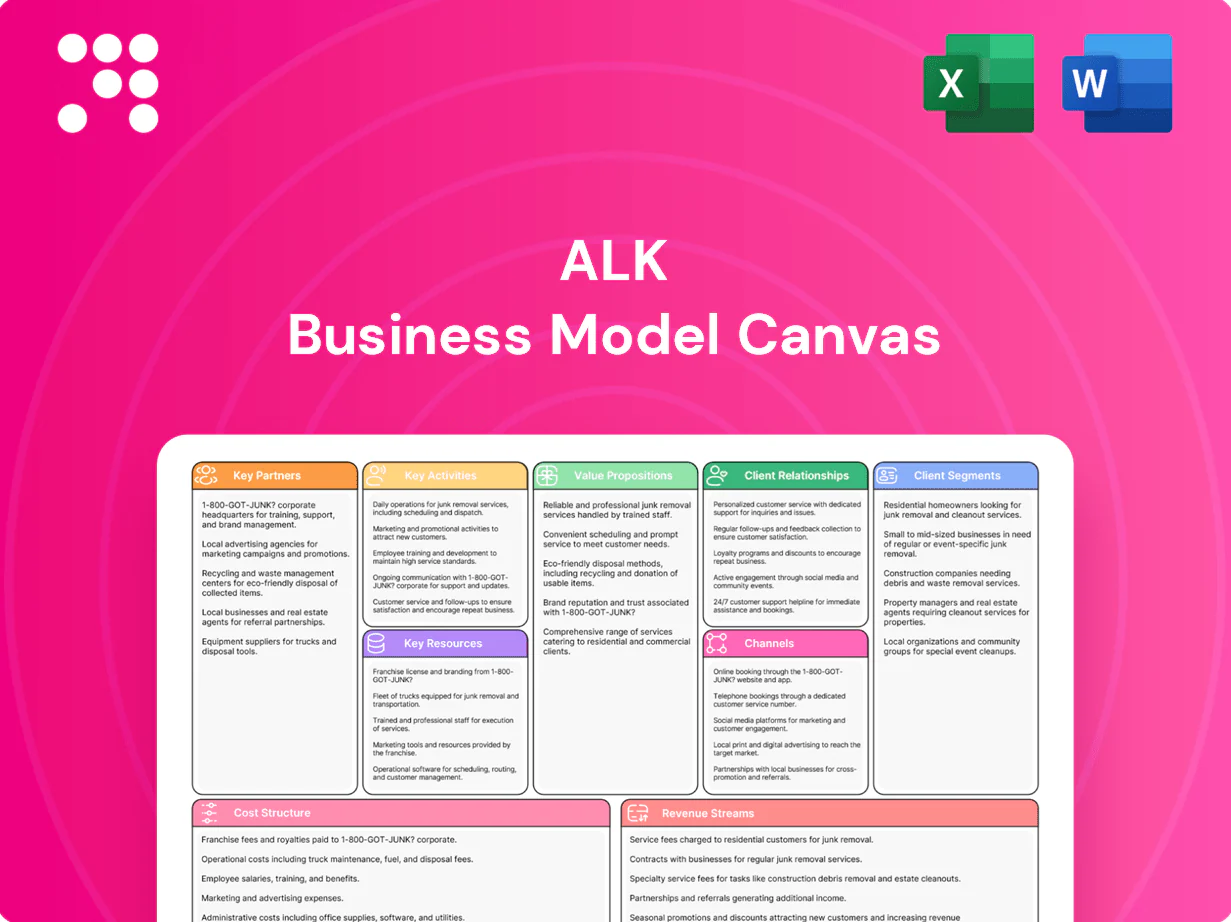
The Alk Business Model Canvas shown here is the actual deliverable, not a mockup, and reflects the exact structure and content you’ll receive after purchase. When you buy, you’ll get this same professional file ready to edit and present. No placeholders, no surprises—what you preview is what you’ll download.

Original: $10.00
-65%$10.00
$3.50Product Information
Product Information
Shipping & Returns
Shipping & Returns
Description
Business Model Canvas: Clear, Actionable Insights to Map Value and Scale Fast
Unlock Alk’s strategic backbone with our concise Business Model Canvas—three to five insights per block explain how Alk creates value, scales, and defends market position. Perfect for investors, founders, and strategists wanting actionable takeaways and benchmarking tools. Download the full, editable Word & Excel Canvas to map opportunities, risks, and monetization tactics for immediate use.
Partnerships
Academic & Research Labs
Universities and immunology institutes co-develop novel AIT mechanisms and biomarkers, providing access to well-characterized patient cohorts and translational-science platforms; joint publications and grants de-risk early discovery and enhance credibility. Long-term collaborations accelerate proof-of-concept and pipeline expansion, supported by >$40B invested into biomedical research in 2024 by major funders.
CROs & CMOs
Contract research organizations run multi-country trials across 10+ sites efficiently and compliantly, accelerating enrollment and regulatory submissions; global CRO networks supported thousands of studies in 2024. Contract manufacturers scale GMP production to millions of tablets and tens of thousands of injectables per month, enabling 3–6 month surge ramps for new launches. These partners add flexibility, lower unit costs, and maintain quality and regulatory standards.
Clinicians & KOL Networks
Allergists, ENT specialists, pulmonologists and pediatric KOLs co-design AIT protocols and drive clinical adoption, addressing allergic rhinitis which affects an estimated 10–30% of the global population. Advisory boards (multidisciplinary expert panels) shape clinical guidelines and product positioning, reflected in endorsements from societies such as EAACI and AAAAI. Early adopters generate real-world evidence and peer influence that accelerate uptake. Ongoing education partnerships deliver CME and practice support to embed best-practice AIT use.
Payers & HTA Bodies
Payers and HTA bodies determine access and pricing for ALK’s allergen immunotherapy; allergic diseases affect up to 30% of the global population (WHO), making payer decisions material to market size. Collaborative health‑economic studies and Cochrane-supported meta-analyses demonstrating AIT’s sustained, disease‑modifying benefit are used to secure favorable coverage. Risk‑sharing and outcomes‑based agreements and continuous dialogue align evidence with market‑access needs and reimbursement.
- Payers set coverage and price
- HTA requires health‑economic evidence
- AIT has sustained benefit per Cochrane reviews
- Risk‑sharing improves reimbursement outcomes
- Ongoing dialogue aligns evidence to payer needs
Suppliers & Device/Digital Partners
Specialized GMP suppliers ensure consistent allergen source materials and excipients, cutting lot-to-lot variability to <5%; device and packaging partners extend stability up to 24 months and can raise adherence by ~30%; digital health firms enable remote monitoring and adherence support, with 2024 trials showing ~25% reduction in missed doses; integrated ecosystems drive better patient outcomes and clear product differentiation.
- Suppliers: GMP, variability <5%
- Devices: +24 months stability
- Digital: −25% missed doses
- Ecosystem: improved outcomes, stronger differentiation
AIT scale: $40B, thousands trials, 30% reach
Universities, CROs, manufacturers and KOLs accelerate AIT R&D and trials, leveraging >$40B biomedical research funding in 2024; CRO networks ran thousands of studies in 2024. Payers/HTA and risk‑sharing shape access; AIT affects up to 30% globally. GMP suppliers/devices/digital reduce variability <5%, extend stability to 24 months and cut missed doses ~25%.
| Partner | 2024 metric | Impact |
|---|---|---|
| Universities | $40B research | de‑risk discovery |
| CROs | thousands studies | faster trials |
| Manufacturers | MM units/mo | scale launches |
What is included in the product
Detailed Word Document
A comprehensive, pre-written Business Model Canvas tailored to Alk’s strategy, covering customer segments, channels, value propositions and revenue streams across the 9 classic BMC blocks; includes competitive-advantage analysis, linked SWOT insights and polished narrative for presentations, investor discussions and validation of business ideas using real-company data.
Customizable Excel Spreadsheet
Condenses Alk’s strategy into a clean, editable one-page canvas that saves hours of structuring, quickly highlights pain points and solutions, and is ideal for team collaboration, boardrooms, or fast executive summaries.
Activities
R&D & Clinical Trials
Discovery, preclinical and phase I–III studies validate safety and efficacy, with average timelines of 10–12 years and industry cost around $2.6B per approved drug. Biomarker development supports patient selection, often reducing required sample size by ~30% and improving responder rates. Post-marketing studies generate long-term evidence for disease modification and extend commercial value, while continuous pipeline renewal sustains growth.
Regulatory & Quality
Global dossier preparation follows the ICH CTD/eCTD formats to secure approvals across jurisdictions; Alk submits centralized or national dossiers tailored to EU, US and key emerging markets. Pharmacovigilance implements PBRER/PSUR reporting (typically annual) and safety signal management to meet post-approval commitments. GMP, GLP and GCP compliance is maintained through certified quality systems and routine inspections. Audit readiness and quality by design practices reduce regulatory and product risk.
Manufacturing & Supply
Standardized allergen extraction and formulation ensure potency consistency across batches, supporting regulatory compliance and predictable clinical outcomes. Scale-up, packaging, and cold-chain logistics guarantee availability during peak seasons and sensitive supply windows. Inventory planning aligns with seasonal pollen peaks and regional demand; allergic rhinitis affects 10–30% of people worldwide in 2024. Business continuity planning mitigates supply disruptions and preserves patient access.
Medical Affairs & Education
Medical Affairs & Education drives scientific exchange with clinicians to disseminate pivotal AIT data and guideline updates, supports CME and hands-on training that increased certified AIT administrators in 2024, coordinates publication planning to broaden evidence visibility, and deploys field medical teams to resolve complex clinical questions at point of care.
- 2024 allergy immunotherapy market ≈ USD 4.5bn
- ~1,200 clinicians trained (2024)
- Field teams handle specialist queries
Commercial & Market Access
Brand strategy and omnichannel promotion drive adoption, with digital channels accounting for up to 60% of new prescriptions in specialty markets (2024 benchmarks). Health economics dossiers demonstrating QALY gains and cost offsets influence >70% of formulary decisions (2024 payer surveys). Tendering and pricing negotiations secure institutional coverage and rebates; patient support programs increase initiation and persistence by ~20% (2024 real-world estimates).
- Brand strategy & omnichannel
- Health economics (HEOR) evidence
- Tendering & pricing negotiations
- Patient support programs
Biomarker-led rhinitis: $2.6B, 10–12y
Discovery-to-launch (10–12y; ~$2.6B per approval) with biomarker-led trials reducing sample size ~30%. Regulatory (eCTD, PBRER) and GMP/GCP compliance ensure approvals and safety. Manufacturing, cold-chain and inventory align to seasonal demand; allergic rhinitis prevalence 10–30% (2024). Commercial: market ≈ USD 4.5bn (2024), 60% digital-origin prescriptions, patient programs +20% initiation.
| Metric | Value (2024) |
|---|---|
| Dev timeline & cost | 10–12y; $2.6B |
| Market size | USD 4.5bn |
| Allergic rhinitis prevalence | 10–30% |
| Clinicians trained | ~1,200 |
| Digital Rx share | 60% |
| Patient program impact | +20% initiation |
Full Version Awaits
Business Model Canvas
The Alk Business Model Canvas shown here is the actual deliverable, not a mockup, and reflects the exact structure and content you’ll receive after purchase. When you buy, you’ll get this same professional file ready to edit and present. No placeholders, no surprises—what you preview is what you’ll download.