Alete GmbH PESTLE Analysis

Make Smarter Strategic Decisions with a Complete PESTEL View
Gain strategic clarity with our PESTLE Analysis of Alete GmbH. We reveal political, economic, social, technological, legal and environmental forces shaping its trajectory. Use these insights to de-risk decisions and spot growth opportunities. Buy the full analysis for the complete, actionable report.
Political factors

EU food policy and infant nutrition priorities
The EU Farm to Fork strategy (targets: 50% pesticide reduction, 50% antimicrobial use cut, 25% organic land by 2030) reshapes baby‑food standards and incentives; EU4Health (€5.3bn) and Horizon Europe (€95.5bn) can fund child‑nutrition projects and public‑procurement tenders, while shifting targets force reformulation, increased reporting and reputational alignment to retain market access.
Trade relations and import dependencies
Baby food inputs like dairy, grains and specialty micronutrients face tariffs, SPS checks and geopolitical risks that can trigger supply squeezes and cost inflation. Disruptions or sanctions have tightened global food chains in recent years, prompting buyers to seek resilience. The EU has 40 trade agreements in force (covering 71 countries), easing sourcing but demanding strict conformity with EU SPS and labelling rules. Diversified suppliers and increased local sourcing buffer political shocks.

Public health campaigns and subsidies
Government breastfeeding promotion and nutrition programs shape demand for formula versus complementary foods: global exclusive breastfeeding rate is about 44% (WHO/UNICEF 2023), reducing formula demand in supported populations. Subsidy/voucher schemes such as US WIC (serving roughly 6 million participants in 2023) and the UK Healthy Start steer purchases toward specific categories and price points. Alete can realign portfolios to public health goals and maintain transparent collaboration to lower reputational and regulatory risk.

Political stability and consumer confidence
Stable governance across Alete GmbH core EU markets generally supports predictable demand and capital investment, though the June 2024 EU elections shifted policymaking and saw stronger populist representation in several member states. Elections can change tax, labeling and environmental priorities; import tariffs and energy subsidies are increasingly politicized. Populist shifts have already influenced tighter import scrutiny and renewable support mechanisms. Scenario planning preserves margins and service continuity.
- EU elections June 2024 increased populist leverage
- Consumer confidence (EU average 2024 ≈ -9) affects demand
- Energy and import policy volatility risks margins
- Scenario planning recommended to protect operations
Food security and strategic reserves
Governments are raising food security scrutiny, prompting stockholding and traceability rules that can force extra inventory or audits; Germany records roughly 700,000 births annually and the baby-food market was about EUR 1.1bn in 2024, increasing regulatory focus on staples. Policies now favor local production of infant staples, and compliance could lift working capital needs by an estimated 5–10%. Alete can market superior supply resilience as a competitive differentiator.
- Regulatory pressure: higher stockholding and audits
- Market scale: ~EUR 1.1bn German baby-food market (2024)
- Demographics: ~700,000 births/year (Germany)
- Impact: working capital +5–10% for compliance
EU Farm to Fork forces reformulation; €100.8bn EU funding backs projects; Germany baby‑food €1.1bn
EU Farm to Fork and post‑2024 rules force reformulation, reporting and reputational alignment; EU4Health €5.3bn and Horizon Europe €95.5bn enable funded projects. Trade/SPS checks and geopolitical shocks raise input costs and favor diversified/local sourcing; Germany baby‑food market ≈ EUR1.1bn (2024), births ≈700,000. Policy shifts and stockholding rules add ~5–10% working‑capital burden.
| Metric | Value |
|---|---|
| Farm to Fork targets | 50% pesticides; 25% organic by 2030 |
| EU funding | EU4Health €5.3bn; Horizon €95.5bn |
| Germany 2024 | Market €1.1bn; births 700,000 |
| Working capital impact | +5–10% |
What is included in the product
 Detailed Word Document
Explores how Political, Economic, Social, Technological, Environmental and Legal forces uniquely affect Alete GmbH, with data-backed trends and region-specific regulatory context. Designed for executives and investors, it highlights threats, opportunities and forward-looking scenarios ready for plans and pitches.

 Customizable Excel Spreadsheet
A concise, visually segmented PESTLE summary for Alete GmbH that simplifies external risk assessment and market positioning, easing inclusion in presentations, team planning sessions, and client reports.
Economic factors

Household income and price elasticity
Infant nutrition remains relatively price inelastic—demand held firm through 2023–24—though trading down rises in downturns as households seek cheaper SKUs. Premium organic and specialty SKUs show higher elasticity and can see double-digit volume swings versus staples. Alete protects share with tiered offerings and value packs across cycles. Monitoring CPI (US 2024 avg CPI-U 3.4%) and wage trends (avg hourly earnings ~+4% in 2024) guides pricing cadence.
Input cost volatility
Dairy, grains, fruits, packaging and energy drive Alete’s COGS volatility, with global food prices falling roughly 25% from 2022 peaks into 2024 yet remaining exposed to harvest shocks; inflation spikes compress margins absent agile hedging. Long-term supplier contracts and product reformulation have been used to stabilize input lines. Cost-to-serve analytics guide SKU rationalization and prioritize high-margin SKUs.

Retail channel mix shift
Discounters (Aldi/Lidl ≈43% combined share in Germany, 2024) and e-commerce (grocery online ≈12% of sales, 2024) keep gaining, pressuring trade terms. Marketplaces force competitive pricing and availability to win buy-box visibility. D2C can lift gross margin by 5–10 p.p. but demands fulfillment excellence. Optimized omni-channel packs and promotions (promo-driven volume ≈30%) sustain velocity.

Currency fluctuations
Currency fluctuations expose Alete GmbH when inputs or exports sit outside the euro; EUR/USD averaged about 1.08 in 2024, amplifying translation and transaction risk. Robust hedging programs and natural offsets (local sourcing/export balancing) materially cut volatility. Pricing corridors must respect limited FX pass-through to retailers, and clear, timely communication preserves retailer trust.
- FX exposure: non-euro flows
- 2024 EUR/USD avg ~1.08
- Hedging + natural offsets lower volatility
- Pricing corridors consider pass-through limits
- Transparent communication preserves trust
Demographic trends and birth rates
Declining birth rates across parts of Europe constrain volume growth: EU total fertility rate ~1.49 (2023), Germany ~1.46, Italy ~1.24 while France remains higher at ~1.78, limiting organic customer base expansion.
- Migratory flows create regional pockets of growth, offsetting declines locally
- Portfolio breadth across stages increases lifetime value per child
- Geographic expansion (new EU/ROW markets) mitigates demographic headwinds
EU Farm to Fork forces reformulation; €100.8bn EU funding backs projects; Germany baby‑food €1.1bn
Infant nutrition demand stayed price‑inelastic through 2023–24 while premium SKUs show higher elasticity; Alete uses tiered SKUs and value packs. COGS driven by dairy/grains/energy; global food prices fell ~25% from 2022 peaks into 2024 so hedging and reformulation remain critical. EU fertility (~1.49, 2023) limits volume—migration and geographic expansion partially offset.
| Metric | Value |
|---|---|
| EUR/USD 2024 avg | ~1.08 |
| EU TFR 2023 | 1.49 |
| Online grocery share 2024 (DE) | ~12% |
What You See Is What You Get
Alete GmbH PESTLE Analysis
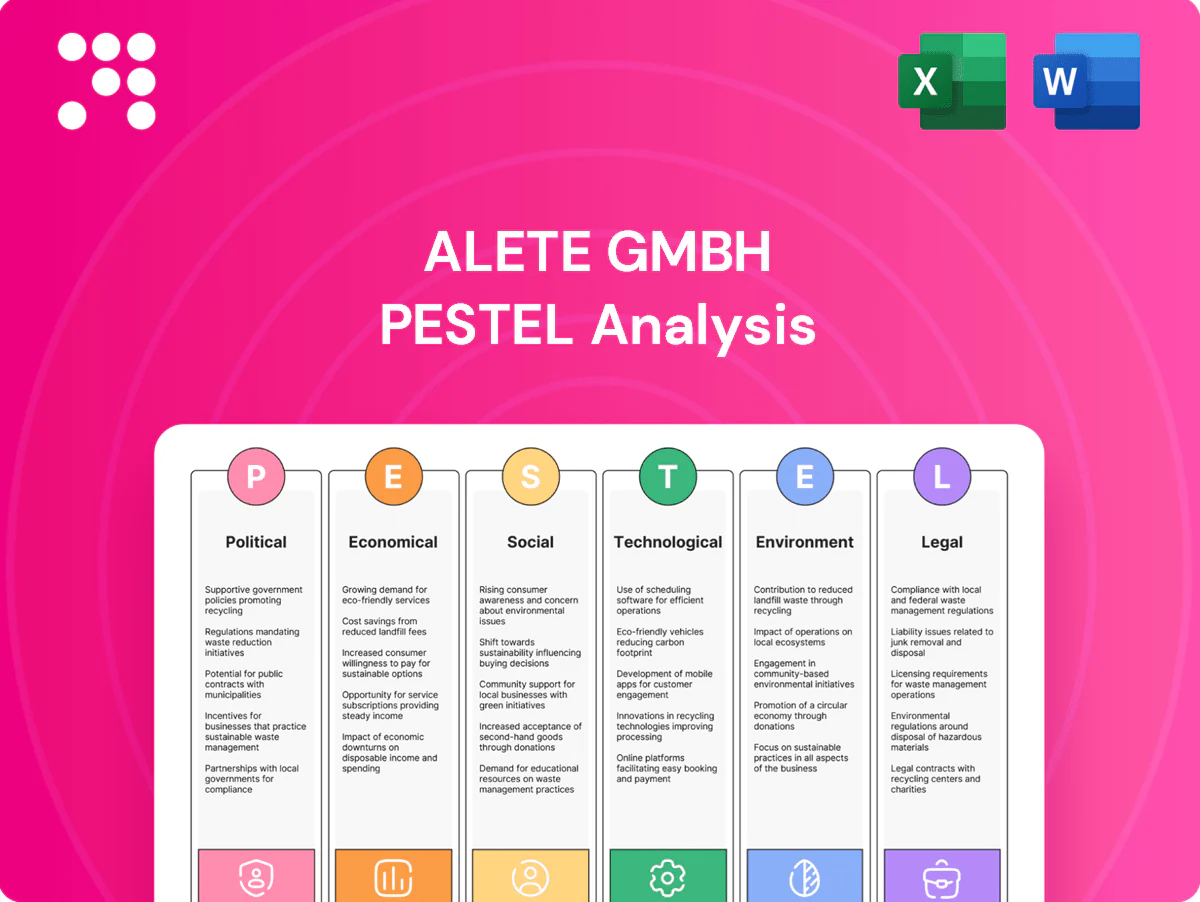
The preview shown here is the exact PESTLE analysis of Alete GmbH you’ll receive after purchase—fully formatted and ready to use. It covers Political, Economic, Social, Technological, Legal and Environmental factors with concise insights for strategic decision‑making. No placeholders or teasers—this is the final file available for immediate download.

Product Information
Product Information
Shipping & Returns
Shipping & Returns
Description
Make Smarter Strategic Decisions with a Complete PESTEL View
Gain strategic clarity with our PESTLE Analysis of Alete GmbH. We reveal political, economic, social, technological, legal and environmental forces shaping its trajectory. Use these insights to de-risk decisions and spot growth opportunities. Buy the full analysis for the complete, actionable report.
Political factors
EU food policy and infant nutrition priorities
The EU Farm to Fork strategy (targets: 50% pesticide reduction, 50% antimicrobial use cut, 25% organic land by 2030) reshapes baby‑food standards and incentives; EU4Health (€5.3bn) and Horizon Europe (€95.5bn) can fund child‑nutrition projects and public‑procurement tenders, while shifting targets force reformulation, increased reporting and reputational alignment to retain market access.
Trade relations and import dependencies
Baby food inputs like dairy, grains and specialty micronutrients face tariffs, SPS checks and geopolitical risks that can trigger supply squeezes and cost inflation. Disruptions or sanctions have tightened global food chains in recent years, prompting buyers to seek resilience. The EU has 40 trade agreements in force (covering 71 countries), easing sourcing but demanding strict conformity with EU SPS and labelling rules. Diversified suppliers and increased local sourcing buffer political shocks.
Public health campaigns and subsidies
Government breastfeeding promotion and nutrition programs shape demand for formula versus complementary foods: global exclusive breastfeeding rate is about 44% (WHO/UNICEF 2023), reducing formula demand in supported populations. Subsidy/voucher schemes such as US WIC (serving roughly 6 million participants in 2023) and the UK Healthy Start steer purchases toward specific categories and price points. Alete can realign portfolios to public health goals and maintain transparent collaboration to lower reputational and regulatory risk.
Political stability and consumer confidence
Stable governance across Alete GmbH core EU markets generally supports predictable demand and capital investment, though the June 2024 EU elections shifted policymaking and saw stronger populist representation in several member states. Elections can change tax, labeling and environmental priorities; import tariffs and energy subsidies are increasingly politicized. Populist shifts have already influenced tighter import scrutiny and renewable support mechanisms. Scenario planning preserves margins and service continuity.
- EU elections June 2024 increased populist leverage
- Consumer confidence (EU average 2024 ≈ -9) affects demand
- Energy and import policy volatility risks margins
- Scenario planning recommended to protect operations
Food security and strategic reserves
Governments are raising food security scrutiny, prompting stockholding and traceability rules that can force extra inventory or audits; Germany records roughly 700,000 births annually and the baby-food market was about EUR 1.1bn in 2024, increasing regulatory focus on staples. Policies now favor local production of infant staples, and compliance could lift working capital needs by an estimated 5–10%. Alete can market superior supply resilience as a competitive differentiator.
- Regulatory pressure: higher stockholding and audits
- Market scale: ~EUR 1.1bn German baby-food market (2024)
- Demographics: ~700,000 births/year (Germany)
- Impact: working capital +5–10% for compliance
EU Farm to Fork forces reformulation; €100.8bn EU funding backs projects; Germany baby‑food €1.1bn
EU Farm to Fork and post‑2024 rules force reformulation, reporting and reputational alignment; EU4Health €5.3bn and Horizon Europe €95.5bn enable funded projects. Trade/SPS checks and geopolitical shocks raise input costs and favor diversified/local sourcing; Germany baby‑food market ≈ EUR1.1bn (2024), births ≈700,000. Policy shifts and stockholding rules add ~5–10% working‑capital burden.
| Metric | Value |
|---|---|
| Farm to Fork targets | 50% pesticides; 25% organic by 2030 |
| EU funding | EU4Health €5.3bn; Horizon €95.5bn |
| Germany 2024 | Market €1.1bn; births 700,000 |
| Working capital impact | +5–10% |
What is included in the product
Detailed Word Document
Explores how Political, Economic, Social, Technological, Environmental and Legal forces uniquely affect Alete GmbH, with data-backed trends and region-specific regulatory context. Designed for executives and investors, it highlights threats, opportunities and forward-looking scenarios ready for plans and pitches.
Customizable Excel Spreadsheet
A concise, visually segmented PESTLE summary for Alete GmbH that simplifies external risk assessment and market positioning, easing inclusion in presentations, team planning sessions, and client reports.
Economic factors
Household income and price elasticity
Infant nutrition remains relatively price inelastic—demand held firm through 2023–24—though trading down rises in downturns as households seek cheaper SKUs. Premium organic and specialty SKUs show higher elasticity and can see double-digit volume swings versus staples. Alete protects share with tiered offerings and value packs across cycles. Monitoring CPI (US 2024 avg CPI-U 3.4%) and wage trends (avg hourly earnings ~+4% in 2024) guides pricing cadence.
Input cost volatility
Dairy, grains, fruits, packaging and energy drive Alete’s COGS volatility, with global food prices falling roughly 25% from 2022 peaks into 2024 yet remaining exposed to harvest shocks; inflation spikes compress margins absent agile hedging. Long-term supplier contracts and product reformulation have been used to stabilize input lines. Cost-to-serve analytics guide SKU rationalization and prioritize high-margin SKUs.
Retail channel mix shift
Discounters (Aldi/Lidl ≈43% combined share in Germany, 2024) and e-commerce (grocery online ≈12% of sales, 2024) keep gaining, pressuring trade terms. Marketplaces force competitive pricing and availability to win buy-box visibility. D2C can lift gross margin by 5–10 p.p. but demands fulfillment excellence. Optimized omni-channel packs and promotions (promo-driven volume ≈30%) sustain velocity.
Currency fluctuations
Currency fluctuations expose Alete GmbH when inputs or exports sit outside the euro; EUR/USD averaged about 1.08 in 2024, amplifying translation and transaction risk. Robust hedging programs and natural offsets (local sourcing/export balancing) materially cut volatility. Pricing corridors must respect limited FX pass-through to retailers, and clear, timely communication preserves retailer trust.
- FX exposure: non-euro flows
- 2024 EUR/USD avg ~1.08
- Hedging + natural offsets lower volatility
- Pricing corridors consider pass-through limits
- Transparent communication preserves trust
Demographic trends and birth rates
Declining birth rates across parts of Europe constrain volume growth: EU total fertility rate ~1.49 (2023), Germany ~1.46, Italy ~1.24 while France remains higher at ~1.78, limiting organic customer base expansion.
- Migratory flows create regional pockets of growth, offsetting declines locally
- Portfolio breadth across stages increases lifetime value per child
- Geographic expansion (new EU/ROW markets) mitigates demographic headwinds
EU Farm to Fork forces reformulation; €100.8bn EU funding backs projects; Germany baby‑food €1.1bn
Infant nutrition demand stayed price‑inelastic through 2023–24 while premium SKUs show higher elasticity; Alete uses tiered SKUs and value packs. COGS driven by dairy/grains/energy; global food prices fell ~25% from 2022 peaks into 2024 so hedging and reformulation remain critical. EU fertility (~1.49, 2023) limits volume—migration and geographic expansion partially offset.
| Metric | Value |
|---|---|
| EUR/USD 2024 avg | ~1.08 |
| EU TFR 2023 | 1.49 |
| Online grocery share 2024 (DE) | ~12% |
What You See Is What You Get
Alete GmbH PESTLE Analysis
The preview shown here is the exact PESTLE analysis of Alete GmbH you’ll receive after purchase—fully formatted and ready to use. It covers Political, Economic, Social, Technological, Legal and Environmental factors with concise insights for strategic decision‑making. No placeholders or teasers—this is the final file available for immediate download.