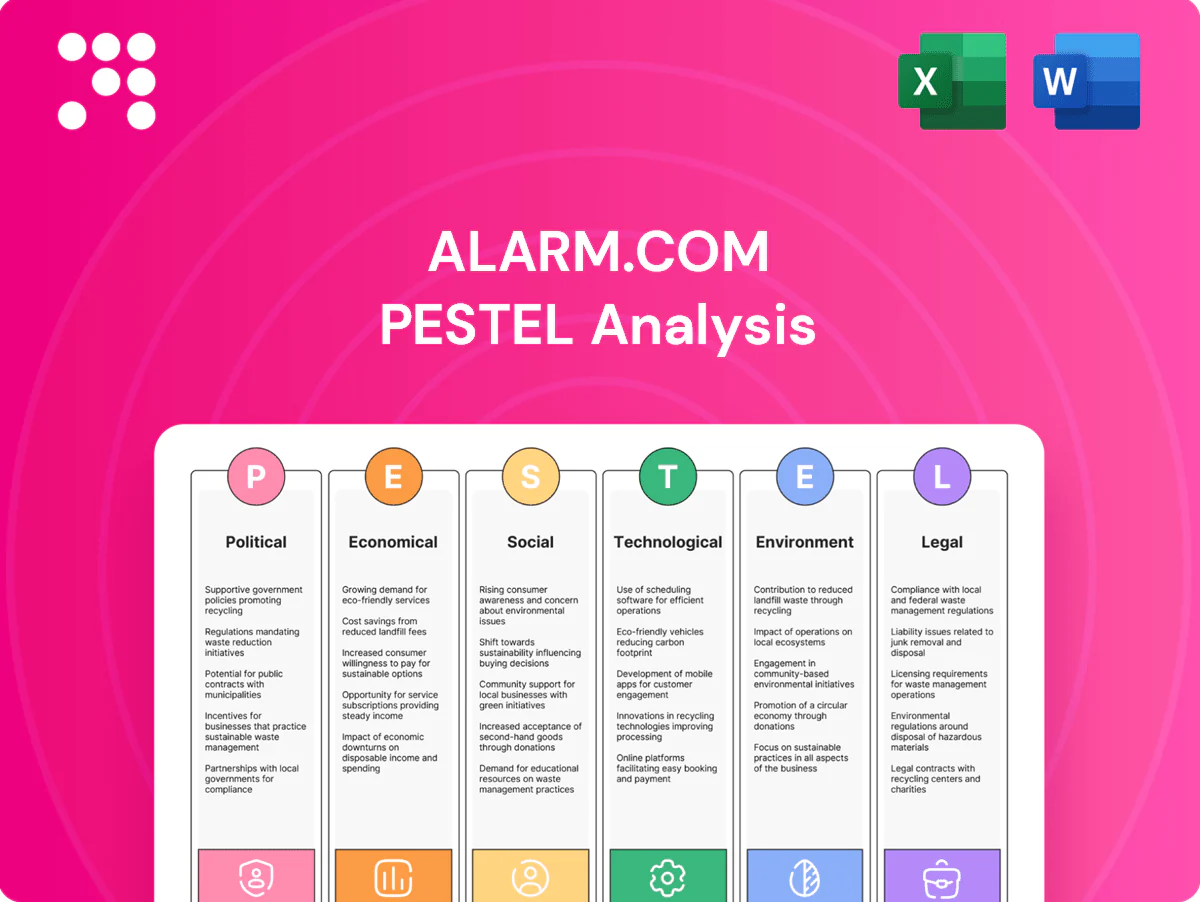
Alarm.com PESTLE Analysis

Your Shortcut to Market Insight Starts Here
Discover how regulatory shifts, tech innovation, and shifting consumer expectations are reshaping Alarm.com's market position in our concise PESTLE snapshot—perfect for investors and strategists. Purchase the full PESTLE for detailed risks, opportunities, and actionable insights you can use immediately.
Political factors

Data privacy regimes
Expanding regimes like the EU GDPR (max fine €20m or 4% global turnover) and California CPRA (effective 2023, statutory breach damages $100–750 per consumer) force Alarm.com to limit data collection, storage duration and govern cross‑border transfers under SCCs and US‑EU frameworks. Compliance drives privacy‑by‑default product design and retention settings; noncompliance risks heavy fines and severe reputational loss.
Telecom and spectrum policy
Regulation of cellular networks and spectrum reallocations (eg FCC C-band auction raised about $81 billion) reshape device connectivity and upgrade timing; major US carriers completed 3G/2G sunsets in 2022–2023, forcing migration to LTE/5G. Carrier certification requirements and mandated sunsets drive costly panel and radio replacements for security-platform providers. Federal broadband incentives, notably the $42.45 billion BEAD program, can expand addressable markets.

Trade and supply chain geopolitics
Tariffs of up to 25% and US export controls on advanced chips (backed by the CHIPS Act's roughly 52 billion dollar subsidy package) raise Alarm.com hardware costs and constrain sourcing choices. US sanctions and blacklists of major PRC video vendors such as Hikvision and Dahua have already reshaped partner ecosystems. As a result, nearshoring and multi-source component diversification are becoming strategic necessities for supply resilience.

Public safety and security policy
Crime-prevention initiatives and expanding smart-city programs are accelerating demand for integrated Alarm.com platforms as municipalities prioritize connected surveillance, access control and analytics to reduce response times. Police-video partnerships and alarm-response protocols shape product roadmaps toward real-time evidence sharing and chain-of-custody features. Changes in municipal and commercial budget priorities directly affect procurement cycles and recurring revenue for security providers.
- Municipal procurement drives platform feature prioritization
- Police-video integrations influence product roadmap and compliance
- Funding shifts alter timing and scale of deployments
Subsidies and energy policy
Energy-efficiency incentives and demand-response programs, reinforced by the Inflation Reduction Act’s ~369 billion USD in clean energy and the Bipartisan Infrastructure Law’s ~65 billion USD for grid upgrades, bolster smart-thermostat and energy-management uptake; building electrification and grid-modernization policies widen integration paths while policy volatility raises planning uncertainty for load-control features.
- IRA funding: ~369B
- BIL grid: ~65B
- Higher integration opportunities
- Policy volatility = planning risk
GDPR, CPRA and $42.45B BEAD accelerate 5G migration and supply-chain reshaping
Geopolitical regulation (GDPR: €20m/4% turnover; CPRA damages $100–750/consumer) forces stricter data minimization and cross‑border controls. Carrier sunsets and FCC spectrum shifts (C‑band ~$81B) accelerate LTE/5G migrations and certification costs. Tariffs, CHIPS subsidies (~$52B) and BEAD ($42.45B) reshape sourcing and addressable markets.
| Item | Value |
|---|---|
| GDPR fine | €20m/4% |
| CPRA damages | $100–750/consumer |
| BEAD | $42.45B |
What is included in the product
 Detailed Word Document
Explores how macro-environmental factors uniquely affect Alarm.com across Political, Economic, Social, Technological, Environmental and Legal dimensions, with data-driven trends and region-specific examples. Designed for executives and investors, it highlights risks, opportunities and forward-looking scenarios in a format ready for business plans and strategic decision-making.

 Customizable Excel Spreadsheet
Condensed Alarm.com PESTLE summary, visually segmented by category for quick interpretation and drop-ready for presentations, helping teams align on external risks and market positioning during planning sessions.
Economic factors

Housing cycle exposure
Residential installs for Alarm.com track housing starts (US ~1.45M in 2024) and existing-home sales (~4.0M in 2024), with remodeling spend near $600B supporting retrofit demand. Weak turnover reduces new-subscription growth, though retrofits and upsells partly offset revenue declines. Rising mortgage rates around 7% and Fed funds at 5.25–5.5% constrain purchases; dealer financing availability therefore materially affects sales timing.
SMB capex sensitivity
Small business security and access-control spend closely tracks broader economic health; Alarm.com noted SMB exposures as customers tightened budgets during the 2023–24 slowdown. Recessions typically elongate sales cycles and push buyers toward lower-tier plans, reducing hardware attach rates and average order values. Alarm.com’s recurring SaaS revenue, which comprised about 73% of 2024 revenue, helps buffer hardware volatility and stabilizes ARR.

Inflation and input costs
Rising component inflation and input costs—US CPI averaged 3.4% in 2024 (BLS)—plus elevated logistics and freight volatility (Drewry WCI down ~80% from 2021 peaks to 2024 but still spiky) squeeze dealer margins as labor tightness at channel partners raises installation and service expenses. Price increases must balance ARPU growth with churn risk. Scale procurement and targeted product redesign mitigate cost spikes.

ARPU and upsell dynamics
Tiered video, AI analytics, and add-on services increase lifetime value by enabling higher-priced plans and event-based fees; industry smart-home ARPU was about $50–$60/month in 2024 while successful upsell programs boosted LTV 10–30% in comparable rollouts. Bundling security, access, and energy raises retention and reduces churn. Macroeconomic stress in 2024–2025 pushed some customers to basic plans, compressing ARPU.
- Tiered video/AI: higher monetization
- Bundling: improved retention
- Add-ons: +10–30% LTV lift (2024 cases)
- Macro risk: downtrading compresses ARPU
Currency and international
Foreign exchange swings materially affect Alarm.coms overseas subscription revenue and component purchases, pressuring margins as the US dollar fluctuates against key currencies; the company reports operations under ticker ALRM and emphasizes localized pricing and billing to reduce FX exposure and billing friction. Regional economic slowdowns can slow partner expansion and delay certification investments in smart-home installers.
- FX exposure: localized pricing/billing
- Revenue mix: international operations impact margins
- Regional GDP cycles affect partner growth
GDPR, CPRA and $42.45B BEAD accelerate 5G migration and supply-chain reshaping
Housing starts ~1.45M (2024) and existing-home sales ~4.0M with $600B remodeling support retrofit demand; mortgage ~7% and Fed funds 5.25–5.5% slow purchases. SaaS ~73% of 2024 revenue and ARPU $50–$60 stabilize ARR despite hardware pressure. Component inflation/CPI 3.4% (2024) and FX swings compress margins; bundling/AI upsells lift LTV 10–30%.
| Metric | Value (2024) |
|---|---|
| Housing starts | 1.45M |
| Existing-home sales | 4.0M |
| Remodel spend | $600B |
| SaaS rev | 73% |
| ARPU | $50–$60/mo |
| CPI (US) | 3.4% |
Preview the Actual Deliverable
Alarm.com PESTLE Analysis
This preview shows the exact Alarm.com PESTLE Analysis you’ll receive after purchase—fully formatted, professionally structured, and ready to use. The content, layout, and data visible here are the real document delivered immediately after checkout. No placeholders or teasers—what you see is what you’ll download and apply to your analysis or report.

Product Information
Product Information
Shipping & Returns
Shipping & Returns
Description
Your Shortcut to Market Insight Starts Here
Discover how regulatory shifts, tech innovation, and shifting consumer expectations are reshaping Alarm.com's market position in our concise PESTLE snapshot—perfect for investors and strategists. Purchase the full PESTLE for detailed risks, opportunities, and actionable insights you can use immediately.
Political factors
Data privacy regimes
Expanding regimes like the EU GDPR (max fine €20m or 4% global turnover) and California CPRA (effective 2023, statutory breach damages $100–750 per consumer) force Alarm.com to limit data collection, storage duration and govern cross‑border transfers under SCCs and US‑EU frameworks. Compliance drives privacy‑by‑default product design and retention settings; noncompliance risks heavy fines and severe reputational loss.
Telecom and spectrum policy
Regulation of cellular networks and spectrum reallocations (eg FCC C-band auction raised about $81 billion) reshape device connectivity and upgrade timing; major US carriers completed 3G/2G sunsets in 2022–2023, forcing migration to LTE/5G. Carrier certification requirements and mandated sunsets drive costly panel and radio replacements for security-platform providers. Federal broadband incentives, notably the $42.45 billion BEAD program, can expand addressable markets.
Trade and supply chain geopolitics
Tariffs of up to 25% and US export controls on advanced chips (backed by the CHIPS Act's roughly 52 billion dollar subsidy package) raise Alarm.com hardware costs and constrain sourcing choices. US sanctions and blacklists of major PRC video vendors such as Hikvision and Dahua have already reshaped partner ecosystems. As a result, nearshoring and multi-source component diversification are becoming strategic necessities for supply resilience.
Public safety and security policy
Crime-prevention initiatives and expanding smart-city programs are accelerating demand for integrated Alarm.com platforms as municipalities prioritize connected surveillance, access control and analytics to reduce response times. Police-video partnerships and alarm-response protocols shape product roadmaps toward real-time evidence sharing and chain-of-custody features. Changes in municipal and commercial budget priorities directly affect procurement cycles and recurring revenue for security providers.
- Municipal procurement drives platform feature prioritization
- Police-video integrations influence product roadmap and compliance
- Funding shifts alter timing and scale of deployments
Subsidies and energy policy
Energy-efficiency incentives and demand-response programs, reinforced by the Inflation Reduction Act’s ~369 billion USD in clean energy and the Bipartisan Infrastructure Law’s ~65 billion USD for grid upgrades, bolster smart-thermostat and energy-management uptake; building electrification and grid-modernization policies widen integration paths while policy volatility raises planning uncertainty for load-control features.
- IRA funding: ~369B
- BIL grid: ~65B
- Higher integration opportunities
- Policy volatility = planning risk
GDPR, CPRA and $42.45B BEAD accelerate 5G migration and supply-chain reshaping
Geopolitical regulation (GDPR: €20m/4% turnover; CPRA damages $100–750/consumer) forces stricter data minimization and cross‑border controls. Carrier sunsets and FCC spectrum shifts (C‑band ~$81B) accelerate LTE/5G migrations and certification costs. Tariffs, CHIPS subsidies (~$52B) and BEAD ($42.45B) reshape sourcing and addressable markets.
| Item | Value |
|---|---|
| GDPR fine | €20m/4% |
| CPRA damages | $100–750/consumer |
| BEAD | $42.45B |
What is included in the product
Detailed Word Document
Explores how macro-environmental factors uniquely affect Alarm.com across Political, Economic, Social, Technological, Environmental and Legal dimensions, with data-driven trends and region-specific examples. Designed for executives and investors, it highlights risks, opportunities and forward-looking scenarios in a format ready for business plans and strategic decision-making.
Customizable Excel Spreadsheet
Condensed Alarm.com PESTLE summary, visually segmented by category for quick interpretation and drop-ready for presentations, helping teams align on external risks and market positioning during planning sessions.
Economic factors
Housing cycle exposure
Residential installs for Alarm.com track housing starts (US ~1.45M in 2024) and existing-home sales (~4.0M in 2024), with remodeling spend near $600B supporting retrofit demand. Weak turnover reduces new-subscription growth, though retrofits and upsells partly offset revenue declines. Rising mortgage rates around 7% and Fed funds at 5.25–5.5% constrain purchases; dealer financing availability therefore materially affects sales timing.
SMB capex sensitivity
Small business security and access-control spend closely tracks broader economic health; Alarm.com noted SMB exposures as customers tightened budgets during the 2023–24 slowdown. Recessions typically elongate sales cycles and push buyers toward lower-tier plans, reducing hardware attach rates and average order values. Alarm.com’s recurring SaaS revenue, which comprised about 73% of 2024 revenue, helps buffer hardware volatility and stabilizes ARR.
Inflation and input costs
Rising component inflation and input costs—US CPI averaged 3.4% in 2024 (BLS)—plus elevated logistics and freight volatility (Drewry WCI down ~80% from 2021 peaks to 2024 but still spiky) squeeze dealer margins as labor tightness at channel partners raises installation and service expenses. Price increases must balance ARPU growth with churn risk. Scale procurement and targeted product redesign mitigate cost spikes.
ARPU and upsell dynamics
Tiered video, AI analytics, and add-on services increase lifetime value by enabling higher-priced plans and event-based fees; industry smart-home ARPU was about $50–$60/month in 2024 while successful upsell programs boosted LTV 10–30% in comparable rollouts. Bundling security, access, and energy raises retention and reduces churn. Macroeconomic stress in 2024–2025 pushed some customers to basic plans, compressing ARPU.
- Tiered video/AI: higher monetization
- Bundling: improved retention
- Add-ons: +10–30% LTV lift (2024 cases)
- Macro risk: downtrading compresses ARPU
Currency and international
Foreign exchange swings materially affect Alarm.coms overseas subscription revenue and component purchases, pressuring margins as the US dollar fluctuates against key currencies; the company reports operations under ticker ALRM and emphasizes localized pricing and billing to reduce FX exposure and billing friction. Regional economic slowdowns can slow partner expansion and delay certification investments in smart-home installers.
- FX exposure: localized pricing/billing
- Revenue mix: international operations impact margins
- Regional GDP cycles affect partner growth
GDPR, CPRA and $42.45B BEAD accelerate 5G migration and supply-chain reshaping
Housing starts ~1.45M (2024) and existing-home sales ~4.0M with $600B remodeling support retrofit demand; mortgage ~7% and Fed funds 5.25–5.5% slow purchases. SaaS ~73% of 2024 revenue and ARPU $50–$60 stabilize ARR despite hardware pressure. Component inflation/CPI 3.4% (2024) and FX swings compress margins; bundling/AI upsells lift LTV 10–30%.
| Metric | Value (2024) |
|---|---|
| Housing starts | 1.45M |
| Existing-home sales | 4.0M |
| Remodel spend | $600B |
| SaaS rev | 73% |
| ARPU | $50–$60/mo |
| CPI (US) | 3.4% |
Preview the Actual Deliverable
Alarm.com PESTLE Analysis
This preview shows the exact Alarm.com PESTLE Analysis you’ll receive after purchase—fully formatted, professionally structured, and ready to use. The content, layout, and data visible here are the real document delivered immediately after checkout. No placeholders or teasers—what you see is what you’ll download and apply to your analysis or report.











