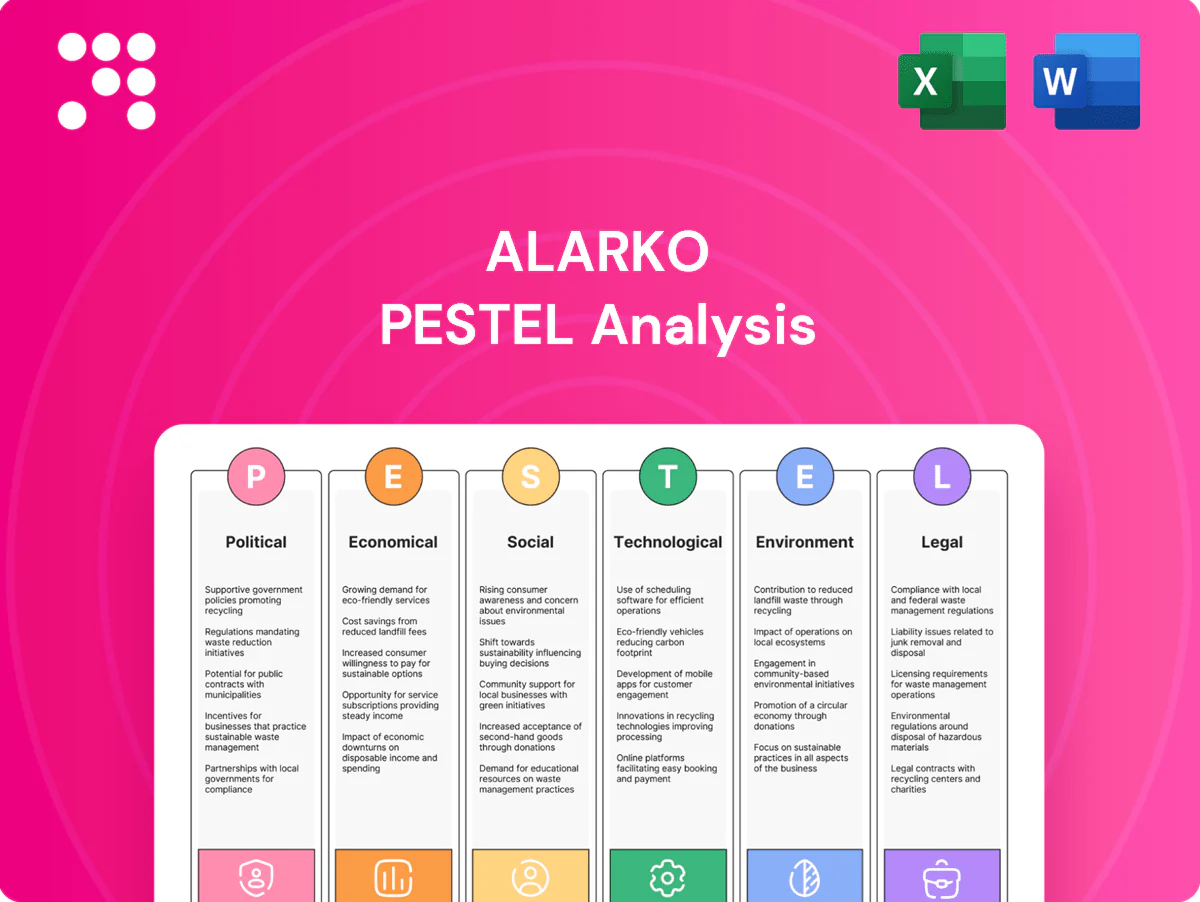
Alarko PESTLE Analysis

Plan Smarter. Present Sharper. Compete Stronger.
Discover how political shifts, economic trends, social dynamics, technological advances, legal changes, and environmental pressures are shaping Alarko’s strategic outlook. This concise PESTLE highlights key external risks and opportunities to inform smarter decisions. Purchase the full, editable analysis for the complete breakdown and actionable insights ready for boardrooms and investment decks.
Political factors

State infrastructure priorities
Government-led infrastructure programs determine Alarko’s project pipeline and margins; Turkey’s public investment has hovered near 4% of GDP in recent years, making budget shifts material to contractors.
Election cycles and fiscal tightening can delay contracts; Alarko’s EPC and PPP exposure raises sensitivity to any reallocation, so active engagement with ministries improves backlog visibility and contract timing.
Energy policy and subsidies
Power generation revenues for Alarko hinge on Turkish market design, incentives and guaranteed purchase mechanisms; recent tariff revisions in 2024 and evolving capacity payment rules have directly affected merchant plant cash flows. Changes to feed-in support and gas pricing formulas alter project-level IRRs and refinancing capacity. Stronger policy support for renewables would unlock new pipeline opportunities, while sudden tariff cuts pose immediate cash-flow risks.

Geopolitical climate
Regional tensions around Turkey and nearby corridors can delay projects and cross-border ventures, impacting supply routes such as the Suez Canal which handles about 12% of global seaborne trade. Currency swings hurt investor sentiment; Turkey recorded roughly USD 254 billion in exports in 2023, exposing firms to FX risk. Industrial supply chains face customs delays and component shortages. Diversification across markets stabilizes overall exposure.

Public–private partnership dynamics
PPP frameworks determine risk allocation, dispute resolution and revenue security for Alarko; renegotiations, payment terms and political will materially affect project IRRs and cashflow predictability. Transparent tendering, clear performance guarantees and a strong track record with state entities provide competitive advantage in securing favorable terms and faster financial close.
EU relations and standards alignment
Turkey–EU interactions, anchored by the 1995 Customs Union, shape Alarko’s construction, environmental and public procurement standards; the EU took ~38% of Turkey’s exports in 2024, influencing inputs and export rules. Alignment eases CE certification and market access, while divergence raises compliance and re-testing costs and delays. EU funds (IPA/CEF) can target energy and transport projects, supporting bids.
- Customs Union 1995
- EU ~38% of TR exports (2024)
- Alignment reduces certification hurdles
- Divergence increases compliance costs
Election-driven fiscal swings, 2024 tariff reforms and Suez risks squeeze project IRRs
Political drivers—public investment (~4% of GDP), election-driven fiscal swings and PPP frameworks—shape Alarko’s project pipeline, margins and cashflow timing. 2024 tariff reforms and capacity payment changes have already affected power-asset IRRs, while regional tensions and trade-route risks (Suez ~12% of seaborne trade) raise execution and supply-chain disruption risk. EU linkages (EU ~38% of Turkey exports in 2024) influence procurement and certification costs.
| Factor | Impact on Alarko | Key data |
|---|---|---|
| Public investment | Pipeline, margins | ~4% of GDP (recent) |
| Tariff/policy | Revenue & IRR sensitivity | 2024 tariff revisions; capacity payment changes |
| Regional/trade risk | Supply delays, FX pressure | Suez ~12% trade; TR exports USD 254bn (2023) |
| EU alignment | Certification, market access | EU ~38% of exports (2024) |
What is included in the product
 Detailed Word Document
Explores how external macro-environmental factors uniquely affect Alarko across Political, Economic, Social, Technological, Environmental and Legal dimensions, with data-backed trends and forward-looking insights to guide executives, investors and strategists in identifying risks, opportunities and scenario-driven actions.

 Customizable Excel Spreadsheet
A concise, visually segmented PESTLE summary of Alarko for easy insertion into presentations, team briefings or strategy packs, enabling quick alignment on external risks and market positioning while allowing note additions for regional or business‑line context.
Economic factors

Currency volatility (TRY)
TRY volatility drives revenue–cost mismatches and amplifies FX-denominated debt effects for Alarko, with USD/TRY trading around 35 in mid-2025, magnifying earnings swings. Imported inputs for energy and industrial operations push margins lower when the lira falls, increasing unit costs in TRY. Active hedging and FX-linked contract coverage are essential safeguards, while pricing power and indexation clauses (TRY or CPI-linked) materially mitigate volatility.
Inflation and interest rates
High inflation in Türkiye (headline CPI ~61% in 2024) pressures wages, materials and working capital across Alarko businesses; elevated policy and market rates (~40% average corporate funding in 2024) increase EPC, energy capex and tourism upgrade costs. Contract indexation and disciplined capex timing help protect margins. Access to long‑tenor, blended financing becomes a key competitive differentiator.

Commodity and energy prices
Steel, cement and fuel cost swings materially affect Alarko’s construction and manufacturing margins, with global rebar and cement input volatility remaining elevated after pandemic-era dislocations. Brent crude averaged roughly $80–90/bbl in 2024, and European TTF gas traded near €30–40/MWh in 2024, directly shaping power‑plant dispatch economics. Such volatility forces formal procurement hedges and pass‑through clauses in project contracts. Greater investment in renewables cuts exposure to fossil‑fuel price swings.

Cyclical demand across sectors
Construction activity for Alarko tracks housing, infrastructure and business investment cycles, with construction contributing roughly 6–7% of Turkey GDP; tourism revenues hinge on global travel demand (UNWTO: 2023 arrivals ~88% of 2019) and exchange-rate competitiveness; industrial orders move with domestic demand and exports; portfolio balance across construction, energy, tourism and industry smooths aggregate cash flows.
- Construction: cyclical, GDP share ~6–7%
- Tourism: recovery ~88% of 2019 arrivals (UNWTO 2023)
- Industry: tied to domestic/export cycles
- Portfolio: diversification smooths cash flow
Capital markets and FDI access
Capital markets and FDI access determine Alarko’s growth via liquidity, risk premia and credit availability; global FDI fell to about 1.02 trillion USD in 2023 (UNCTAD), tightening external funding and raising borrowing costs. Partnerships with DFIs and export-credit agencies can cut financing spreads and insurance costs, while equity market strength affects valuation and funding optionality; stronger governance typically attracts a 8–12% investor valuation premium.
- Liquidity pressure: global FDI 2023 ~1.02tn USD
- DFI/export-credit: lower spreads, enhance project finance
- Equity markets: affect valuation and optionality
- Governance: ~8–12% valuation premium
Election-driven fiscal swings, 2024 tariff reforms and Suez risks squeeze project IRRs
TRY volatility (USD/TRY ~35 mid‑2025) and high inflation (CPI ~61% in 2024) amplify FX‑debt and cost pressures across Alarko; hedging, indexation and pricing power are essential. Elevated funding costs (~40% avg. corporate funding 2024) raise capex and EPC costs. Commodity swings (Brent $80–90/bbl 2024) and constrained FDI (global FDI $1.02tn 2023) affect project economics.
| Metric | Value |
|---|---|
| USD/TRY | ~35 (mid‑2025) |
| CPI | ~61% (2024) |
| Funding cost | ~40% avg (2024) |
| Brent | $80–90/bbl (2024) |
| Global FDI | $1.02tn (2023) |
Preview Before You Purchase
Alarko PESTLE Analysis
The Alarko PESTLE Analysis provides concise, sector-specific insights into political, economic, sociocultural, technological, legal and environmental factors affecting the company. The preview shown here is the exact document you’ll receive after purchase—fully formatted and ready to use. No placeholders or teasers: download the final, professional file immediately after checkout.

Product Information
Product Information
Shipping & Returns
Shipping & Returns
Description
Plan Smarter. Present Sharper. Compete Stronger.
Discover how political shifts, economic trends, social dynamics, technological advances, legal changes, and environmental pressures are shaping Alarko’s strategic outlook. This concise PESTLE highlights key external risks and opportunities to inform smarter decisions. Purchase the full, editable analysis for the complete breakdown and actionable insights ready for boardrooms and investment decks.
Political factors
State infrastructure priorities
Government-led infrastructure programs determine Alarko’s project pipeline and margins; Turkey’s public investment has hovered near 4% of GDP in recent years, making budget shifts material to contractors.
Election cycles and fiscal tightening can delay contracts; Alarko’s EPC and PPP exposure raises sensitivity to any reallocation, so active engagement with ministries improves backlog visibility and contract timing.
Energy policy and subsidies
Power generation revenues for Alarko hinge on Turkish market design, incentives and guaranteed purchase mechanisms; recent tariff revisions in 2024 and evolving capacity payment rules have directly affected merchant plant cash flows. Changes to feed-in support and gas pricing formulas alter project-level IRRs and refinancing capacity. Stronger policy support for renewables would unlock new pipeline opportunities, while sudden tariff cuts pose immediate cash-flow risks.
Geopolitical climate
Regional tensions around Turkey and nearby corridors can delay projects and cross-border ventures, impacting supply routes such as the Suez Canal which handles about 12% of global seaborne trade. Currency swings hurt investor sentiment; Turkey recorded roughly USD 254 billion in exports in 2023, exposing firms to FX risk. Industrial supply chains face customs delays and component shortages. Diversification across markets stabilizes overall exposure.
Public–private partnership dynamics
PPP frameworks determine risk allocation, dispute resolution and revenue security for Alarko; renegotiations, payment terms and political will materially affect project IRRs and cashflow predictability. Transparent tendering, clear performance guarantees and a strong track record with state entities provide competitive advantage in securing favorable terms and faster financial close.
EU relations and standards alignment
Turkey–EU interactions, anchored by the 1995 Customs Union, shape Alarko’s construction, environmental and public procurement standards; the EU took ~38% of Turkey’s exports in 2024, influencing inputs and export rules. Alignment eases CE certification and market access, while divergence raises compliance and re-testing costs and delays. EU funds (IPA/CEF) can target energy and transport projects, supporting bids.
- Customs Union 1995
- EU ~38% of TR exports (2024)
- Alignment reduces certification hurdles
- Divergence increases compliance costs
Election-driven fiscal swings, 2024 tariff reforms and Suez risks squeeze project IRRs
Political drivers—public investment (~4% of GDP), election-driven fiscal swings and PPP frameworks—shape Alarko’s project pipeline, margins and cashflow timing. 2024 tariff reforms and capacity payment changes have already affected power-asset IRRs, while regional tensions and trade-route risks (Suez ~12% of seaborne trade) raise execution and supply-chain disruption risk. EU linkages (EU ~38% of Turkey exports in 2024) influence procurement and certification costs.
| Factor | Impact on Alarko | Key data |
|---|---|---|
| Public investment | Pipeline, margins | ~4% of GDP (recent) |
| Tariff/policy | Revenue & IRR sensitivity | 2024 tariff revisions; capacity payment changes |
| Regional/trade risk | Supply delays, FX pressure | Suez ~12% trade; TR exports USD 254bn (2023) |
| EU alignment | Certification, market access | EU ~38% of exports (2024) |
What is included in the product
Detailed Word Document
Explores how external macro-environmental factors uniquely affect Alarko across Political, Economic, Social, Technological, Environmental and Legal dimensions, with data-backed trends and forward-looking insights to guide executives, investors and strategists in identifying risks, opportunities and scenario-driven actions.
Customizable Excel Spreadsheet
A concise, visually segmented PESTLE summary of Alarko for easy insertion into presentations, team briefings or strategy packs, enabling quick alignment on external risks and market positioning while allowing note additions for regional or business‑line context.
Economic factors
Currency volatility (TRY)
TRY volatility drives revenue–cost mismatches and amplifies FX-denominated debt effects for Alarko, with USD/TRY trading around 35 in mid-2025, magnifying earnings swings. Imported inputs for energy and industrial operations push margins lower when the lira falls, increasing unit costs in TRY. Active hedging and FX-linked contract coverage are essential safeguards, while pricing power and indexation clauses (TRY or CPI-linked) materially mitigate volatility.
Inflation and interest rates
High inflation in Türkiye (headline CPI ~61% in 2024) pressures wages, materials and working capital across Alarko businesses; elevated policy and market rates (~40% average corporate funding in 2024) increase EPC, energy capex and tourism upgrade costs. Contract indexation and disciplined capex timing help protect margins. Access to long‑tenor, blended financing becomes a key competitive differentiator.
Commodity and energy prices
Steel, cement and fuel cost swings materially affect Alarko’s construction and manufacturing margins, with global rebar and cement input volatility remaining elevated after pandemic-era dislocations. Brent crude averaged roughly $80–90/bbl in 2024, and European TTF gas traded near €30–40/MWh in 2024, directly shaping power‑plant dispatch economics. Such volatility forces formal procurement hedges and pass‑through clauses in project contracts. Greater investment in renewables cuts exposure to fossil‑fuel price swings.
Cyclical demand across sectors
Construction activity for Alarko tracks housing, infrastructure and business investment cycles, with construction contributing roughly 6–7% of Turkey GDP; tourism revenues hinge on global travel demand (UNWTO: 2023 arrivals ~88% of 2019) and exchange-rate competitiveness; industrial orders move with domestic demand and exports; portfolio balance across construction, energy, tourism and industry smooths aggregate cash flows.
- Construction: cyclical, GDP share ~6–7%
- Tourism: recovery ~88% of 2019 arrivals (UNWTO 2023)
- Industry: tied to domestic/export cycles
- Portfolio: diversification smooths cash flow
Capital markets and FDI access
Capital markets and FDI access determine Alarko’s growth via liquidity, risk premia and credit availability; global FDI fell to about 1.02 trillion USD in 2023 (UNCTAD), tightening external funding and raising borrowing costs. Partnerships with DFIs and export-credit agencies can cut financing spreads and insurance costs, while equity market strength affects valuation and funding optionality; stronger governance typically attracts a 8–12% investor valuation premium.
- Liquidity pressure: global FDI 2023 ~1.02tn USD
- DFI/export-credit: lower spreads, enhance project finance
- Equity markets: affect valuation and optionality
- Governance: ~8–12% valuation premium
Election-driven fiscal swings, 2024 tariff reforms and Suez risks squeeze project IRRs
TRY volatility (USD/TRY ~35 mid‑2025) and high inflation (CPI ~61% in 2024) amplify FX‑debt and cost pressures across Alarko; hedging, indexation and pricing power are essential. Elevated funding costs (~40% avg. corporate funding 2024) raise capex and EPC costs. Commodity swings (Brent $80–90/bbl 2024) and constrained FDI (global FDI $1.02tn 2023) affect project economics.
| Metric | Value |
|---|---|
| USD/TRY | ~35 (mid‑2025) |
| CPI | ~61% (2024) |
| Funding cost | ~40% avg (2024) |
| Brent | $80–90/bbl (2024) |
| Global FDI | $1.02tn (2023) |
Preview Before You Purchase
Alarko PESTLE Analysis
The Alarko PESTLE Analysis provides concise, sector-specific insights into political, economic, sociocultural, technological, legal and environmental factors affecting the company. The preview shown here is the exact document you’ll receive after purchase—fully formatted and ready to use. No placeholders or teasers: download the final, professional file immediately after checkout.