AirBoss PESTLE Analysis

Plan Smarter. Present Sharper. Compete Stronger.
Discover how political, economic, social, technological, legal, and environmental forces are shaping AirBoss’s strategic outlook in this concise PESTLE overview. Use our expert insights to spot risks and growth opportunities. Purchase the full PESTLE analysis for a complete, actionable report ready for investment decisions and strategy planning.
Political factors

Defense procurement cycles
AirBoss’ survivability sales hinge on multi‑year government budgets and threat perceptions; the US defense topline reached about $858 billion in FY2024, underscoring scale and variability. Changes in defense appropriations can accelerate or delay CBRN orders, with procurement awards often spanning 3–5 years and lead times of 18–36 months. Election outcomes and shifting foreign policy can reallocate funds across programs, so pipeline visibility and disciplined lobbying are essential.
Buy-national and localization rules
Buy-national policies such as Buy American and the Defense Production Act prioritize domestic sourcing for defense, supported by a US FY2024 defense budget of about $858 billion and $1.2 trillion in IIJA infrastructure funds, which can boost North American capacity but complicate global supply optimization.
Contracts increasingly mandate local content, specific certifications, and subcontractor screening; compliance raises manufacturing and certification costs yet can secure preferred-vendor status on high-value federal programs.

Trade policy and tariffs
Tariffs, anti-dumping measures and customs friction materially affect rubber chemicals and industrial inputs, raising input costs and compliance burdens. USMCA, in force since July 1, 2020, provides regional stability but complex rules-of-origin increase administrative cost and can limit tariff relief. The US still maintains tariffs on roughly $360 billion of Chinese goods, heightening risk that escalating Asia tensions will disrupt compounding-additive supplies. Diversifying suppliers across ASEAN, Europe and North America mitigates political trade shocks.

Geopolitical risk and CBRN demand
Regional conflicts and terrorism drive demand for CBRN protective solutions; global military spending reached about 2.24 trillion USD in 2024 (SIPRI), supporting procurement spikes, while détente or budget austerity can sharply reduce orders. Sanctions on Russia, Iran and others constrain sales and distribution in affected jurisdictions. Scenario planning aligns AirBoss inventory and capacity with geopolitical cycles and procurement volatility.
- Defense spend 2024 ~2.24T USD
- CBRN PPE market ~3.6B USD (2024 est.)
- Sanctions limit market access
- Scenario planning mitigates demand swings
Export controls and alliances
CBRN products for AirBoss are subject to Canadian Export and Import Permits Act and may trigger US ITAR/EAR equivalents when US content or partners are involved, requiring approvals, end‑use checks and partner vetting that slow cross‑border deals. NATO standardization (32 members, STANAGs) can open allied procurement channels but increases documentation and certification burdens. Robust compliance systems are essential to access allied markets while avoiding licence breaches.
CBRN revenues tied to defense budgets, geopolitics and export controls; procurement volatile
AirBoss' CBRN revenues hinge on government budgets and geopolitics; US defense spend FY2024 ~858B USD and global military spend 2024 ~2.24T USD drive procurement volatility. Buy‑national rules, tariffs and sanctions (Russia/Iran) restrict markets while ITAR/EAR/Canadian EIPA raise compliance costs. Diversified suppliers and strong compliance mitigate supply and access risks.
| Metric | 2024 |
|---|---|
| US defense | ~858B USD |
| Global military | ~2.24T USD |
| CBRN PPE market | ~3.6B USD |
What is included in the product
 Detailed Word Document
Explores how Political, Economic, Social, Technological, Environmental, and Legal forces uniquely impact AirBoss, with data-backed trends and region-specific regulatory context to identify risks and growth levers. Designed for executives, investors, and strategists, it delivers detailed sub-points, forward-looking scenarios, and ready-to-use insights for planning, funding, and competitive positioning.

 Customizable Excel Spreadsheet
Condenses AirBoss's PESTLE into a clear, shareable brief that highlights external risks and opportunities for quick decision-making and seamless inclusion in presentations.
Economic factors

Automotive and industrial cyclicality
Rubber compounds and molded goods closely track OEM production—global light-vehicle output was about 80 million units in 2024—so downturns compress volumes and pricing while upswings strain capacity; shifts toward aftermarket or defense contracts can buffer volatility, and flexible cost structures (variable labor, outsourcing) reduce margin whipsaw by allowing rapid scale adjustments.
Feedstock and energy costs
Feedstock and energy—notably butadiene, carbon black, process oils and utilities—are the primary drivers of AirBoss COGS and margins; butadiene averaged near $1,600/ton and Brent crude about $83/bbl in 2024, while natural gas ran near $3/MMBtu, amplifying synthetic rubber and freight cost swings. Surcharges and formula pricing have allowed partial pass‑through of inflation to customers. Active hedging and multi‑sourcing have stabilized contribution per pound.

FX exposure CAD/USD
With Canadian roots and significant US sales, CAD moves affect translation and competitiveness; CAD averaged about 0.74 USD in 2024 and USD/CAD was ~1.36 in June 2025, so a stronger USD aids exports from Canada but raises costs for US‑sourced inputs. Matching USD revenues to USD costs provides natural hedging that reduces P&L volatility, while treasury hedges and USD pricing clauses further protect margins.

Labor markets and wages
- Skilled shortages → higher wage cost
- Training + automation → capacity resilience
- Labor stability → defense delivery risk
- Union/regional incentives → footprint strategy
Interest rates and capital access
High policy rates (US fed funds 5.25–5.50% and BoC ~5.00% mid‑2025) raise AirBoss’s cost of capacity expansion and working capital, making new plant financing and inventory funding more expensive. Secured government contracts improve credit quality and receivable certainty, supporting conservative leverage to preserve flexibility; capex will prioritize high‑margin survivability lines.
- Higher rates: raises financing costs
- Govt contracts: improve receivable certainty
- Prudent leverage: preserves cyclical flexibility
- Capex focus: high‑margin survivability lines
CBRN revenues tied to defense budgets, geopolitics and export controls; procurement volatile
OEM light‑vehicle output (~80M units in 2024) drives rubber demand and pricing volatility; feedstock/energy costs (butadiene ~$1,600/t, Brent ~$83/bbl in 2024) heavily influence COGS and pass‑through limits margins. CAD ~0.74 USD (2024) / USD/CAD ~1.36 (Jun 2025) affects competitiveness; mid‑2025 policy rates (Fed 5.25–5.50%, BoC ~5.00%) raise financing costs and capex discipline.
| Metric | Value |
|---|---|
| Light vehicles (2024) | ~80M units |
| Butadiene (2024) | $1,600/ton |
| Brent (2024) | $83/bbl |
| NatGas (2024) | $3/MMBtu |
| CAD/USD (2024) | 0.74 |
| USD/CAD (Jun 2025) | 1.36 |
| Fed funds (mid‑2025) | 5.25–5.50% |
| Unemployment (US, 2024) | 3.7% |
Full Version Awaits
AirBoss PESTLE Analysis
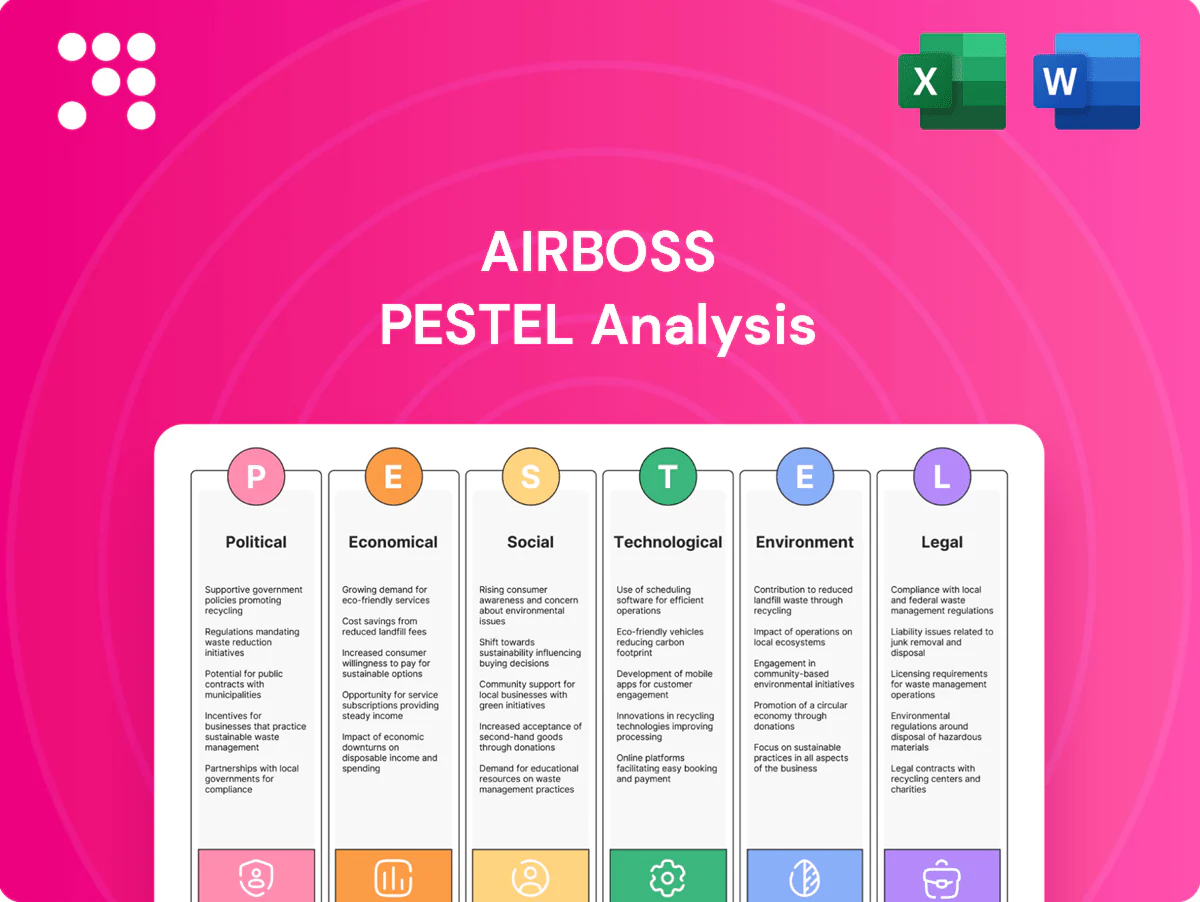
This AirBoss PESTLE Analysis preview is the exact document you’ll receive after purchase—fully formatted, professionally structured, and ready to use. It provides concise political, economic, social, technological, legal, and environmental insights specific to AirBoss, with clear implications for strategy and risk. No placeholders or teasers—what you see is the finished file available for immediate download.

Original: $10.00
-65%$10.00
$3.50Product Information
Product Information
Shipping & Returns
Shipping & Returns
Description
Plan Smarter. Present Sharper. Compete Stronger.
Discover how political, economic, social, technological, legal, and environmental forces are shaping AirBoss’s strategic outlook in this concise PESTLE overview. Use our expert insights to spot risks and growth opportunities. Purchase the full PESTLE analysis for a complete, actionable report ready for investment decisions and strategy planning.
Political factors
Defense procurement cycles
AirBoss’ survivability sales hinge on multi‑year government budgets and threat perceptions; the US defense topline reached about $858 billion in FY2024, underscoring scale and variability. Changes in defense appropriations can accelerate or delay CBRN orders, with procurement awards often spanning 3–5 years and lead times of 18–36 months. Election outcomes and shifting foreign policy can reallocate funds across programs, so pipeline visibility and disciplined lobbying are essential.
Buy-national and localization rules
Buy-national policies such as Buy American and the Defense Production Act prioritize domestic sourcing for defense, supported by a US FY2024 defense budget of about $858 billion and $1.2 trillion in IIJA infrastructure funds, which can boost North American capacity but complicate global supply optimization.
Contracts increasingly mandate local content, specific certifications, and subcontractor screening; compliance raises manufacturing and certification costs yet can secure preferred-vendor status on high-value federal programs.
Trade policy and tariffs
Tariffs, anti-dumping measures and customs friction materially affect rubber chemicals and industrial inputs, raising input costs and compliance burdens. USMCA, in force since July 1, 2020, provides regional stability but complex rules-of-origin increase administrative cost and can limit tariff relief. The US still maintains tariffs on roughly $360 billion of Chinese goods, heightening risk that escalating Asia tensions will disrupt compounding-additive supplies. Diversifying suppliers across ASEAN, Europe and North America mitigates political trade shocks.
Geopolitical risk and CBRN demand
Regional conflicts and terrorism drive demand for CBRN protective solutions; global military spending reached about 2.24 trillion USD in 2024 (SIPRI), supporting procurement spikes, while détente or budget austerity can sharply reduce orders. Sanctions on Russia, Iran and others constrain sales and distribution in affected jurisdictions. Scenario planning aligns AirBoss inventory and capacity with geopolitical cycles and procurement volatility.
- Defense spend 2024 ~2.24T USD
- CBRN PPE market ~3.6B USD (2024 est.)
- Sanctions limit market access
- Scenario planning mitigates demand swings
Export controls and alliances
CBRN products for AirBoss are subject to Canadian Export and Import Permits Act and may trigger US ITAR/EAR equivalents when US content or partners are involved, requiring approvals, end‑use checks and partner vetting that slow cross‑border deals. NATO standardization (32 members, STANAGs) can open allied procurement channels but increases documentation and certification burdens. Robust compliance systems are essential to access allied markets while avoiding licence breaches.
CBRN revenues tied to defense budgets, geopolitics and export controls; procurement volatile
AirBoss' CBRN revenues hinge on government budgets and geopolitics; US defense spend FY2024 ~858B USD and global military spend 2024 ~2.24T USD drive procurement volatility. Buy‑national rules, tariffs and sanctions (Russia/Iran) restrict markets while ITAR/EAR/Canadian EIPA raise compliance costs. Diversified suppliers and strong compliance mitigate supply and access risks.
| Metric | 2024 |
|---|---|
| US defense | ~858B USD |
| Global military | ~2.24T USD |
| CBRN PPE market | ~3.6B USD |
What is included in the product
Detailed Word Document
Explores how Political, Economic, Social, Technological, Environmental, and Legal forces uniquely impact AirBoss, with data-backed trends and region-specific regulatory context to identify risks and growth levers. Designed for executives, investors, and strategists, it delivers detailed sub-points, forward-looking scenarios, and ready-to-use insights for planning, funding, and competitive positioning.
Customizable Excel Spreadsheet
Condenses AirBoss's PESTLE into a clear, shareable brief that highlights external risks and opportunities for quick decision-making and seamless inclusion in presentations.
Economic factors
Automotive and industrial cyclicality
Rubber compounds and molded goods closely track OEM production—global light-vehicle output was about 80 million units in 2024—so downturns compress volumes and pricing while upswings strain capacity; shifts toward aftermarket or defense contracts can buffer volatility, and flexible cost structures (variable labor, outsourcing) reduce margin whipsaw by allowing rapid scale adjustments.
Feedstock and energy costs
Feedstock and energy—notably butadiene, carbon black, process oils and utilities—are the primary drivers of AirBoss COGS and margins; butadiene averaged near $1,600/ton and Brent crude about $83/bbl in 2024, while natural gas ran near $3/MMBtu, amplifying synthetic rubber and freight cost swings. Surcharges and formula pricing have allowed partial pass‑through of inflation to customers. Active hedging and multi‑sourcing have stabilized contribution per pound.
FX exposure CAD/USD
With Canadian roots and significant US sales, CAD moves affect translation and competitiveness; CAD averaged about 0.74 USD in 2024 and USD/CAD was ~1.36 in June 2025, so a stronger USD aids exports from Canada but raises costs for US‑sourced inputs. Matching USD revenues to USD costs provides natural hedging that reduces P&L volatility, while treasury hedges and USD pricing clauses further protect margins.
Labor markets and wages
- Skilled shortages → higher wage cost
- Training + automation → capacity resilience
- Labor stability → defense delivery risk
- Union/regional incentives → footprint strategy
Interest rates and capital access
High policy rates (US fed funds 5.25–5.50% and BoC ~5.00% mid‑2025) raise AirBoss’s cost of capacity expansion and working capital, making new plant financing and inventory funding more expensive. Secured government contracts improve credit quality and receivable certainty, supporting conservative leverage to preserve flexibility; capex will prioritize high‑margin survivability lines.
- Higher rates: raises financing costs
- Govt contracts: improve receivable certainty
- Prudent leverage: preserves cyclical flexibility
- Capex focus: high‑margin survivability lines
CBRN revenues tied to defense budgets, geopolitics and export controls; procurement volatile
OEM light‑vehicle output (~80M units in 2024) drives rubber demand and pricing volatility; feedstock/energy costs (butadiene ~$1,600/t, Brent ~$83/bbl in 2024) heavily influence COGS and pass‑through limits margins. CAD ~0.74 USD (2024) / USD/CAD ~1.36 (Jun 2025) affects competitiveness; mid‑2025 policy rates (Fed 5.25–5.50%, BoC ~5.00%) raise financing costs and capex discipline.
| Metric | Value |
|---|---|
| Light vehicles (2024) | ~80M units |
| Butadiene (2024) | $1,600/ton |
| Brent (2024) | $83/bbl |
| NatGas (2024) | $3/MMBtu |
| CAD/USD (2024) | 0.74 |
| USD/CAD (Jun 2025) | 1.36 |
| Fed funds (mid‑2025) | 5.25–5.50% |
| Unemployment (US, 2024) | 3.7% |
Full Version Awaits
AirBoss PESTLE Analysis
This AirBoss PESTLE Analysis preview is the exact document you’ll receive after purchase—fully formatted, professionally structured, and ready to use. It provides concise political, economic, social, technological, legal, and environmental insights specific to AirBoss, with clear implications for strategy and risk. No placeholders or teasers—what you see is the finished file available for immediate download.