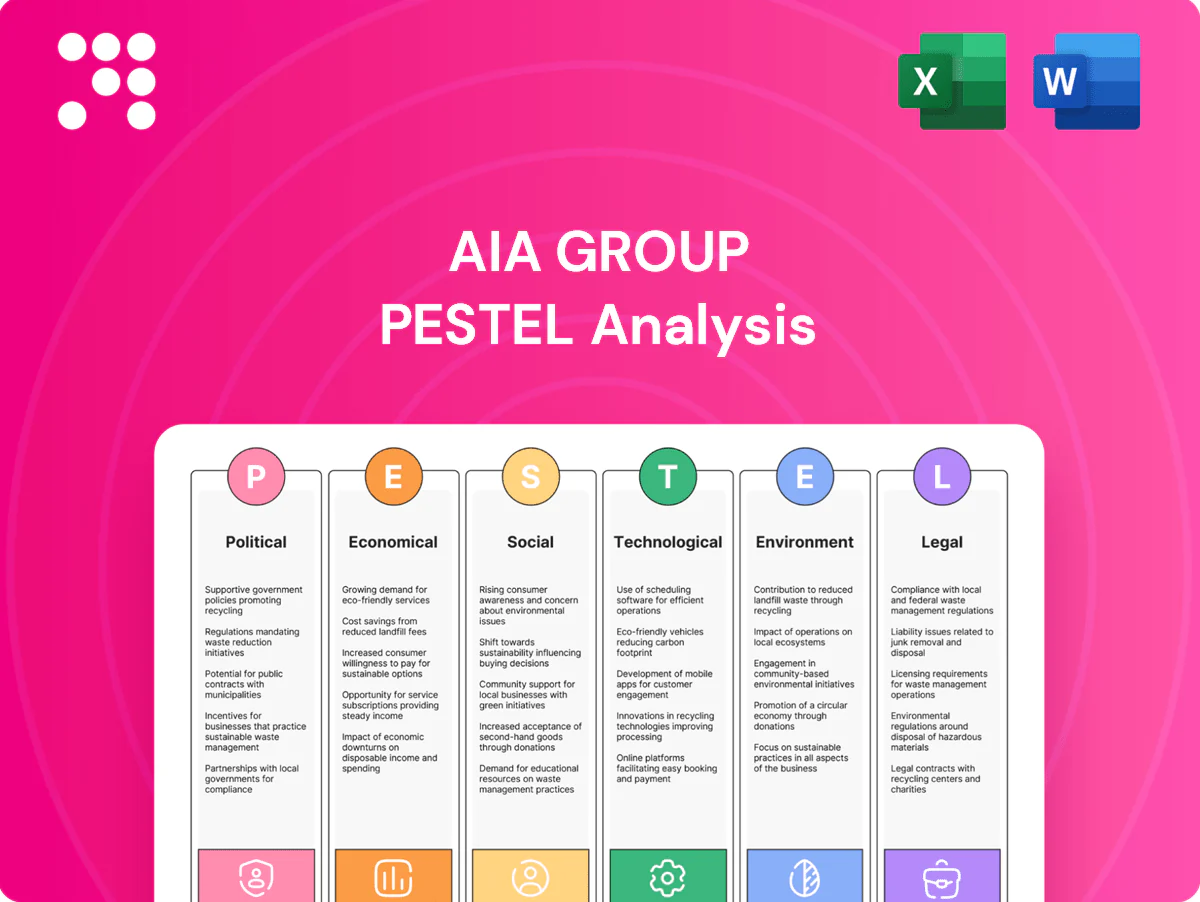
AIA Group PESTLE Analysis

Your Shortcut to Market Insight Starts Here
Unlock strategic clarity with our PESTLE Analysis of AIA Group—revealing how political, economic, social, technological, legal, and environmental forces will shape its prospects. Ideal for investors, consultants, and planners seeking actionable market intelligence. Purchase the full report to access in-depth findings and ready-to-use strategic recommendations.
Political factors

Regulatory stability across markets
Life insurance is highly regulated and AIA operates across 18 markets, so multi-jurisdiction alignment directly shapes product design and capital planning, particularly for long-duration guarantees.
Frequent rule changes in key markets can delay approvals and raise compliance costs, often extending product launch timelines by several months.
Regulatory stability enables longer-term guarantees and agency expansion, while Asia’s divergent regimes force AIA to maintain flexible operating models and localized capital strategies.
Geopolitical tensions and trade dynamics
Rising US–China tensions, with goods trade around US$690bn in 2023, can dent investor sentiment, disrupt supply chains and capital flows, and thus alter household savings demand across Asia.
Sanctions and tech export limits complicate vendor and data choices for insurers dependent on cross‑border platforms, raising operational and compliance costs.
Market volatility tends to boost pure protection demand but can depress investment‑linked sales; AIA, serving ~36m customers across 18 markets, must remain neutral and further diversify asset and geographic exposure.

Government healthcare policies
Public healthcare funding gaps, with out-of-pocket shares still around 30–40% in several Asian markets (WHO 2022–24), create clear demand for AIA private protection products. Policy shifts toward universal health coverage can force product redesign and price compression as benefits standardize. Fiscal incentives or tax relief in markets such as Singapore and Malaysia have historically boosted private uptake. Sudden reimbursement rule changes materially alter claims experience and loss ratios.

Cross-border capital and repatriation controls
Cross-border restrictions on dividends, limits on capital movement and caps on foreign ownership materially constrain AIA Group cash flows; 2024 regulatory updates in several APAC jurisdictions heightened requirements for local capital retention to support growth dividends. Currency remittance approvals can introduce multi-week delays, forcing working-capital management and timing of shareholder distributions. Structuring local entities and reinsurance/holding arrangements to comply with local rules is essential to preserve liquidity and returns.
- Restrictions on dividends reduce upstreamable cash
- Local capital build-up required for growth payouts
- Remittance approvals cause transfer delays
- Local entity structure critical for compliance and repatriation
Public–private partnerships
Public–private partnerships in health, retirement and catastrophe insurance expand AIA’s distribution by linking with national programs and insurers, enhancing reach and cross-selling opportunities while boosting brand visibility and trust through governmental affiliation.
- PPPs open gov-linked distribution channels
- Collaboration enhances trust and brand visibility
- Government tenders require strict compliance and data sharing
- Long contracting cycles need patience and policy alignment
Pan-Asia insurer: regulation, capital rules, geopolitics; trade US$690bn, OOP 30–40%
AIA’s operations across 18 markets and ~36m customers mean multi‑jurisdictional regulation directly shapes product design, capital planning and launch timing. Divergent Asian regimes and 2024 local capital retention rules force localized entity structures and remittance controls. Geopolitical strains (US–China trade ~US$690bn in 2023) and sanctions raise vendor/data risks and compliance costs. Public healthcare gaps (OOP ~30–40% WHO 2022–24) sustain private protection demand.
| Tag | Metric | Value |
|---|---|---|
| Markets | Operating markets | 18 |
| Customers | Active customers | ~36m |
| Geopolitics | US–China trade 2023 | US$690bn |
| Health | OOP share | 30–40% (WHO 2022–24) |
What is included in the product
 Detailed Word Document
Explores how Political, Economic, Social, Technological, Environmental and Legal forces uniquely affect AIA Group, with data-driven insights and regional/regulatory context to identify risks and opportunities; designed for executives and investors to inform strategy, scenario planning and investor communications.

 Customizable Excel Spreadsheet
Clean, visually segmented PESTLE summary of AIA Group that simplifies complex regulatory, economic and demographic risks for quick reference, easily dropped into presentations or shared across teams to streamline planning and stakeholder alignment.
Economic factors

Interest rate environment
Lower interest rates compress investment yields and strain AIA’s guaranteed liabilities; with global policy rates now around US Fed funds 5.25–5.50% (July 2025), prolonged lower-for-longer scenarios would depress new business margins. Rising rates improve reinvestment returns but can reveal ALM mismatches; a 100bp shift materially affects embedded value and capital buffers, so dynamic asset–liability management is critical.
Asia’s GDP growth and middle class
Asia's economic expansion—emerging and developing Asia grew about 5% in 2024 per IMF—bolsters premium growth in protection and savings as higher incomes raise affordability. A rising middle class (projected to expand sharply through 2030) increases demand for health and retirement products, supporting AIA's core markets. Economic slowdowns, however, compress discretionary savings product purchases, and country-level market mix matters since growth rates vary widely across China, India, Southeast Asia and Hong Kong.

Currency fluctuations
FX swings materially affect AIA when consolidating across 18 Asia-Pacific markets and HKEX reporting, distorting reported earnings and potentially shaving capital ratios during strong local currency moves. Local pricing and product repricing must embed currency risk to protect margins and policyholder affordability. Extensive hedging programs mitigate volatility but increase costs and limit upside. Persistent local-currency depreciation can erode demand and strain premium affordability.

Medical inflation and claims trend
Medical inflation in many Asian markets runs roughly 2–4 percentage points above headline CPI (2023–24), pressuring AIA as premium repricing lags can widen loss ratios and erode profitability; claims-led morbidity trends pushed health claims growth into mid-single digits in several markets. Network management and preventive/wellness programs have demonstrated claim cost reductions of about 5–10%, and transparent communication around repricing limits lapse spikes.
- Medical inflation vs CPI: +2–4pp (2023–24)
- Wellness programs: −5–10% claims
- Repricing lag → higher loss ratios
- Transparent comms → lower lapse risk
Employment and household savings rates
Pan-Asia insurer: regulation, capital rules, geopolitics; trade US$690bn, OOP 30–40%
Higher policy rates (US Fed funds 5.25–5.50% July 2025) lift reinvestment yields but expose ALM mismatch risk; a 100bp shock materially affects embedded value and capital buffers.
Emerging Asia growth ~5% in 2024 (IMF) and expanding middle class support protection and retirement sales, but country variance (China, India, SEA, HK) alters mix.
FX volatility across 18 APAC markets and HKEX reporting can swing reported earnings and solvency; hedging reduces volatility but raises cost.
Medical inflation +2–4pp vs CPI (2023–24) raises loss ratios; wellness programs cut claims ~5–10% and improve persistency.
| Metric | Value |
|---|---|
| Fed funds (Jul 2025) | 5.25–5.50% |
| Asia GDP (2024) | ~5% (IMF) |
| Medical inflation vs CPI | +2–4pp |
Preview the Actual Deliverable
AIA Group PESTLE Analysis
The AIA Group PESTLE Analysis preview shown here is the exact document you’ll receive after purchase—fully formatted and ready to use. It comprehensively covers political, economic, social, technological, legal and environmental factors. No placeholders or teasers—this is the final, professionally structured file you’ll download immediately after payment.

Original: $10.00
-65%$10.00
$3.50Product Information
Product Information
Shipping & Returns
Shipping & Returns
Description
Your Shortcut to Market Insight Starts Here
Unlock strategic clarity with our PESTLE Analysis of AIA Group—revealing how political, economic, social, technological, legal, and environmental forces will shape its prospects. Ideal for investors, consultants, and planners seeking actionable market intelligence. Purchase the full report to access in-depth findings and ready-to-use strategic recommendations.
Political factors
Regulatory stability across markets
Life insurance is highly regulated and AIA operates across 18 markets, so multi-jurisdiction alignment directly shapes product design and capital planning, particularly for long-duration guarantees.
Frequent rule changes in key markets can delay approvals and raise compliance costs, often extending product launch timelines by several months.
Regulatory stability enables longer-term guarantees and agency expansion, while Asia’s divergent regimes force AIA to maintain flexible operating models and localized capital strategies.
Geopolitical tensions and trade dynamics
Rising US–China tensions, with goods trade around US$690bn in 2023, can dent investor sentiment, disrupt supply chains and capital flows, and thus alter household savings demand across Asia.
Sanctions and tech export limits complicate vendor and data choices for insurers dependent on cross‑border platforms, raising operational and compliance costs.
Market volatility tends to boost pure protection demand but can depress investment‑linked sales; AIA, serving ~36m customers across 18 markets, must remain neutral and further diversify asset and geographic exposure.
Government healthcare policies
Public healthcare funding gaps, with out-of-pocket shares still around 30–40% in several Asian markets (WHO 2022–24), create clear demand for AIA private protection products. Policy shifts toward universal health coverage can force product redesign and price compression as benefits standardize. Fiscal incentives or tax relief in markets such as Singapore and Malaysia have historically boosted private uptake. Sudden reimbursement rule changes materially alter claims experience and loss ratios.
Cross-border capital and repatriation controls
Cross-border restrictions on dividends, limits on capital movement and caps on foreign ownership materially constrain AIA Group cash flows; 2024 regulatory updates in several APAC jurisdictions heightened requirements for local capital retention to support growth dividends. Currency remittance approvals can introduce multi-week delays, forcing working-capital management and timing of shareholder distributions. Structuring local entities and reinsurance/holding arrangements to comply with local rules is essential to preserve liquidity and returns.
- Restrictions on dividends reduce upstreamable cash
- Local capital build-up required for growth payouts
- Remittance approvals cause transfer delays
- Local entity structure critical for compliance and repatriation
Public–private partnerships
Public–private partnerships in health, retirement and catastrophe insurance expand AIA’s distribution by linking with national programs and insurers, enhancing reach and cross-selling opportunities while boosting brand visibility and trust through governmental affiliation.
- PPPs open gov-linked distribution channels
- Collaboration enhances trust and brand visibility
- Government tenders require strict compliance and data sharing
- Long contracting cycles need patience and policy alignment
Pan-Asia insurer: regulation, capital rules, geopolitics; trade US$690bn, OOP 30–40%
AIA’s operations across 18 markets and ~36m customers mean multi‑jurisdictional regulation directly shapes product design, capital planning and launch timing. Divergent Asian regimes and 2024 local capital retention rules force localized entity structures and remittance controls. Geopolitical strains (US–China trade ~US$690bn in 2023) and sanctions raise vendor/data risks and compliance costs. Public healthcare gaps (OOP ~30–40% WHO 2022–24) sustain private protection demand.
| Tag | Metric | Value |
|---|---|---|
| Markets | Operating markets | 18 |
| Customers | Active customers | ~36m |
| Geopolitics | US–China trade 2023 | US$690bn |
| Health | OOP share | 30–40% (WHO 2022–24) |
What is included in the product
Detailed Word Document
Explores how Political, Economic, Social, Technological, Environmental and Legal forces uniquely affect AIA Group, with data-driven insights and regional/regulatory context to identify risks and opportunities; designed for executives and investors to inform strategy, scenario planning and investor communications.
Customizable Excel Spreadsheet
Clean, visually segmented PESTLE summary of AIA Group that simplifies complex regulatory, economic and demographic risks for quick reference, easily dropped into presentations or shared across teams to streamline planning and stakeholder alignment.
Economic factors
Interest rate environment
Lower interest rates compress investment yields and strain AIA’s guaranteed liabilities; with global policy rates now around US Fed funds 5.25–5.50% (July 2025), prolonged lower-for-longer scenarios would depress new business margins. Rising rates improve reinvestment returns but can reveal ALM mismatches; a 100bp shift materially affects embedded value and capital buffers, so dynamic asset–liability management is critical.
Asia’s GDP growth and middle class
Asia's economic expansion—emerging and developing Asia grew about 5% in 2024 per IMF—bolsters premium growth in protection and savings as higher incomes raise affordability. A rising middle class (projected to expand sharply through 2030) increases demand for health and retirement products, supporting AIA's core markets. Economic slowdowns, however, compress discretionary savings product purchases, and country-level market mix matters since growth rates vary widely across China, India, Southeast Asia and Hong Kong.
Currency fluctuations
FX swings materially affect AIA when consolidating across 18 Asia-Pacific markets and HKEX reporting, distorting reported earnings and potentially shaving capital ratios during strong local currency moves. Local pricing and product repricing must embed currency risk to protect margins and policyholder affordability. Extensive hedging programs mitigate volatility but increase costs and limit upside. Persistent local-currency depreciation can erode demand and strain premium affordability.
Medical inflation and claims trend
Medical inflation in many Asian markets runs roughly 2–4 percentage points above headline CPI (2023–24), pressuring AIA as premium repricing lags can widen loss ratios and erode profitability; claims-led morbidity trends pushed health claims growth into mid-single digits in several markets. Network management and preventive/wellness programs have demonstrated claim cost reductions of about 5–10%, and transparent communication around repricing limits lapse spikes.
- Medical inflation vs CPI: +2–4pp (2023–24)
- Wellness programs: −5–10% claims
- Repricing lag → higher loss ratios
- Transparent comms → lower lapse risk
Employment and household savings rates
Pan-Asia insurer: regulation, capital rules, geopolitics; trade US$690bn, OOP 30–40%
Higher policy rates (US Fed funds 5.25–5.50% July 2025) lift reinvestment yields but expose ALM mismatch risk; a 100bp shock materially affects embedded value and capital buffers.
Emerging Asia growth ~5% in 2024 (IMF) and expanding middle class support protection and retirement sales, but country variance (China, India, SEA, HK) alters mix.
FX volatility across 18 APAC markets and HKEX reporting can swing reported earnings and solvency; hedging reduces volatility but raises cost.
Medical inflation +2–4pp vs CPI (2023–24) raises loss ratios; wellness programs cut claims ~5–10% and improve persistency.
| Metric | Value |
|---|---|
| Fed funds (Jul 2025) | 5.25–5.50% |
| Asia GDP (2024) | ~5% (IMF) |
| Medical inflation vs CPI | +2–4pp |
Preview the Actual Deliverable
AIA Group PESTLE Analysis
The AIA Group PESTLE Analysis preview shown here is the exact document you’ll receive after purchase—fully formatted and ready to use. It comprehensively covers political, economic, social, technological, legal and environmental factors. No placeholders or teasers—this is the final, professionally structured file you’ll download immediately after payment.











