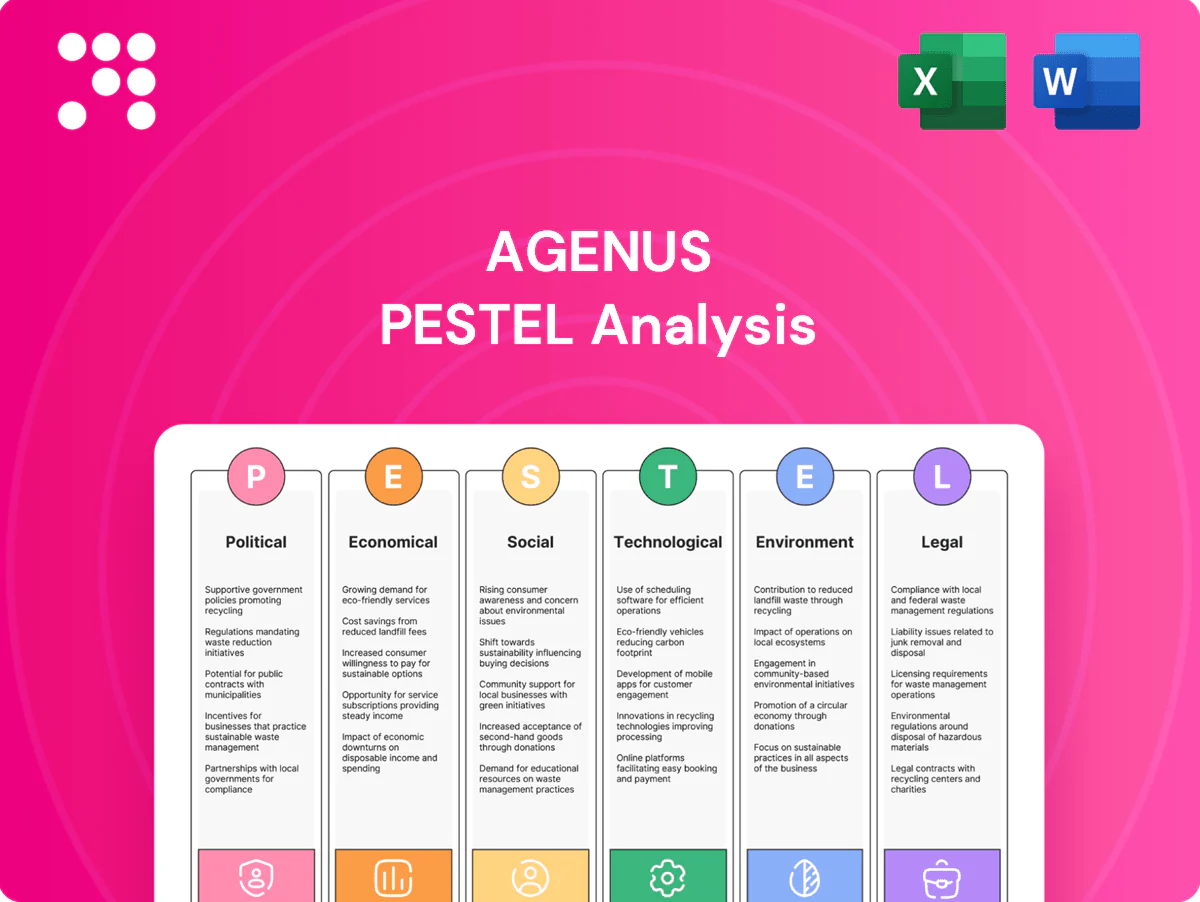
Agenus PESTLE Analysis

Your Competitive Advantage Starts with This Report
Gain strategic clarity with our PESTLE Analysis of Agenus—three-to-five sentence overview of how political, economic, social, technological, legal, and environmental forces shape its prospects. Ideal for investors and strategists, this concise briefing highlights key external risks and opportunities. Purchase the full, editable report to access deep-dive insights and actionable recommendations for smarter decisions.
Political factors

U.S. FDA and global regulator priorities
Shifts in oncology review priorities, accelerated approvals and advisory committee stances increasingly dictate Agenus trial design and timelines, with regulators in 2024 emphasizing stronger confirmatory evidence for IO therapies to justify accelerated pathways.
Healthcare funding and reimbursement politics
Government budget constraints and high-profile pricing debates materially affect market access for oncology biologics, with payers increasingly demanding demonstrated cost-effectiveness; value-based frameworks reward high-response, biomarker-driven therapies but compress list prices. National payer policies in the EU/UK commonly use managed entry agreements (eg NICE/CDF pathways) to control uptake, while Medicare/Medicaid stability and international reference pricing used by roughly 30 countries materially shape launch sequencing and revenue forecasts for Agenus.

Geopolitical supply chain resilience
Trade tensions and export controls can disrupt antibody raw materials, CHO media, and single-use systems, with industry surveys reporting up to 30% longer lead times in 2020–22; sanctions and logistics bottlenecks have pushed COGS higher for biotechs. Multi-region sourcing and local fill-finish reduce exposure, while political risk insurance and inventory buffers are increasingly strategic for companies like Agenus facing supply volatility.

Public–private R&D incentives
- Grants: NIH ~49B (FY2024)
- BARDA: government biodefense grants support translational work
- Tax credits: Orphan 25% reduces clinical costs
- PRV: up to ~350M USD increases NPV
IP diplomacy and cross-border trials
Harmonization under ICH eases protocol alignment but differing data exclusivity (US biologics 12 years; EU 8+2+1) shapes multi-country trial value. Political relations can throttle patient recruitment at major oncology centers and extend start-up timelines. Over 60 countries impose data localization rules, complicating cross-border data flow; proactive country selection reduces approval and start-up delays.
- ICH harmonization: faster protocol alignment
- Data exclusivity: US 12y; EU 8+2+1
- Data localization: >60 countries
- Mitigation: strategic country selection
IO approvals tightened; payers cut price; lead times +30%
Regulators (2024) demand stronger confirmatory IO evidence, tightening accelerated approvals and extending timelines. Payers press cost-effectiveness—Medicare/Medicaid and EU frameworks plus reference pricing shape launch sequencing. Trade controls lengthened biologics lead times ~30% (2020–22), raising COGS; NIH budget ~49B FY2024 offsets R&D via grants.
| Factor | Metric | Impact |
|---|---|---|
| Regulatory | Stronger confirmatory data 2024 | Longer trials |
| Payer | Reference pricing ~30 countries | Price pressure |
| Supply | Lead times +30% | Higher COGS |
| Funding | NIH 49B FY2024 | Non-dilutive R&D |
What is included in the product
 Detailed Word Document
Explores how macro-environmental factors uniquely affect Agenus across Political, Economic, Social, Technological, Environmental and Legal dimensions, with data‑backed trends and sector-specific subpoints to identify risks and opportunities; designed for executives and investors and including forward‑looking insights for scenario planning and strategy.

 Customizable Excel Spreadsheet
A concise, visually segmented Agenus PESTLE that summarizes external factors for quick reference, easily dropped into presentations or shared across teams; editable notes allow tailoring to regions or business units to streamline planning and risk discussions.
Economic factors

Capital intensity and funding cycles
Agenus' capital-intensive model means biotech valuations and risk capital availability—impaired since the 2021 peak—directly shape runway and partnering terms; late-stage trials often exceed $100M and collaborations commonly feature milestone payments of $10–200M. A higher rate environment (fed funds 5.25–5.50% in 2024–25) raises equity cost and makes convertible debt pricier. Milestone deals de-risk but cap upside, forcing Agenus to trade dilution versus asset optionality.
Oncology market growth and pricing power
Rising cancer incidence (IARC GLOBOCAN 2020: 19.3M new cases) sustains demand for innovative IO therapies and underpins a growing oncology market now valued in the low hundreds of billions annually. Payer pushback drives gross-to-net rebates and outcomes contracts commonly compressing net price by ~20–40%. Companion diagnostics can enable 20–50% premium pricing. Economic downturns curb elective care by ~20% but oncology demand is relatively inelastic, often falling <5%.

Manufacturing scale economics
Biologics COGS fall as upstream yield and scale-up improve, making high-yield platform processes critical to margin expansion; industry reports showed CDMO biologics capacity utilization above 90% in 2023–2024, tightening slots and raising timelines and slot premiums. Early platform investment lowers per-dose cost and development risk, so Agenus must prioritize programs by modality-specific margin profiles when sequencing launches.

FX and international revenue mix
Global launches expose Agenus to currency volatility, where a 5% USD move can change reported international revenue by several percentage points; hedging programs typically add ~1–2% in financial costs but stabilize cash flows. Regional pricing corridors and reimbursement mean realized ASPs vary materially by market, so launch sequencing should align FX exposure with local reimbursement timing.
- FX exposure: variable; 5% USD move meaningful
- Hedging cost: ~1–2% of revenue
- ASP variance: significant by region
- Strategy: sequence launches to optimize FX/reimbursement
M&A and partnering environment
Big Pharma appetite for IO assets in 2024 continued to set benchmark valuations and clear exit paths for Agenus, with strategic buyers driving premium pricing and accelerated timelines for late‑stage programs. Competitive BD landscapes have elevated deal premiums and forced earlier-optioning of assets; co-development deals remain common to spread trial costs while splitting IP economics. Macro shocks such as 2023–24 banking stress and rate shocks demonstrated how quickly deal markets can freeze, pushing companies to arrange contingency financing.
- Benchmarks: Big Pharma-led IO acquisitions set valuation comparables in 2024
- Premiums: Competitive BD raises deal pricing and accelerates exits
- Co-dev: Shares trial cost and IP upside
- Macro risk: 2023–24 shocks highlighted need for contingency financing
IO approvals tightened; payers cut price; lead times +30%
Agenus' capital intensity ties valuation to risk-cap markets; late-stage trials >$100M and milestone deals $10–200M shape dilution vs optionality. Fed funds 5.25–5.50% (2024–25) raises equity/debt cost; CDMO utilization >90% (2023–24) tightens slots. Oncology demand stable (IARC 2020: 19.3M cases); payer rebates cut net price ~20–40%.
| Metric | Value |
|---|---|
| Fed funds | 5.25–5.50% |
| Late-stage cost | >$100M |
| Milestones | $10–200M |
| CDMO util | >90% |
| Cancer incidence | 19.3M (2020) |
Full Version Awaits
Agenus PESTLE Analysis
The Agenus PESTLE Analysis provides a clear, professional assessment of political, economic, social, technological, legal, and environmental factors affecting the company. The content and structure shown in the preview is the same document you’ll download after payment. No placeholders—this is the final, ready-to-use file. Use it immediately for strategic or investment decisions.

Original: $10.00
-65%$10.00
$3.50Product Information
Product Information
Shipping & Returns
Shipping & Returns
Description
Your Competitive Advantage Starts with This Report
Gain strategic clarity with our PESTLE Analysis of Agenus—three-to-five sentence overview of how political, economic, social, technological, legal, and environmental forces shape its prospects. Ideal for investors and strategists, this concise briefing highlights key external risks and opportunities. Purchase the full, editable report to access deep-dive insights and actionable recommendations for smarter decisions.
Political factors
U.S. FDA and global regulator priorities
Shifts in oncology review priorities, accelerated approvals and advisory committee stances increasingly dictate Agenus trial design and timelines, with regulators in 2024 emphasizing stronger confirmatory evidence for IO therapies to justify accelerated pathways.
Healthcare funding and reimbursement politics
Government budget constraints and high-profile pricing debates materially affect market access for oncology biologics, with payers increasingly demanding demonstrated cost-effectiveness; value-based frameworks reward high-response, biomarker-driven therapies but compress list prices. National payer policies in the EU/UK commonly use managed entry agreements (eg NICE/CDF pathways) to control uptake, while Medicare/Medicaid stability and international reference pricing used by roughly 30 countries materially shape launch sequencing and revenue forecasts for Agenus.
Geopolitical supply chain resilience
Trade tensions and export controls can disrupt antibody raw materials, CHO media, and single-use systems, with industry surveys reporting up to 30% longer lead times in 2020–22; sanctions and logistics bottlenecks have pushed COGS higher for biotechs. Multi-region sourcing and local fill-finish reduce exposure, while political risk insurance and inventory buffers are increasingly strategic for companies like Agenus facing supply volatility.
Public–private R&D incentives
- Grants: NIH ~49B (FY2024)
- BARDA: government biodefense grants support translational work
- Tax credits: Orphan 25% reduces clinical costs
- PRV: up to ~350M USD increases NPV
IP diplomacy and cross-border trials
Harmonization under ICH eases protocol alignment but differing data exclusivity (US biologics 12 years; EU 8+2+1) shapes multi-country trial value. Political relations can throttle patient recruitment at major oncology centers and extend start-up timelines. Over 60 countries impose data localization rules, complicating cross-border data flow; proactive country selection reduces approval and start-up delays.
- ICH harmonization: faster protocol alignment
- Data exclusivity: US 12y; EU 8+2+1
- Data localization: >60 countries
- Mitigation: strategic country selection
IO approvals tightened; payers cut price; lead times +30%
Regulators (2024) demand stronger confirmatory IO evidence, tightening accelerated approvals and extending timelines. Payers press cost-effectiveness—Medicare/Medicaid and EU frameworks plus reference pricing shape launch sequencing. Trade controls lengthened biologics lead times ~30% (2020–22), raising COGS; NIH budget ~49B FY2024 offsets R&D via grants.
| Factor | Metric | Impact |
|---|---|---|
| Regulatory | Stronger confirmatory data 2024 | Longer trials |
| Payer | Reference pricing ~30 countries | Price pressure |
| Supply | Lead times +30% | Higher COGS |
| Funding | NIH 49B FY2024 | Non-dilutive R&D |
What is included in the product
Detailed Word Document
Explores how macro-environmental factors uniquely affect Agenus across Political, Economic, Social, Technological, Environmental and Legal dimensions, with data‑backed trends and sector-specific subpoints to identify risks and opportunities; designed for executives and investors and including forward‑looking insights for scenario planning and strategy.
Customizable Excel Spreadsheet
A concise, visually segmented Agenus PESTLE that summarizes external factors for quick reference, easily dropped into presentations or shared across teams; editable notes allow tailoring to regions or business units to streamline planning and risk discussions.
Economic factors
Capital intensity and funding cycles
Agenus' capital-intensive model means biotech valuations and risk capital availability—impaired since the 2021 peak—directly shape runway and partnering terms; late-stage trials often exceed $100M and collaborations commonly feature milestone payments of $10–200M. A higher rate environment (fed funds 5.25–5.50% in 2024–25) raises equity cost and makes convertible debt pricier. Milestone deals de-risk but cap upside, forcing Agenus to trade dilution versus asset optionality.
Oncology market growth and pricing power
Rising cancer incidence (IARC GLOBOCAN 2020: 19.3M new cases) sustains demand for innovative IO therapies and underpins a growing oncology market now valued in the low hundreds of billions annually. Payer pushback drives gross-to-net rebates and outcomes contracts commonly compressing net price by ~20–40%. Companion diagnostics can enable 20–50% premium pricing. Economic downturns curb elective care by ~20% but oncology demand is relatively inelastic, often falling <5%.
Manufacturing scale economics
Biologics COGS fall as upstream yield and scale-up improve, making high-yield platform processes critical to margin expansion; industry reports showed CDMO biologics capacity utilization above 90% in 2023–2024, tightening slots and raising timelines and slot premiums. Early platform investment lowers per-dose cost and development risk, so Agenus must prioritize programs by modality-specific margin profiles when sequencing launches.
FX and international revenue mix
Global launches expose Agenus to currency volatility, where a 5% USD move can change reported international revenue by several percentage points; hedging programs typically add ~1–2% in financial costs but stabilize cash flows. Regional pricing corridors and reimbursement mean realized ASPs vary materially by market, so launch sequencing should align FX exposure with local reimbursement timing.
- FX exposure: variable; 5% USD move meaningful
- Hedging cost: ~1–2% of revenue
- ASP variance: significant by region
- Strategy: sequence launches to optimize FX/reimbursement
M&A and partnering environment
Big Pharma appetite for IO assets in 2024 continued to set benchmark valuations and clear exit paths for Agenus, with strategic buyers driving premium pricing and accelerated timelines for late‑stage programs. Competitive BD landscapes have elevated deal premiums and forced earlier-optioning of assets; co-development deals remain common to spread trial costs while splitting IP economics. Macro shocks such as 2023–24 banking stress and rate shocks demonstrated how quickly deal markets can freeze, pushing companies to arrange contingency financing.
- Benchmarks: Big Pharma-led IO acquisitions set valuation comparables in 2024
- Premiums: Competitive BD raises deal pricing and accelerates exits
- Co-dev: Shares trial cost and IP upside
- Macro risk: 2023–24 shocks highlighted need for contingency financing
IO approvals tightened; payers cut price; lead times +30%
Agenus' capital intensity ties valuation to risk-cap markets; late-stage trials >$100M and milestone deals $10–200M shape dilution vs optionality. Fed funds 5.25–5.50% (2024–25) raises equity/debt cost; CDMO utilization >90% (2023–24) tightens slots. Oncology demand stable (IARC 2020: 19.3M cases); payer rebates cut net price ~20–40%.
| Metric | Value |
|---|---|
| Fed funds | 5.25–5.50% |
| Late-stage cost | >$100M |
| Milestones | $10–200M |
| CDMO util | >90% |
| Cancer incidence | 19.3M (2020) |
Full Version Awaits
Agenus PESTLE Analysis
The Agenus PESTLE Analysis provides a clear, professional assessment of political, economic, social, technological, legal, and environmental factors affecting the company. The content and structure shown in the preview is the same document you’ll download after payment. No placeholders—this is the final, ready-to-use file. Use it immediately for strategic or investment decisions.











