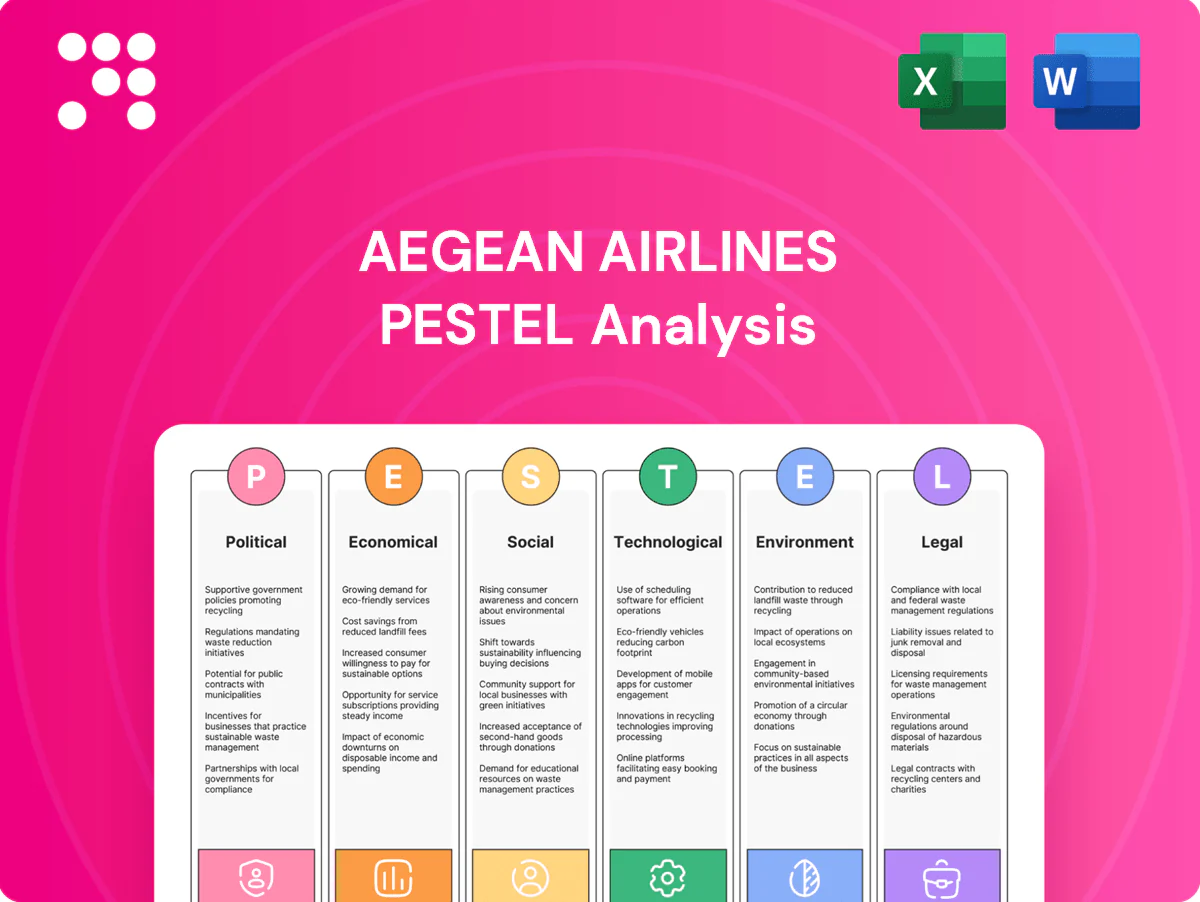
Aegean Airlines PESTLE Analysis

Skip the Research. Get the Strategy.
Discover how shifting regulations, tourism cycles, and sustainability pressures are shaping Aegean Airlines’ strategic outlook. Our concise PESTLE highlights risks and opportunity hotspots to inform investments and planning. Want the full, actionable breakdown with sources and recommendations? Purchase the complete PESTLE now for immediate download.
Political factors

EU aviation policy and governance
As an EU carrier Aegean operates under Brussels-driven aviation policy, affecting market access, slots and EASA safety oversight across the EU's 27 member states. Stability and alignment with EU transport priorities secure slot access, open-skies frameworks with neighbors and consumer protections (e.g., Regulation 261). Shifts in competition, state aid rules or foreign-ownership limits can reshape strategy. Engagement with EU bodies and Star Alliance (26 members) lobbying is pivotal.
Greek government tourism agenda
Greece treats tourism as a national growth pillar, targeting roughly 30–32 million visitors and over €20 billion in receipts in 2024, which drives policies supporting air connectivity to islands and regions. Route incentives, airport concessions and announced infrastructure upgrades (multi‑hundred million euro projects at regional airports) materially affect Aegean’s route economics and yield management. Policy backing during crises—seen in 2020–24 capacity relief measures—helps stabilize Aegean’s capacity plans, while political continuity determines execution speed and funding availability.

Regional geopolitics and airspace
Eastern Mediterranean tensions and Middle East instability disrupt routing and demand, forcing Aegean—Greece's largest carrier—to reroute flights and face market volatility. Diversions and airspace restrictions increase block hours and operating costs, elongating flight times and reducing aircraft utilization. Diplomatic relations determine bilateral traffic rights with non-EU markets, while robust crisis-response capability helps mitigate short-term revenue shocks.

Public health and crisis readiness
Post‑pandemic frameworks set border protocols and contingency rules that shape Aegean’s network flexibility; EU coordination has reduced fragmentation in 2024 as IATA reported global passenger demand near 106% of 2019 levels, aiding predictability for seasonal routes.
Political travel advisories and preparedness planning remain high priorities—EU-level health guidance and national contingency funding influence inbound tourism flows and Aegean’s operational resilience.
- EU coordination reduced fragmentation in 2024
- IATA: 2024 passenger demand ~106% of 2019
- Travel advisories directly affect inbound tourism
Airport ownership and regulation
Greek airport privatizations (Fraport Greece concession of 14 regional airports since 2017 with an upfront payment of €1.234bn) and concession models set fee and service benchmarks; regulated charges at hubs like Athens (≈25 million pax in 2023) directly affect yields and connectivity. Political oversight steers regional airport investment vital for island networks and predictable regulation supports long-term fleet and base planning.
- 14 airports concession — Fraport Greece
- Upfront payment €1.234bn
- Athens ~25m pax (2023)
- Predictable regulation enables multi-year fleet/base decisions
EU rules, slots & EASA; IATA ~106%; Greece 30–32m
EU aviation rules, slot allocation and EASA oversight shape Aegean’s market access and compliance costs; IATA 2024 demand ~106% of 2019. Greek policy prioritizes tourism (30–32m visitors, ~€20bn receipts 2024) and funds regional airport upgrades, aiding route economics. Geopolitical tensions raise diversion costs and reduce utilization, while Fraport concession (14 airports, €1.234bn) sets fee benchmarks.
| Factor | 2024/25 Metric |
|---|---|
| EU demand | ~106% of 2019 (IATA 2024) |
| Greece tourism | 30–32m visitors; ~€20bn receipts (2024) |
| Athens traffic | ~25m pax (2023) |
| Fraport concession | 14 airports; €1.234bn upfront |
What is included in the product
 Detailed Word Document
Explores how Political, Economic, Social, Technological, Environmental and Legal forces uniquely affect Aegean Airlines, with data-backed insights and forward-looking scenarios tied to regional market and regulatory dynamics; designed for executives, consultants and investors and delivered in ready-to-use formatting to reveal actionable risks and opportunities.

 Customizable Excel Spreadsheet
A compact, visually segmented PESTLE summary for Aegean Airlines that simplifies regulatory, economic and environmental risks for quick meetings; editable notes and slide-ready format speed team alignment, consultant reporting and on-the-go decision-making.
Economic factors

Tourism-driven demand cyclicality
Aegean’s volumes hinge on European leisure travel to Greece, with arrivals reaching about 31 million in 2023 and tourism contributing roughly 20% of Greek GDP, concentrating demand in summer months. Seasonality stresses fleet utilization, staffing and cash cycles as peak quarters generate the bulk of revenue. Diversification into city pairs and shoulder-season routes has improved load-factor stability. Macroeconomic slowdowns in source markets rapidly transmit to bookings.
Fuel price and forex exposure
Jet fuel volatility materially drives Aegean's unit costs: jet fuel averaged about $92/barrel in 2024, keeping fuel as one of the largest cost items and causing sharp swings in CASK. USD‑priced fuel versus predominantly EUR revenues creates currency exposure as EUR/USD traded near 1.08 in 2024. Aegean's hedging program (roughly 50% coverage in 2024) cushions but cannot eliminate price shocks, while fleet renewal with A320neo engines cuts fuel burn by roughly 15%, offsetting spikes.

Inflation and consumer spend
Euro‑area inflation, having eased from 2022 highs to roughly 2%–3% in 2024–mid‑2025, tightens discretionary travel budgets and raises price elasticity for Aegean; cost inflation in catering, ground handling and wages has squeezed margins. Dynamic pricing and ancillaries (baggage, seat choice, F&B) helped sustain unit revenue in 2024, while clear value positioning vs ultra‑low‑cost carriers remains critical.

Interest rates and financing
Higher interest rates raise Aegean’s lease, debt and pre-delivery financing costs, forcing tighter capital allocation between fleet renewal and liquidity while maintaining returns; strong Q2–Q3 cash generation historically supports cyclical de‑leveraging and investment.
- Lease/debt sensitivity
- Capital allocation trade-off
- Seasonal cash strength
- Star Alliance aids market access
Competitive landscape and alliances
ULCC expansion on Greek leisure routes has compressed fares and pressured margins, while Aegean — carrier of about 12.5 million passengers in 2023 and a fleet ~46 aircraft in 2024 — leverages Star Alliance membership (joined 2010) to boost connectivity and corporate traffic. Joint marketing and codeshares expand network reach without heavy asset investment, and yield management plus product differentiation defend yield and share against ULCCs.
- ULCC pressure: fare compression, leisure market focus
- Star Alliance (joined 2010): enhances corporate/connectivity
- Codeshares/joint marketing: network breadth, low CAPEX
- Defensive levers: revenue management, product differentiation
EU rules, slots & EASA; IATA ~106%; Greece 30–32m
Aegean depends on ~31M Greece arrivals (2023) with tourism ≈20% of GDP, creating sharp summer seasonality and cash swings. Jet fuel averaged ~$92/bbl (2024) and EUR/USD ~1.08, hedging ≈50% in 2024; A320neo lowers burn ~15%. Euro area inflation ~2–3% (2024–mid‑2025) squeezes costs; ULCC fare pressure offsets Star Alliance network gains.
| Metric | Value |
|---|---|
| Greece arrivals (2023) | 31M |
| Aegean pax (2023) | 12.5M |
| Fleet (2024) | ~46 |
| Jet fuel (2024) | $92/bbl |
| Hedge coverage (2024) | ~50% |
What You See Is What You Get
Aegean Airlines PESTLE Analysis
The preview shown here is the exact Aegean Airlines PESTLE Analysis you’ll receive after purchase—fully formatted, professionally structured, and ready to use. It contains the same content, layout, and data as the downloadable file with no placeholders or teasers. After checkout you’ll instantly get this identical final document.

Product Information
Product Information
Shipping & Returns
Shipping & Returns
Description
Skip the Research. Get the Strategy.
Discover how shifting regulations, tourism cycles, and sustainability pressures are shaping Aegean Airlines’ strategic outlook. Our concise PESTLE highlights risks and opportunity hotspots to inform investments and planning. Want the full, actionable breakdown with sources and recommendations? Purchase the complete PESTLE now for immediate download.
Political factors
EU aviation policy and governance
As an EU carrier Aegean operates under Brussels-driven aviation policy, affecting market access, slots and EASA safety oversight across the EU's 27 member states. Stability and alignment with EU transport priorities secure slot access, open-skies frameworks with neighbors and consumer protections (e.g., Regulation 261). Shifts in competition, state aid rules or foreign-ownership limits can reshape strategy. Engagement with EU bodies and Star Alliance (26 members) lobbying is pivotal.
Greek government tourism agenda
Greece treats tourism as a national growth pillar, targeting roughly 30–32 million visitors and over €20 billion in receipts in 2024, which drives policies supporting air connectivity to islands and regions. Route incentives, airport concessions and announced infrastructure upgrades (multi‑hundred million euro projects at regional airports) materially affect Aegean’s route economics and yield management. Policy backing during crises—seen in 2020–24 capacity relief measures—helps stabilize Aegean’s capacity plans, while political continuity determines execution speed and funding availability.
Regional geopolitics and airspace
Eastern Mediterranean tensions and Middle East instability disrupt routing and demand, forcing Aegean—Greece's largest carrier—to reroute flights and face market volatility. Diversions and airspace restrictions increase block hours and operating costs, elongating flight times and reducing aircraft utilization. Diplomatic relations determine bilateral traffic rights with non-EU markets, while robust crisis-response capability helps mitigate short-term revenue shocks.
Public health and crisis readiness
Post‑pandemic frameworks set border protocols and contingency rules that shape Aegean’s network flexibility; EU coordination has reduced fragmentation in 2024 as IATA reported global passenger demand near 106% of 2019 levels, aiding predictability for seasonal routes.
Political travel advisories and preparedness planning remain high priorities—EU-level health guidance and national contingency funding influence inbound tourism flows and Aegean’s operational resilience.
- EU coordination reduced fragmentation in 2024
- IATA: 2024 passenger demand ~106% of 2019
- Travel advisories directly affect inbound tourism
Airport ownership and regulation
Greek airport privatizations (Fraport Greece concession of 14 regional airports since 2017 with an upfront payment of €1.234bn) and concession models set fee and service benchmarks; regulated charges at hubs like Athens (≈25 million pax in 2023) directly affect yields and connectivity. Political oversight steers regional airport investment vital for island networks and predictable regulation supports long-term fleet and base planning.
- 14 airports concession — Fraport Greece
- Upfront payment €1.234bn
- Athens ~25m pax (2023)
- Predictable regulation enables multi-year fleet/base decisions
EU rules, slots & EASA; IATA ~106%; Greece 30–32m
EU aviation rules, slot allocation and EASA oversight shape Aegean’s market access and compliance costs; IATA 2024 demand ~106% of 2019. Greek policy prioritizes tourism (30–32m visitors, ~€20bn receipts 2024) and funds regional airport upgrades, aiding route economics. Geopolitical tensions raise diversion costs and reduce utilization, while Fraport concession (14 airports, €1.234bn) sets fee benchmarks.
| Factor | 2024/25 Metric |
|---|---|
| EU demand | ~106% of 2019 (IATA 2024) |
| Greece tourism | 30–32m visitors; ~€20bn receipts (2024) |
| Athens traffic | ~25m pax (2023) |
| Fraport concession | 14 airports; €1.234bn upfront |
What is included in the product
Detailed Word Document
Explores how Political, Economic, Social, Technological, Environmental and Legal forces uniquely affect Aegean Airlines, with data-backed insights and forward-looking scenarios tied to regional market and regulatory dynamics; designed for executives, consultants and investors and delivered in ready-to-use formatting to reveal actionable risks and opportunities.
Customizable Excel Spreadsheet
A compact, visually segmented PESTLE summary for Aegean Airlines that simplifies regulatory, economic and environmental risks for quick meetings; editable notes and slide-ready format speed team alignment, consultant reporting and on-the-go decision-making.
Economic factors
Tourism-driven demand cyclicality
Aegean’s volumes hinge on European leisure travel to Greece, with arrivals reaching about 31 million in 2023 and tourism contributing roughly 20% of Greek GDP, concentrating demand in summer months. Seasonality stresses fleet utilization, staffing and cash cycles as peak quarters generate the bulk of revenue. Diversification into city pairs and shoulder-season routes has improved load-factor stability. Macroeconomic slowdowns in source markets rapidly transmit to bookings.
Fuel price and forex exposure
Jet fuel volatility materially drives Aegean's unit costs: jet fuel averaged about $92/barrel in 2024, keeping fuel as one of the largest cost items and causing sharp swings in CASK. USD‑priced fuel versus predominantly EUR revenues creates currency exposure as EUR/USD traded near 1.08 in 2024. Aegean's hedging program (roughly 50% coverage in 2024) cushions but cannot eliminate price shocks, while fleet renewal with A320neo engines cuts fuel burn by roughly 15%, offsetting spikes.
Inflation and consumer spend
Euro‑area inflation, having eased from 2022 highs to roughly 2%–3% in 2024–mid‑2025, tightens discretionary travel budgets and raises price elasticity for Aegean; cost inflation in catering, ground handling and wages has squeezed margins. Dynamic pricing and ancillaries (baggage, seat choice, F&B) helped sustain unit revenue in 2024, while clear value positioning vs ultra‑low‑cost carriers remains critical.
Interest rates and financing
Higher interest rates raise Aegean’s lease, debt and pre-delivery financing costs, forcing tighter capital allocation between fleet renewal and liquidity while maintaining returns; strong Q2–Q3 cash generation historically supports cyclical de‑leveraging and investment.
- Lease/debt sensitivity
- Capital allocation trade-off
- Seasonal cash strength
- Star Alliance aids market access
Competitive landscape and alliances
ULCC expansion on Greek leisure routes has compressed fares and pressured margins, while Aegean — carrier of about 12.5 million passengers in 2023 and a fleet ~46 aircraft in 2024 — leverages Star Alliance membership (joined 2010) to boost connectivity and corporate traffic. Joint marketing and codeshares expand network reach without heavy asset investment, and yield management plus product differentiation defend yield and share against ULCCs.
- ULCC pressure: fare compression, leisure market focus
- Star Alliance (joined 2010): enhances corporate/connectivity
- Codeshares/joint marketing: network breadth, low CAPEX
- Defensive levers: revenue management, product differentiation
EU rules, slots & EASA; IATA ~106%; Greece 30–32m
Aegean depends on ~31M Greece arrivals (2023) with tourism ≈20% of GDP, creating sharp summer seasonality and cash swings. Jet fuel averaged ~$92/bbl (2024) and EUR/USD ~1.08, hedging ≈50% in 2024; A320neo lowers burn ~15%. Euro area inflation ~2–3% (2024–mid‑2025) squeezes costs; ULCC fare pressure offsets Star Alliance network gains.
| Metric | Value |
|---|---|
| Greece arrivals (2023) | 31M |
| Aegean pax (2023) | 12.5M |
| Fleet (2024) | ~46 |
| Jet fuel (2024) | $92/bbl |
| Hedge coverage (2024) | ~50% |
What You See Is What You Get
Aegean Airlines PESTLE Analysis
The preview shown here is the exact Aegean Airlines PESTLE Analysis you’ll receive after purchase—fully formatted, professionally structured, and ready to use. It contains the same content, layout, and data as the downloadable file with no placeholders or teasers. After checkout you’ll instantly get this identical final document.