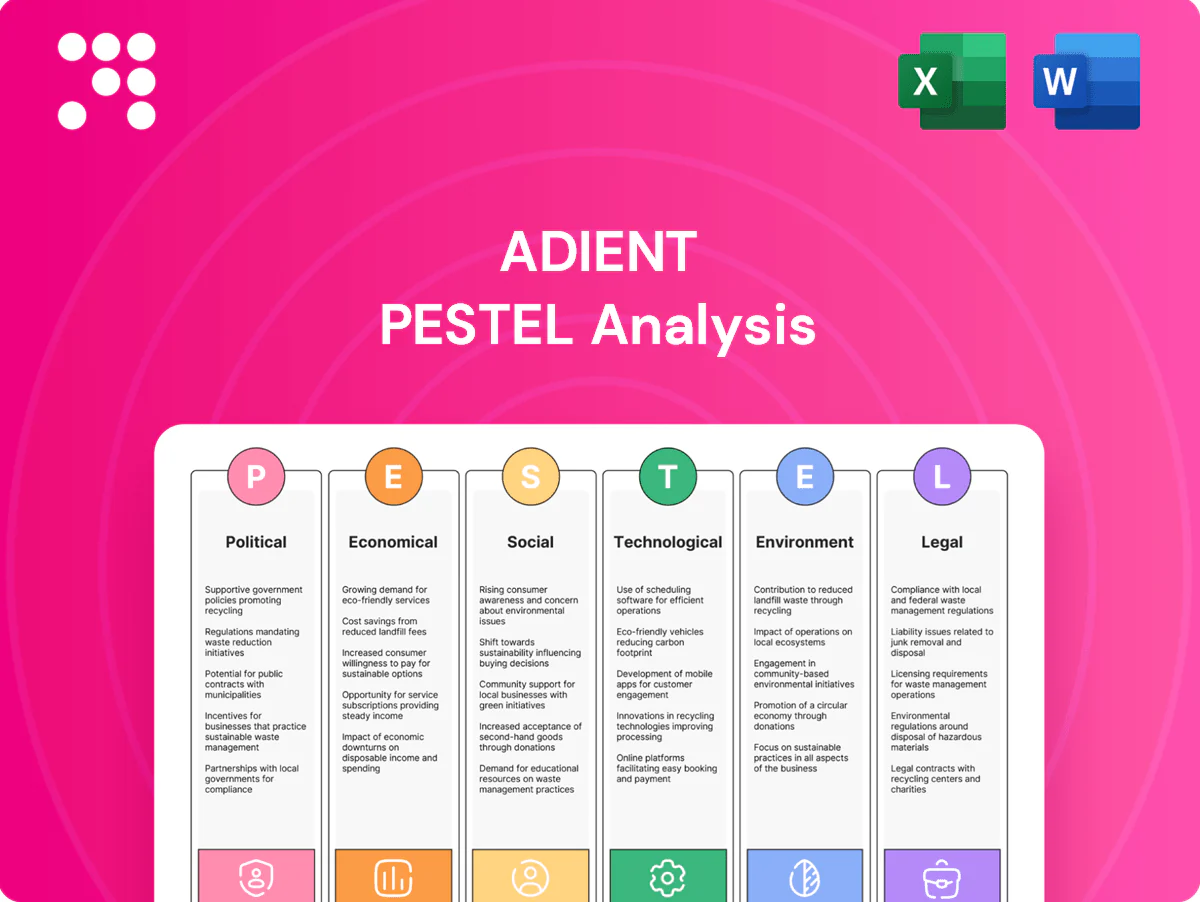
Adient PESTLE Analysis

Your Shortcut to Market Insight Starts Here
Gain actionable insight into how political, economic, social, technological, legal and environmental forces shape Adient’s strategy and risk profile. This concise PESTLE highlights regulatory, supply-chain and EV transition impacts. Ideal for investors and strategists—buy the full analysis for the detailed breakdown and ready-to-use slides.
Political factors

Trade policies and tariffs
Shifts in tariffs — notably US Section 301 duties on China up to 25% and USMCA automotive rules raising regional content to 75% — can raise Adient’s parts costs and change plant-to-plant flows between the U.S., EU, China and Mexico. Rules of origin drive sourcing and assembly location decisions, and Adient’s use of proactive rerouting and dual-sourcing reduces exposure to sudden policy shocks.
Government EV/industrial strategy
Nation-level EV/industrial strategies materially shape Adient’s OEM awards: US IRA offers up to 7,500 USD tax credits tied to domestic content and assembly and allocates ~369 billion USD for clean energy, the EU’s 2035 ICE phase-out and localization rules push regional sourcing, and China remains the largest EV market (over half of global EV volumes in 2024). Subsidies and targeted zone grants favor local plants, while content rules steer seat sourcing; aligning capacity to policy hubs secures program share.

Geopolitical risk and supply continuity
Tensions in the Taiwan Strait, Red Sea and Eastern Europe have heightened risks to material supply and logistics, increasing transit times and spot-rate volatility. Political instability in emerging markets can disrupt labor and utilities, directly affecting plant uptime and parts flow. Adient’s diversified footprint across over 30 countries and regional inventory buffers improve resilience against these continuity shocks.

Public procurement and commercial fleets
- Policy impact: fleet electrification accelerates OEM seat spec changes
- Data: ~10.5 million EVs sold globally in 2023
- Procurement: contracts typically 5–12 years, favor early-compliant suppliers
Local content and industrial relations
Localization mandates (commonly 30-50% domestic content) and strong union dynamics constrain Adient’s labor cost flexibility and plant competitiveness, raising fixed labor expense and reshoring pressure. Government incentives or procurement preferences for domestic suppliers can tilt sourcing toward local tiers and improve program retention. Constructive engagement with unions and policymakers helped suppliers through UAW-era wage pressures (~20–30% contract increases in 2023) and stabilized operations.
- Labor cost exposure: unions and mandates
- Policy levers: credits/preferences for local suppliers
- Mitigation: engagement sustains programs
Tariffs, IRA cash and wage shocks force EV supply-chain localization and dual-sourcing
Tariff shifts (US Section 301 up to 25%, USMCA 75% regional content) raise part costs and shift plant flows; dual-sourcing mitigates shocks. National EV/industrial policies (US IRA ~369 billion USD, EU 2035 ICE ban, China >50% global EV volumes in 2024) drive localization and OEM awards. Geopolitical routes, union wage shocks (~20–30% UAW increases in 2023) and localization mandates (30–50%) affect costs and uptime.
| Metric | Value |
|---|---|
| US IRA funding | ~369 billion USD |
| Section 301 tariff | up to 25% |
| China EV share (2024) | >50% |
| UAW wage rise (2023) | ~20–30% |
What is included in the product
 Detailed Word Document
Explores how macro-environmental factors uniquely affect Adient across Political, Economic, Social, Technological, Environmental and Legal dimensions, with data-driven trends and regional industry context. Designed to help executives and investors identify risks, opportunities and scenario-ready strategies.

 Customizable Excel Spreadsheet
Clean, summarized Adient PESTLE for easy reference in meetings or presentations, visually segmented by category for quick interpretation at a glance. Provides a concise, shareable format to support discussions on external risk and market positioning across teams.
Economic factors

Auto demand cyclicality
Adient seat volumes closely track global light-vehicle production, roughly 80 million units annually, exposing the company to auto demand cyclicality. Recessions and inventory corrections have historically cut OEM orders within months, as seen in the 2008 financial crisis and the 2020 pandemic slowdown. Adient mitigates swings through flexible cost structures and variable labor models that help protect margins.
Input cost volatility
Input cost volatility—steel (~$700/ton HRC in 2024–25), chemicals for foam, fabrics and energy (Brent ~$80/bbl, US Henry Hub ~$3.50/MMBtu in 2024) drives Adient’s COGS variability; swings can alter margins materially. Indexation clauses and hedging lower exposure but typically lag spot moves. Ongoing value engineering and design-for-cost programs help offset pass-through gaps to OEMs.

FX and interest rates
Adient’s multi-currency revenues and costs expose the company to translation and transaction risks as a stronger dollar (DXY ~104 in 2024) can compress reported sales and margins. Rate moves — with Fed funds around 5.25–5.50% in 2024 — affect OEM financing and consumer auto demand and directly raise Adient’s borrowing costs. The company relies on natural hedges in regional operations and selective derivatives (forwards/options) to stabilize cash flows.

OEM pricing pressure
OEM pricing pressure forces Tier-1s into annual cost-downs of roughly 2–4% (industry procurement surveys 2023–24) and aggressive competitive bidding; winning platforms requires balancing low price with innovation and quality, while operational excellence and differentiated seating technologies can sustain price realization and secure 3–6% premium on certain platforms.
- cost-downs: 2–4% pa
- price premium from tech: 3–6%
- win factors: price, innovation, quality
- sustainability: operational excellence
Regional production shifts
Nearshoring and China-plus-one strategies are reallocating build volumes toward North America and Southeast Asia, forcing Adient to realign capacity and tooling with shifting OEM footprints to avoid plant underutilization. Timely capex and targeted plant reconfiguration maintain production flexibility and protect margin density as OEM sourcing patterns evolve. Failure to adapt increases fixed-cost exposure and margin erosion.
- Nearshoring shifts demand footprints
- Align capacity/tooling to avoid idle assets
- Timely capex preserves margins
Tariffs, IRA cash and wage shocks force EV supply-chain localization and dual-sourcing
Adient tied to ~80m global light-vehicle build exposes revenues to cyclical auto demand; Fed rates 5.25–5.50% (2024) and DXY ~104 pressure volumes and reported margins. Input-cost volatility (HRC steel ~$700/t, Brent ~$80/bbl, Henry Hub ~$3.50/MMBtu) drives COGS swings despite hedging. OEM cost-downs 2–4% pa; tech premiums 3–6% reward differentiation.
| Metric | 2024–25 |
|---|---|
| Global LV build | ~80m |
| HRC steel | $700/t |
| Brent | $80/bbl |
| Fed funds | 5.25–5.50% |
What You See Is What You Get
Adient PESTLE Analysis
The Adient PESTLE Analysis preview shown here is the exact document you’ll receive after purchase—fully formatted and ready to use. This is the real, finished file with complete content and professional structure, no placeholders or teasers. After payment you’ll be able to download this same document immediately, exactly as displayed.

Original: $10.00
-65%$10.00
$3.50Product Information
Product Information
Shipping & Returns
Shipping & Returns
Description
Your Shortcut to Market Insight Starts Here
Gain actionable insight into how political, economic, social, technological, legal and environmental forces shape Adient’s strategy and risk profile. This concise PESTLE highlights regulatory, supply-chain and EV transition impacts. Ideal for investors and strategists—buy the full analysis for the detailed breakdown and ready-to-use slides.
Political factors
Trade policies and tariffs
Shifts in tariffs — notably US Section 301 duties on China up to 25% and USMCA automotive rules raising regional content to 75% — can raise Adient’s parts costs and change plant-to-plant flows between the U.S., EU, China and Mexico. Rules of origin drive sourcing and assembly location decisions, and Adient’s use of proactive rerouting and dual-sourcing reduces exposure to sudden policy shocks.
Government EV/industrial strategy
Nation-level EV/industrial strategies materially shape Adient’s OEM awards: US IRA offers up to 7,500 USD tax credits tied to domestic content and assembly and allocates ~369 billion USD for clean energy, the EU’s 2035 ICE phase-out and localization rules push regional sourcing, and China remains the largest EV market (over half of global EV volumes in 2024). Subsidies and targeted zone grants favor local plants, while content rules steer seat sourcing; aligning capacity to policy hubs secures program share.
Geopolitical risk and supply continuity
Tensions in the Taiwan Strait, Red Sea and Eastern Europe have heightened risks to material supply and logistics, increasing transit times and spot-rate volatility. Political instability in emerging markets can disrupt labor and utilities, directly affecting plant uptime and parts flow. Adient’s diversified footprint across over 30 countries and regional inventory buffers improve resilience against these continuity shocks.
Public procurement and commercial fleets
- Policy impact: fleet electrification accelerates OEM seat spec changes
- Data: ~10.5 million EVs sold globally in 2023
- Procurement: contracts typically 5–12 years, favor early-compliant suppliers
Local content and industrial relations
Localization mandates (commonly 30-50% domestic content) and strong union dynamics constrain Adient’s labor cost flexibility and plant competitiveness, raising fixed labor expense and reshoring pressure. Government incentives or procurement preferences for domestic suppliers can tilt sourcing toward local tiers and improve program retention. Constructive engagement with unions and policymakers helped suppliers through UAW-era wage pressures (~20–30% contract increases in 2023) and stabilized operations.
- Labor cost exposure: unions and mandates
- Policy levers: credits/preferences for local suppliers
- Mitigation: engagement sustains programs
Tariffs, IRA cash and wage shocks force EV supply-chain localization and dual-sourcing
Tariff shifts (US Section 301 up to 25%, USMCA 75% regional content) raise part costs and shift plant flows; dual-sourcing mitigates shocks. National EV/industrial policies (US IRA ~369 billion USD, EU 2035 ICE ban, China >50% global EV volumes in 2024) drive localization and OEM awards. Geopolitical routes, union wage shocks (~20–30% UAW increases in 2023) and localization mandates (30–50%) affect costs and uptime.
| Metric | Value |
|---|---|
| US IRA funding | ~369 billion USD |
| Section 301 tariff | up to 25% |
| China EV share (2024) | >50% |
| UAW wage rise (2023) | ~20–30% |
What is included in the product
Detailed Word Document
Explores how macro-environmental factors uniquely affect Adient across Political, Economic, Social, Technological, Environmental and Legal dimensions, with data-driven trends and regional industry context. Designed to help executives and investors identify risks, opportunities and scenario-ready strategies.
Customizable Excel Spreadsheet
Clean, summarized Adient PESTLE for easy reference in meetings or presentations, visually segmented by category for quick interpretation at a glance. Provides a concise, shareable format to support discussions on external risk and market positioning across teams.
Economic factors
Auto demand cyclicality
Adient seat volumes closely track global light-vehicle production, roughly 80 million units annually, exposing the company to auto demand cyclicality. Recessions and inventory corrections have historically cut OEM orders within months, as seen in the 2008 financial crisis and the 2020 pandemic slowdown. Adient mitigates swings through flexible cost structures and variable labor models that help protect margins.
Input cost volatility
Input cost volatility—steel (~$700/ton HRC in 2024–25), chemicals for foam, fabrics and energy (Brent ~$80/bbl, US Henry Hub ~$3.50/MMBtu in 2024) drives Adient’s COGS variability; swings can alter margins materially. Indexation clauses and hedging lower exposure but typically lag spot moves. Ongoing value engineering and design-for-cost programs help offset pass-through gaps to OEMs.
FX and interest rates
Adient’s multi-currency revenues and costs expose the company to translation and transaction risks as a stronger dollar (DXY ~104 in 2024) can compress reported sales and margins. Rate moves — with Fed funds around 5.25–5.50% in 2024 — affect OEM financing and consumer auto demand and directly raise Adient’s borrowing costs. The company relies on natural hedges in regional operations and selective derivatives (forwards/options) to stabilize cash flows.
OEM pricing pressure
OEM pricing pressure forces Tier-1s into annual cost-downs of roughly 2–4% (industry procurement surveys 2023–24) and aggressive competitive bidding; winning platforms requires balancing low price with innovation and quality, while operational excellence and differentiated seating technologies can sustain price realization and secure 3–6% premium on certain platforms.
- cost-downs: 2–4% pa
- price premium from tech: 3–6%
- win factors: price, innovation, quality
- sustainability: operational excellence
Regional production shifts
Nearshoring and China-plus-one strategies are reallocating build volumes toward North America and Southeast Asia, forcing Adient to realign capacity and tooling with shifting OEM footprints to avoid plant underutilization. Timely capex and targeted plant reconfiguration maintain production flexibility and protect margin density as OEM sourcing patterns evolve. Failure to adapt increases fixed-cost exposure and margin erosion.
- Nearshoring shifts demand footprints
- Align capacity/tooling to avoid idle assets
- Timely capex preserves margins
Tariffs, IRA cash and wage shocks force EV supply-chain localization and dual-sourcing
Adient tied to ~80m global light-vehicle build exposes revenues to cyclical auto demand; Fed rates 5.25–5.50% (2024) and DXY ~104 pressure volumes and reported margins. Input-cost volatility (HRC steel ~$700/t, Brent ~$80/bbl, Henry Hub ~$3.50/MMBtu) drives COGS swings despite hedging. OEM cost-downs 2–4% pa; tech premiums 3–6% reward differentiation.
| Metric | 2024–25 |
|---|---|
| Global LV build | ~80m |
| HRC steel | $700/t |
| Brent | $80/bbl |
| Fed funds | 5.25–5.50% |
What You See Is What You Get
Adient PESTLE Analysis
The Adient PESTLE Analysis preview shown here is the exact document you’ll receive after purchase—fully formatted and ready to use. This is the real, finished file with complete content and professional structure, no placeholders or teasers. After payment you’ll be able to download this same document immediately, exactly as displayed.