ACADIA PESTLE Analysis

Your Competitive Advantage Starts with This Report
Discover how political shifts, economic trends, social dynamics, and tech innovations are shaping ACADIA’s strategic path in our concise PESTLE briefing. This analysis highlights regulatory risks, market opportunities, and environmental pressures you can act on. Purchase the full PESTLE to access the complete, editable intelligence and make confident decisions today.
Political factors

Drug pricing and reimbursement reforms
Policy shifts like US Medicare negotiation (starting 2026, initial rounds targeting high-spend drugs) and international reference pricing can compress CNS net prices by an estimated 20–60% in worst-case scenarios; OECD studies show reference pricing often reduces launch prices 10–30%. ACADIA should model 25–40% gross‑to‑net erosion and tiered discount scenarios, engage payors/HTA bodies proactively, and scale advocacy to protect indications and access criteria.
Regulatory approval pathways and guidance
Changes in FDA/EMA guidance for neuropsychiatric endpoints shift trial design, often increasing sample sizes and costs. Priority review (6 months vs 10 months standard), breakthrough and orphan designations (US orphan 7 years, EU orphan 10 years) can accelerate timelines. Post-marketing study obligations are commonly required and EMA centralized review runs ~210 active days, so regional divergence shapes global launch sequencing.

Government funding and mental health policy
Increased public funding for mental health—WHO estimates >280 million people worldwide live with depression—boosts awareness and screening, expanding diagnosed populations and addressable markets. Government grants and public–private CNS collaborations (e.g., NIH/NIMH funding ~USD 2.2–2.3B annually in recent years) de-risk early-stage research. Policy support for caregiver programs can raise treatment uptake, though shifting public-health priorities could reallocate CNS resources.

Geopolitical risk and supply chain security
Tariffs, export controls and regional conflicts can interrupt supply of APIs, excipients and specialized equipment; FDA estimates roughly 80% of APIs for US-marketed drugs are made overseas. Governments (US CHIPS/IRA, EU Critical Raw Materials Act) are promoting domestic or ally-shoring, forcing ACADIA toward multi-sourcing and inventory buffers. Compliance with evolving sanctions (eg Russia/Belarus measures since 2022) increases operational complexity and costs.
- Tariffs/export controls: higher disruption risk
- 80% APIs sourced abroad: reshoring pressure
- Multi-sourcing + buffer inventory needed
- Sanctions compliance: added cost and complexity
Healthcare system stability and elections
Election outcomes can alter CMS coverage, Medicaid expansion, and mental health parity enforcement. Medicaid had expanded in 40 states plus DC as of 2024. Stability of national health systems shortens reimbursement timelines and reduces launch forecasting risk, while policy volatility raises investor and partner uncertainty.
- Medicaid expansion: 40 states + DC (2024)
- Higher policy stability = lower forecasting risk
- Volatility = increased investor uncertainty
Medicare 2026, intl pricing & supply geopolitics risk 25–40% gross-to-net
US Medicare negotiation (starts 2026) and international reference pricing threaten 25–40% gross‑to‑net erosion; model tiered discounts and payer engagement. Regulatory divergence (FDA/EMA timelines, post‑marketing demands) alters launch sequencing and adds trial cost. Supply‑chain geopolitics (≈80% APIs overseas) and election-driven coverage shifts (Medicaid in 40 states + DC, 2024) raise operational and reimbursement risk.
| Risk | Impact | Key metric |
|---|---|---|
| Price pressure | Revenue erosion | 25–40% gross‑to‑net |
| Regulatory | Timing/cost | FDA priority 6m vs std 10m |
| Supply | Disruption/cost | ≈80% APIs abroad |
| Political | Coverage risk | Medicaid 40 states + DC (2024) |
What is included in the product
 Detailed Word Document
Explores how external macro-environmental factors uniquely affect ACADIA across Political, Economic, Social, Technological, Environmental and Legal dimensions, with data-backed trends, forward-looking insights and detailed sub-points to support executives, investors and consultants in identifying risks, opportunities and strategy-ready actions aligned to regional market and regulatory dynamics.

 Customizable Excel Spreadsheet
A concise, visually segmented ACADIA PESTLE summary that’s easily dropped into presentations, editable for local context, and shareable across teams to streamline risk discussions and strategy alignment.
Economic factors

Payor mix and reimbursement pressure
Commercial, Medicare (≈67 million beneficiaries in 2024) and Medicaid mixes drive realized price per prescription, with Medicaid subject to a statutory minimum rebate of 23.1% that compresses net revenue.
CNS therapies commonly face step edits and prior authorizations, expanding gross-to-net deductions—industry specialty gross-to-net averaged roughly 35% in 2023—reducing realized price.
Robust real-world evidence (FDA/CMS emphasis on RWE) can secure favorable coverage, and proactive contracting strategy is central to revenue durability.
Capital markets and cost of capital
Higher interest rates (US federal funds ~5.25–5.50% in mid-2025) and muted biotech risk appetite constrain R&D and BD funding, raising discount rates and hurdle rates. Elevated cost of capital compresses pipeline optionality and forces slower trial pacing or program prioritization. Non-dilutive partnerships and licensing deals become more attractive while follow-on offering windows remain brief and timing-sensitive.

Macroeconomic cycles and demand resilience
Neuropsychiatric treatment demand is relatively inelastic but highly sensitive to copay burdens, which reduce adherence and initiation rates; recessions like 2020 (US unemployment peak 14.8% in Apr 2020) drove delays and higher lapse risk. Patient assistance programs and manufacturer copay support partially mitigate affordability gaps, while payer budget constraints can slow formulary upgrades and access timing.

Global expansion and currency exposure
Global launches diversify ACADIA’s revenue base but increase FX exposure as EUR/USD traded roughly 1.05–1.15 in 2024, amplifying reported sales volatility; EU pricing corridors and parallel trade can compress margins across member states; local pharmacoeconomic thresholds — NICE at £20,000–30,000/QALY — constrain list-price strategy; corporate hedging policies are used to reduce earnings swings.
- Diversification vs FX risk
- EUR/USD 2024: ~1.05–1.15
- EU parallel trade compresses returns
- NICE threshold £20k–30k/QALY
- Hedging cuts earnings volatility
M&A and partnership dynamics
Large-cap pharma intensified searches for CNS assets to replenish pipelines, favoring out-licensing or co-commercialization as risk-sharing; Alzheimer disease affects about 55 million people globally (WHO 2020) with projections near 78 million by 2030, underscoring addressable populations.
- Valuations tied to late-stage de-risking and addressable population size
- Platform/asset swaps optimize portfolio focus
- Competitive deals drive back-loaded, milestone-heavy structures
Medicare 2026, intl pricing & supply geopolitics risk 25–40% gross-to-net
Commercial/Medicare (~67M beneficiaries in 2024) and Medicaid (statutory rebate 23.1%) mixes drive net price; specialty gross-to-net ~35% in 2023 compresses realized revenue.
Higher rates (fed funds ~5.25–5.50% mid-2025) raise cost of capital, slowing BD/R&D and favoring non-dilutive, milestone-heavy deals.
Global launches raise FX exposure (EUR/USD 2024 ~1.05–1.15) and face NICE thresholds £20k–30k/QALY.
| Metric | Value |
|---|---|
| Medicare 2024 | ~67M |
| Medicaid rebate | 23.1% |
| Gross-to-net 2023 | ~35% |
| Fed funds mid-2025 | 5.25–5.50% |
| EUR/USD 2024 | ~1.05–1.15 |
| NICE | £20k–30k/QALY |
Same Document Delivered
ACADIA PESTLE Analysis
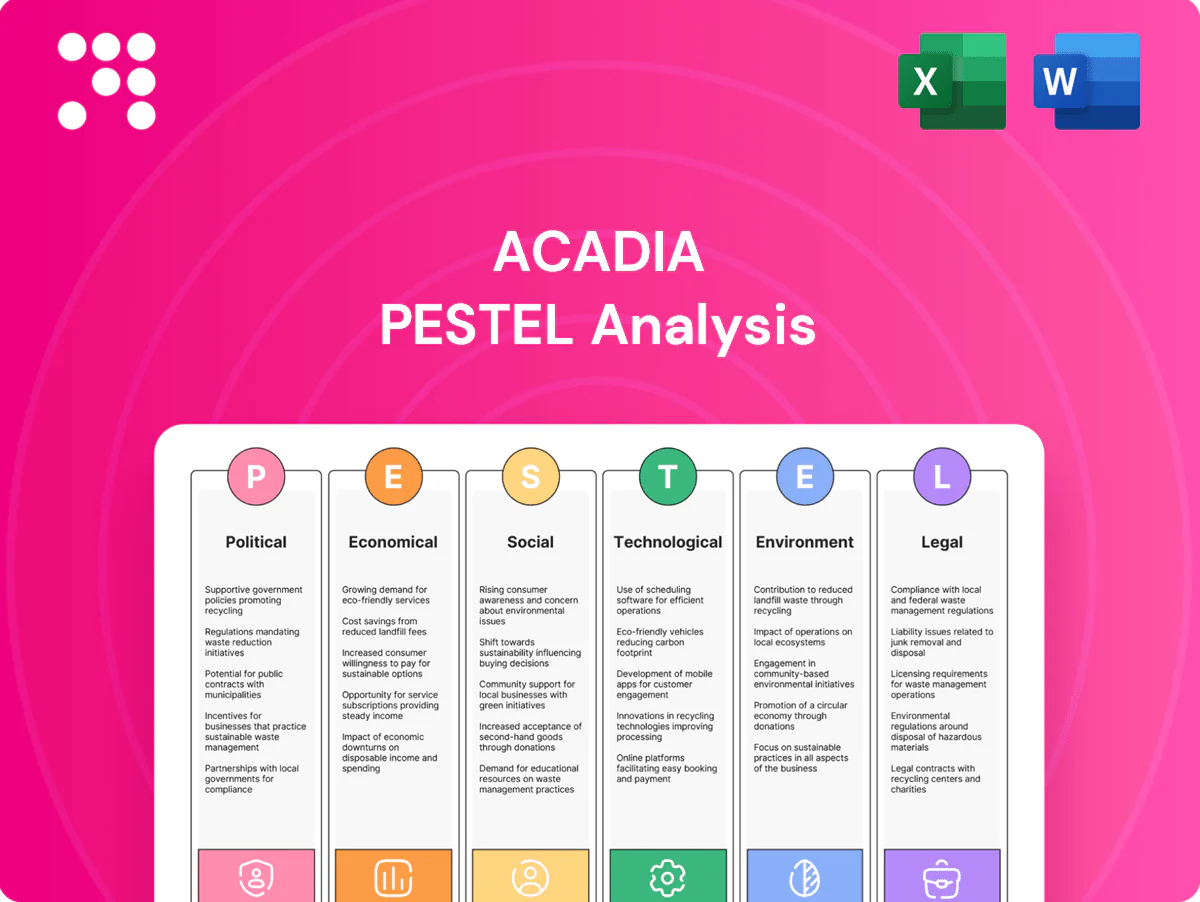
The ACADIA PESTLE Analysis preview shown here is the exact document you’ll receive after purchase—fully formatted and ready to use. The content, structure, and layout visible are the final version delivered immediately after payment. No placeholders or teasers—this is the real, professional file you’ll download.

Original: $10.00
-65%$10.00
$3.50Product Information
Product Information
Shipping & Returns
Shipping & Returns
Description
Your Competitive Advantage Starts with This Report
Discover how political shifts, economic trends, social dynamics, and tech innovations are shaping ACADIA’s strategic path in our concise PESTLE briefing. This analysis highlights regulatory risks, market opportunities, and environmental pressures you can act on. Purchase the full PESTLE to access the complete, editable intelligence and make confident decisions today.
Political factors
Drug pricing and reimbursement reforms
Policy shifts like US Medicare negotiation (starting 2026, initial rounds targeting high-spend drugs) and international reference pricing can compress CNS net prices by an estimated 20–60% in worst-case scenarios; OECD studies show reference pricing often reduces launch prices 10–30%. ACADIA should model 25–40% gross‑to‑net erosion and tiered discount scenarios, engage payors/HTA bodies proactively, and scale advocacy to protect indications and access criteria.
Regulatory approval pathways and guidance
Changes in FDA/EMA guidance for neuropsychiatric endpoints shift trial design, often increasing sample sizes and costs. Priority review (6 months vs 10 months standard), breakthrough and orphan designations (US orphan 7 years, EU orphan 10 years) can accelerate timelines. Post-marketing study obligations are commonly required and EMA centralized review runs ~210 active days, so regional divergence shapes global launch sequencing.
Government funding and mental health policy
Increased public funding for mental health—WHO estimates >280 million people worldwide live with depression—boosts awareness and screening, expanding diagnosed populations and addressable markets. Government grants and public–private CNS collaborations (e.g., NIH/NIMH funding ~USD 2.2–2.3B annually in recent years) de-risk early-stage research. Policy support for caregiver programs can raise treatment uptake, though shifting public-health priorities could reallocate CNS resources.
Geopolitical risk and supply chain security
Tariffs, export controls and regional conflicts can interrupt supply of APIs, excipients and specialized equipment; FDA estimates roughly 80% of APIs for US-marketed drugs are made overseas. Governments (US CHIPS/IRA, EU Critical Raw Materials Act) are promoting domestic or ally-shoring, forcing ACADIA toward multi-sourcing and inventory buffers. Compliance with evolving sanctions (eg Russia/Belarus measures since 2022) increases operational complexity and costs.
- Tariffs/export controls: higher disruption risk
- 80% APIs sourced abroad: reshoring pressure
- Multi-sourcing + buffer inventory needed
- Sanctions compliance: added cost and complexity
Healthcare system stability and elections
Election outcomes can alter CMS coverage, Medicaid expansion, and mental health parity enforcement. Medicaid had expanded in 40 states plus DC as of 2024. Stability of national health systems shortens reimbursement timelines and reduces launch forecasting risk, while policy volatility raises investor and partner uncertainty.
- Medicaid expansion: 40 states + DC (2024)
- Higher policy stability = lower forecasting risk
- Volatility = increased investor uncertainty
Medicare 2026, intl pricing & supply geopolitics risk 25–40% gross-to-net
US Medicare negotiation (starts 2026) and international reference pricing threaten 25–40% gross‑to‑net erosion; model tiered discounts and payer engagement. Regulatory divergence (FDA/EMA timelines, post‑marketing demands) alters launch sequencing and adds trial cost. Supply‑chain geopolitics (≈80% APIs overseas) and election-driven coverage shifts (Medicaid in 40 states + DC, 2024) raise operational and reimbursement risk.
| Risk | Impact | Key metric |
|---|---|---|
| Price pressure | Revenue erosion | 25–40% gross‑to‑net |
| Regulatory | Timing/cost | FDA priority 6m vs std 10m |
| Supply | Disruption/cost | ≈80% APIs abroad |
| Political | Coverage risk | Medicaid 40 states + DC (2024) |
What is included in the product
Detailed Word Document
Explores how external macro-environmental factors uniquely affect ACADIA across Political, Economic, Social, Technological, Environmental and Legal dimensions, with data-backed trends, forward-looking insights and detailed sub-points to support executives, investors and consultants in identifying risks, opportunities and strategy-ready actions aligned to regional market and regulatory dynamics.
Customizable Excel Spreadsheet
A concise, visually segmented ACADIA PESTLE summary that’s easily dropped into presentations, editable for local context, and shareable across teams to streamline risk discussions and strategy alignment.
Economic factors
Payor mix and reimbursement pressure
Commercial, Medicare (≈67 million beneficiaries in 2024) and Medicaid mixes drive realized price per prescription, with Medicaid subject to a statutory minimum rebate of 23.1% that compresses net revenue.
CNS therapies commonly face step edits and prior authorizations, expanding gross-to-net deductions—industry specialty gross-to-net averaged roughly 35% in 2023—reducing realized price.
Robust real-world evidence (FDA/CMS emphasis on RWE) can secure favorable coverage, and proactive contracting strategy is central to revenue durability.
Capital markets and cost of capital
Higher interest rates (US federal funds ~5.25–5.50% in mid-2025) and muted biotech risk appetite constrain R&D and BD funding, raising discount rates and hurdle rates. Elevated cost of capital compresses pipeline optionality and forces slower trial pacing or program prioritization. Non-dilutive partnerships and licensing deals become more attractive while follow-on offering windows remain brief and timing-sensitive.
Macroeconomic cycles and demand resilience
Neuropsychiatric treatment demand is relatively inelastic but highly sensitive to copay burdens, which reduce adherence and initiation rates; recessions like 2020 (US unemployment peak 14.8% in Apr 2020) drove delays and higher lapse risk. Patient assistance programs and manufacturer copay support partially mitigate affordability gaps, while payer budget constraints can slow formulary upgrades and access timing.
Global expansion and currency exposure
Global launches diversify ACADIA’s revenue base but increase FX exposure as EUR/USD traded roughly 1.05–1.15 in 2024, amplifying reported sales volatility; EU pricing corridors and parallel trade can compress margins across member states; local pharmacoeconomic thresholds — NICE at £20,000–30,000/QALY — constrain list-price strategy; corporate hedging policies are used to reduce earnings swings.
- Diversification vs FX risk
- EUR/USD 2024: ~1.05–1.15
- EU parallel trade compresses returns
- NICE threshold £20k–30k/QALY
- Hedging cuts earnings volatility
M&A and partnership dynamics
Large-cap pharma intensified searches for CNS assets to replenish pipelines, favoring out-licensing or co-commercialization as risk-sharing; Alzheimer disease affects about 55 million people globally (WHO 2020) with projections near 78 million by 2030, underscoring addressable populations.
- Valuations tied to late-stage de-risking and addressable population size
- Platform/asset swaps optimize portfolio focus
- Competitive deals drive back-loaded, milestone-heavy structures
Medicare 2026, intl pricing & supply geopolitics risk 25–40% gross-to-net
Commercial/Medicare (~67M beneficiaries in 2024) and Medicaid (statutory rebate 23.1%) mixes drive net price; specialty gross-to-net ~35% in 2023 compresses realized revenue.
Higher rates (fed funds ~5.25–5.50% mid-2025) raise cost of capital, slowing BD/R&D and favoring non-dilutive, milestone-heavy deals.
Global launches raise FX exposure (EUR/USD 2024 ~1.05–1.15) and face NICE thresholds £20k–30k/QALY.
| Metric | Value |
|---|---|
| Medicare 2024 | ~67M |
| Medicaid rebate | 23.1% |
| Gross-to-net 2023 | ~35% |
| Fed funds mid-2025 | 5.25–5.50% |
| EUR/USD 2024 | ~1.05–1.15 |
| NICE | £20k–30k/QALY |
Same Document Delivered
ACADIA PESTLE Analysis
The ACADIA PESTLE Analysis preview shown here is the exact document you’ll receive after purchase—fully formatted and ready to use. The content, structure, and layout visible are the final version delivered immediately after payment. No placeholders or teasers—this is the real, professional file you’ll download.