Associated British Foods PESTLE Analysis

Plan Smarter. Present Sharper. Compete Stronger.
Unlock how political shifts, economic pressures, social trends, and regulatory changes shape Associated British Foods’ strategy and risk profile in our concise PESTLE Analysis. Ideal for investors, consultants, and strategists, this briefing highlights actionable implications and growth levers you can use today. Buy the full version for the complete, editable report and make smarter, faster decisions.
Political factors

Trade policy and tariffs
Associated British Foods’ cross-border flows of sugar, ingredients and apparel face shifting tariff schedules and non-tariff barriers; apparel faces an average applied tariff around 9% in many markets, amplifying margin pressure. UK–EU post‑Brexit rules of origin and customs checks commonly add 1–2 days and estimated handling costs of £60–£80 per consignment, raising working capital and logistics spend. New trade deals or protectionist moves in key markets can re‑price sourcing—changing landed costs by several percentage points—so ABF pursues supplier diversification and customs optimization to mitigate volatility.
Agricultural subsidies and quotas
Sugar and crop inputs remain shaped by farm support schemes, quotas and export restraints — the EU sugar quota system was abolished in 2017, changing price dynamics for processors. Policy shifts in the EU, UK and emerging markets affect farmgate prices and supply stability, impacting ABF’s British Sugar, the UK’s primary sugar-beet processor. ABF’s cost base and capacity planning rely on predictability of these supports, so active engagement with policymakers helps anticipate regime changes.

Geopolitical instability and sanctions
Geopolitical conflict such as the Russia-Ukraine war and Red Sea shipping disruptions in 2023–24 have highlighted how sanctions and unrest can sever ingredient supply chains and apparel sourcing hubs. Currency controls and banking restrictions raise settlement and logistics frictions for ABF’s global divisions. ABF needs robust contingency plans and multi-region sourcing to sustain operations. Insurance, inventory buffers and alternative routes mitigate operational risk.

Public health and nutrition policies
Sugar taxes such as the UK Soft Drinks Industry Levy (2018) prompted a 44% reduction in sugar in soft drinks by 2018, HFSS restrictions introduced from October 2022 limit promotions and prominent shelf placement, and school food standards enforce calorie and nutrient limits—collectively forcing ABF to reformulate products, change portion sizes and adjust portfolios while working with regulators to maintain volumes.
- Sugar tax impact: 44% sugar reduction in soft drinks (PHE, 2018)
- HFSS rules: promotion and placement limits since Oct 2022
- School standards: mandatory calorie/nutrient limits in state schools
- ABF response: reformulation, portioning, regulator collaboration
Labor and minimum wage policies
National wage hikes such as the UK National Living Wage at £11.44 from April 2024, combined with Working Time Regulations capping a 48-hour average, and rising union activity, directly affect Primark stores and manufacturing partners by increasing hourly and overtime costs. Policy shifts force changes to store-level rostering, productivity tools and supplier contracts to contain margin pressure.
- NLW £11.44 (Apr 2024)
- 48-hour working-time average cap
- Higher supplier unit costs risk
- Need: scheduling, productivity tech, revised vendor terms
- Mitigants: social dialogue, compliance audits
UK apparel margins squeezed by ~9% tariffs, customs delays & rising wage and shipping costs
ABF faces ~9% average apparel tariffs, UK–EU customs adding 1–2 days and ~£60–80 handling per consignment, raising working capital. Sugar policy shifts affect British Sugar margins after EU quota removal; soft-drink sugar fell 44% (PHE, 2018). NLW £11.44 (Apr 2024) raises Primark wage costs; sanctions and Red Sea disruptions elevated shipping risk in 2023–24.
| Item | Value |
|---|---|
| Apparel tariff | ~9% |
| Customs handling | £60–80 / consignment |
| NLW | £11.44 (Apr 2024) |
| Sugar cut | 44% (PHE 2018) |
What is included in the product
 Detailed Word Document
Explores how Political, Economic, Social, Technological, Environmental and Legal forces uniquely affect Associated British Foods, with data-backed trends and forward-looking insights to identify risks and opportunities; crafted for executives, consultants and investors and formatted for easy insertion into reports, decks and plans.

 Customizable Excel Spreadsheet
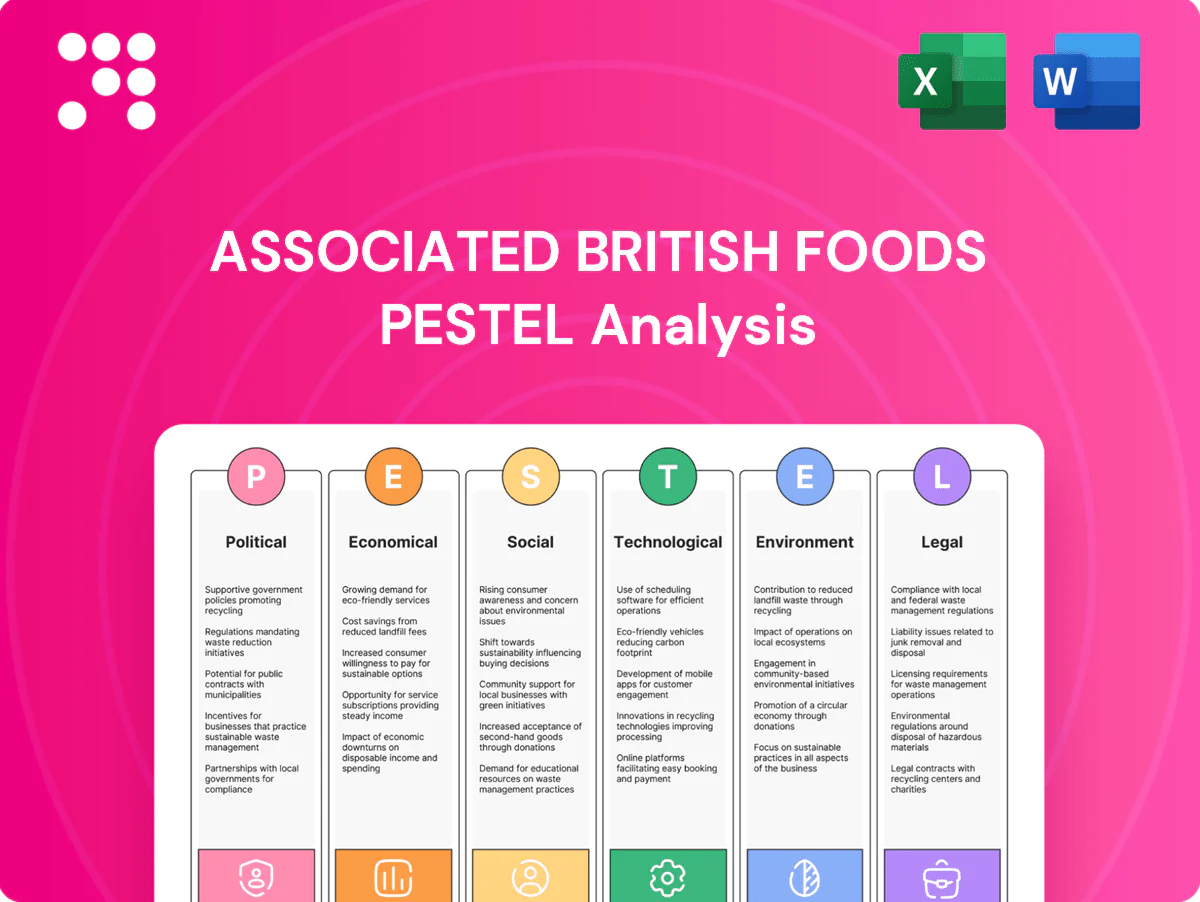
A concise, visually segmented PESTLE summary for Associated British Foods that’s editable for regional or business-line notes, easy to drop into presentations or share across teams to streamline risk discussions and strategic planning.
Economic factors

Consumer spending and retail cycles
Value fashion is highly sensitive to real disposable income and consumer confidence; with UK CPI easing to around 3% in 2024 and households still rebuilding spending power, downturns squeeze basket size but often drive trade-down to Primark. Primark, with over 400 stores, typically gains share in weak phases while recoveries support like-for-like growth and new-space expansion. Flexible pricing and fast inventory turns are critical levers to protect margins and capture volume.
Commodity and energy price volatility
Commodity and energy price volatility—sugar, wheat, oils, cotton and gas/electricity—drives significant COGS variability for Associated British Foods, forcing use of hedging, long-term supplier contracts and efficiency programs to stabilize margins. Input cost spikes require agile pricing and product-mix management. Process optimization and energy-saving capex cushion shocks and protect margin resilience.

Foreign exchange fluctuations
Multi-currency revenues and costs expose Associated British Foods to translation and transaction risk, with shifts in exchange rates able to move reported margins between its grocery, sugar, ingredients and retail divisions. A stronger US dollar or weaker sterling can materially reshape divisional profitability by inflating local-currency costs or revenues. ABF uses natural hedges via regional sourcing and currency-matched procurement alongside financial instruments to reduce earnings volatility. Regional sourcing strategies lower FX mismatch in cost bases and help stabilize margins.

Interest rates and capital costs
Higher interest rates (UK Bank Rate c.5.25% in 2024–25) lift borrowing costs and hurdle rates for store roll-outs and plant investments, pushing ABF to prioritise projects with faster paybacks; discount rate increases reduce DCF valuations across grocery, ingredients and retail divisions; efficient working capital and disciplined capex sequencing gain importance; fixed-rate debt and staggered maturities mitigate refinancing risk.
- Bank Rate ~5.25%: raises cost of capital
- Higher discount rates: lower DCF values
- Focus: working capital, capex sequencing
- Hedge: fixed-rate debt, staggered maturities
Supply chain capacity and logistics costs
Freight rates moderated from pandemic highs, with the Drewry World Container Index averaging about $1,250 per 40ft in 2024, while UNCTAD reported average port waiting times near 2.0 days, making freight cost and port congestion primary drivers of ABF delivery reliability. Apparel lead times and ingredient freshness hinge on logistics agility; nearshoring and multimodal transport adoption rose in 2024 to boost resilience. Integrated planning and S&OP reduce demand-supply imbalances and inventory costs.
- Freight rates: Drewry WCI ~ $1,250/40ft (2024)
- Port congestion: ~2.0 days average waiting (UNCTAD 2024)
- Operational fix: Nearshoring + multimodal transport + S&OP
UK apparel margins squeezed by ~9% tariffs, customs delays & rising wage and shipping costs
Value-fashion demand tracks real disposable income and confidence; UK CPI ~3% (2024) and Bank Rate ~5.25% tighten spending but drive Primark (400+ stores) share gains. Commodity/energy swings (sugar, wheat, cotton, gas) and FX volatility force hedges and regional sourcing. Freight Drewry WCI ~$1,250/40ft and port waits ~2.0 days keep logistics and working capital central.
| Metric | 2024–25 | Impact |
|---|---|---|
| Bank Rate | ~5.25% | Higher cost of capital |
| CPI | ~3% | Spending pressure |
| Primark | 400+ stores | Share gains in downturns |
| Drewry WCI | ~$1,250/40ft | Logistics cost |
| Port waits | ~2.0 days | Delivery risk |
Preview the Actual Deliverable
Associated British Foods PESTLE Analysis
This Associated British Foods PESTLE Analysis provides concise political, economic, social, technological, legal and environmental insights tailored for strategic decision‑making. The preview shown here is the exact document you’ll receive after purchase—fully formatted and ready to use.

Product Information
Product Information
Shipping & Returns
Shipping & Returns
Description
Plan Smarter. Present Sharper. Compete Stronger.
Unlock how political shifts, economic pressures, social trends, and regulatory changes shape Associated British Foods’ strategy and risk profile in our concise PESTLE Analysis. Ideal for investors, consultants, and strategists, this briefing highlights actionable implications and growth levers you can use today. Buy the full version for the complete, editable report and make smarter, faster decisions.
Political factors
Trade policy and tariffs
Associated British Foods’ cross-border flows of sugar, ingredients and apparel face shifting tariff schedules and non-tariff barriers; apparel faces an average applied tariff around 9% in many markets, amplifying margin pressure. UK–EU post‑Brexit rules of origin and customs checks commonly add 1–2 days and estimated handling costs of £60–£80 per consignment, raising working capital and logistics spend. New trade deals or protectionist moves in key markets can re‑price sourcing—changing landed costs by several percentage points—so ABF pursues supplier diversification and customs optimization to mitigate volatility.
Agricultural subsidies and quotas
Sugar and crop inputs remain shaped by farm support schemes, quotas and export restraints — the EU sugar quota system was abolished in 2017, changing price dynamics for processors. Policy shifts in the EU, UK and emerging markets affect farmgate prices and supply stability, impacting ABF’s British Sugar, the UK’s primary sugar-beet processor. ABF’s cost base and capacity planning rely on predictability of these supports, so active engagement with policymakers helps anticipate regime changes.
Geopolitical instability and sanctions
Geopolitical conflict such as the Russia-Ukraine war and Red Sea shipping disruptions in 2023–24 have highlighted how sanctions and unrest can sever ingredient supply chains and apparel sourcing hubs. Currency controls and banking restrictions raise settlement and logistics frictions for ABF’s global divisions. ABF needs robust contingency plans and multi-region sourcing to sustain operations. Insurance, inventory buffers and alternative routes mitigate operational risk.
Public health and nutrition policies
Sugar taxes such as the UK Soft Drinks Industry Levy (2018) prompted a 44% reduction in sugar in soft drinks by 2018, HFSS restrictions introduced from October 2022 limit promotions and prominent shelf placement, and school food standards enforce calorie and nutrient limits—collectively forcing ABF to reformulate products, change portion sizes and adjust portfolios while working with regulators to maintain volumes.
- Sugar tax impact: 44% sugar reduction in soft drinks (PHE, 2018)
- HFSS rules: promotion and placement limits since Oct 2022
- School standards: mandatory calorie/nutrient limits in state schools
- ABF response: reformulation, portioning, regulator collaboration
Labor and minimum wage policies
National wage hikes such as the UK National Living Wage at £11.44 from April 2024, combined with Working Time Regulations capping a 48-hour average, and rising union activity, directly affect Primark stores and manufacturing partners by increasing hourly and overtime costs. Policy shifts force changes to store-level rostering, productivity tools and supplier contracts to contain margin pressure.
- NLW £11.44 (Apr 2024)
- 48-hour working-time average cap
- Higher supplier unit costs risk
- Need: scheduling, productivity tech, revised vendor terms
- Mitigants: social dialogue, compliance audits
UK apparel margins squeezed by ~9% tariffs, customs delays & rising wage and shipping costs
ABF faces ~9% average apparel tariffs, UK–EU customs adding 1–2 days and ~£60–80 handling per consignment, raising working capital. Sugar policy shifts affect British Sugar margins after EU quota removal; soft-drink sugar fell 44% (PHE, 2018). NLW £11.44 (Apr 2024) raises Primark wage costs; sanctions and Red Sea disruptions elevated shipping risk in 2023–24.
| Item | Value |
|---|---|
| Apparel tariff | ~9% |
| Customs handling | £60–80 / consignment |
| NLW | £11.44 (Apr 2024) |
| Sugar cut | 44% (PHE 2018) |
What is included in the product
Detailed Word Document
Explores how Political, Economic, Social, Technological, Environmental and Legal forces uniquely affect Associated British Foods, with data-backed trends and forward-looking insights to identify risks and opportunities; crafted for executives, consultants and investors and formatted for easy insertion into reports, decks and plans.
Customizable Excel Spreadsheet
A concise, visually segmented PESTLE summary for Associated British Foods that’s editable for regional or business-line notes, easy to drop into presentations or share across teams to streamline risk discussions and strategic planning.
Economic factors
Consumer spending and retail cycles
Value fashion is highly sensitive to real disposable income and consumer confidence; with UK CPI easing to around 3% in 2024 and households still rebuilding spending power, downturns squeeze basket size but often drive trade-down to Primark. Primark, with over 400 stores, typically gains share in weak phases while recoveries support like-for-like growth and new-space expansion. Flexible pricing and fast inventory turns are critical levers to protect margins and capture volume.
Commodity and energy price volatility
Commodity and energy price volatility—sugar, wheat, oils, cotton and gas/electricity—drives significant COGS variability for Associated British Foods, forcing use of hedging, long-term supplier contracts and efficiency programs to stabilize margins. Input cost spikes require agile pricing and product-mix management. Process optimization and energy-saving capex cushion shocks and protect margin resilience.
Foreign exchange fluctuations
Multi-currency revenues and costs expose Associated British Foods to translation and transaction risk, with shifts in exchange rates able to move reported margins between its grocery, sugar, ingredients and retail divisions. A stronger US dollar or weaker sterling can materially reshape divisional profitability by inflating local-currency costs or revenues. ABF uses natural hedges via regional sourcing and currency-matched procurement alongside financial instruments to reduce earnings volatility. Regional sourcing strategies lower FX mismatch in cost bases and help stabilize margins.
Interest rates and capital costs
Higher interest rates (UK Bank Rate c.5.25% in 2024–25) lift borrowing costs and hurdle rates for store roll-outs and plant investments, pushing ABF to prioritise projects with faster paybacks; discount rate increases reduce DCF valuations across grocery, ingredients and retail divisions; efficient working capital and disciplined capex sequencing gain importance; fixed-rate debt and staggered maturities mitigate refinancing risk.
- Bank Rate ~5.25%: raises cost of capital
- Higher discount rates: lower DCF values
- Focus: working capital, capex sequencing
- Hedge: fixed-rate debt, staggered maturities
Supply chain capacity and logistics costs
Freight rates moderated from pandemic highs, with the Drewry World Container Index averaging about $1,250 per 40ft in 2024, while UNCTAD reported average port waiting times near 2.0 days, making freight cost and port congestion primary drivers of ABF delivery reliability. Apparel lead times and ingredient freshness hinge on logistics agility; nearshoring and multimodal transport adoption rose in 2024 to boost resilience. Integrated planning and S&OP reduce demand-supply imbalances and inventory costs.
- Freight rates: Drewry WCI ~ $1,250/40ft (2024)
- Port congestion: ~2.0 days average waiting (UNCTAD 2024)
- Operational fix: Nearshoring + multimodal transport + S&OP
UK apparel margins squeezed by ~9% tariffs, customs delays & rising wage and shipping costs
Value-fashion demand tracks real disposable income and confidence; UK CPI ~3% (2024) and Bank Rate ~5.25% tighten spending but drive Primark (400+ stores) share gains. Commodity/energy swings (sugar, wheat, cotton, gas) and FX volatility force hedges and regional sourcing. Freight Drewry WCI ~$1,250/40ft and port waits ~2.0 days keep logistics and working capital central.
| Metric | 2024–25 | Impact |
|---|---|---|
| Bank Rate | ~5.25% | Higher cost of capital |
| CPI | ~3% | Spending pressure |
| Primark | 400+ stores | Share gains in downturns |
| Drewry WCI | ~$1,250/40ft | Logistics cost |
| Port waits | ~2.0 days | Delivery risk |
Preview the Actual Deliverable
Associated British Foods PESTLE Analysis
This Associated British Foods PESTLE Analysis provides concise political, economic, social, technological, legal and environmental insights tailored for strategic decision‑making. The preview shown here is the exact document you’ll receive after purchase—fully formatted and ready to use.