PetMed Express Porter's Five Forces Analysis

Elevate Your Analysis with the Complete Porter's Five Forces Analysis
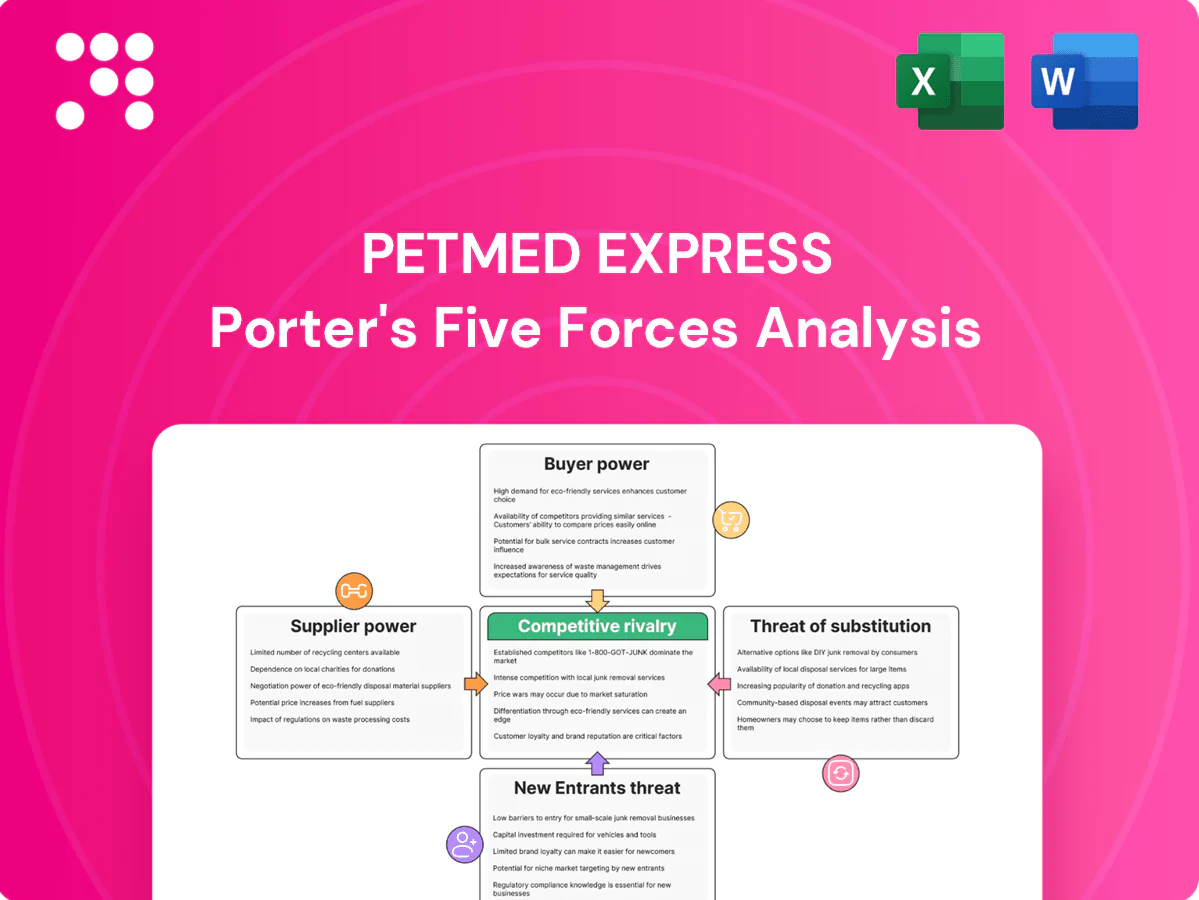
PetMed Express faces moderate supplier leverage, evolving buyer expectations, growing online competition, and meaningful substitute threats that shape its margin profile and growth runway. This snapshot highlights key pressures but only scratches the surface. Unlock the full Porter's Five Forces Analysis for force-by-force ratings, visuals, and actionable strategy tailored to PetMed Express.
Suppliers Bargaining Power

Concentrated pharma manufacturers
Pet medications are dominated by a few large animal health companies—Zoetis, Elanco, Boehringer Ingelheim and Merck—whose leading brands and R&D give suppliers leverage over pricing, contract terms and promotional access. In 2024 these major suppliers accounted for over half of companion-animal pharmaceutical sales, concentrating bargaining power. PetMed must sustain supplier relationships to secure breadth and competitive costs, as losing a key label can materially reduce category mix and traffic.
Brand exclusivity and MAP policies
Brand exclusivity and strict MAP/selective distribution policies constrain PetMed Express’s pricing flexibility, forcing margins to compress when retailers cannot discount; manufacturers often tie authorized reseller status to MAP compliance. Maintaining compliance preserves access to co-op advertising funds and branded marketing assets, while documented deviations can trigger supply curtailment or termination of authorized status. These controls strengthen supplier bargaining power over online pharmacies.

Regulatory and Rx verification dependence
Prescription drugs for animals require vet authorization and adherence to pharmacy regulations enforced across all 50 states as of 2024, raising documentation burdens for online dispensers. Suppliers increasingly demand compliance audits and detailed records, amplifying operational complexity and costs. Any documented compliance lapse can trigger immediate supply suspension, giving suppliers heightened oversight power over online pharmacies like PetMed Express.

Limited substitutes for patented therapies
For newer or patented molecules where generics are absent, supplier leverage is elevated and PetMed’s negotiating power weakens; in 2024 generics still represented roughly 90% of U.S. prescriptions but only about 20% of total drug spending, concentrating cost risk in branded therapies. Suppliers can push price increases with limited demand elasticity, especially for chronic therapies where patient dependence raises stickiness, so PetMed must offset through product mix, private-label development, and promotions on adjacent SKUs.
- Higher supplier power: patented drugs lack substitutes
- 2024: generics ~90% prescriptions, ~20% spending
- PetMed mitigation: mix shifts, private label, adjacent-SKU promos
- Chronic therapies increase dependence and price inelasticity
Distributor and wholesaler intermediation
When sourcing via wholesalers, PetMed faces added layers that can raise costs and constrain availability; in 2024 the three major U.S. wholesalers (McKesson, AmerisourceBergen, Cardinal Health) continued to dominate distribution, intensifying upstream leverage. Allocation during shortages typically favors higher-volume or strategic accounts, while lead times and fill rates fluctuate and can degrade service levels. This variability strengthens supplier bargaining power and raises supply risk for PetMed.
- Dominant wholesalers concentrate distribution power
- Shortage allocation favors large accounts
- Variable lead times and fill rates worsen service
- Higher upstream leverage increases cost and supply risk
Supplier concentration (>50%) and wholesale allocation squeeze retailer margins
Supplier concentration among Zoetis, Elanco, Boehringer Ingelheim and Merck gave suppliers outsized pricing and distribution leverage in 2024, limiting PetMed Express’s margin flexibility. Brand exclusivity, MAP policies and vet-prescription controls tightened retailer negotiating power and raised compliance costs. Dominant wholesalers and shortage allocation practices further strengthen upstream supplier bargaining.
| Metric | 2024 | Impact |
|---|---|---|
| Top animal pharma share | >50% companion-animal sales | Concentrated supplier power |
| Generics | ~90% prescriptions, ~20% spend | Branded cost concentration |
| Wholesaler dominance | McKesson/Ameri/Cardinal lead | Allocation, lead-time risk |
What is included in the product
 Detailed Word Document
Tailored Porter's Five Forces analysis for PetMed Express revealing competitive intensity, buyer/supplier bargaining power, threat of substitutes and new entrants, plus strategic levers to protect margins and market share.

 Customizable Excel Spreadsheet
A clear, one-sheet Porter's Five Forces summary for PetMed Express that quickly surfaces competitive, supplier, buyer and substitute pressures to relieve strategic decision pain; perfect for board decks and rapid scenario planning.
Customers Bargaining Power

High price transparency online
Pet owners compare prices across Chewy (net sales $8.44B in 2023), Amazon (net sales $514B in 2023) and Walmart (FY2023 revenue $611B), plus local clinics; this high transparency heightens price sensitivity and compresses PetMed Express’s margins. Coupons and autoship discounts are now baseline expectations, so customer loyalty depends on perceived total value—convenience, service and bundled savings—not just list price.
Low switching costs
For OTC items and many Rx refills, switching retailers is simple once prescriptions are on file, and competing platforms in 2024 — including Amazon with Prime 2-day shipping — offer quick account setup and rapid delivery, enabling buyers to bargain by threatening to switch. PetMed must counter with superior convenience, reliable refill fulfillment and targeted retention incentives such as auto-ship discounts and loyalty pricing. Low switching costs intensify price and service pressure on margins.

Value in convenience and trust
Despite price sensitivity, buyers prioritize legitimate pharmacies, correct dosing and timely delivery—critical as roughly 70% of US households owned pets in 2024 (APPA), raising prescription demand. Verified pharmacy status and strong customer service reduce perceived risk and temper buyer power for essential meds. Service failures, however, quickly erode loyalty and push price-driven switching.

Subscription and autoship leverage
Autoship programs deepen stickiness and can lift repeat-purchase rates 20–30% but train customers to expect ongoing discounts; buyers can exert leverage by pausing or canceling subscriptions. PetMed must offer differentiated perks and loyalty tiers to sustain retention, while consistent on-time delivery is critical to avoid churn and preserve CLV.
- Autoship boosts repeat rates 20–30%
- Discount expectations increase buyer leverage
- Pause/cancel options are negotiation tools
- Delivery reliability directly ties to churn
Influence of veterinarians and reviews
Veterinarians routinely steer pet owners toward preferred fulfillment channels, shaping buyer expectations; APPA 2024 data shows about 70% of owners value vet recommendations. Online reviews and social proof heavily influence retailer choice—BrightLocal 2023 found 98% of consumers read reviews—so negative feedback can trigger rapid switching. Education and vet-friendly processes reduce that external influence.
- Vet influence: ~70% (APPA 2024)
- Review impact: 98% read reviews (BrightLocal 2023)
- Mitigation: vet partnerships and education lower churn
Price transparency and low switching costs compress margins; autoship lifts repeats 20-30%
High price transparency (Chewy net sales $8.44B 2023; Amazon $514B 2023; Walmart $611B FY2023) and low switching costs heighten buyer leverage, compressing margins. Autoship lifts repeat rates 20–30% but normalizes discounts; 70% US pet ownership (APPA 2024) sustains Rx demand while review impact (98% read reviews, BrightLocal 2023) amplifies churn risk.
| Metric | Value |
|---|---|
| Chewy sales | $8.44B (2023) |
| Amazon sales | $514B (2023) |
| Walmart revenue | $611B (FY2023) |
| Pet ownership | 70% (APPA 2024) |
| Autoship impact | +20–30% repeat rate |
| Review reach | 98% read reviews (BrightLocal 2023) |
What You See Is What You Get
PetMed Express Porter's Five Forces Analysis
This preview shows the exact Porter's Five Forces analysis for PetMed Express that you'll receive—no mockups or placeholders. The full document is fully formatted, professionally written, and includes force-by-force assessment and implications for strategy. Once you purchase, you'll get instant access to this identical file, ready to download and use immediately.

Original: $10.00
-65%$10.00
$3.50Product Information
Product Information
Shipping & Returns
Shipping & Returns
Description
Elevate Your Analysis with the Complete Porter's Five Forces Analysis
PetMed Express faces moderate supplier leverage, evolving buyer expectations, growing online competition, and meaningful substitute threats that shape its margin profile and growth runway. This snapshot highlights key pressures but only scratches the surface. Unlock the full Porter's Five Forces Analysis for force-by-force ratings, visuals, and actionable strategy tailored to PetMed Express.
Suppliers Bargaining Power
Concentrated pharma manufacturers
Pet medications are dominated by a few large animal health companies—Zoetis, Elanco, Boehringer Ingelheim and Merck—whose leading brands and R&D give suppliers leverage over pricing, contract terms and promotional access. In 2024 these major suppliers accounted for over half of companion-animal pharmaceutical sales, concentrating bargaining power. PetMed must sustain supplier relationships to secure breadth and competitive costs, as losing a key label can materially reduce category mix and traffic.
Brand exclusivity and MAP policies
Brand exclusivity and strict MAP/selective distribution policies constrain PetMed Express’s pricing flexibility, forcing margins to compress when retailers cannot discount; manufacturers often tie authorized reseller status to MAP compliance. Maintaining compliance preserves access to co-op advertising funds and branded marketing assets, while documented deviations can trigger supply curtailment or termination of authorized status. These controls strengthen supplier bargaining power over online pharmacies.
Regulatory and Rx verification dependence
Prescription drugs for animals require vet authorization and adherence to pharmacy regulations enforced across all 50 states as of 2024, raising documentation burdens for online dispensers. Suppliers increasingly demand compliance audits and detailed records, amplifying operational complexity and costs. Any documented compliance lapse can trigger immediate supply suspension, giving suppliers heightened oversight power over online pharmacies like PetMed Express.
Limited substitutes for patented therapies
For newer or patented molecules where generics are absent, supplier leverage is elevated and PetMed’s negotiating power weakens; in 2024 generics still represented roughly 90% of U.S. prescriptions but only about 20% of total drug spending, concentrating cost risk in branded therapies. Suppliers can push price increases with limited demand elasticity, especially for chronic therapies where patient dependence raises stickiness, so PetMed must offset through product mix, private-label development, and promotions on adjacent SKUs.
- Higher supplier power: patented drugs lack substitutes
- 2024: generics ~90% prescriptions, ~20% spending
- PetMed mitigation: mix shifts, private label, adjacent-SKU promos
- Chronic therapies increase dependence and price inelasticity
Distributor and wholesaler intermediation
When sourcing via wholesalers, PetMed faces added layers that can raise costs and constrain availability; in 2024 the three major U.S. wholesalers (McKesson, AmerisourceBergen, Cardinal Health) continued to dominate distribution, intensifying upstream leverage. Allocation during shortages typically favors higher-volume or strategic accounts, while lead times and fill rates fluctuate and can degrade service levels. This variability strengthens supplier bargaining power and raises supply risk for PetMed.
- Dominant wholesalers concentrate distribution power
- Shortage allocation favors large accounts
- Variable lead times and fill rates worsen service
- Higher upstream leverage increases cost and supply risk
Supplier concentration (>50%) and wholesale allocation squeeze retailer margins
Supplier concentration among Zoetis, Elanco, Boehringer Ingelheim and Merck gave suppliers outsized pricing and distribution leverage in 2024, limiting PetMed Express’s margin flexibility. Brand exclusivity, MAP policies and vet-prescription controls tightened retailer negotiating power and raised compliance costs. Dominant wholesalers and shortage allocation practices further strengthen upstream supplier bargaining.
| Metric | 2024 | Impact |
|---|---|---|
| Top animal pharma share | >50% companion-animal sales | Concentrated supplier power |
| Generics | ~90% prescriptions, ~20% spend | Branded cost concentration |
| Wholesaler dominance | McKesson/Ameri/Cardinal lead | Allocation, lead-time risk |
What is included in the product
Detailed Word Document
Tailored Porter's Five Forces analysis for PetMed Express revealing competitive intensity, buyer/supplier bargaining power, threat of substitutes and new entrants, plus strategic levers to protect margins and market share.
Customizable Excel Spreadsheet
A clear, one-sheet Porter's Five Forces summary for PetMed Express that quickly surfaces competitive, supplier, buyer and substitute pressures to relieve strategic decision pain; perfect for board decks and rapid scenario planning.
Customers Bargaining Power
High price transparency online
Pet owners compare prices across Chewy (net sales $8.44B in 2023), Amazon (net sales $514B in 2023) and Walmart (FY2023 revenue $611B), plus local clinics; this high transparency heightens price sensitivity and compresses PetMed Express’s margins. Coupons and autoship discounts are now baseline expectations, so customer loyalty depends on perceived total value—convenience, service and bundled savings—not just list price.
Low switching costs
For OTC items and many Rx refills, switching retailers is simple once prescriptions are on file, and competing platforms in 2024 — including Amazon with Prime 2-day shipping — offer quick account setup and rapid delivery, enabling buyers to bargain by threatening to switch. PetMed must counter with superior convenience, reliable refill fulfillment and targeted retention incentives such as auto-ship discounts and loyalty pricing. Low switching costs intensify price and service pressure on margins.
Value in convenience and trust
Despite price sensitivity, buyers prioritize legitimate pharmacies, correct dosing and timely delivery—critical as roughly 70% of US households owned pets in 2024 (APPA), raising prescription demand. Verified pharmacy status and strong customer service reduce perceived risk and temper buyer power for essential meds. Service failures, however, quickly erode loyalty and push price-driven switching.
Subscription and autoship leverage
Autoship programs deepen stickiness and can lift repeat-purchase rates 20–30% but train customers to expect ongoing discounts; buyers can exert leverage by pausing or canceling subscriptions. PetMed must offer differentiated perks and loyalty tiers to sustain retention, while consistent on-time delivery is critical to avoid churn and preserve CLV.
- Autoship boosts repeat rates 20–30%
- Discount expectations increase buyer leverage
- Pause/cancel options are negotiation tools
- Delivery reliability directly ties to churn
Influence of veterinarians and reviews
Veterinarians routinely steer pet owners toward preferred fulfillment channels, shaping buyer expectations; APPA 2024 data shows about 70% of owners value vet recommendations. Online reviews and social proof heavily influence retailer choice—BrightLocal 2023 found 98% of consumers read reviews—so negative feedback can trigger rapid switching. Education and vet-friendly processes reduce that external influence.
- Vet influence: ~70% (APPA 2024)
- Review impact: 98% read reviews (BrightLocal 2023)
- Mitigation: vet partnerships and education lower churn
Price transparency and low switching costs compress margins; autoship lifts repeats 20-30%
High price transparency (Chewy net sales $8.44B 2023; Amazon $514B 2023; Walmart $611B FY2023) and low switching costs heighten buyer leverage, compressing margins. Autoship lifts repeat rates 20–30% but normalizes discounts; 70% US pet ownership (APPA 2024) sustains Rx demand while review impact (98% read reviews, BrightLocal 2023) amplifies churn risk.
| Metric | Value |
|---|---|
| Chewy sales | $8.44B (2023) |
| Amazon sales | $514B (2023) |
| Walmart revenue | $611B (FY2023) |
| Pet ownership | 70% (APPA 2024) |
| Autoship impact | +20–30% repeat rate |
| Review reach | 98% read reviews (BrightLocal 2023) |
What You See Is What You Get
PetMed Express Porter's Five Forces Analysis
This preview shows the exact Porter's Five Forces analysis for PetMed Express that you'll receive—no mockups or placeholders. The full document is fully formatted, professionally written, and includes force-by-force assessment and implications for strategy. Once you purchase, you'll get instant access to this identical file, ready to download and use immediately.